Software
Houzz Logo Print
amyinowasso

Watermelon

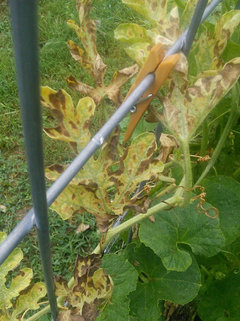
What's wrong with this? I've never gotten watermelon this far before.

Comments (34)

  • 10 years ago

    the picture won't load yellowing leaves with brown splotches. Note the plant next to it is healthy.

  • 10 years ago

    It probably is several things going on at once. First, the mottled yellow appearance of the leaves might be spider mite damage. Have you checked the undersides of the leaves to see if mites are visible? The odd brown areas are either too large or too dark to be any of the common cucurbit diseases that you might see. I've never seen watermelon leaves look like this so I feel like I'm stumped on helping you figure out what it is. I'd bet it is a disease, but I don't know which one. I don't think it resembles anything I've ever seen on the leaf pages of the TAMU Cucurbit Problem Solver, but I'll link it anyway in case you might see a photo there that resembles an earlier stage of this problem that you might have seen days or weeks ago.

    TAMU Cucurbit Problem Solver

    Is there any chance the watermelons got extremely dry at some point? When that happens you can get a lot of yellowing and browning from dying/dead leaf tissue that got too dry and stayed dry too long, though watermelons in general are fairly drought tolerant.

    Got squash bugs? Sometimes their feeding on cucurbit leaves can cause irregular brown and yellow dieback on the leaves, although yours doesn't really look like that to me. They infect plants with some toxins while feeding and the toxins can cause foliar dieback sort of similar to yours, but normally it has a much brighter yellow appearance.

    Did this problem, whatever it may be, appear suddenly or develop slowly over days or weeks? Are there other watermelon vines that look fine or is this the only one you have?

  • 10 years ago

    I'm not sure when this started. I only really noticed it last night, though it looked less than happy maybe last weekend. I took a picture July 19 and it looked fine. I spent a week at the hospital. It may have gotten dry, but the winter melon right next to it looks happy. It is in the bed with the pole beans with spider mites. I have seen 3 or 4 squash bugs or maybe stink bugs on the tomatoes, there was a cucumber beetle at the other end of the bed. I figure if I see one of something there are more.

    I have tried to grow these before, without ever getting to fruit stage. I'd blame the seeds, but it was a new pack.

    I'll go scan that website.

  • 10 years ago

    It looks like this picture of downy mildew (NOT what I thought mildew looked like) Downy mildew on watermelon

  • 10 years ago

    "The disease is favored by cool (60°F night and up to 77°F day) temperatures, along with rain or continuous high humidity. This disease can occur in a field miles away from other cucurbits, indicating that the spores can travel great distances. The fungus develops and spreads rapidly during cool, moist weather conditions" from TAMU page on downy mildew. Really doesn't fit the last week. I went looking for herbicide damage to watermelon, nothing like it. The picture of ozone damage kind of looks like it did last week, but this is my back yard, half a mile from the highway, I doubt it. I picked a tiny melon last night. No where near what it should have been. I think I will pull it up. Maybe I'll stick some bush beans there, or just let the other melon take over.

  • 10 years ago

    I haven't had much first-hand experience with downy mildew on my own plants (except once on cabbage) but have seen it on somebody else's cucurbits when it was in the earlier stage when it was pale grayish-brown and fuzzy to indicate it was growing and sporulating. I guess I shouldn't be totally shocked that this is what your plants have, but I've never seen it once it has advanced to the stage where you get those big, brown splotches. I'd yank it out too to protect any other existing cucurbits.

    Maybe when your dad was hospitalized and you were away so much, the days or nights might have gotten a bit cooler than you thought they did, if rain was falling then. I know that when my dad was hospitalized years ago, I completely lost track of time, weather, and everything else that week. It was like living in two worlds---the one in the hospital (and then in the hospice facility) where you focus on only what is going on in there, and then the world outside the hospital, which you sort of pass through in a foggy, distracted state and hardly even notice.

    You know, downy mildew is an odd duck and maybe that is why we don't see it more often here. It doesn't generally overwinter in our climate, as far as I know, so it has to spread to us from someplace that it survives the winter---like the warmer parts of Texas, for example. (Not that I am blaming Texas. With the way the wind blows here in the summer, it probably could have come from any direction.) So, I went to look it up and see how quickly it can appear and/or spread, and I found info from Clemson University that indicates it is carried on the wind and can travel hundreds of miles very quickly. That makes me think it spread to your part of the state from somewhere else, and it came in on the wind. So, at least the good thing is that it won't overwinter in your garden or compost pile or anywhere.

    Here's the Clemson Univ. info on downy mildew. I'm going to try to file this away in my brain for future reference because it probably will pop up somewhere else, especially with the way all the scattered rain is falling over much of the state. Many diseases only need minutes of wet foliage at a certain temperature in order for them to get a toehold and then start growing. With early blight, I think it is as little as 15 minutes or so. I used to know the exact amount of time, but my memory isn't what it once was.

    Clemson University: Downy Mildew


  • 10 years ago
    last modified: 10 years ago

    It's gone. It probably had spidermites, too. I wasn't sure if it was spores or spidermites on the backs of the leaves. And a couple of aphids. Boy, a stressed plant attracts everything. Last year I lost melons to powdery mildew. Does okra get mildew? I think watermelon is off my grow list.

  • 10 years ago

    Yes, stressed plants are disease and pest magnets. In our hot and often dry climate, plants that are perfectly happy in milder, cooler, wetter weather can go downhill almost overnight when dry, hot conditions arrive and stress them, and then the pests and diseases move in like crazy.

    Okra can get powdery mildew. I've never heard of it having downy mildew, but I'm not saying it never would get it because there is a slim chance it might.

  • 10 years ago

    NC State Watermelon Disease Handbook.

    cuke.hort.ncsu.edu/cucurbit/melon/wmdshndbk/g 

    Has there been cucumbers or cantaloupe or watermelon grown in this soil before?

  • 10 years ago
    last modified: 10 years ago

    Thanks Authereray. No, this was a new bed last year. Mostly brassica over the winter. I grew from seed, I don't know if seed can be infected. I actually had several little melons on it. 3rd year I've tried to grow watermelon. The others perished early.

  • 10 years ago

    Hmmm. Brassicas can have downy mildew, but I think you would have noticed the discolored leaves if your brassicas had had it. I'm still inclined to think it flew in on the wind. At least it doesn't overwinter here, so there's that.

  • 10 years ago

    According to the NC. web site it can be carried on the seed. But it can come from so many different ways. I have a grape vine that started having it last year, to much moisture at the wrong time I guess.

  • 10 years ago

    It was a new pack of seeds, off a rack somewhere, I've forgotten where. I guess I'll toss them, just in case. I'm just hoping the other melons don't get it. I've not had good luck with melons in general. I'm in that burned out stage where I don't know if I care any more.

  • 10 years ago

    You don't have to toss out the seeds. Just soak them in a bleach/water solution to kill any existing pathogens before you plant.

  • 10 years ago

    I believe th muskmelons hve it too. Yellowing spots and white spots on the back. Not enough light for me to be sure. I need to look it up and see if it's safe to plant anything there the rest of the summer.

  • 10 years ago

    I'm curious if you would need to treat the soil in some way to get rid of any spores? Organically, of course.

    Carol

  • 10 years ago

    I really can't figure it out, downy mildew isn't really even classified as a fungus, it is more like algae, traveling in water on the plant. Supposedly it is not a problem in hot weather(?) I don't water with a sprinkler, I try to water the roots without splattering on the leaves. The bed isn't mulched, but since it is blown in on the air that might not help. You can treat it with copper, but I read some things that said fungicides weren't helpful. And mostly you should treat BEFORE you get it. One thing I read said there are lots a "races", some only affect watermelon, some affect all cucurbits. Cabbage can get it, but I was unable to find anything that said if it was the same "race" as the cucurbit kind. This bed had been slated to be the winter compost pile, but I don't want it overwintering, so I may change that plan. I can grow a cover crop that is not a host. If it weren't for the okra I would cover it with plastic and solarize it, but that is the only place I have okra. One time interplanting bites me.

  • 10 years ago

    No, you wouldn't have to treat the soil. Downy mildew only survives on growing cucurbit plants, not in the soil or even on dead plant debris. It has to have a live host in order to overwinter. In the wintertime, the downy mildew survives on winter cucurbit crops, especially those grown in Florida and in southern Texas, and then the wind carries the downy mildew spores progressively further north as cucurbits begin growing in other areas in the spring and summer.

    I've had downy mildew appear on cabbage in rainy springs, but the plants survived and I just pulled off the affected outer leaves and found perfect heads of cabbage underneath. Then I planted succession crops to follow the cabbage after the cabbage was harvested, and none of the succession crops planted immediately after I removed the cabbage ever were affected by downy mildew. There are different species of downy mildew that affect different crops, so if I was replacing a crop affected by downy mildew in the same year, I'd probably go back in to the bed with a crop from a different plant family. That alone should be all it takes to break the downy mildew cycle.

  • 10 years ago

    I think I'll leave it as compost then.

  • 10 years ago

    Thanks Authereray, I'm just burned out right now. I may not do watermelon, but I ordered a melon from Isreal for next year, so I'll try that next year. The very first year I gardened I grew a melon, green fleshed, called a pineapple melon. I'm still looking to find it again. It made big unbelievably good melons. No doubt the weather cooperated that year, but what did I know then.

  • 10 years ago

    authereray, I think you're right. That's why watermelons are so happy in sandy soil---it drains so quickly that even after a good, heavy rainfall, they are pretty dry again pretty quickly. My dad and his family grew watermelons dryland style in sandy soil near Spanish Fort, TX, and those watermelons never got irrigation, since irrigation required hauling water by the bucketful from the Red River. If anyone was going to haul home water a bucketful at a time, it was to try to save the fruit trees in a dry year, not the watermelons.

    amy, I often grow two Israeli melons and both are superb---Old Original Israeli from Willhite Seed and Ha'Ogen, aka Ogen.

    Your pineapple melon might have been Ananas D'Amerique A Chair Verte as it often is referred to as a pineapple melon, or it could have been a more modern version/similar type called Sharlyn or it could be Israeli/Old Israeli/Old Original Israeli. I have grown them all (though not all in the same year) and all are very similar and have both a superb flavor and a superb aroma. The names can vary depending on the seller, but the flavor is remarkably and consistently outstanding.

    Dawn

  • 10 years ago

    The Ha'Ogen is the one I got for next year. The bed the watermelon was in is in the low side of the yard. Maybe it had wet feet, though every thing seemed dry before the last rain and the bed is above grade level. I've been very philosophical today, telling myself I'm learning the garden and figuring out what I should grow more of and how the weather affects things. I've read about it, but nothing teaches you like living it.

  • 10 years ago

    Haaogen is my favorite.


  • 10 years ago

    Amy, I agree that nothing teaches you like living it. My beds even change over the years, as their soil's composition improves. I can grow onions now, for example, in places where I couldn't grow them 10 or 15 years ago because those beds, even though they were raised, didn't drain as well then as they do now. I did learn last year that in a year when you get 24" of rain just in the month of May alone, onions won't do well no matter where they are. They drown and rot equally everywhere. So, even when you think you have a great understanding of your own soil, Mother Nature still is capable of throwing a wicked curve ball.

    Kim, I agree. I don't always grow it and then in the years when I don't, I regret it. This year I grew Ha'Ogen, Ogen, Old Original Israeli and Israeli. I had old seed to use up before it got too old, and I figured that a person never can have too many melons. I planted them late, so am still waiting for the first melon, and Hale's Best Jumbo is likely to beat them all, but it got planted a few weeks earlier than the rest did.

    When it became apparent that we were not going to get much rain here this summer, I crammed almost everything into the front garden so I wouldn't have to water the back garden all summer, and that means the melons had to partially grow in the shade of the tomato plants for a while. The tomato plants are mostly out of the way now (except for the handful of fall tomato plants) and my garden is ruled by melons, watermelons, winter squash, squash, peppers, and one remaining planting of southern peas. The other 5 southern pea plantings are out.

    If we get the forecasted break in the weather and some rain, I'll probably plant the fall garden in the back and hope the voles don't eat the plants. Otherwise, I'm going to have to cram the fall greens, brassicas, beets, etc. into a relatively small part of the front garden that isn't buried under melon, watermelon and winter squash vines.

    If we don't get good rainfall, I'll likely just rototill the back garden in September and sow a cover crop that will tolerate low moisture.

    Right now the back garden is just a playground for the Copper Maran hens, who love to dig and scratch around in the sandy soil all day and take soil/dust baths there in the evenings.

    Dawn

  • 10 years ago

    Well, I lost my cane in the garden tonight. I guess I'll have to put florescent tape on it like I do my tools. I can't figure out where I left it. Yesterday I tipped my chair over looking for the remote that miraculously appeared on the table RIGHT next to the chair? Since it was too hot I cleaned house today. At least I don't feel like a total bum.

  • 10 years ago

    Ha ha ha and I meant to post this on the conversation thread.

  • 10 years ago

    I lose all kinds of things in the garden, then I forget that I've lost them, and then when I am doing fall cleanup, I find them and I am surprised to find them there.

    I hope you find your cane.

    This heat is so awful that I feel like anything we are able to do is an achievement. Since I'm not canning and not working the garden several hours a day, I'm pretty caught up on indoor chores. That's a good thing. It is too hot to do anything. By the time I feed and water the poultry and water the plants, my energy is used up and I feel like I"m done for the day. Eventually I recover enough to cook dinner though.

  • 10 years ago

    Kind of like the remote, leaning against the patio table. Not leaning against a fence, the chicken house or a tomato cage like I thought it must be. It gives me better balance and support if the knee gives out, but one handed gardening is impossible.

  • 9 years ago

    Next time you have something try Copper Based Fungicides. Diseases can come on the seed or be picked up in green houses and garden & potting soil. That is why most seed companies ask you to sign statement that absolves them of any blame if disease shows up in your water melon plants. I hope this helps.

  • 9 years ago

    Thanks, Authereray. For whatever reason, I have not found copper fungicide. I must be looking in the wrong place. It IS on my shopping list.

  • 9 years ago

    Amy, I see it in bottles in TSC, Lowe's and Home Depot every Spring. It is not necessarily on the shelves all year. I did buy some at Walmart this year, which is not a place I normally see it. Most of the time, when I find it, it is in little bottle that looks like this:


    Example of Southern Ag's Copper Fungicide Concentrate

    The one I see most often in stores probably is the Bonide brand, but I see Southern Ag's version just about as often. There also is a copper dust product but I prefer liquid. I don't use it very often, but it is nice to have it when you need it.

  • 9 years ago

    Amazon has copper spray too.

  • 9 years ago

    Thanks for the info.

Sponsored
Wannemacher Interiors
Average rating: 5 out of 5 stars26 Reviews
Customized Award-Winning Interior Design Solutions in Franklin Cnty OH