Software
Houzz Logo Print
hairmetal4ever

Firewood

10 years ago

We’re removing a couple shrubs/trees from our yard.

Which of these make “acceptable” or “good” firewood? Which ones are worth burning if they’re free? Which ones would you NOT burn?

Yew (typical overgrown Taxus hedge, 4” trunks)

Acer saccharum (90% of canopy is dead)

Quercus phellos (nice specimen but BAD spot)

Morus alba

Pinus strobus

Comments (41)

  • 10 years ago
    last modified: 10 years ago

    I would burn all of them, but I like pine the least. Yew should be pretty heavy and rich in energy for a conifer. Maple is good firewood and oak is generally excellent even if that particular species may not be among the best.

  • 10 years ago

    Second the above and add Morus probably better for kindling, pine and probably yew need to be burned HOT to avoid creosote buildup in chimney.

  • 10 years ago

    Proper drying and seasoning is nearly as important as species. Cut to length and split, sugar maple should be ready to burn in a year, maybe 6 months if you live in a low humidity climate. Figure on at least 3 years for the oak. The yew and pine, 2 years, but even then conifers contain fewer btu's than hardwoods and produce more creosote when burned. They also contain pitch pockets which send sparks flying up the chimney or into the room, so best in a wood stove or very well-screened fireplace. Yew is also extremely difficult to split, so 4" pieces may not be worth the trouble except as kindling after several years of drying. Mulberry probably falls somewhere in the mid-range of btu content for hardwood. A really valuable tool for anyone using firewood is a moisture meter. General has a decent one for not much money. Firewood should read 20% moisture or less for the cleanest, most efficient burns.

  • 10 years ago

    I would also say pine is the least desirable on your list. I'd burn it when well cured though. Well cured wood creates less creosote than poorly cured.


  • PRO
    10 years ago

    They will all burn, but don't burn pine in a fireplace. It will cause this black buildup that is hard to remove.

  • 10 years ago

    Black buildup=creosote.

  • 10 years ago

    For our personal use we only burn oak. To list on CL as free wood, I list all. People have all kinds of motives for burning whatever and I've YET to have a listing that was not claimed.

  • 10 years ago

    I would take all the oak I could get- it burns long and produces a lot of heat. I find that maple burns fast and hot- useful in the shoulder seasons but I don't like it for the dead of winter.

    I would not use anything that produces creosote. I paid too much for my system to be junking it up with difficult to remove deposits.

    It's best to stay a couple of years ahead on firewood- that we are getting ready now will not be used until the winter of '17-'18. The wood we will burn this coming winter has been out there seasoning for a couple of years.

  • 10 years ago
    last modified: 10 years ago

    To all that has been said, I'd only add-there is no wood which can't be burned. That said, pine is best in outdoor fire pits, as it pops and crackles, but really, where volume is not too extreme, any of this stuff can be burned indoors or out. Just watch the creosote. Which would be true regardless where the wood was being procured.

    ps..........Was reminded of something I read long ago-about how the British East India Company-maybe that's the wrong group-but at any rate, some early British colonial outposts here in the western Great Lakes region-this would have been back in the 1600s-1700s-burned only green aspen for heat, cooking etc. It's what they had-they made it work. Of course, you want to talk about creosote-burn green wood. I expect these old-timers knew what they were doing.

  • 10 years ago

    tom beat me ... lol .. i would use the pine outdoors ... gives me that up north MI experience ... a very nice aroma.. you might miss indoors .. and it wont set your chimney on fire ... depending on heavy use .. and the last time you had it cleaned ... dont know about yew ...


    ken

  • 10 years ago

    My woodstove is an airtight, EPA certified for mobile homes with an insulated metal stack. It draws air from under the house rather than from within. That gives a positive air pressure in the house rather than negative if it was drawing air from inside. The stack has never needed cleaning since I installed it in 1979! I do have to clean the topcap of creosote several times during the burning season however. Since the stack is insulated double wall there is very little temperature difference for the creosote to condense on.

    I've gone through several woodstoves over the years. My Lopi has been the best by far, both in efficiency and durability.

    I burn Cottonwood when available which most people here avoid. It burns hot if completely cured and dry. It's bad reputation comes from burning it when it's not cured all the way and not dry as it should be. It's not my first choice though.

    Mike


  • 10 years ago

    miketann: If you're having to clean creosote from the cap several times a burning season, something is not right. I've been heating with wood for close to 40 years, 5 to 6 cords per winter. EPA stove and 6" insulated liner installed in 2010 after many years with an original Vermont Castings Defiant. The cap has never needed cleaning in the winter. Accumulated Stage 1 creosote, aka soot, is around a coffee can's worth after sweeping in the spring. If your fire is burning hot enough and the stove is not run in a smoldering mode for too much of the time, it's hard to understand how the cap could remain cool enough to clog with creosote several times a winter.

  • 10 years ago

    Just a guess here, but maybe the PNW winter type-with long periods of mostly light rainfall-I know it's heavy sometimes too-keeping that cap cool. Just a thought-I know Maine can get wintertime rain too, though I would think not nearly as consistently as say, western Washington state.

  • 10 years ago

    Possible, I guess, but pretty hard to see how even a lot of rain with lots of temperatures above freezing could cool the cap enough to have creosote condense onto the cap surface. Especially when compared to dealing with temperatures near or below zero for days at a time. My guess would be too many start up fires rather than continuous burning combined with maybe too quick reduction in air. Very different than burning 24/7, but a modern EPA stove should not be clogging any part of the chimney system several times a winter.

  • 10 years ago

    My insulated stack is the old 8" size. That might have something to do with it.

    With our mild winter temps I usually don't have to burn a very hot fire. The creosote only forms where it hits the cool outside air. It's dry and brittle and with a few knocks is easily removed.

    All my wood is at least a year old with most of it two years old and stored in a open sided woodshed with a metal roof. I burn mostly Red Alder, Acer macrophyllum, and Doug Fir.

    I think you're right akamainegrower, Too many start up fires in Spring and Fall and too quick reduction in air. I get it started, load it up, turn the air down, and then go outside to work in the garden. It'd be different if I could stay indoors and monitor it better.

    Mike

  • 10 years ago

    Makes sense Mainer.

  • 10 years ago

    An 8 inch flue has almost double the interior area of a 6 inch one. Stoves designed to be vented into a 6 inch stack vented into an 8 inch one will usually work, but the flue gasses are so slowed down on their exit up the chimney that the chances of creosote deposits are greatly increased. If you're willing to do the extra work of cleaning the cap frequently, you are probably fine. Putting a 6 inch liner inside the 8 inch one would, however, greatly improve your stove's performance and safety. Even easily knocked off creosote deposits can ignite and burn with amazing fierceness.

  • 10 years ago

    Yes, I should buy a 6" liner for the 8" stack. Now would be a good time.

    Mike

  • 10 years ago
    last modified: 10 years ago

    Wow, to think some of us just buy the compressed, gaseous form of 10 million year old trees!


  • 10 years ago

    Burning wood satisfies some ancient desire in the human mind that gas does not.

  • 10 years ago

    Understandable but I was more in awe over the work mike must put into keeping warm in winter.

  • 10 years ago

    I don't know about Mike, but for me collecting firewood is more than just work. It's a passion, I love firewood almost as much as I love living trees. The whole process from felling the tree to burn it in my wood stove. It is when I'm standing there, splitting wood I really can think thoughts all the way to the end.

  • 10 years ago

    While I'm not presently a heat-with-wood guy, I have been in numerous such situations, and somehow, there is just something right about wood heat. Used to spend lots of time at a cabin where, when we would get there, we could park underneath the building-underground garage, but then the wood stove was down in that basement as well. Getting that thing nice and cheery warm, then allowing natural convection to warm up the whole upstairs, etc. was one of the true joys of going there.

  • 8 years ago

    Here's a chainsaw question, am hoping someone can give me their thoughts. Have had my beautiful Stihl chainsaw for about 3 years. Never had any problems starting. Last week I emptied every drop of fuel from my can into the saw. Now I can't start the saw to save my soul. I should mention have been using "cornahol" which is the same thing I put in the pickup. I mix the 2 cycle additive in the can. The cornahol has 10% ethanol. Do you guys use fuel with ethanol from the gas station for chainsaw/weed wackers or something else or doesn't matter? If you use gasoline without ethanol, where do you get it?

  • 8 years ago
    last modified: 8 years ago

    I use regular with ethanol from the pump in my Stihl 'Farmboss'. No problems what so ever. I asked them when I bought the saw if that was ok and they affirmed.

    Are you using a funnel with a screen? Emptying the can usually means dumping all the sludge and sediment from the can into the saw, which can plug the little filter at the end of the fuel pickup hose, inside the tank.

  • 8 years ago
    last modified: 8 years ago

    Ethanol containing fuel is considered especially bad for small engines for various reasons. Gas that has absorbed too much water can quickly kill a 2 cycle engine. Even my no-nonsense tree trimmer uses EtOH free fuel. There are places to buy it. It's gone mainstream, you can even buy it at Wallyworld these days. I bought some at VP racing fuels in Delaware. DO NOT buy the Stihl branded stuff, it is insanely, preposterously expensive. (but good for Stihl for exploiting that revenue stream LOL)

  • 8 years ago
    last modified: 8 years ago

    How old is the gas/oil mix in the can? It is quite a bit higher price wise but I use the premixed gas/oil that Stihl sells since I want the saw to run when I need it, not spend time fixing on it.

    Edited to add, I just saw davidrt's comment. It is very expensive with the Stihl name on it. I also stocked up on WM's when it was on closeout.

  • 8 years ago
    last modified: 8 years ago

    This is my second Stihl, 5 years now and the first one I had for 20 years. And I would cut at least 10-15 cords of fire wood each season plus logs for lumber. Only ever used ethanol gas and have never had an issue.

    Have had the filter replaced a couple of times.

    And there are things you have to watch out for when using ethanol fuel for your chainsaw. You need to shake the can up good before fueling and make sure you use fresh gasoline. Anything over two months old is too old. Nothing over 10% ethanol. I'll admit I haven't adhered to all these rules, all the time but haven't had any trouble.

    More information from the Stihl web site:

    Guidelines for using E10 gasoline in STIHL power equipment:

    If the proper precautions are taken, gasoline containing a 10% quantity of ethanol can safely be used in your STIHL products.

    • Use a minimum of 89 octane gasoline and always use fresh fuel. Only buy enough gasoline that you can easily use up within a two-month period or use a specially formulated fuel mixture like STIHL MotoMix® Premixed Fuel. STIHL MotoMix® is a high-grade, high-octane, ethanol-free premixed fuel containing STIHL HP Ultra synthetic oil. It is a pure and stable fuel mixture that can be stored for up to two years in the original container and is ideal for machines that are used infrequently.
    • For air-cooled, two-cycle engines, use a quality mix oil that meets the engine manufacturer's recommendations. All STIHL oils are designed to readily mix with gasoline containing 10% ethanol.
    • Properly store your equipment. If your equipment is not going to be used for a couple of months, the remaining gasoline in the machine should be drained from the tank and disposed of properly. To ensure that any remaining ethanol is removed from your equipment, STIHL recommends adding a small amount of STIHL MotoMix® Premixed Fuel to the tank and running the engine for a few minutes to circulate the fuel through the carburetor.
    • Equipment should be serviced regularly by your STIHL Dealer. Items such as fuel filters, fuel lines, carburetor diaphragms and spark plugs should be checked and replaced if necessary as part of a normal engine tune-up.
  • 8 years ago
    last modified: 8 years ago

    Orrr...you could also hugelkultur or woodchip & mulch them!

  • 8 years ago

    Thanks for the responses. I did not use high octane gasoline. It took two months or more for me to use 2 1/2 gallons of fuel so I guess my fuel was old. I can see will have to be more careful in the future. Saw is in the shop.

  • 8 years ago

    I usually mix up a gallon at a time, sometimes two if it's a big job ahead. And never use metal gas cans, use plastic made specifically for petroleum.

    I use a 2 gal. motor oil jug. A short piece of rope from that jug to a gallon jug of chain oil. I take a small paint brush along to sweep around the gas and oil fill caps before opening, that really helps keep the sawdust and dirt out of tanks thus saving on problems with flow.

    You can take a clean wire with a bent hook, to fish the fuel line with filter out of the tank, to replace it yourself. If the oiler stops feeding, I open the screw fully open, most of the time the 'speck' will then pass when you rev up the motor and then reset the oiler.

    Ah, reminds me of the 'good old days'. :-)

    I used to have at least 3 years of firewood cut ahead of time so it would cure well. All my buildings including the house were built using native jack & Norway pine lumber from logs I hauled to the saw mill. Most of my cutting was done late winter. Here's a couple of pics of days past in the country (hope you don't mind).

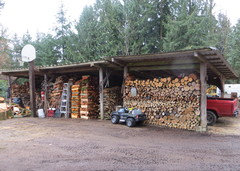
    Poplar and Ash firewood ready to haul:

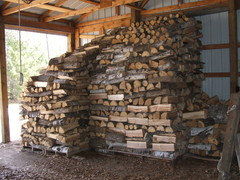
    Above: Wood curing on palets in the shed. (No the noose is for hoisting deer) lol.

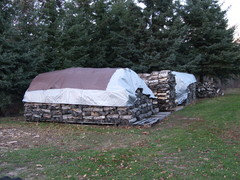
    Below: Dry wood stacked near the house.

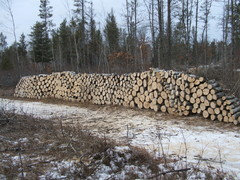
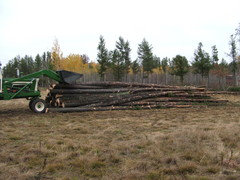
    Above: Pulling limbed pine trees to the landing.

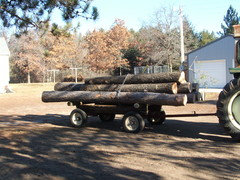
    Logs ready for the mill. These made into rafters for the lean to.
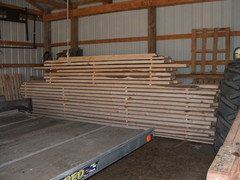
    Lumber drying in the shed.
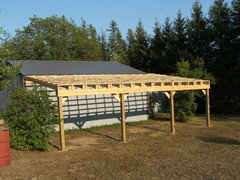
    New lean too ready for the steel sheeting.

    I still do some brushing/cutting around the 40 to keep the trails open and help my son get firewood but in a more limited fashion. Enjoy! :)

  • 8 years ago

    He's a lumberjack and he's OK...

    tj

  • 8 years ago

    lol: There was a time when that's pretty much all I did.

  • 8 years ago
    last modified: 8 years ago

    I think the crux of the matter is if you use your chainsaw near constantly throughout the year you are OK with E10. If you let it sit around like a lot of us do, for months between assignments, you better use EtOH free gas.

    I'm having to imagine there are chains holding my fingers down, to stop me from typing, because I want to go into what a monstrous boondoggle the ethanol subsidy is. But I'll stop there!

  • 8 years ago

    For most people, that's probably true. But in these last several years, I used mixed e10 in my saw that was left over from last year and never had problems. Even left gas in the saw in the spring and finished it the next fall.

    Makes me wonder, how can so many people be having trouble using e10 when I have broke all the rules and still never had troubles?

  • 8 years ago


    HERE is a tidbit from the Husqvarna site. It spells out some of the problems with ethanol in gasoline. As for me, still waiting to hear back from the repair shop.

  • 8 years ago

    Yeah, Husqvarna had a much more dismal view on the matter.

    Better buy Stihl. ;-)

  • 8 years ago

    what a monstrous boondoggle the ethanol subsidy is

    I agree and will stop there also....

  • 8 years ago
    last modified: 8 years ago

    "Makes me wonder, how can so many people be having trouble using e10 when
    I have broke all the rules and still never had troubles?"

    Just guessing, with our longer growing season and overall higher yearly "partial pressure of water vapor per unit time", our gas goes bad more quickly? Not happening now, be we can have long stretches of 50s and rainy in winter. Most of the time, I don't need a home humidifier here in winter to be comfortable. (I did run one last week!) OTOH, when I was in Denver in the winter for only a couple days, I felt like I was turning into dried husk LOL.

  • 8 years ago

    Yeah, probably location issues. Didn't think of that. Maybe those perks are why I'm up here freezing my behind off. :lol: