Software
Houzz Logo Print
orneryponystudio

Flasking 'Albino' Seedings on Basal Medium

10 years ago
last modified: 10 years ago

Yesterday, my husband made a comment that gave me an 'ah hah' moment while I was prattling on about a theory concerning 'albino' adenium seedlings. My theory being that they may be homozygous variegates (or in some cases dilutes) due to the fact that they /sometimes/ survive long enough to produce leaves with some green in them. This has also been proven through grafting them onto regular root stalks. That would refute the notion that they are true albinos.

Currently I have four white adenium seedlings from variegated hybrid crosses that came up. Three from Star of Top selfing and 1 from a Super Yellow Leaf selfing. These usually die for lack of chlorophyll but if I flask them onto basal medium to supply the necessary sucrose for them, they may survive long enough to make mature leaves that may have traces of green. I can also add traces of magnesium sulfate to attempt to encourage the development of chlorophyll as is proved helpful in the production of other 'all white' babies from variegated and dilute explants.

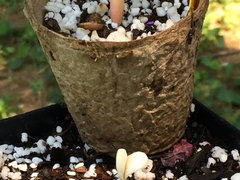
So, yesterday I sterilized the four seedlings and flasked them. If in four days they show no traces of contamination of the basal media, then I'll wait and see if they continue to grow, utilizing the sugars in the agar mixture. They are in bright filtered light in a warm location and I'll see about getting a descent photo of them now they are relocated. If it doesn't work, I'll keep on trying later with more white seedlings and eventually see if I can get any interesting results.

My expectation is that if the plants survive they will be very slow growing, sensitive to full sun exposure with easily burned leaves, and may be very difficult to flower. BUT if they are homozygous for variegates then they could provide a very useful pollen parent to attempt further and faster hybridization attempts of other variegated or dilutes when crossed with known non-variegated or dilute cultivars.

Comments (26)

  • 10 years ago

    Best of luck to you! I read each and every word, but have zero experience with this!

  • 10 years ago

    Wow, what an experiment. Love it. They look so pink w white ears. Must be nice to have this experience and knowledge. Kudos, to you Hyn.

    Rick

  • 10 years ago

    Kudos only if it works! Thanks. I learned to do this when I worked for a greenhouse that mostly did orchids about 20 years ago. So I'm rusty and have only begun this year to get back into practicing. I need to find my lidded jars.

  • 10 years ago

    How exciting! It's great to be able to follow this through with you. I've heard and seen the orchid flasking practices, but haven't ever done it, thanks for posting the details of the experiment....good luck. Those pink seedlings look so cute don't they!

    I do however have a ? So, can I ask is your first name 'Patty', so we can address you correctly, hope you don't mind the query? Cheers!

    Gill

  • 10 years ago

    What is a basal medium, how does it work? And when to use?

  • 10 years ago
    last modified: 10 years ago

    My last name is Patty - it's Irish. So call me Hyn, which is a nickname that has stuck with me for decades. ;)

    The medium I'm using is a mixture of plant hormones, sugars, nutrients, and gelatin (agar for firmness) to feed an explant (cutting) or seed so it may grow in sterile conditions. If any fungal spores or bacterium get to the medium, it too will flourish so it requires absolutely sterile prep. Think of petri dishes. Same thing.

    As the longer answers to your questions get very complicated fast, I'll suggest you Google away! It gets technical. But in a nutshell there are different kinds of mediums for different plant groups based on their individual needs. There are also other mediums that can be prepared that have different hormones for promoting specifically the growth of roots, for example. So it isn't unusual to start a cutting on basal medium and then move it onto other mediums as they go through the desired stages before being ready to go into potting mix.

    Tissue culture is widely used to produce clone plants very rapidly from tiny cuttings. If you have plant stock that is known to be infected with virus, meristem cells can be cultured to produce virus free stock. I use it to grow orchid seed, orchid cuttings, and for tissue culture experiments in general.

    https://en.wikipedia.org/wiki/Growth_medium 

  • 10 years ago

    I'm jealous. I need this kind of patience and discipline. Lacking either, I'll just watch you, Hyn, as well as add your name to my user dictionary so it's not underlined. Will the albino be fertile or senile? And if you add magnesium, you will end up with variegation instead of a chlorophyll-free plant?

    Pagan

  • 10 years ago

    Currently I believe I have the wrong media on hand and am reading scientific journals to determine which medias I require for adeniums - whether I'm aiming for stem calluses or rooting so I may move the seedlings over accordingly.

  • 10 years ago

    I haven't added magnisium sulfate yet. That would come later.

    My only concern at this juncture is getting the correct media selected and ordered and blunder through trial and error to see if I can keep the material alive. So I plan to reflask them individually as soon as new media arrives in a few days.

    Bear in mind I haven't attempted tissue culture of /regular/ stem material or seedling flasking of adeniums before and it would be wiser if I did that and had success before attempting this with white seedlings. But I had them on hand and knew they were likely to die within days if I didn't try something immediately. So I stand to loose nothing really if they don't make it - I'll still learn something.

    At this point I have no idea if the seedlings will survive, let alone prove fertile. One thing at a time. If I get to the point later that some survive to make flowers, then I can see if the anthers and stigma form properly, etc.

  • 10 years ago

    Don't take anything I am doing here too seriously. I'm screwing around and don't really expect anything very impressive. This can take years. I will try some tip cuttings later from my variegated Star of Top, and see how that goes as well.

  • 10 years ago

    Thanks for your name clarification Hyn, as I'd spotted it with both as your first name:-)

    Gill

  • 10 years ago

    Haha, I'm used to everyone assuming Patty is my first name. No worries! ;) I'm on Facebook too if you ever want to look me up there.

  • 10 years ago

    I never knew there were albino plants until today. I thought I had some odd rare seedlings of plumeria and adenium. Now to figure out how to keep them alive.

  • 10 years ago

    I personally think 'albino' is a misleading label. I -think- these are examples of seedlings that are homozygous for either dilute traits or variegated because in both cases, if grafted onto regular plant stocks, they will eventually begin to produce /some/ if limited chlorophyll. A true albino would not. I think it warrants further study. I will definitely be grafting some next year.

  • 10 years ago

    Your two there look like dilutes rather than like mine.

  • 10 years ago
    The adenium has pink trunk with pale yellow leaves. The plumeria is Snow White
  • 10 years ago

    I think I have two white seedlings that have come up with a non-variegated cross. They appear to be dilutes and are different from my other 'albinos' as they are faintly more creamy and seem to have yellowish stems with pink leaves so far, instead of white leaves with pink stems. I find this fascinating.

  • 9 years ago

    Hi Hyn.

    I was wondering whatever became of the albino seedlings in the first image of this post?

    Thanks,

    Tyler

  • 9 years ago

    They didn't make it! None of my albino seedlings made it, not even the ones that I grafted. They lasted the longest and were kept shaded. Live and learn. I didn't really expect them to last but as some people have managed to keep them going, I thought it worth trying. ;) All the rest of my 400+ regular seedlings are doing very well.

  • 9 years ago

    Oddly enough my two obvious variegated seedlings didn't make it either. They both turned pure white over time with new growth, alas. Still educational and I have a variegated grafted young adult plant so I'm not without and it's doing fine.

  • 9 years ago

    Thanks for the update. They were so pretty. I was hoping they were still alive.

    Tyler

  • 9 years ago
    last modified: 9 years ago

    Thanks but from my reading I knew my odds were very slim. I figured it was worth trying though even the few that have made it for others aren't nearly as pretty as adult plants. They don't keep the pink much. I found a photo of one that had been grafted and survived.

  • 9 years ago

    Well, I'm glad someone tried the agar. Between the odds of getting an albino and someone willing to try to save it AND post the results online, it's hard to find out what happens.


    If you ever get another one, you might try mycorrhizae. I've heard of mycotrophs feeding on them, and they're basically just slightly evolved albino plants. Some of them actually diverged so recently they still look almost identical to their normal green relatives.


    The idea is that the microbes connected to a healthy plant still connect to the albino roots, and the albino is able to hijack the network and steal nutrients. Since mycorrhizae allow plant roots to absorb nutrients more efficiently than they would be able to on their own, it might work better than agar.


    I've heard albino redwoods attach themselves to the roots of normal redwoods and leach off of that network, but I'm not sure if they rely on mycorrhizae as seedlings or throughout the process or not at all, though I've heard pines and other conifers have to have a mycorrhizal association to survive as seedlings. If it's just sticking to roots, then I don't see how it would be any different than grafting.


    By the way, could you post that albino graft picture? I've heard tell of them but I've never actually seen a successful one. A few successful variegated seedling grafts, sure, but not a true albino.

  • 9 years ago

    I can post if /if/ I can find it again. I don't know if I bookmarked it. I don't know if my flasked albino seedlings would have made it or not but they were contaiminated and molded. If I get more I can try flasking them on medium again and see if I have any better luck, but in the long run they'd still die without grafting as I couldn't keep them on medium for long. Most of my attempts are good but as I do home flasking and don't have a lab, I loose some of them. It makes it harder to control.

  • 9 years ago

    Hey! this is interesting, if off-topic, that you do "if /if/". We did "iff". The posh private school for rich dimwits across the street from ours did "ifof"

    Okay, going back to lurk.

0