Software
Houzz Logo Print
12pud12sce

Olmsted Firm Designed Garden

10 years ago
last modified: 10 years ago

I'm a member of a garden club involved in the restoration of an Olmsted firm designed garden. We have the original plans and planting list for the tulip bulbs. No one in the states sell any of the bulbs that were originally used. Two Netherlands companies list some of the bulbs for sale. Not sure if we can buy from them. All the bulbs are listed as being at the Hortus Bulborum. These are not ancient bulbs. Most from 1900-1920 introductions. I've identified bloom time, colors, shape and height for the originals. Will most likely end up matching as close to those parameters as possible. Can anyone offer anything more? If there is any interest I can post the tulips used. Thanks for your time.

Comments (6)

  • 10 years ago

    Just match the bulbs as near as you can for colours, heights, season etc. The idea of faithful authenticity is totally ludicrous and does not exist in any known reality except in the head of the office bound archivist. Let me give you a clear example. I grow roses - antique roses which have been grown for nigh on 2 centuries - but a rose such as Etoile d'Hollande, bred in the 30s bears very little resemblance to the currently grown 'clone' going by the same name. Originally possessing more than 30-40 petals (and classed as double), they now only have 16-25 petals and are semi-double. And they have changed growth habits so there is a climbing and bush version. And this adaptation and slight generational change occurs throughout the plant world - they are dynamic, growing, living things - not a set design. The bulbs which existed in 1920, even if they could be sourced, WILL NOT LOOK THE SAME...so please, horticultural faithfulness (if you must) rests less on named varieties and more on style, colour, ambiance and emotional response...and I cannot imagine any designer worth their salt would be happy with this 'preserved in aspic' ideal - it is the death of innovation, beauty, creativity and the beginning of tick boxes and some deathly idea of permanence and constancy - the very opposite of gardening.

  • 10 years ago

    Thanks for the replies. I wouldn't call our efforts "ludicrous". As stated above "Will most likely end up matching as close to those parameters as possible." Which I've done.

    The plans and planting list for all perennials and bulbs used were provided by the Olmsted archives in Brookline. Percival Gallagher was the main designer of the gardens at Brookby.

    My understanding the Blodgett's replaced their bulbs ever year, donating the old stock.

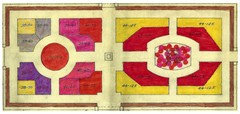
    Below is list of the bulbs used. Attached is the plan of the bulb plantings, one being colorized to give a concept of the hues.


    Velvet King, 1912 (syn.: Velvet Gem; Dreadnought.) (HB) Dutch Florists Tulip. Bybloemen. Cup-shaped, large; bright dark red-purple; base small, sharply defined, white; 31 inches; May 14, 15 days. #10 on plan, 110 bulbs.


    Ellen Willmott, 1900 (HB) One of the lily-flowering tulips blooms in soft primrose yellow with scented flowers. #38 on plan, 100 bulbs.


    Fairy Queen, (HB) Cottage Tulip. Flower shot. Type 2: pointed. Form and substance good; outside light purple, passing to a paler margin, tinged with primrose-yellow; inside deep yellow, with a purplish flush; base dull; filaments with a black ring at apex; 30 inches; May 15, 14 days. #37 on plan, 110 bulbs.


    Orange Beauty, 1905 (syn.; Prince of Orange.) (HB) Formerly classified as a Cottage Tulip. Flower orange scarlet. A form of 'Gesneriana' Large, opening well; form good, substance fair; outside with a purplish flush; base indefinite, yellow, streaked with olive; filaments olive; 26 inches; May 10, 16 days. #41 on plan, 100 bulbs.


    Inglescombe Pink, 1908 (syn.: Parisian Aurore; Salmon Queen.) (NO-HB) Cottage Tulip. Flower pink. Type 1: cup-shaped. Large form and substance good; colour good, much deeper outside, pale blue; 25 inches; May 8, 17 days. #39 on plan, 123 bulbs.


    Grenadier, 1912 (HB) Cottage Tulip. Flower orange-scarlet. Type 3: egg-shaped. Large, form and substance good; colour very bright, yellow; 21 inches; May 8, 17 days. #40 on plan, 75 plus 40 bulbs.


    John Ruskin, 1904 (HB) Cottage Tulip. Flower shot. Type 3: egg-shaped. Form and substance fair; pink and orange; base yellowish, with olive ring; 24 inches; May 10, 15 days. #42 on plan, 123 bulbs.


    Orange King, 1903 (HB) Formerly classified as a Cottage Tulip. Flower orange-scarlet. Form and substance good; base yellow, with a faint olive margin and an olive blotch on each outer segment; 29 inches; May 8,19 days. #43 on plan, 75 bulbs.


    Vitellina, 1896 (HB) Cottage Tulip. Flower primrose. Type 2: pointed. Long, form and substance good; 31 inches; May 16, 12 days. #44 on plan, 500 bulbs.


    gesneriana L. Spathulata, 1904 (HB) Cottage Tulip. Flower cochineal-red. Type 2: pointed. Large, of good substance, opening well; colour bright and clear, clear bright blue; 28 inches; May 8, 18 days. A strong and brilliant garden flower. #45 on plan, 460 bulbs.


    Cardinal Manning, 1913 (HB) Dutch Florists Tulip. Bybloemen. Egg-shape, large; Bishop's purple; base diffuse, tinged yellow; filaments blue at apex; 34 inches; May 8, 22 days. #21 on plan, 40 bulbs.


    This was just one area of the property. Link provided to a Facebook page for more on the estate - https://www.facebook.com/Friends-of-Brookby-House-John-W-Blodgett-Estate-East-Grand-Rapids-MI-184500511629157/

  • 10 years ago

    Ah, it isn't the attempt to reproduce a historical garden that I am sceptical about (although not for me) but the insane hope that plants have remained somehow true to type after numerous generations. Even vegetatively propagated plants will show genetic shifting while seed strains may be botanically correct in their structure but will certainly reveal a differing phenotype since plants cannot exist in some neutral context but are as affected by soil, climate, maintenance and, notoriously in tulips, viral pressure. You seriously don't think Olmstead...or any other designer was not thinking 'um, just that right shade of apricot next to that plummy purple, flowers simultaneously in late April' without giving 2 hoots what precise cultivar of hugely hybridised bulbs were used...or that this same cultivar could or should be faithfully tracked down a century later...and yet I see this same bizarre insistence on some sort of imaginary horticultural standard in many of these historical reproduction fantasies.

  • 10 years ago
  • 9 years ago
Sponsored
Top Choice for Reliable Tile & Stone | Franklin County, Ohio