Software
Houzz Logo Print
witten_hayes

Met with Another Architect! (Budget Question)

10 years ago

Are we going to get one of these posts every time? No.


So we met with architect #2. He charges $85 per hour. The last architect we talked to charges on a percentage basis of 8%. We've adjusted our budget of $250,000 to exclude land. We're wanting to build a small, rectangular home with a shed roof and a semi-modern aesthetic. Open design, no hallways, no garage, no upper cabinets, no fireplace, unfinished basement (for now).

8% of $250,000 is $20,000. $20,000 divided $85 per hour is 235 hours. Seems to me like a heck of a lot of time just to throw a shed roof on a rectangle. Obviously I'm being obtuse but the hourly route is the smartest option, right? We're also going to try to pull a Persnickety and source some items personally to save money.

Both architects are revered and experienced and can help throughout the process, including the construction to ensure that the end result is what we were shooting for.

Thoughts? Any cost-saving suggestions?

Comments (31)

  • 10 years ago

    If both pay structures are acceptable to you, which architect do you like better?

    I think hourly would appeal to me, too, but I am very decisive. It sometimes can take a little while to make a decision, but once I do, it is final. I imagine that kind of personality works better with hourly rate fees?

  • 10 years ago

    The cost to go out to the site to make sure all is working well, can add up quickly.

    235 hours equals 29.375 8 hour days. Considering building a house alone can take 10-18 months to finish, you might actually be better off with the percentage.

    But, more importantly, which one did you have a better rapport with? Which one did you feel better understood your wants and needs? If all you're building is a box, then either one will be fine, but if you truly want an designed home, then be sure your styles mesh too

  • 10 years ago

    I had a box, then hired ARG from this forum and well, no more box ! Best thing I ever did.

  • PRO
    10 years ago
    last modified: 10 years ago

    When one hires a professional, such as an architect, one gets what one pays for. There aren't any shortcuts. Really.

    Cpartist makes the important point: Architect 1 charges 8% for full services from inception to occupancy. Architect 2 charges $85/hour.

    For a principal architect and experienced architect, $85/hr is ridiculously low. I would expect a principal architect (one whose name is on the door) to be charging in the range of $200/hr., if they work on an hourly rate. Or more.

    Are these two architects comparable in experience and knowledge? Do they have a similar record of projects over time?

    It sounds to me like you have a principal architect (Architect 1) and a beginning architect out on their own (Architect 2).

    PS: If all the OP wants is to "throw a shed roof on a rectangle", s/he is wasting their time talking to any architect. Just go find a budget builder.

    This thread is going downhill.

  • 10 years ago

    Wow, Mr. Virgil, thank you for giving us the $200/hr figure. In my ignorance, I had been expecting $100-$150. Good to adjust my expectations, thank you!

  • 10 years ago

    Based on your design intent why do you want to use an architect?
    You've almost described a loft.

    Some architects will charge per sqft if you're simply interested in a plan.

    Average rate for an independent architect in my area is $150 per hour.

  • 10 years ago

    I know you're hiring an architect but I thought the off the shelf plans by Greg La Vardera might interest you given your aesthetic... Modern house plans

  • 10 years ago
    last modified: 10 years ago

    First, who is the second architect - there is some probability that I have worked with them or have a close friend who has. If you don't feel comfortable posting the name, then message me.

    Second, I would resist the urge to think about your architect in terms of hourly pay or the value of his services. Architecture is a creative process and two architects given the same guidelines will create vastly different structures, so you can't simply compare their economy. Value for creative processes is usually a function of results and not cost. In the end, the architect whose fee was most reasonable will probably be the architect who gave you more of what you wanted, even if you maybe didn't realize you wanted it.

    Finally, I admit that I think of all homes as financial transactions - results created for money spent. I am sorry to be "Debbie Downer", but I don't see the value here. Central Kentucky is the land of transitional brick homes, in fact many neighborhoods will even deed restrict stone. Here is the amended deed restriction for a lot off of 27. The bolded part was the amendment that the neighborhood association (not the developer) decided to put in.

    Any dwelling […] shall be at least 80% masonry construction
    on the exterior. Masonry construction as
    defined herein, shall include Field stone, however Bedford stone, Tennessee
    stone, hardy plank, concrete coating, concrete board or similar materials shall
    not be considered masonry construction and shall not be permitted.

    This just goes to show you how little Central Kentucky thinks of creativity. They not only don't want a hardy plank house, they don't want your hardy plank house bringing down the value of the neighborhood. This is fairly typical, we originally wanted to build a craftsman house near Lexington. We abandoned the idea as not feasible. I don't see how the house is going to appraise, and I certainly don't see the house you are describing ever selling. Which I wouldn't think was a problem if you were a little more established in your life. However, having kids changes you at a fundamental level, and you can't possibly anticipate that change.

    I know I am being negative and I do really hope you build the house but I also want you to consider everything. One time when I was making a serious decision a guy told me, "if you aren't having some serious concerns about a decision this important then you shouldn't be making it," now I am telling you.

  • 10 years ago
    last modified: 10 years ago

    To Virgil and Mark -

    There are very few architects there who do any significant work in single family residence design, I have heard of architects reducing their fees for single family residences when they have time.

    I would bet the market breakdown is something like - 85% tract builders (80% of that is one builder), 10% large custom homes from design build firms, 3-4% online home plans or draftsman designed and 1-2% architect designed. While this is very unscientific, I assure you that I am being very very generous to architect designed homes. In reality there is no way that 2 of 100 homes are designed by an architect. Architects have significant commercial, educational and multi-housing work but most do very little in single family homes.

  • 10 years ago

    By the way - Scott Guyon is someone you should talk to. He and Pohl Rosa Pohl are my two favorite in Central Kentucky.

  • 10 years ago
    last modified: 10 years ago

    These are certainly things we are thinking about heavily. If the home can't appraise for the right value then we certainly won't be building it. I don't understand the appraisal process that well, but certainly we don't want to burn money. This is the main reason for posting here - we have ideas for our home, but don't want those ideas to be our undoing!

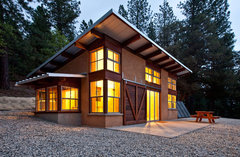
    Would this appraise poorly and not resell? (This is just a conceptual example).

    Chalk Hill Off-Grid Cabin · More Info

  • 10 years ago

    OP, if finding suitable land will be as problematic as bry states, I think consulting architects early on, like you're doing, is a *must*. My project, for different reasons, also requires finding an architect first.

    I also understand bry's concern about going outside established norms, and the risk and difficulty involved. Since I've been weird my whole life, I'm mostly used to it, so it personally doesn't bother me. Admittedly, however foolish others perceive it to be, at this point I actually *like* being different, and would relish being outside of the majority.

    So now that you know my biases, Mr. And Mrs. Zerifin, I would, of course, encourage y'all to stick with your plan to use an architect and build a house for *you*. Art is risky. Consider your home a piece of art, not necessarily an investment. If that is acceptable to you, then go for it!

  • PRO
    10 years ago
    last modified: 10 years ago

    This appears to be a well-designed, and well built, home, deceptively simple, but in reality creatively designed, using high quality materials, details and materials/finishes. For example, look at the roof beams, roof decking, the metal standing rib roofing and fascia, the windows, consistent grading and sealed slab, the photo-voltaic electrical panels and the southern orientation of the house!

    It appears to be a fun home in which to live. It would seem to me to be appealing to folks who are concerned with creative design and energy conscious design. I can't speak to the lending and construction economics or the resale for the area.

    But one thing is sure--it's not just some 2X4 wall studs thrown up and a plywood roof stapled on!

    EDIT: I didn't realize until after posting that the house was a straw bale house, and designed as a "get away" house for a San Francisco couple with two small boys. My guess is that the average general consumer might not know what a straw bale house is/does, and that the large opens spaces, the interior detailing and finishes might be a bit too much "get away" and not enough living "year round" in the house. Designed with more conventional materials and details on the interior would probably make the house appeal to a larger segment of the population. I don't care for the exterior gravel "yard", but surmise that some special requirement resulted in all of the uniform gravel treatment. Perhaps low maintenance, or, more likely, reduction of fire threat in the vicinity of the house. Wild fires are a perennial problem in parts of California.

  • 10 years ago

    @virgil

    We would modify that look into a semi-modern aesthetic. I more or less just wanted to supply a basic concept of what we like.

  • 10 years ago

    Nlzerifin, over the weekend I would drive around the areas you're interested in and see if all houses are the same old traditional types of houses or if there are a proportion that are more cutting edge or more contemporary. If there are none, then you probably have answered your own question about future resale.

    However saying that, I love what my FIL used always said, "If someone made it, someone will buy it." So for all you know, if you ever decide to sell, you may find that one buyer who loves what you came up with.

    I guess I'm agreeing with ODD in that you should build what you love.

  • 10 years ago

    CP's father-in-law's words remind me of my mom's: "You are never the *only* one," with a question, a desire, a need, a problem, etc. If there were a greater variety of homes available, fewer of us would feel the need to build our own. So why build yet another home that mirrors what we didn't like in the first place?

  • 10 years ago

    Your sayings are totally better than what I learned in the car business when I worked in in through college - "there's an a$$ for every seat"...

    I don't think the Dame is weird. I kinda like her.

    I think that if you really want something, and want something "different", then go for it. HOWEVER - know that it may come with some risk / some increased cost. Modern, even semi-modern, while looking "simple" - usually ends up being way more expensive than the more traditional. This happens in several ways: Increased design (vs. a production builder), materials that need to be of a higher quality because they get less "treatment" or covering, higher level of finishes because those simple materials need more perfect finishing - as the flaws would jump out otherwise, fewer folks who can do this work (i.e. drywall with a reveal at the bottom and drywall returns vs covering everything with lots of flaw hiding molding.

    And - it might not appraise - although my experience with appraisers has led me to believe they don't care much about aesthetics or green features - only something they can enumerate - square footage, number of bedrooms, bathrooms, overall rooms, fireplaces, pools, etc.

  • 10 years ago

    echoing Jannicone, there is quite a gulf between 'elegantly minimal' and 'inexpensively simple'. Sometimes it works ok (slab front IKEA kitchen cabinets vs. poggenpohl), sometimes it just looks cheap.

    But back to the original question - if you use a builder who has worked (well) with your architect in the past, there really is little need for ongoing oversight by the architect. The builder knows what the architect expects, and the architect has confidence the builder will deliver, and both are based off of experience. We had a flat rate from the architect for design, plans and bid review, and then an hourly rate ($175 in NJ) for further site visits as needed. Other than him coming out to check out the work for his own curiousity and a couple of minor clarifications the builder needed we haven't needed to engage him formally.

  • 10 years ago
    last modified: 10 years ago

    Isn't there a possibility that a modern-ish home would standout among the landscape of traditional homes and thus raise its value from a resale standpoint?

    Let me throw this out there for clarification: The loan originator that we spoke with said that they'd finance 90% of the value of the home. We buy land, work with an architect and come up with the plans and specs for the home. Based on that information, the appraiser determines what the value of the home will be. Is that correct? If so, beyond mere square footage and number of bedrooms and bathrooms, what are the major factors that affect the appraised value? Should an architect have a decent understanding of the impact their design decisions would have on the appraised value?

  • 10 years ago

    It's good you are doing so much research prior to starting. I have to agree with everyone else that $85 an hour sounds extremely cheap for an architect. Have you seen this architect's work? If you like his work, it wouldn't hurt to ask if he could give you a fee for the design and plans, and then charge you hourly for any construction advice. If the lot and home design are simple, and if you have a good contractor, his visits may be minimized. You could also ask for this from the first architect.

    If you plan to live in this house for a long time, try not to skimp on things like house size, design, and the lot. I would make the these are your prime investments. Some things can always be changed later, like kitchen cabinets and applicances. You might even build the house now so it would be amenable to an addition should your family need it in the future.

  • 10 years ago

    I never thought to reach out directly to the appraiser. Figured there'd be some kind of conflict of interest. I'll certainly try!

  • 10 years ago

    Based on that information, the appraiser determines what the value of the home will be. Is that correct?

    It is my understanding that bank will ask for cost of building your home as per builder. They will review your ability to pay that loan amount and based on products available they will do 90% LTV or 80% LTV or in some cases 95% LTV. I believe in your case could be a construction loan converted to conventional loan.

    Once house is built, based on the appraisal of the home, bank will allow you to take full loan on 80%, 90% or 95% of appraised value if it comes higher than the build cost and take back cash at closing. If appraisal for some reason comes lower than the build cost, I am almost certain that they will only loan you at 80%, 90% or 95% appraisal value and you will have to come out of pocket for the difference.

    Architect/Designer should be able to guide you to make good decision on material and design choices. Game changer will be in sourcing the same material at the cheapest price you possibly can. That is what will add value to the house.

    Hope this helps.


  • 10 years ago

    You won't get much help - in this new day - where appraisers are so concerned about lawsuits and their appraisals being challenged - the banks often are forced to use a "pool" and don't know what appraiser will be used to avoid collusion.


  • PRO
    10 years ago

    Check with your lender to confirm their lending policies relative to architect's fees and land costs. Some lenders will roll one or both into the loan, and other lenders may have other policies, such as requiring you to own the property. Depends on the numbers and your credit rating.

    I doubt many architects have a sense of how appraisers work; it's a sort of black magic game that only they play. I believe Jannicone is correct--in many areas lenders must use an appraiser from a pool of available appraisers, and not someone they pick themselves.

    You might be able to buy an hour of consulting time from a respected appraiser in your area and get some advice.

  • 10 years ago
    last modified: 10 years ago

    Would this appraise poorly and not resell? (This is just a conceptual example).

    I broke down and called a friend who is an appraiser in the area. She said if you can get down close to Herrington there are a lot more modern and shed roof designs to pull comps from. In the end, she will use every piece of information obtainable to validate her appraisal, including other houses with a modern design and other homes by the architect that have sold recently. It is not about assigning the value it is about obtaining sufficient evidence to support that value. Which means sold homes.

    Since you are going to have to buy land, I would use an appraiser that maintains a real estate license as a realtor. Then you are killing two birds with one stone.

    Isn't there a possibility that a modern-ish home would standout among the landscape of traditional homes and thus raise its value from a resale standpoint?

    It is possible, and like cpartist noted there is a buyer for everything. However, when selling houses timing is everything. You don't want to wait for that one person who loves it, you want lots of people to really like it. In order to appeal to the masses it is easier to just be a lemming.

    Case in point - They did the full court press on this house, it was featured in an article in the paper, they ran open houses constantly and really marketed the house. It sold for $73/sq.ft. after 10 months. For full disclosure I didn't like the house and I do like the design you are thinking about.

    I want to reiterate, I am really not against you doing the house. I am just playing devil's advocate. If you are absolutely sure that you want to stay there for a decent amount of time then go for it. It is only money, which is worthless until you spend it, and if you can buy something to be proud of and happy with then it is money well spent.

  • 10 years ago

    The appraisal for my recent construction loan ended up being all about timing. We had two different appraisals two months apart with two different banks. The second appraisal was higher and it was thanks to a very similar new build selling. The bank was willing to do up to 95% of the appraised value. We still had to bring extra money to close to stay out of pmi but not as much as if we would have gone with the first bank's appraisal. Bank 1 could only do 80%. Start checking recent sales of similar style homes to give you an idea. Hopefully the appraisal won't include houses that are 20 years old like our first appraisal. Our appraiser called us for clarification and I actually gave her a comp that she ended up using. It's a strange game they play all thanks to the "bubble" bursting. Do your homework.

  • 10 years ago
    last modified: 10 years ago

    Most appraisals near me are based on sales within a few months. Square footage, and features like fireplace, pool, decks, garage, docks. style doesn't make much difference. Recent comps are more important.