

Show Us Your Gardens - A photo Thread - September 2016
Welcome to the New England Gardening "Show Us Your Gardens" Photo Thread.
This is a place to post photos, and to discuss, what is in your New England garden. All New England garden photos are welcome. Since Fall is upon us, our focus will be shifting away from flowers and we expect to see more photos of visual interest. However, all New England landscape and garden photos are welcome. If it is a photo taken in your New England garden or your yard in the month of September it is fair game to post it here.
Here is the link to Sept 2015
Comments (38)
 10 years ago
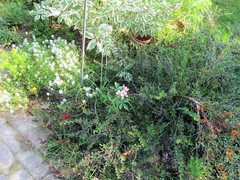
The top photo is what happens under two hanging baskets next to a brick walkway to the kitchen porch. I'm not sure I'm happy with the halo dogwood but because of the drought, it looks pretty healthy unlike wetter years when the leaves have gotten diseased. I love the spreading cotoneaster. One year a bluebird family feasted on the berries. The clump of white alyssum self seeded from Proven Winners I had in the hanging baskets two years ago. You can also see a tiny cleome, there's a yellow viola and a single lemon gem marigold. Everything on the ground that self seeded survived early season weeding. Eagle eyes might also spot some garlic chives in bloom.
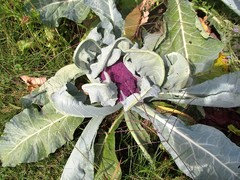
I attended a seed starting workshop which also focused on colorful vegetables. I must have gotten this purple broccoli there. It's sweeter than green broccoli and kept its color when cooked. The workshop presenter shared plants and seeds so we could learn how to plant seeds properly and also how to transplant very young seedlings. My veggie beds are bordered by lawn (to explain all the grass).
 10 years ago
I like the idea of volunteers under the hanging baskets, defrost - more likely to be interesting plants than the volunteers you get under bird feeders. And the purple broccoli is startling!
I seem to keep posting the same plants in bloom, but they fit with the time frame of these threads (i.e., they're still blooming in September).
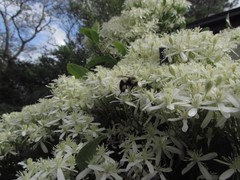
Sweet Autumn Clematis, mostly volunteers, are now in full bloom.
This one is on the fence bordering the Phlox Protection Zone, protecting the phlox that are fading away but still in flower (and uneaten by woodchucks).
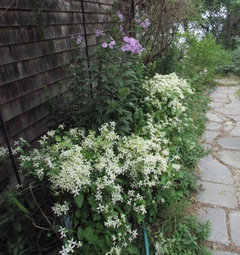
The volunteer on the storage shelf is in full bloom.
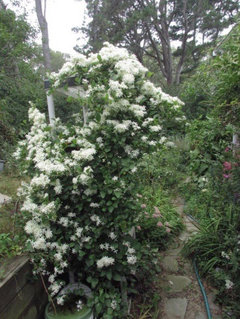
and the bees are happy.
White wood aster is blooming all over the place although the drought has diminished it.
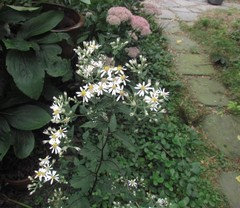
Here the asters are surrounding my little Hopi crape myrtle which got battered by the late winter/early spring temperature swings even though it was protected. It didn't bloom this year either but it's in part shade and not in an ideal location. I know it would do better in full sun but all the full sun locations are either taken or subject to nasty winter winds.
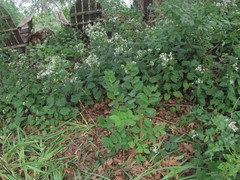
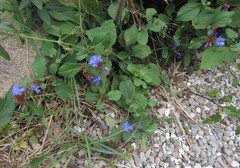
Ceratostigma has been blooming for a while even though it's too crowded.
And the monster mullein still has flowers on the tips.
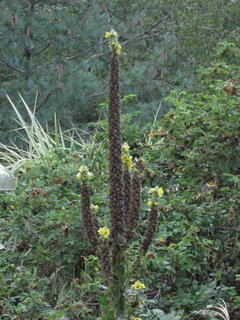
Goldenrod should be blooming soon.
Claire
Related Professionals
Fort Smith Landscape Architects & Landscape Designers · Ocala Landscape Architects & Landscape Designers · Tulsa Landscape Architects & Landscape Designers · Salem Landscape Architects & Landscape Designers · Anderson Landscape Contractors · Victoria Landscape Contractors · Stamford Landscape Contractors · Tucson Landscape Contractors · Greensboro Tile and Stone Contractors · Portsmouth Tile and Stone Contractors · Lufkin Tile and Stone Contractors · Huntington Tile and Stone Contractors · Martinsburg Tile and Stone Contractors · Lubbock Tile and Stone Contractors · Salt Lake City Tile and Stone Contractorsspedigrees z4VT
Original Author10 years agoDefrost, I love your photos of volunteer plants beneath your hanging baskets. In the spirit of this, here is a photo of my volunteer portulacas that have sprung up this year in the cracks between the patio bricks in my "orange garden" as compared to portulacas planted in a pot from saved seeds. First it is notable that the volunteers are doing far better in the spot they chose for themselves than the spot I picked for them! I'm guessing they like less water and poor soil.
Secondly the seeds sold to me 2 years ago were specifically "orange" portulacas (which they were indeed last summer) but they must have been hybrids because they have reverted back to multi-colored.
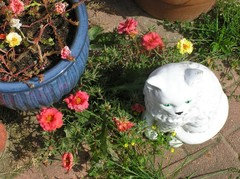
I'm beginning to think that my orange garden may eventually evolve to being multi-colored if I let nature determine my garden plan, as I have in many other areas of my property. The all-orange garden sprung from a year when every non-orange flower I planted died out, and only the orange ones throve. Now I'm thinking maybe that was then, and now is now, and it's time to turn the garden plan back to Mother Nature. One thing I definitely plan to do is to plant my saved portulaca seeds next spring in the cracks of the patio bricks and plant marigolds or nasturtiums in the flower pots.
Claire, I'm happy that your phlox protection zone actually has worked for your many varieties of phlox! I love phlox and would be devastated if mine were attacked as yours were.
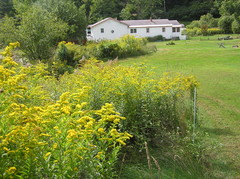
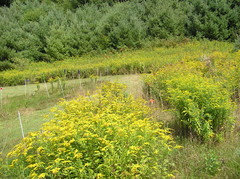
Here goldenrod is the "thing" now. Goldenrod stretches as far as the eye can see, replacing milkweed as the dominant wild flower (although sadly I did not see a single monarch butterfly all summer - not even a one).
- 10 years ago
Spedigrees: Always a good idea to defer to Mother Nature, at least as far as choice of colors and growing conditions is in question (deferring to her otherwise can lead to chaos, or lots of poison ivy and ragweed).
It always surprises me when something like goldenrod is in flower in sunny Vermont but still in bud in partly shady coastal Massachusetts.
I have to admit that my Phlox Protection Zone probably wouldn't work if the woodchucks were desperate, they can climb fences after all, but they probably don't even know the phlox are there while they do know there's birdseed on the ground.
I have a few more things to show:
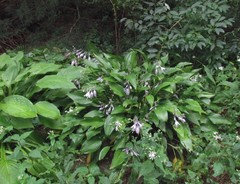
An inherited hosta, probably lancifolia, is an oldie that stays smallish and blooms late.
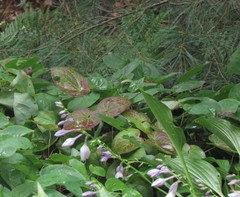
And just behind the hosta is a patch of epimediums and a few are showing fall color. I don't know if this is an anomaly with damaged epimediums but I like the color.
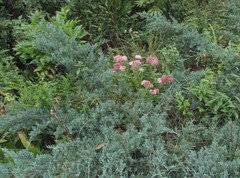
Sedums are getting pinker and this one is nicely nestled in a Grey Owl Juniper.
Claire, still waiting for the goldenrod to bloom.
- 10 years ago
Claire, I almost didn't believe your goldenrod isn't blooming yet. Ours has been blooming for weeks. To me, it's a sign that Fall is starting to sneak in. I was surprised to see more early color in Nashua yesterday than we have in the Concord area.
Spedigrees, your volunteer portulaca is beautiful. What a difference. My favorite marigold is Lemon Gem tagetes, tiny blossoms with lemon scented frilly foliage. It's hard to find 6-packs and so far I haven't been able to grow from seed. There is an orange version. Tends to get a little tall and bushy so might not be appropriate for your planter. Of course, maybe trimming it would help the bushiness.
spedigrees z4VT thanked defrost49  9 years agolast modified: 9 years ago
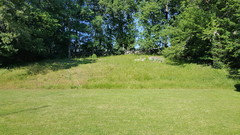
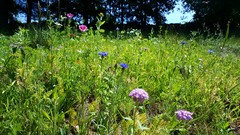
Spedigrees..did you fill in your field yourself? I'm trying to fill in a large hill. This is my first year and I just had a handful of cosmos, Nigella, and unknown wildflowers from a mix I threw down in the spring. I am hoping between some seeds that fell on their own and the ones I'm collecting for wintersowing we can get the hill looking good in about 20 years.lol.
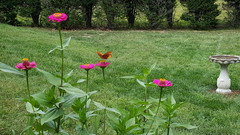
This is our hill. And the pics below is a close up of some of the flowers that don't look like much from the house but are pretty up close.
I'm finally getting butterflies :)
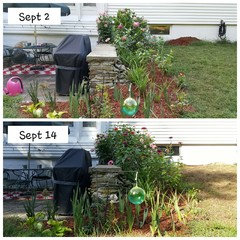
In 12 days my dahlias got fuller and our grass got browner...
I know Tuberose are definitely not a New England flower but I am obsessed with their scent. My first shot at the pink ones....
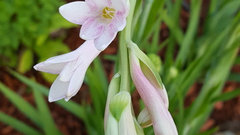
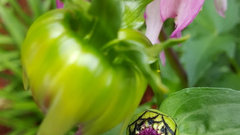
I don't know why but I love this shot of 3 stages of my new favorite dahlia. The bees LOVE this dahlia....(now that I'm looking at the foliage closer i realize the small bud is not a dahlia but a Zinnia that got very friendly with my dahlias) I'm new to gardening so I still don't always ID my own flowers correctly.lol
 9 years agolast modified: 9 years ago
That zinnea bud is stunning! It looks like your garden is off to a good start.
For your hill, some of the plants you could add include natives (most have many species) that will tolerate a fairly dry spot and no real attention from you:
Solidago - goldenrod
Rudbeckia - black-eyed Susans
Lupinus - lupine
Symphyotrichum - aster (they just changed the name of N. American asters from Aster to Symphyotrichum, so you may find them listed as either. European asters are still called asters.)
You can also add daffodils (non-native), which will bloom in spring and are critter resistant unlike many other bulbs. They will increase over time, giving you clumps of blooms.
If you want to keep it a meadow you will want to mow the hill annually in fall after the seeds ripen, since it will keep down woody plants that will otherwise seed in and take over. Open areas in New England will always progress towards woods unless they are mowed, burned, or have some other control measure.
If you want seeds for any of the natives, let me know and I'll collect some as they ripen. You can usually find relatively inexpensive daffodils to use in a natural setting like yours.
spedigrees z4VT
Original Author9 years agolast modified: 9 years agoPinkmauisunset, your hill and lawn are very reminiscent of mine, and the flower seed mix you sowed are very beautiful. NHBabs is right in that woody plants will move in if the area is not mowed regularly, and the daffodil suggestion is a good one.
For our hill, I have mostly let nature take its course. The trees in the wooded area at the top of our hill seeded down from trees in the older forest behind it. I have planted some spruce seedlings in amongst the volunteer trees.
The lower portion of that hill, I intend to keep mostly open, with only a few select trees and shrubs here and there. A few apple trees appeared on their own, and I planted a lilac and a flowering crabapple. Any other trees or shrubs that attempt to grow there, I cull.
Daffodil bulbs are the only flower I have actually planted on our hill, on the lower slope. The rest of the wildflowers and weeds appeared on their own. The hill has never been mown. To keep brush from taking over, I periodically remove seedling trees and bushes with a pair of brush shears.
The other unmowed "wild" areas on our property are planted with seedling trees and will eventually become wooded areas, as the trees I have planted there grow. The wildflowers and weeds growing there now are an interim measure. It is healthier for the trees if the area around them is left to grow up.
Most of my care of both the hill and the areas I am reforesting has consisted of culling undesirable plants, as opposed to planting anything. Except for the daffodil bulbs, I have planted no flowers in the "wild" areas. I cut down poison parsnip and burdocks mostly, usually with a grass whip or sometimes a battery powered string trimmer as they first spring up. As Claire remarked, letting Mother Nature go completely unchecked invites chaos!
I imagine that many factors determine which wildflowers and weeds will spring up when an area is left to its own devices. Probably which plants decide to take up residency depends on the soil, the drainage, the amount of water and sun or shade, and the climate in any particular area.
- 9 years ago
No wide open expanses here (except for the Bay) and the goldenrod is just starting to open. I'm sitting on the deck as the sun gets lower and I should have taken this picture earlier in better light, but white wood aster (Aster divaricatus/Eurybia divaricata) is everywhere. I love it so I just let it spread wherever it wants. A free shade-tolerant filler.
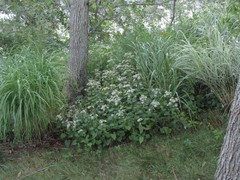
Looking out my kitchen window earlier, the fall scene is developing. It's heavy on ornamental grasses (and squirrels) and a big old winterberry is the backdrop.
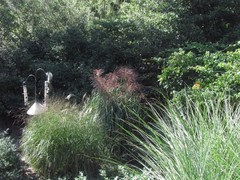
That's Miscanthus 'Malepartus' opening and a pieris in bud.
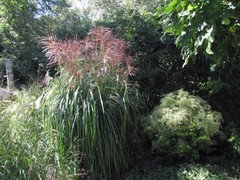
The big old winterberry has berries that are turning red, not yet as bright as they will be. It's most impressive when the leaves have dropped.
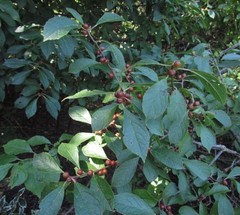
Claire - still waiting for the goldenrod
 9 years ago
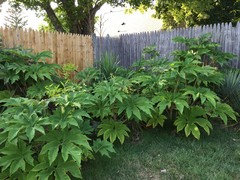
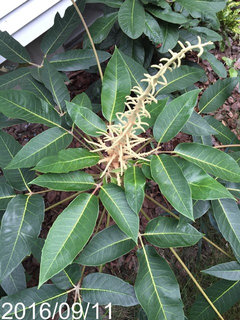
Tetrapanex with great big leaves
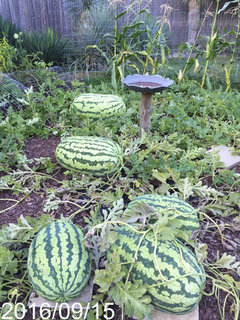
Time to pick watermelon
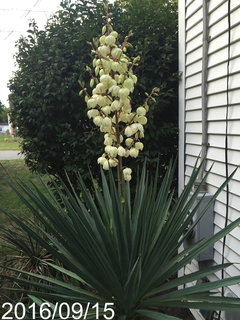
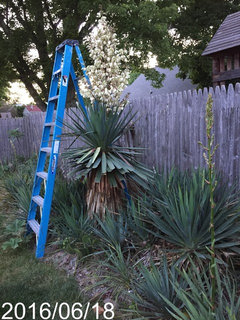
Yucca gloriosa blooming
Schefflera delavayi sending up a bloom
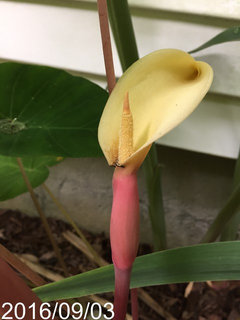
Hardy elephant ears blooming
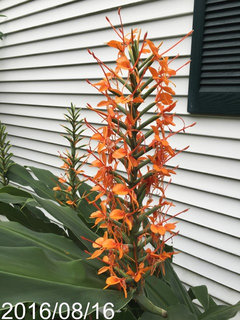
Hardy gingers finished up but drop dead gorgeous
- 9 years ago
Beautiful watermelon crop, timbz6, and I love the gingers!
I didn't know Yucca gloriosa is hardy in zone 6. Do you protect it in the winter? I have Yucca filamentosa and love the flowers but they're earlier than gloriosa.
Claire
- 9 years ago
NHBabs.....thank you! I have the Rudbeckia but didn't think of Lupine and the dafodils are a great idea, I prefer pink flowers so maybe I'll have to look for some in the pink family. You're right about it turning woody! I've been pulling mini trees left and right which always makes me feel a little bit guilty.
I would love some of your native seeds! I"ll send you a PM :)
Spedigrees...I also planted a lilac :) from my grandmother's many seedlings. I am wondering if I should allow some of the trees to grow. The hill was a wooded area but the original owner's in the 1950s cut it down and later regretted it (according to our neighbors) he hated the mowing upkeep. We also hated mowing the hill so we are trying to turn it into a meadow type area. It looks like a hot mess of weeds right now and I can't burn it and I won't spray pesticides so it's a matter of a lot of weed pulling and planting random things.
- 9 years ago
Claireplymouth...your grasses are beautiful!
Timbz6...I didn't know we could grown watermelon that big in New England, I'm going to try next year! I love the Tetrapanax but it doesn't look like it's hardy in my zone :( those leaves are gorgeous.
- 9 years ago
Hi Claire! Yucca gloriosa has many forms, some are not hardy. This form is from Tennessee and has been in my garden since 2003. It did fine after the 2014-2015 winter which killed several other forms I have. This form generally blooms in fall but did bloom in spring one time. It's a trunk forming Yucca and currently has a three foot tall trunk.
This other form was found in North Carolina and survived the 2014-2015 winter as well. This one bloomed in the spring and has a massive bloom. If your in my area I can dig up a root. The ladder was for hybridization. I trimmed the lower leaves so the seedlings from other hybrids can get more sun.
- 9 years ago
Pinkmauisunset, the Tetrapanex is a perennial in our climate and will die to the ground each winter. The watermelon is Carolina Cross by Burpee. Most stores will carry this type. The biggest one is 121lbs. If your in my area I can load you up with divisions of Tetrapanex, etc. I'm just east of Providence RI.
- 9 years ago
Thanks for the offer, timbz6 - that's a magnificent specimen. I wasn't thinking of the size of the yucca, just the beauty, and, unfortunately, I don't have an appropriate place to plant what is essentially a small tree that loves sun and hates winter winds. Right now my Hopi crape myrtle is longing for a nice, sunny, protected spot.
I guess I'll stay with Yucca filamentosa 'Color Guard'.
Claire
- 9 years ago
Timbz6, Thank you for the generous offer, but I've banned myself from planting anything else this year. I told my husband if I can home with any more plants to throw them out, my body can't take anymore digging.lol
I am definitely going to try that watermelon when I wintersow this year :)
- 9 years ago
I started the watermelon seed in the garden about June 1. They dislike cold soil and dislike root disturbance.
- 9 years ago
timbz6, Wow, on your watermelon. I'm further north on the colder size of zone 5 so doubt I could grow the watermelon but this year I grew cantaloupe for the first time after finding a tasty variety at the Norwich VT farmers market last year. I think I got the seeds from Fedco or Johnny's.
Regarding woods and fields - we live on a property that in the early 70s still had a section of ancient and half dead apple trees. It was soon after that the trees were cut just to get rid of them but the area wasn't mowed. We moved here in 2007 and my husband began cutting oak, ash and maple (mostly maple) that had grown up in what had been the old orchard. We heat with wood. The front of our property near the road tends to be marshy. I can remember a lot of wild iris in the 70s but now there aren't many. I don't know if a grass choked them out or not. This meadow is mowed once a year, usually during the driest part of August. The driveway is edged with wild asters, goldenrod and other wildflowers and I am most unhappy that a clump of Joe Pye weed that is fairly new was mowed. I have a clump of Little Joe in a perennial bed that came from a friend but it has gotten taller than expected. I don't know if the new clump came from that somehow or not. About 50 or so yards away. Also new in the past 15 years is an expanding clump of cat tails in what should be a seasonal brook but is dry this year.
Glad to come home from a short trip to see some rain.
 9 years ago
Tim. is that tall Yucca in FULL sun? I LOVE LOVE LOVE it..It looks so tropical)) I live in Mass near the southern New Hampshire border..
- 9 years ago
Defrost49,
i agree you would be pushing the limits growing these giant watermelons.
Mikerno_1micha,
if your in my area I'll dig some roots for you. Yuccas prefer full sun but can take as little as 3 hr per day.
- 9 years ago
defrost49, good to know about the Joe Pye, I kept reading good things about it and it seemed more weed than not to me. I do want to plant Milkweed next year though for the butterflies.
- 9 years ago
pinkmauisunset, anything good for beneficials is smart. I thought we had more milkweed in years past and wonder if my husband's mowing schedule isn't good. Our asparagus patch became mostly weeds so there is a lot of milkweed in it. We get some asparagus in the spring but not much. I also have a strip of "wild things" between my vegetable garden and the mowed area. That is so insects and birds can find things to eat. We usually have goldfinches after the seedheads on my flowers. Wild turkeys enjoy the grass seeds on tall stalks. I do clean up in the spring.
- 9 years ago
Tim, that is so kind of you,..I have always wanted one of those that make a trunk like that..It looks so tropical and I use to live there..So it would find a great spot in my yard..Just let me know what I need to do and I will give you what you need..Thank you. How old is that one?
- 9 years ago
Mikerno,
If you like tropical, you might like this Yucca better? It bloomed last season. Super hardy too.
Yucca elata
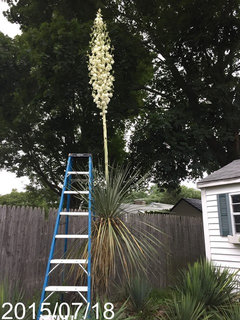
Do you ever get to the Providence area? Ivan load you up with plants. Many Yucca forms.
Yucca rostrata is a beauty too, it's the tall Yucca in the back. The blooming Yucca in front is a hybrid between filamentosa and rostrata.
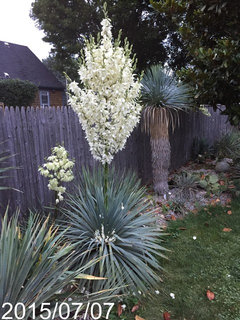
- 9 years agolast modified: 9 years ago
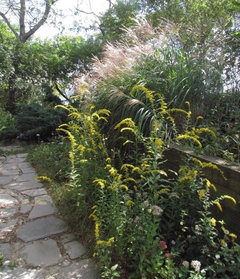
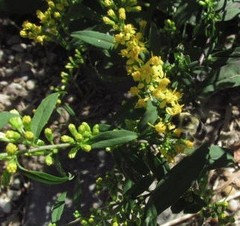
Well, I finally have goldenrod blooming - not the vast fields that spedigrees shows, but I have a small yard and the yellow paint strokes are very welcome.
Here in the alley across from the Phlox Protection Zone, blooming with grasses and sedums:
And near my porch steps with grasses and a hosta and white wood asters:
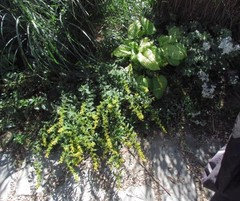
The bees appreciate the goldenrod - if you squint you can see a bee there. I like the fact that there are late blooming flowers like goldenrod and asters that feed beneficial insects.
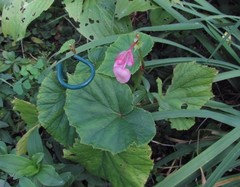
And the hardy begonia (B. grandis 'Heron's Pirouhette') is still hanging in there, just starting to bloom. I planted three originally and each year this one comes back smaller and smaller but still alive. This year a second one appeared but hasn't bloomed. It's probably a race between bloom time and first frost so I'll keep watching. I may try moving them in the spring if I can find them (that's why the plant support is there as a marker - the leaves are very late to emerge)
Claire
spedigrees z4VT
Original Author9 years agotimbz6, your yucca plants are beautiful. I think northern New England is too cold for them, but I'll keep them in mind in case our climate gets warmer or we move! I never knew they had such spectacular blooms.
Claire, somehow I never picture your yard as being small. Somehow it seems much larger, perhaps because of the profuse wildlife it harbors, or maybe the seascape behind it adds the impression of space.
I love goldenrod, asters, and jewelweed too for the late season nourishment they provide to the wildlife. The worker bees are nearing the end of their life cycles, and many seem confused and disorientated, but at least they are not going hungry, not yet at least.
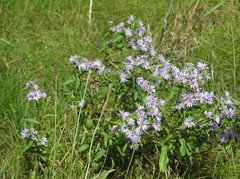
The wild asters are blooming now. There is a richer purple variety on our roadsides that I have tried many times to seed or transplant to my property with no success. My other half suggested that perhaps that variety prefers sandy, poor soil, and I think he hit on the reason they do not do well here. This are my pale variety in one of my wild areas.
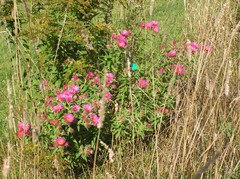
I was surprised to find that my domestic asters are apparently thriving and spreading in an adjacent wild area. I bought these from bluestone perennials some years ago, and then transplanted them from my perennial bed into a weed bed when they did not seem to like it where I first put them. I haven't the heart to "shovel prune" anything, but I will sometimes transplant an unthrifty plant to a weed bed to give them a second chance, and these pink asters apparently took that chance!
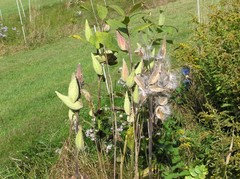
The goldenrod and milkweed have mostly gone by now. Milkweed seeds attached to their fluffy little parachutes are blowing about in the wind.
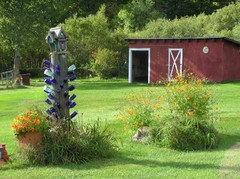
The last holdouts of the garden flowers are these nasturtiums on the left and orange cosmos on the right.
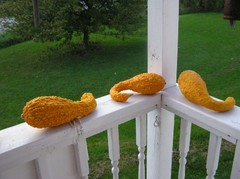
And the last remnants of the (mostly failed) veggie garden are these gnarly, overripe late summer squash, good now only for seed saving and porch decorations at this point.
 9 years ago
tim, it's been a while since we chatted. Your yuccas are really spectacular!
I lost a few things this past winter. Here I think it was that we had quite a mild season right through January, then February got to what I consider "normal" cold, up until Valentine's Day. Then we got hit with minus 9 degrees (!) all of a sudden overnight and only a high of 12 degrees the next day and then back below zero for a couple of more nights, Most plants weren't hardened off enough by a normal, gradual cooling. My 7 foot camellia was reduced to a 10-inch stump, although it's recovered and has a lot of new growth. But I doubt that I'll have any flower for a year or two. And if we get another really cold spell, well, who knows? My Magnolia "Bracken's Brown Beauty" came through fine, as did all of the cacti and Hesperaloe ("Red Yucca" - not a true yucca). Gardenia "Frostproof" was covered with a styrofoam cooler and was mostly OK when I uncovered it in spring.
I would love to grow that hardy ginger. Could you tell me more about it, such as the species, and where you bought it?
- 9 years ago
Hi Bill,
its great to hear from you again. Too bad about your Camellia, did any other forms do better?
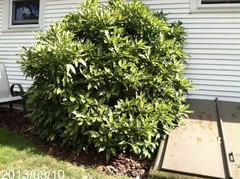
my 6 foot tall Aucuba japonica got very beat up after the 14-15 winter and the 15-16 winter did even more damage. I ripped it out of the ground. Local school hit -13F last winter. Brrrrr
Aucuba which passed
The ginger is Hedychium 'Tara'. It must be planted against the foundation or mulched heavily. I've had mine for many years now. Big orange flowers.
- 9 years ago
Tim, I had no idea you responded to my last post..I am so sorry..My e-mail did not notify me at all...Are we still on for a plant or two? I love the other you showed me...Please let me know..If you need my e-mail I can give it to you.
I think I have only been to Rhode Island once...lol BUt if I had to make a trip down there next spring, I would be game for that. My Mom has been very sick and they just put my father in a nursing facility...So I am kind of straight out for travel..
- 9 years ago
Mike, give me a heads up when you want to come down and you can dig up offshoots of what is available. Swaiting to spring is no problem. Send your email. I'm in Mass but east of Providence.
- 9 years ago
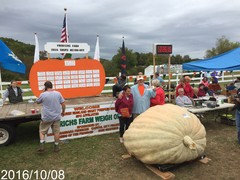
I visited Frerichs Farm, Warren, RI and took these photos. Amazing how big pumpkins can grow.
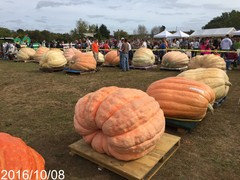
The winning pumpkin, WOW. A North American record.
- 9 years agolast modified: 9 years ago
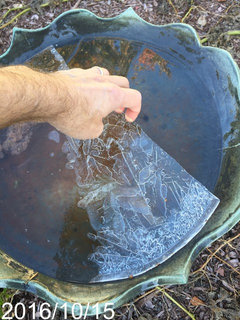
This is the September thread . . . there is an October one for 2016. We haven't got ice on standing water yet, but it was 28 on 10/15 here, just not cold enough for long enough to form ice other than frost.
spedigrees z4VT thanked NHBabs z4b-5a NH - 9 years ago
NH Babs, It's not fair you didn't get ice yet (your z4 while I'm z6b)! Plants under trees are fine here. This bird bath was not under a tree.





timbz6