Software
Houzz Logo Print
guamyankee

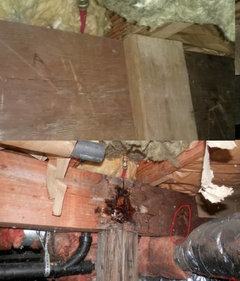
Wood Support Beam Rot/Water Damage

10 years ago
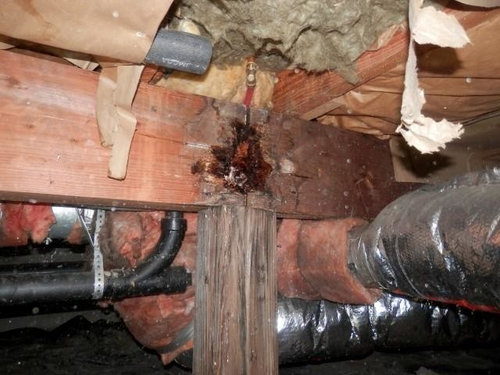
My wife and I are in the final stages of negotiations to buy a house. There is damage to a support beam due to a previous water leak. The seller claims they were told by the contractor who fixed the water leak that the beam was solid and didn't need replaced.

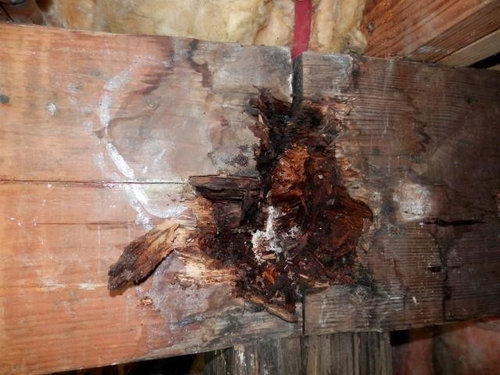
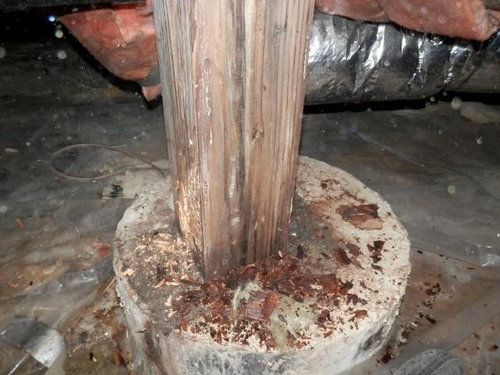
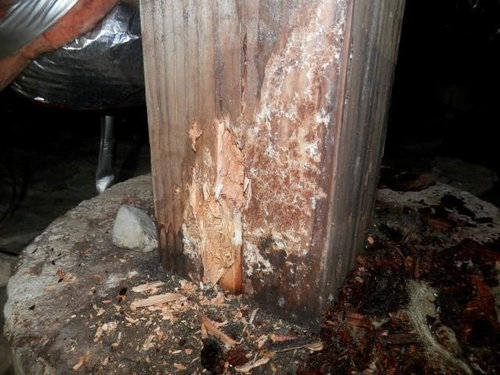
Based on the following photos, what would your level of concern be? Also, how much do you estimate it would cost to have beam(s) replaced?


Comments (31)

  • 10 years ago

    Yes, we are thinking the same thing. Thanks for the advice.

  • 10 years ago
    Good point about the 2 pieces. Why isn't it 1 piece? That post would seem to only be half supporting each side. Im not an engineer either. Although, I did have a very thorough inspector....but then again that is probably not his specialty. At any rate, I wont be comfortable unless this is looked at by a licensed professional.
  • PRO
    10 years ago

    I am not a structural engineer but have been involved on projects with a clients solving water entry issues where we brought an engineer in to review similar conditions and advise what repairs were required.


    The rotted portions of the horizontal beams definitely need to be replaced.


    Based on the photo it looks like this is at the center of the home with the beams coming from either side of the home and ending on top of the post. If that is the case there is a lot of weight bearing here presenting a major safety risk.


    As for the repair, the cost will vary but I would guess at least $5000. As rrah said, it is likely they can just sister beams on either side. They would need to remove the rotted portions and install blocking in its place. The vertical post may require replacement but would be simple as they would already have shoring installed for the beam repair.


    As it appears the beam is exposed in this unfinished space your costs will mainly be for the installation of shoring and the wood structure repairs.


    If you really want this house get a structural engineer to look at this before you sign anything. To have one just have a quick look and give you their thoughts should only cost you a couple hundred dollars.

    Guam Yankee thanked Sustainable Home Catalyst
  • 10 years ago

    Actually, after reviewing my e-mail, it was the contractor that the seller had put a new deck in who said that the beam was solid, and not the contractor that repaired the water leak. All the same...I am still highly concerned about this issue and feel that it needs to be addressed before moving forward.

    I don't see any fasteners there either, but I have no idea if they are supposed to be there or not.

    Thanks to everyone for responding...great advice and a great help.

  • 10 years ago

    It needs to be fixed properly. Having the somewhat rotted ends of two beams supported like that, and also without apparent fasteners is not ok. Even if there were no rot, I doubt this would be to code. Having said that, I think it might not be that expensive to fix. It's possible that you could remedy it this way:

    1) Hold the beams up with a jack on each one so that a new, wider, and beefier post can be installed, perhaps with a larger footer,

    2) Tie the two beam ends together with a pair of heavy duty steel plates that are T-shaped and are bolted onto each side of the beams and run down the top part of the new post, where they will also be bolted.

    However, I'm not a structural engineer. I recommend you get one involved so you can get independent, reliable, professional advice on what the best fix is, and not close on the house until a structural engineer gives an assessment so you can understand how much it will cost to fix it. It's not an un-fixable flaw, but it is serious, particularly if you live anywhere an earthquake is possible.

  • 10 years ago

    This may seem like a silly question but wouldn't the inspection bring this up? I agree with Lilly'smom the chipping on the beam that comes down through the cement is odd. Why is that chipped away? I would absolutely have a structural engineer or someone with that type of expertise look at this and give you the story on financial fix and what it will take. That would be a serious concern to me. Good luck with it!

    Guam Yankee thanked NewEnglandgal
  • 10 years ago
    last modified: 10 years ago

    "This may seem like a silly question but wouldn't the inspection bring this up?"

    Er, yes. The OP said the inspection did identify this problem.

  • 10 years ago

    Thanks Salti. What I was trying to ask and worded incorrectly was wouldn't the inspection show whether this was safe as the owner states or whether it was indeed a major safety hazard? In other words, does the inspection only state there was rot and water damage or does it go on to say whether or not it is indeed a safety hazard.

  • 10 years ago
    last modified: 10 years ago

    Very likely the Inspector is not a Structural Engineer, and even if he/she were they would not offer up a "free" assessment nor accept the liability associated with making that assessment.

    I worked for many years in shipboard and industrial environments and based on my experience it is much easier to pronounce something unsafe then it is to stand up alone and declare something safe in the face of a suggestion by someone else that something is unsafe.

    Been there, done that!

  • 10 years ago

    nancy-

    I agree with SaltiDawg. In addition, I will point out that people place far too much faith in what is accomplished with an inspection. Many assume that it is exhaustive, or that, if something is noted, it is a defect that must be fixed; neither of these things is necessarily true. Some inspectors are quite good, and others are borderline incompetent. in addition, where I live, there is a specific disclaimer in any inspection contract that disavows responsibility for things that are missed or mischaracterized. One should look on a home inspection as, at best, a second set of eyes that might help you find some problems you might have missed on your own. Don't get me wrong...I think they can be valuable, and I have had some done that turned out to be thorough and accurate. But they are sort of like getting a physical: even if the doctor says everything looks good, it doesn't mean you don't have cancer.

  • 10 years ago

    where I live, there is a specific disclaimer in any inspection contract that disavows responsibility for things that are missed or mischaracterized.

    Just as a point of clarification - while almost every inspection contract will include a disclaimer of liability above the amount the inspector was paid, they are rarely valid. In most jurisdictions inspectors have a duty to meet a certain standard of care. In other, words they are responsible for catching everything they should catch, they are not responsible for things that are hidden or hard to detect. In many jurisdictions they are required to carry insurance and that rate is based on paid claims, so inspectors try to discourage you from pursuing it, but in the end, most will simply turn the claim over to their insurance carrier.

  • 10 years ago

    bry11-

    I don't dispute that, but it also illustrates why, although an inspection can be helpful, people should realize that it has significant limitations. If your house collapses several years after you move in, it may not be very comforting to try to sue the inspector. The other problem I have seen with inspectors is that many of them include extensive boilerplate language in the final report that tries to cover their butts, like saying there could be unidentified insect damage because there are plants in proximity to the house, or there could be unidentified wood rot because it rains in the area, or there could be unidentified electrical problems because not all the wiring was visible, etc. I'm not dissing inspectors or saying they aren't useful; just pointing out that people should not expect total comprehensibility or infallibility from an inspection.

  • 10 years ago
    In this case, the inspector stated, "There is moisture damage at one or more of the support post. This can compromise the support of the structure. I recommend further evaluation and correct as necessary. This should be completed by a qualified licensed contractor."
  • 10 years ago

    Sounds like good advice. I'll be interested to hear how this turns out for you. Good luck.

  • 10 years ago

    I would get a structural engineer. He/she can not only tell you about the damage, but can also tell exactly how to remedy it. We had a structural engineer look at our basement (1908 home) and he told us exactly what we needed to do and why. We also had him come out when we took out a wall. Money well spent!

  • 10 years ago

    Kudzu - I agree with almost everything you said and took no issue with it. I was just clarifying the responsibility that an inspector has.

  • 10 years ago

    And I didn't take your comments as anything but helpful. I think we're in heated agreement...

  • 9 years ago

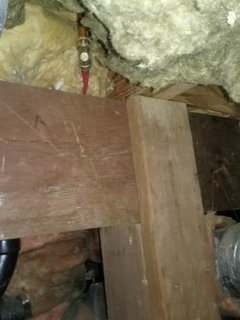
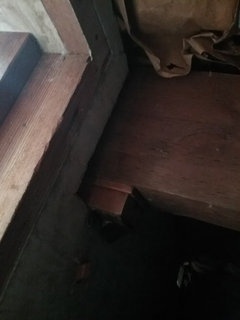
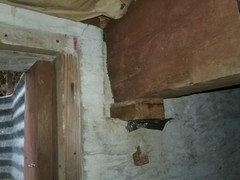
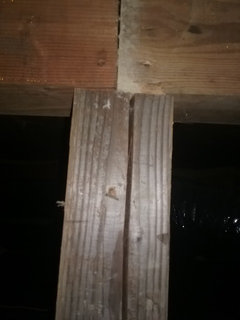
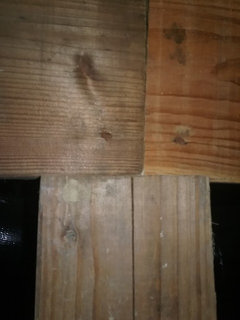
    Follow up: The sellers agreed to repair the damage. The first shot below shows repairs. It looks great...my only concern is the other side of the new beam (second and third photo.) Does this look secure?


  • 9 years ago

    How far "back" into the wall does it go? Is it sitting on the foundation, or just on that 2x4ish piece?

  • 9 years ago
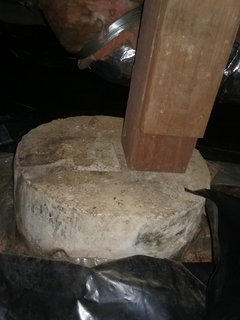
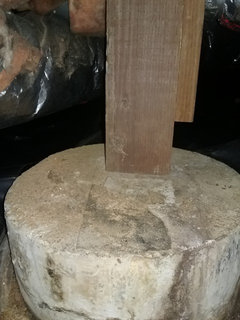
    It's just that piece. You are looking at the very end of the beam and the smaller little piece of wood (which is actually 2 small pieces) on which it sits. The 2 small pieces are only half sitting on the concrete foundation, at best. The other half extends out into open air, as seen in picture #2.
  • 9 years ago

    FWIW, former licenced builder/renovator here and I wouldn't be satisfied at all with that "repair". All they did is cover up the rot.

    As for the beam resting on the 2"x4" and 1"x4", if the beam and the shims go the full distance of the concrete, I wouldn't be worried. One block foundation I built on, the entire base plate on one side was shimmed with cedar shakes as the foundation wasn't level. After that, I switched to steel shims so no settlement would ever happen.


  • 9 years ago
    Actually, you may be correct about covering up the rot. Only 1 beam was replaced (the beam on the left side.) So they may have only eliminated half of the rot. Thanks for the input. We're going to have a contractor inspect the repairs.
  • 9 years ago

    It sounds to me like the beam end is barely inserted into the concrete pocket. If so, I wouldn't consider that to be adequate.

  • 9 years ago
    last modified: 9 years ago

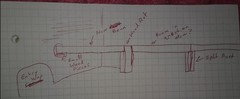
    Ok, here's the latest update after re-inspecting the site myself. First, here's a diagram I drew to help show where everything is:

    I'll work from left to right to deal with the current 2 possible issues, and 1 issue I think is resolved.

    1. Beam end in the concrete pocket. The beam goes about 2 inches into the pocket, about an inch away from the wall. This is about 3 inches in length. The small piece of wood hangs out by about 2 and a half inches. here is a closeup photo:

    2. Wood Rot. The wood rot is actually gone. They made the new left beam a little bit longer, and then they cut the rotted end off of the right beam. Then they replaced and moved the old post over to the right. See the reference photo below (disregard the red circled area. Use the red hose above the beam for reference):


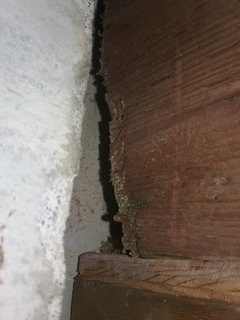
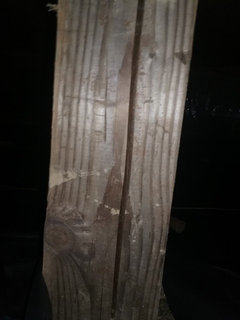
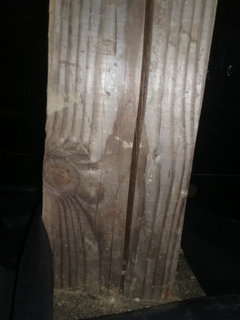
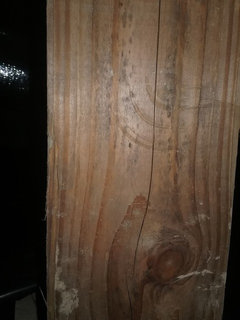
    3. Split beam. Now, here's something new I discovered. The post that supports the right side of the beam on the right (the beam they cut but didn't replace), has a nasty split. I suspect it is new damage, as I can't imagine my inspector wouldn't have mentioned it:


    Now the same post on the other side:


    When we had the house first inspected, our inspector was very thorough. He did not mention the split post. That's why I think this damage is new. Either way, looking for thoughts on where everything stands now. Thanks in advance.

  • 9 years ago

    Looks good to me. The rot is gone. You did not request the split post to be repaired, and by the looks of the grey color of the inside of the split, which is the same color of the exposed wood on the outside of the post, I would say the split has been there for a long time. If you are worried about the new beam only being on the block by three inches, then just put another post under at at that end. And replace the split post if it bothers you.

  • 9 years ago
    Ok, because they didnt replace both beams, the post is now alot closer to the edge of the concrete. The question is whether we should be concerned about it.
  • 9 years ago

    Yes, you should be concerned because it is apparently not attached to anything. I would have said something sooner, but I assumed it was set into the concrete pad. An earthquake or even a blow to the base from being bumped hard by something could move it. Even if it was in the middle of the pad, like your first photos, it would not be ok, and would not pass any building code I am aware of. At a minimum, this needs a pair of steel, right-angle brackets that are bolted into the concrete pad and into the base of the post. Also, what does that pad sit on? If it sits on top of dirt, then the whole support is compromised. Sorry to be so critical, but you seem to want to know if this situation is adequately taken care of, and it isn't...

  • 9 years ago
    Thanks for the response. And the new location of post on the concrete sits on the exact far side of where the beam above it meets the wall on the left where it sits on 2 inches of concrete. That means if there is any shifting, the left side of the beam is going to come right out of the wall.
  • 9 years ago

    You're right...yikes!