Software
Houzz Logo Print
celia_jean

Severe cutbacks on jade

10 years ago
last modified: 10 years ago
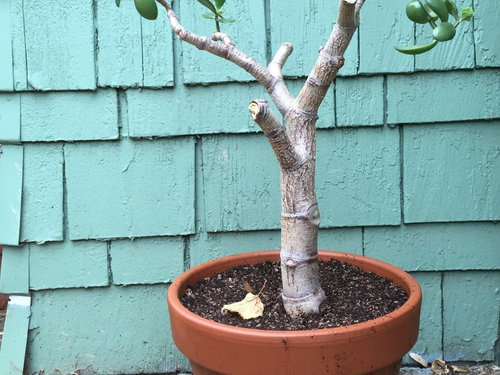
My poor jade was infested with mealy bugs for a long time. I finally started cleaning the bugs with alcohol and the leaves and branches were dropping left and right.

I also cut off many branches which were disfigured.

This is what I ended up with.

It's a little (ahem...) late, but if you have any advice on nursing it back to health, I'd be appreciative.

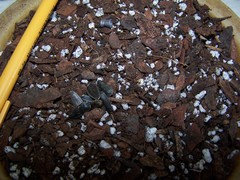
I repotted it into a bigger pot with a succulent and cacti soil mix. It's outside now, as it seems to still like it (I'm in zone 8a, Oregon), but I will bring it inside soon.

The central stem is about 2 or 2 1/2 inches in diameter.

Thank you!

Comments (16)

  • 10 years ago

    There is a lot of info on cutting jades in the succulent/cactus forum. I did a search because I have one that needs it, too, and found lots of good threads with pics.

    Celia Lin thanked maggiepatty
  • 10 years ago

    More experienced growers can probably give more advice, but I think that it will come back if it is totally free of mealybugs. Keep it in as much light as you can, and don't water too frequently.

    If it had been sitting in a darker area for a while, don't immediately shove it into direct sunlight-that will likely burn the remaining leaves. Gradually introduce it to direct sun by keeping the plant in a place that receives ambient light outside for a week, then slowly put it into direct sun by leaving it in the sun for an hour, then two hours, etc. until it is fully acclimated.

    Celia Lin thanked goldstar135
  • 10 years ago

    You already did the trimming, and not much advice needed. I just want to add that if it gets enough sunlight it will come back with a vengeance. Just give it time

    Celia Lin thanked hellkitchenguy Manuel
  • 10 years ago

    I am glad to hear that it is likely that it will rebound. Whew! Thank you all.

    I will try to find a spot inside with more light. It's hard because my most ideal plant places, the living and dining rooms, are under construction, so no plants in there.

    I've trimmed it a ton over the years, but never this much. I was concerned that it didn't have enough leaves to photosynthesize.

    Those damn mealy bugs!!! I vow to stay on top of them...

  • 10 years ago

    As far as bringing it inside, I've kept them outside when the temperature was 50 and over. Not sure how much lower they can tolerate.

    Celia Lin thanked hellkitchenguy Manuel
  • 10 years ago

    Mine grow outside in Florida. They get strong sun all day. We have a few months of cool weather with nights down close to the 30's.

    I have never brought them in and it doesn't seem to bother them. But, this is Florida and cold nights are not every night. We could have weeks in the low 40's but warm days.

    I don't think a few cool nights will hurt them.

    Jane

    Celia Lin thanked jane__ny
  • 10 years ago

    I would take advantage of outside air and temps. All my succulents are still outdoors and we had several nights (not consecutively, and lasting for only 1-3 hrs) with temps around 44-45*F. You may have another month or so. It must have been quite etiolated since the space between the existing leaves is quite long - unless there were more leaves in-between that fell off...I can't tell from the photo.

    Celia Lin thanked rina_Ontario,Canada 5a
  • 10 years ago

    It will be fine outdoors here in zone 8a. Bring it in only if frost is forecast. And keep it in as much light as possible.

    Celia Lin thanked Jean
  • 10 years ago

    Rina, that is an inspiring photo series. It makes me feel better about my own jade's prospects. Thank you.

  • 10 years ago

    That is quite inspiring, rina! So neat. Thanks for sharing.

    I brought the jade inside because I am out of town and can't monitor the weather, although I'm sure it would be fine.

    Unfortuently I can only give it north facing light right now.

  • 10 years ago

    The two keys are appropriate amounts of light and avoiding soggy soil conditions, with heavy emphasis on the later. The soil looks like it wants to hold a LOT of water, so my suggestion would be to monitor water needs carefully and only water when the plant needs it. You can also employ a wick through the drain hole, and tipping the pot after you water can remove much more 'excess' water than you might imagine. See figs B and E below. The shaded areas represent soil saturated with water and the impacts various remedies have on water retention.

    Al

  • 10 years ago

    Celia

    As per Al's post, well draining potting mix is essential. The pot is very large, holds lots of soil (it does look quite water retentive) and that will dry up even slower. Look at the size of pot my plant is in. The mix is made of grit, sifted perlite and some turface. It stays outside as long as temps allow, I am not concerned about rain - all excess water just drains out.

    Celia Lin thanked rina_Ontario,Canada 5a
  • 10 years ago

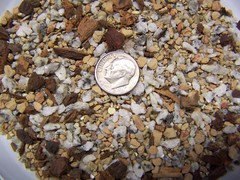
    If it helps, this is what I grow all my long term plantings in - houseplants, succulents, bonsai, and plants that are growing on as potential future bonsai. It looks and performs much like Rina's soil. You can rely on her input.

    The dime is so you can get an idea of the size of the particles.

    Al

    Celia Lin thanked tapla (mid-Michigan, USDA z5b-6a)
  • 10 years ago

    I've been reading the threads about well draining potting soil, and it's been quite eye opening. I've been into house plants for many years, but this is new info for me and makes a lot of sense.

    When I get a chance I will dive right in to making my own mix.

    I would amend soils in my "old life" back in MN, and the plants loved it. I read a book about starting seeds and they recommended a hand made mix, and the practices spilled over into my house plants.

    Once or twice a year I would repot or pot up my plants, and tweak their locations. They all went outside in the summer, too.

    I also vermicomposted and gave my plants the juice often, they also loved it. When I moved in 2010, I had over 50 happy house plants.

    I took about 6 of them with me to OR. Only 2 have survived, including this very sick jade.

    For years I wondered why I was so good with plants in MN but not in OR. I figured it was a moisture thing, because it's so damp here. And because I was busy.

    BUT looking back, it seems obvious: little reporting and root trimming, no soil making, no supplemental worm juice, no outside time. No wonder they got mealy bugs, scales, or just plain died.

    I *hope* that I can help them out now. I was busy going to grad school, then had a baby, I just didn't have the time nor space (lived in a 600 sf apartment) :( Now we have a house with great light and outside spaces for plants.

    Reading though this forum has really helped already, although I have a lot of work to do :)

  • 10 years ago

    I enjoyed that bit of input and the chronology of your partnership with plants.

    When I first started suggesting what I was using as bonsai soils and a soil utilizing a large fraction of chunky pine bark as its base

    offered containerized plants the opportunity to realize more of their genetic potential than the 'out-of-the-bag- peaty mixes' that were used almost exclusively, I felt like a salmon swimming upstream. At the time, the characteristics that determined a soil's desirability were how closely it resembled compost and how dark it was. Conversations focusing on qualities like structure, utility, and durability, were pretty much absent from even the soil and composting forum unless the discussion centered on how well they served as the home for roots of plants growing in our gardens and beds. It was broadly assumed that because "rich looking", black soils were the goal for those gardening in the earth, it should follow that they would serve equally well in containers.

    Over the years, I've watched with great interest the shift in thinking about what constitutes a worthy home for every individual's plants. Because we order our priorities with so much variation it almost seems random, there is no right or wrong soil choice. We decide what to use as a home for roots based on how much value we put on plants and how much time we want to set aside for same. While the stark contrast of 'right or wrong' is off the table for the sensible, comparative degrees ranging from poor or practically unusable (from the plant's perspective) to good and many degrees of better still apply. It might not be wrong for Johnny to grow in pudding, put there ARE better choices (so let's explore them). I tend to limit descriptors in comparative discussions to no more than 'better'. 'Better' can be supported, but the word 'best' is much more likely to produce heat than light.

    I enjoy talking about soils for two reasons, 1) poor root health due to soil choice and poor watering habits account for an overwhelming fraction of the ills that befall our herbaceous charges, and 2) the largest step forward a container gardener can take is in gaining an understanding of how to consistently prepare media that aren't inherently limiting.

    Thanks for sharing some of your history.

    Al

    Celia Lin thanked tapla (mid-Michigan, USDA z5b-6a)