Software
Houzz Logo Print
esox07

"Chili Pepper"

When a recipe calls for "Chili Peppers", what kind of pepper are they actually talking about? I am assuming it is just a common Jalapeno, but not sure.

Comments (42)

  • 10 years ago

    It really does depend.

    But usually, yeah, whatever chile you have available in your area, such as Jal's, Serranos, et cetera. It also comes down to personal heat tolerance.

    Same thing when recipes call for chile flakes, or crushed red pepper...which red pepper, indeed ;-)

    Josh

  • 10 years ago

    Good question! I interpret it to mean any chile to get the heat level one is seeking.


  • 10 years ago

    This vague recipe ingredient drives me nuts. I'm unfamiliar with a lot of the peppers I'm growing since this is my first year growing things besides bells and jalapenos. I understand that the cook gets to decide the heat level but I think some recipes are better with certain peppers. I have one hot sauce recipe that gives a list of peppers depending on what heat level you want. This has been helpful because I just don't know how hot things are even though I ordered from Pucker Butt's mild category except for a couple of things. I have a good crop of Santa Fe Grande peppers and I was pleased to read someone say they were about equivalent to a jalapeno.

  • 10 years ago

    Thanks guys, I guess I am not the only one then. I guess my interpretation is Jalapeno for chili pepper and if you are talking powder or flakes, I take that to mean Cayenne. In reality, quite a few people think those are the only hot peppers there are....I think that has changed a lot over the last 5-10 years however.

  • 10 years ago

    I became a fan of Aleppo pepper thanks to a great yogurt marinade for chicken. I'm growing my own this year and will dehydrate it. The recipe says you can sub cayenne plus paprika but the flavor is just not the same. I don't want to use generic ingredients. Years ago a friend was surprised that there are different kinds of potatoes. Well, there's different kinds of peppers, too. I grew several varieties that are supposed to be fruity so I'd like to be able to use a recipe that depends on that trait. I think my local supermarket only sells two kinds of green beans - yellow and green. Kind of a blue lake type. Gardeners know there are lots more beans than that. Maybe we'll see more recipes for specific peppers.

  • 10 years ago

    I have never seen a recipe that did not specify the exact type of chili that was supposed to be used, but some recipes will give options. If you post the recipe, we can probably tell you which chili would be preferable.

  • 10 years ago

    Lars: thanks. I just used Jalapenos. I have seen several recipes that simply state "Chilis" or "Chili Peppers". But the one that prompted my question was a Kimchee recipe. I was preparing it yesterday and noted there was a picture in the recipe that showed some of the ingredients. I did see the "Chili Peppers" and although they were sliced up very thin, they were green so that kinda confirmed they were using Jalapenos.

  • 10 years ago

    What farmerdill said

  • 10 years ago
    last modified: 10 years ago

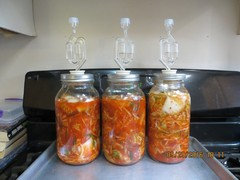
    Here is the Kimchee:

    Ten days of fermenting in half gallon jars before they go in the frig. I used Jalapenos by the way.

  • 10 years ago

    Looking good esox07! I'll have to make a batch soon enough as I'm starting to run out.

  • 10 years ago

    question about those airlocks on the jars. Is all the water supposed to move from half full in both to all of it in the one closest to the outlet?

  • 10 years ago

    Yeah, the water in the airlocks moves depending on the pressure that builds up inside the jars. If you started with the right amount of water to begin with then it is not an issue.

    Rodney

  • 10 years ago

    Apart from selecting for heat level I try to match the type of cuisine with the peppers most commonly used in that culture, if I have them available.

    Eg I make my peri-peri chicken and chakalaka relish with African birds eye peppers & try to match Korean, Indian & Thai curries & salads with peppers from those countries.

  • 10 years ago
    last modified: 10 years ago

    esox07 (4b) Wisconsin

    " question
    about those airlocks on the jars. Is all the water supposed to move
    from half full in both to all of it in the one closest to the outlet? "


    As fermentation starts and builds up CO2 in the jar, yes, the water should be pushed into that second chamber. Depending on how good a "seal" the Tattler gasket is giving, as well as the vigor of the fermentation, you might never see and actual bubble go up through the airlock, but seeing positive pressure (from inside the jar) is a good sign.

  • 10 years ago

    OK, not seeing it on two of the three. I have re-positioned the airlocks and the Tattler seals twice now. They worked fine on the first batch. Not sure what the issue is this time.

  • 10 years ago

    Regardless of what is happening with the airlock, is the product fermenting yet? Any bubbles rising if you press down on it with a spoon? If yes, then I would not worry too much.

  • 10 years ago
    last modified: 10 years ago

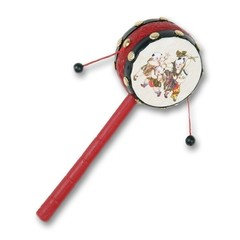
    I wouldn't take the lids off, Bruce. That'll just reintroduce oxygen into the anaerobic environment. If it is fermenting, you should see tiny air bubbles forming in between the chunks of mash/fruit/vegetables (whatever). What I like to do is gently "ratchet" the whole jar back and forth, quickly enough that the jar and the contents of the jar aren't moving at the same "pace," if that makes any sense. Sort of like trying to get it to "slosh" around inside the jar. You know those oriental "drum" like toys that are on a stick, with the two strings that have the little balls on them? When you twist the stick back and forth in the palms of your hands, the balls hit the drum? Like that, but more gently ;) That should free up any trapped bubbles inside, and you'll see them rise up the walls of the jar to the top of the brine.

    #1 rule of fermenting: DO NOT OPEN THAT JAR! :)

  • 10 years ago

    OK, I won't open the jars any more. lol

  • 10 years ago

    I'm serious, Bruce! :) That was the easiest way I could think of explaining it, haha. I'd just hate to see you spoil a ferment by letting too much oxygen in and jeopardizing it, especially since you were hesitant to try it to begin with. People think getting bit by the pepper bug is bad when you're first starting out? Just wait until the fermenting bug sinks its big, sharp teeth in deep! You'll be addicted, haha ;)

  • 10 years ago

    I 'burp" my jars of mash, MIke. They really don't need it, but I do it every week or so. But I don't even use airlocks. I just take a quart canning jar, put mash in, and then take a canning lid(no ring) and just set it loosely on jar rim.


    Kevin

  • 10 years ago

    HMmmm, well, I checked mine, and they are definitely creating air bubbles down inside the Kimchee so I guess it is all good. Thanks everyone.

  • 10 years ago

    Kevin:

    Yah, why couldn't a guy simply set a canning lid on top of the jar with no ring and maybe put some weight on it. It isn't like the stuff inside would build enough pressure to crack the jar.

  • 10 years ago

    I don't think weight would be a good thing. Though I also don't think pressure would build enough to crack the jar, you do want the gas to escape.

  • 10 years ago

    I am talking maybe just few ounces of weight???

  • 10 years ago
    last modified: 10 years ago

    Technically (and I've seen it done before), if you can keep the contents FULLY submerged beneath the brine, you don't even need a lid on the jar. They sell glass disc shaped weights just for that purpose. Or, you can use a "brine bag." Fill a ziploc bag with the same brine you're using in the jar, and use it to hold your mash down. Even if it leaks, it's just brine going into the jar.

    As long as the mash is in the anaerobic environment (under the brine), no "nasties" can grow

  • 10 years ago

    Yep Mike. That's how they do pickles in barrels...they just lay a bunch of dinner plates on the cukes to weigh them down. Also, I've read that even if some mold does grow, you can just scrape it off.


    Bruce: I wouldn't add any weight. Besides, YOU have the airlocks---you're good to go.

  • 10 years ago

    I have a Perfect Pickler airlock which looks like the ones in the photo. Have one and wish I had more. I did one ferment recently with a 1/2 pint jar filled with water to use as a weight. It worked but it takes up more room than the small metal cup that comes with the Perfect Pickler. You will note that recipes that aren't using an airlock recommend putting the jar in a shallow dish to catch the overflow of brine pushed during fermentation. For a small batch, I think the airlock is a lot easier and neater. If you use a weight/water-filled half pint jar, the brine can push past it. The air lock let air out but does not let new air in. I saw weights and fermenting crocks for sale at a mall kitchen store but like the airlock better. The crocks would be good if you are doing a large batch but they are also expensive. Also, I never had mold develop using the airlock but I did this year using the weighted jar.

  • 10 years ago
    last modified: 10 years ago

    "Also, I've read that even if some mold does grow, you can just scrape it off."

    Kahm yeast, yes. MOLD, no! Not trying to nitpick, Kevin :P I'd just hate to see anyone get sick. Kahm yeast will start out as a white or grayish film growing in (or on top of) the mash. It's perfectly safe to leave it in there until the end, and scrape it out later. Mold, I think, is a blackish color, and could potentially make you very sick. Generally, rule of thumb is "Follow your nose." If it smells nasty, chuck it. Not too scientific, but I highly advise erring on the side of caution when trying to decide what's "safe" to let grow in your ferment. Knock on wood, I haven't lost a ferment yet, but even (safe) kahm yeast skeeves me out, haha BLECH!!!

  • 10 years ago

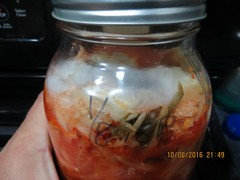
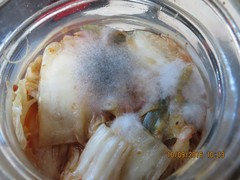
    Ummm, I am guessing I have lost one of my three jars of Kimchee:

  • 10 years ago

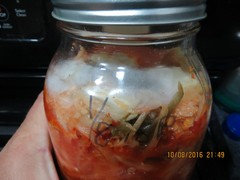
    Ummm, I am guessing I have lost one of my three jars of Kimchee:

  • 10 years ago
    last modified: 10 years ago

    Not sure, Bruce. That might just be kahm yeast, but I absolutely cannot say for sure. It does look light enough (in color) to be yeast, BUT it does look kinda dark towards the center of the jar (mold)..... Did you smell it? If it smells "okay" you may be able to scrape out as much as you can, stir it around, and close it back up. I'm no expert, so I'm very, very hesitant to give you any advice here. A good motto when fermenting is: When in doubt, throw it out

    Hopefully someone with some more experience will chime in.

  • 10 years ago

    It does get darker in the middle. The jar makes it hard to get a good photo, but the color is more white on the outsides and more grey in the middle.

  • 10 years ago

    That is funny I have always wondered myself. My assumption is that they are maybe talking about any pepper you can find at your local store which involves peppers that contain some kind of heat. Especially the dried ones that are usually in the Hispanic section that come in plastic film packaging. That's my guess


  • 10 years ago

    Yah, it seems to have become an extremely generic term.

  • 10 years ago

    Again talking about the term chile, a high percentage of the time it is a general interpretation from an ethnic language. Kimchee is a great example. Korean hot peppers are not diverse, nor are southwest pepper varieties like Jalapeno, Serrano,etc known widely in Korea. A local would know what varieties would be used in a dish. Certainly when you see the term Chile pepper, it will pay to determine the ethnicity of the dish and determine what hot peppers are used in that culture.

  • 10 years ago

    What was the verdict, Bruce? Did you end up tossing or keeping that jar? How are the other two doing?

  • 10 years ago

    I tossed it. To me, it looked like Mold. I guess it could have been that other harmless stuff, but I didn't want to mess with it. I still had two good 1/2 gallon jars full.


  • 10 years ago

    Yeah, looks like a furry mold to me, too. Glad you tossed it.

    Bruce, your first kimchi seemed to have too much liquid....whereas this batch looks too dry, in that the upper surface isn't submerged in the liquid.

    When my sister makes kimchi, she leaves the lidded jars on the counter for a about a day, watching it bubble very actively, then throws the jars into the 'fridge to slow the fermentation. That second phase usually takes only a few days to a week, and we've never had any signs of mold.

    Josh

  • 10 years ago

    Hmmmmm, There was plenty of liquid in the jars. In fact, there was probably an inch in the bottom of the jar with the contents all floating to the top. I could have easily submerged the contents, but I don't know how I would do that effectively to keep it submerged.

  • 10 years ago

    Bruce, you could put a stone in a plastic bag, and use that to keep the vegetables under the brine. Usually the jar is packed so tightly that nothing can float.

    Josh

  • 10 years ago

    Yah, I could try something like that I guess. When I packed the jars with the raw cabbage and other veggies, I did press it down pretty hard. But, I had to leave a little room so the brine didn't reach up to the airlocks.

Sponsored
Peabody Landscape Group
Average rating: 3.5 out of 5 stars8 Reviews
Franklin County's Reliable Landscape Design & Contracting