Software
Houzz Logo Print
heruga

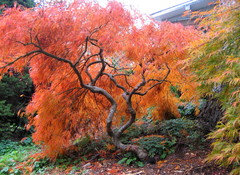
How to make a Japanese maple look like this?

9 years ago
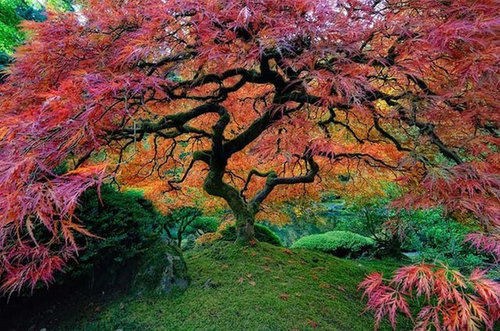
With those extremely curved, haunted looking branches. Does that require some sort of pruning technique? Or do the branches naturally grow like that?

Comments (32)

  • 9 years ago

    That tree is here in Portland, OR, in the Japanese Garden. It is meticulously pruned every year.

  • 9 years ago

    It's a combination of the age of the tree and the skill of the person pruning it. Google around "aesthetic pruning" and "The Essence of the Tree"- maybe start here.

    And the first video by one popular specialist, then the second.

  • 9 years ago

    Upright forms of JM's tend not to produce that very twisted, sculptural branching habit but the weeping dissectums can and do. However most are grown with rather low grafts that prevent this natural growth habit from really being distinct.......they are buried in branches and so short you seldom ever see it. But with proper training and pruning, starting with a young tree, it can be achieved.

    btw, the older the tree, the more likely it is to display this sculptural growth habit and the more pronounced the sculptural effect - and of course, with proper pruning to enhance this effect!! The tree shown in the photo above is reported to be at least 120 years old.

  • 9 years ago

    Oh wow.. so is this kind of pruning something you can learn off from the internet and do it yourself? Or do you really need a professional who has a degree/certificate in pruning do it for you?

  • 9 years ago
    last modified: 9 years ago

    Well, you can certainly try :-) IME, most YouTube videos are sorely lacking in both accuracy and detail but now and again you can find a good one (haven't check the previously attached links). But there is definitely an acquired skill set to get results similar to what is shown in the photo!! And that skill set doesn't often come from any degree or certificate but from years of apprenticing and training with a "master" pruner.

    With any luck, Mike (who posts here frequently and has a great collection of JM's) will visit and post some of his pruning successes. He is quite accomplished :-) But not everyone has the patience or an understanding of the plants - a primary requirement, IMO - or the pruning skills necessary to achieve this look. But we all gotta start somewhere!!

  • 9 years ago

    if you research videos or other sites on bonsai, a technique used for them is either called "clip and grow" or "directional pruning." The same can be used for full sized trees to achieve the look of the tree above. For example, I used directional pruning over 15 years to get this unusual trunk on a Coast Live Oak. It's never had any wire on it.

  • 9 years ago
    last modified: 9 years ago

    How did you get the main trunk to go squiggly like that? I know you can prune the branches so the buds face upwards but how do you do the main trunk? And then can I prune the lower branches all the way to the base?

  • 9 years ago

    You start at the inside base and work up and out. If you start pruning at the top and outside going down, the decision process is a lot more difficult.

    The squiggly trunk comes from selecting the main branches and encouraging them to grow upright. It would be hard to make the trunks go straight. They pretty much grow curvy by themselves.

    It wasn't pruned yet in the back when this picture was taken. I was saving it to show a friend how to reduce the congestion there and make it look like the rest of the tree. Looking southwest.

  • 9 years ago

    Oh ok well I actually have a acer palmatum waterfall, if you know what that is. Its a green laceleaf maple. Now do green ones also become squiggly trunks? Or just red ones? And my waterfall maple trunk is very straight right now..its not squiggly as you said it should be. But I only planted it 2 months ago and it is about 4 feet tall if that has do with anything

  • 9 years ago

    Yes they do........above the graft, that is. It was probably grafted on a high standard normal upright Japanese maple. The straight trunk will not become squiggly. :-(

    Just go on up from there!

    Mike


  • 9 years ago

    Ah alright. Well when is the best time to prune them? While they are dormant? Also since I just planted this tree, should i wait until the roots become established?

  • 9 years ago
    last modified: 9 years ago

    There is a correct time and that, for me, is anytime I feel the need for it, whether dormant or not. I'm in the colder part of Zone 8 and have never seen dieback from late season pruning.

    Unless there is an immediate need for pruning, it's best to wait until better established.

  • 9 years ago
    last modified: 9 years ago

    Can anyone list some varieties that would be amendable to this type pruning that would result in a tree that would have similar form to that of the first picture?

    From what I understand the variety is unknown or not readily available and I'm okay with that. I just want to know some current varieties available that would work.

    Green or red, but I'd prefer to use a green in my garden. I don't even know the size of the one at PJG, but I would like it be medium sized in my garden.

  • 9 years ago

    It is a variety of dissectum or weeping laceleaf Japanese maple, most probably a green leafed one like 'Viridis' or 'Waterfall'. All weeping dissectums are inclined to have this very sculptural, twisting growth habit, some much more pronounced than others. Very little of this is due to pruning except to enhance the natural form and removal of unnecessary or lower branching.

    You want to find a small tree that already has some of these characteristics - the beginning of a turn in the branching structure or a lean in particular direction and then encourage growth and training to enhance these qualities. Most dissectums have rather low grafts so you may need to do some staking of the upper most branch(es) to encourage additional height.

    btw, the tree in the photo is quite old - certainly at least 50 y.o. but likely more along the lines of 75-100 years. Just so you know, this is a very long term project :-) You may not see anything quite like the photo in your lifetime!

  • 9 years ago

    Someone told me this frequently photographed and well known tree was approximately a century old. And it's being cultivated in a very favorable climate for Japanese maples. And it is a beautiful tree. but let me say there are no ugly 100 year old japanese maples. the idea that this the work of a "master pruner" who "studied for years" is kinda funny to me. that's like subway calling the teenager who made my sub a "sandwich artist" Or me saying a "master dry wall installer" just finished my garage. my buddy owns a car wash should I start calling him a "master detailer?" the tree looks how I would expect a weeping 100 year old maple to look. You don't need to paint Mr. Miyagis fence or sand his deck or study for years to learn this stuff. buy a book. it isn't rocket science.

  • 9 years ago

    " it isn't rocket science."

    It may not be rocket science but it IS a carefully acquired skill - Joe Homeowner is unlikely to develop a JM with this form on his own without considerable practice and/or training. The man who is responsible for this tree (and all the others in this garden) has been plying his craft for more than 40 years and despite your disparaging comments to the contrary, IS a master pruner and a skilled artisan! One of the finely honed skills he possesses is the ability to prune without something looking like it has been pruned............I daresay this tree would NOT look like this without his ministrations for the last 35 years!!

    It is a bit demeaning to his dedication to this garden and his abilities to give him such short shrift. I know a few guys who are very skilled and experienced at pruning JM's and even they are unlikely to generate results like this. If this process were so easy to duplicate, I doubt all the JM pruning workshops the PJG offers would be consistently sold out.

  • 9 years ago
    last modified: 9 years ago

    Tod, you're greatly simplifying the pruning process of Japanese maples. I've read books and seen most of the You Tube videos and they can't completely explain the nuances of good Japanese maple pruning. I have pruned hundreds of them professionally. (The stories I could tell....)

    Yes, Gardengal, those You Tube videos are bad,.... real bad.

  • 9 years ago

    LOL Mike!! You are in fact one of the few really skilled pruners of JM's I have come into contact with (and referred to in my previous response). The other lives over here in Kitsap and makes a living doing just that.......and teaching JM pruning classes.

  • 9 years ago

    Hey mike if you can prune Japanese maples are you also able to do niwaki techniques on pine trees such as the Japanese black pine? Are the pruning concepts similar or are they a whole different thing

  • 9 years ago

    At one time I grew and pruned, in the niwaki style, quite a few Japanese Black pines for installation in my landscapes. I discontinued that when I realized none of my customers would do the follow up pruning even though I showed them how to do it. My customers were not gardeners and it took me awhile to realize the extent of it. They just wanted a low maintenance good looking landscape. My enthusiasm in those days didn't rub off.

    That didn't dampen my enthusiasm for pruning though. It's one of the most enjoyable parts of gardening as far as I'm concerned. As my landscape matures, I'm getting plenty of it.

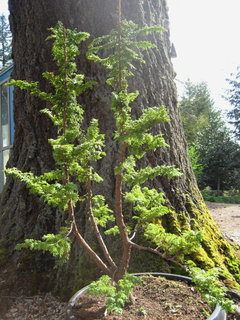
    Here's a Fernspray cypress I pruned in the Niwaki style. It's a little too large for a bonsai.

  • 9 years ago
    last modified: 9 years ago

    Edited 12/14/16

    I have removed most of my comments here as they were directed at a subsequently deleted post(s) disparaging the skill and accomplishments of the man responsible for the tree in the OP and trivializing the experience that is necessary to accomplish a result that looks like the PJG signature maple. Sorry that this has made this end of the thread read somewhat disjointedly.

  • 9 years ago

    Heruga, my third picture is a green weeping laceleaf and probably a 'Waterfall'.

  • 9 years ago
    last modified: 9 years ago

    To get that shape on a upright tree JM palmatum with fuller leaves, I agree is a huge effort in pruning.

    However, that trunk structure is quite normal for the bushy dissected leaf laceleaf JMs. So check with JM specialists for the largest growing variety they have. And it will also have to get old to get limbs that big in diameter!

    This bonsai shape would show even with most of the 5 to 8' laceleaf JMs common here in PNW yards if one just removes some bottom branches. (And bonsai care over the years yes would help further.) Also helps to plant on a mound or hilltop where they a displayed better.

  • 9 years ago

    That photo is rather deceiving :-) That tree looks very large in the photo but is only about 10' tall. Just quite wide spreading and very carefully limbed up.

  • 9 years ago

    @Heruga. You are in NJ. I'm in Rockland Co NY. I have 3 that are near 60yrs old. The basic form is natural. They may have been tended when they were young but not by an expert. The original owner was not near the gardener i am. I'm a hack compared to years of knowledge but i do keep up with the tending.

    I did pick up a couple small decent specimens to 'hack' about 5 yrs ago. Though small they have been my testers for form and pruning. I did let them settle in for a year, then formed a bend with wire and weights, etc. Pretty spectacular to watch growing and very zen to prune.

    I would recommend, if you want to give it a go, find a reputable nursery and purchase the best one you can afford....then a couple smaller ones to play with.


  • 6 years ago

    Question:


    Can you prune a Coral Bark Japanese Maple Tree this way?

  • 6 years ago

    Not like the original photo, no. Coral Bark just does not grow in a manner that would lend itself to that very sculptural branch formation.

  • 6 years ago
    last modified: 6 years ago

    So what Japanese Maple would be good to plant that fits in a 12 foot wide by over 10 feet high area that grows well in part shade zone 7? That would be good for pruning like this?

  • 6 years ago

    Any of the weeping dissectums could work. I find that it is best to visit a nursery that carries a good selection of JM's and find one that starts to show some trunk character at a young age. Then you keep working at it to enhance that feature. Will take years before you get a look similar to the photo, however.

  • 5 years ago

    Would you be so kind as to recommend a good resource I could purchase as I start to study the art of sculptural pruning for Japanese maples? Thanks much...

  • 5 years ago

    I want an Orangeola JM that have a start or can be trained to have that a contorted trunk. There are no local nurseries here in East Tennessee that have JMs, so it would have to be ordered. What do I ask for, ie., low graft or high graft? Is it better to get a 1 gallon which are available or wait for a larger one which are almost impossible to find now. Recommendations, please.

Sponsored