Software
Houzz Logo Print
hzdeleted_24200779

transplanting one-year old ceanothus repens

9 years ago
last modified: 9 years ago

I've read that it is difficult to successfully transplant mature ceanothus shrubs, but I have one purchased and planted out last autumn. It's a ceanothus thyrsiflorus repens,and I think it's going to be too tall for the spot in which I put it. Is it still young enough for me to have some chance of success in moving it? Thanks in advance...

Comments (30)

  • 9 years ago

    If yours is 'repens' it will not grow very tall, unless it's backing onto a wall. It's basically a deep ground cover. How tall is too tall for you?

    User thanked floral_uk z.8/9 SW UK
  • 9 years ago

    'Repens' is just a low growing form of what typically gets to be a pretty large shrub. And IME, they grow pretty fast. The shrub forms DO resent transplanting - I have never attempted moving any of the groundcover forms so can't say for certain how they might respond. If it is truly in the wrong spot, all you can do is try :-)

    User thanked gardengal48 (PNW Z8/9)
  • 9 years ago

    The nursery from which i got it said it's mature height would be 30-35 cms tall, but I see on other sites that it's final height is more like 1 meter tall, and I believe these,since it's already at least to 30 or 40 cms in height,and is sending out shoots that go above that. It's right on the edge of a bed,where I think I'd prefer to have something shorter...like 30-35 cms maximum. A meter-tall plant would work better further back into the bed, I think.

  • 9 years ago

    After submitting the above remark,your post appeared,Gardengal...so, can I ask you this: did you end up losing all the ceanothus shrubs that you transplanted? Also, how old were they when you moved them?

  • 9 years ago

    LOL!! I've never tried to move any of my own - I believed the reports that said they didn't respond well to transplanting!! But I have had clients move them with almost complete failure as well as seen other comments here on GW about issues when transplanting. But these have been the larger shrub forms almost exclusively. Other than growth habit, I can't think of any difference a low growing cultivar would offer that would make this process easier.

    FWIW, I did have a "dwarf" form that got much too big too fast for the area I had intended. And while there were other areas in my garden I could have placed it, I just ripped it out. It was at least 3 years old.

    Be sure to consider the spread of your shrub as well - Repens can get as much as 3 meters across!!

    User thanked gardengal48 (PNW Z8/9)
  • 9 years ago

    yikes! Well, hopefully some other people will weigh in, but I'm thinking you may well be right in saying" all you can do is try".30-35 cms, forsooth!!! However it's true that here in Italy it's probably alot drier than it is for you in the PNW,which might have a slightly dwarfing effect.

  • 9 years ago

    Like many CA natives, Ceanothus are very difficult to transplant. They don't make dense rootballs and so it's tough to get the roots out with any kind of soil remaining. (Can you tell that I've tried?) If they are tiny and you can use a big shovel to more or less get them out in one swipe of the blade, that sometimes works (I planted a hillside with about 150 4" 'Yankee Point 'once.) But I'm with gardengal - not likely to succeed and not worth the agony of trying. And also note her comment about width - I don't know that one but every low-growing Ceanothus I've ever seen has been very wide. That's why I used it on that difficult hillside. The hill looked like it was studded with hair transplants when I planted them, and within a year or so had a dense covering with no exposed soil. Difficult to use in a mixed border unless it is a big one. Our SF Bay Area climate is more similar to you in Italy. Ceanothus are native to here and they LIKE the dry air, so yours might get bigger! ;-)

    User thanked Sara Malone Zone 9b
  • 9 years ago

    Back again .... I've been outside gardening.... I am aware that 'repens' is a form of C thyrsiflorus. I was trying to find out what height the OP wanted it to be and that they had understood the difference between 'repens' and the type.

    It sounds as if, sadly, the wrong plant has been chosen for the spot. Maybe you'll just have to enjoy it until it gets too big and then get rid of it. I wouldn't try to keep it low by pruning because all the ones I've known have resented being cut into. In my climate they don't live particularly long anyway. My neighbour had the type and it lasted about 6 years.

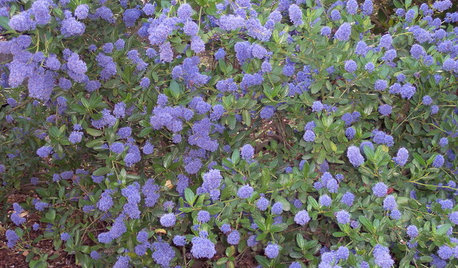
    This one was on my walk to work. I am afraid it's also dead now.

    User thanked floral_uk z.8/9 SW UK
  • 9 years ago

    I am not familiar with this shrub, but my guess would be if you must transplant it, do it during dormancy. I would wait (I assume you are in a tropical zone) until january when it is cooler. Never seen this plant but it looks really cool from floral's picture.

    User thanked Logan L Johnson
  • 9 years ago

    yes, I've pruned with no problems, however trying to keep it to a shape that it doesn't naturally have will likely end up exposing a lot of wood and probably won't be very attractive.

    User thanked Sara Malone Zone 9b
  • 9 years ago

    I defer to your experience GG. It's just that all the ones I have known have not been happy after trimming. There was often die back. But maybe they were going to decline anyway whether pruned or not. And obviously I don't live in Italy so it might behave differently there.

    Logan-Caldwell - Italy is not tropical.

    User thanked floral_uk z.8/9 SW UK
  • 9 years ago

    Maybe a bit off topic but would this plant grow here in 7b? I had to update my zone after looking at the USDA interactive map I realized that I was borderline. Makes since how plants not hardy to 7a have survived.

    User thanked Logan L Johnson
  • PRO
    9 years ago

    Not a chance. Does not like summer water in warm summer climates. Can be grown in UK due to relatively cool summers.

    User thanked Form and Foliage
  • 9 years ago

    I think it's going to be too tall for the spot in which I put it.


    ==>> then learn how to prune it ... as noted above ... ken

    User thanked ken_adrian Adrian MI cold Z5
  • 9 years ago

    to clarify .... not much dies thru pruning alone ... but if you move it.. it dies ... so just cut on the thing ... teach it a lesson.. tame it ...


    whats to lose.. but to gain some learning about pruning ...


    ken

    User thanked ken_adrian Adrian MI cold Z5
  • 9 years ago

    yes, Sara, from what I'm seeing of this plants actual behaviour, I think the slope idea is perfect,whereas my placement was mistaken. As I said, on the nursery site they made it sound like a much more low-growing, compact sort of plant... (30-35 cms; 3 plants per square meter ??? I don't think so!) So now I have to decide: experiment with moving it or experiment with pruning it! I do have others, so I am kind of leaning towards trying to move it,since it seems like a now-or-never situation...

  • 9 years ago

    Yes if I were going to move it I would move it right away!

    User thanked Sara Malone Zone 9b
  • 9 years ago

    After a full year it is likely to be too late already for this kind of shrub. 'Victoria' has hybrid characters and is probably in addition a synonym of 'Skylark'.

    User thanked Embothrium
  • 9 years ago

    I think I am going to try moving it. It's already invading the path too much,so it's not only promising to be too tall but also too wide. To keep it out of the path I'd have to prune it in an ugly way, I think; and ruin it's shape,so at that point I may as well risk moving it. I did look around on Internet and will continue to do so, and found a few comments on moving them,but all seemed to be talking about plants that had been in place for 3 or 4 years at least, and all were about the larger shrub forms, not repens. In some cases moving WAS successful,even with these much older, larger specimens,so it's not automatically doomed. Embothrium, I do have a couple "Victorias", but these are fine where I've planted them,since I knew that they'd get big. It's just the repens that is out of place; I think I imagined a much more compact, ground-hugging sort of plant.

  • 9 years ago
    last modified: 9 years ago

    Evergreen Ceanothus are like broom (Cytisus), in that they grow back well from pruning IF you stay within the existing green outer shell. And it is best done right after the main spring flush of bloom so there is time for them to recover before autumn.

    User thanked Embothrium
  • 9 years ago

    I'm not sure what you mean by "existing outer green shell"; can you explain, please?

  • 9 years ago

    You don't cut back into hard bare branches. Same as with most conifers.

    User thanked Embothrium
  • 9 years ago

    Well, I did it-moved two of them, actually, not long after my first post. At first, there was some wilting of the newest growth, but now, about a month later, they are looking good, so I am hopefull.But it sure is true that I couldn't get any real "rootball" type of thing on these. I call it with this vague name, because for moving roses, people often seem so hung up on the "rootball" concept, excessively so, IMO. But I could see that these ceanothus just grow very differently from roses underground: they don't seem to have that sort of natural "core of unified roots " that roses and many trees and shrubs have; perhaps this is what is meant by the phrase "root ball".

  • 9 years ago

    CA natives often do not have a root 'ball' - just a bunch of long roots going out every which way...soudns like you did ok, though!

    User thanked Sara Malone Zone 9b
  • 9 years ago

    Luck was a big part of it ,too,IMO.We've been getting regular rain,thank Heaven!!!

  • 9 years ago

    One reason contributing to the varied success in moving Ceanothus is that since there is no rootball, the roots dry out while moving it. It doesn't take much time with thin exposed roots.

    User thanked Mike McGarvey
  • 9 years ago

    I agree, Mike; and not only is there the risk of them drying out during the physical move. This is why I think that the regular rain was a key factor in what might be my success. Because the rain managed to keep all those long, un-unified-in-a rootball-type-structure roots regularly hydrated after the move,in a way that I seriously doubt that I could've done with artificial watering.

  • 9 years ago

    .But it sure is true that I couldn't get any real "rootball" type of
    thing on these. I call it with this vague name, because for moving
    roses, people often seem so hung up on the "rootball" concept,
    excessively so, IMO.


    ==>>> when i moved to this property of all glacial sand ... i learned.. that there is no such thing as moving a root BALL ... no matter how carefully i tried to dig a ball of soil ... it frankly... just fell off ...


    so i learned how to move things bare root .. lol ...


    frankly ... it does matter .. period ...


    BUT ... and there is usually a big but around somewhere ... i learned that timing of moves.. as well as aftercare is really the solution ...


    a few of much much used cliches:


    move in dormancy.. so there is reduced water stress .. trying to hold active leaves ...


    do it in the right season ... for me in my z5 MI ... fall or spring.. when dormant.. and so they are set.. and the roots working.. 6 to 8 weeks before the heat of the next hot season ...


    and finally.. move nothing after about 6/1 .... unless i can personally care for it. and thats not easy on 5 acres ... some times you have to do.. what you have to do.... say a building project .... but then.. i have to be checking it every few days.. inserting finger.. etc ...


    so.. back to your premise.... the BALL ... is basically irrelevant .... so dont fixate on it ... but hey ... if you can get a good chunk of roots.. with the soil ... all the better... all the easier ... but again... its not requisite ...


    ken


    ps: back when i was a rose collector ... i mail ordered hundreds of them.. all bare root ... with barely a couple stringy roots ... off some larger woody ones ... never lost a single one for that ... so there is no real reason .. not to bare root a rose ... in the right season.. etc ... the dirt is not the important part .... [here in MI.. winter killed most of the foo foo roses i tried to collect ...but thats a different show]


  • 9 years ago

    Yep, timing. Seasonally, and then daily.

    Bart, that rainy day you picked was just what the Dr. ordered.

    User thanked Mike McGarvey