Software
Houzz Logo Print
rick7072

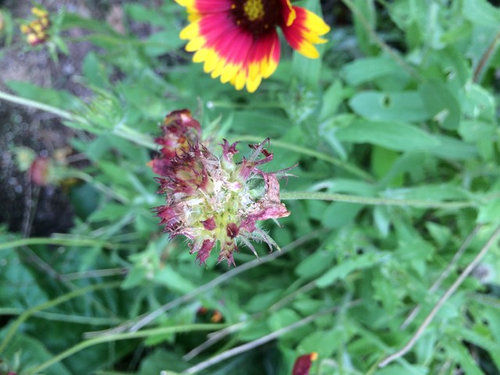
What insect is causing this damage to Indian Blanketflower?

9 years ago
last modified: 9 years ago
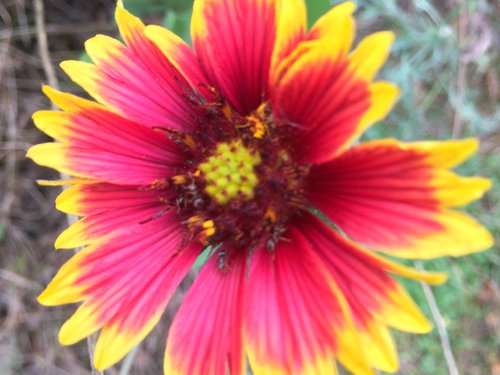
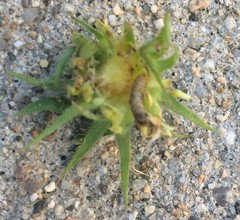
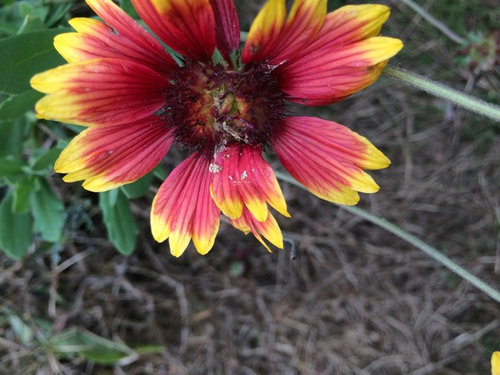
Am finally getting around to asking about this problem I've been having since June ... I've been growing Gaillardia pulchella (the annual form) this year and it's still wonderfully in bloom here outside Boston. But since July many of the blooms have been plagued by some sort of insect damage. After they reach their fullest flowering and even sometimes during, the heads quickly look raggedy and eaten, there seems to be frass, and I don't think seeds ever form. In the first photo you can see an insect that looks awfully like ants hovering around, but I didn't think ants eat flowers. Any thoughts as to what this is?

In the lower petals are what look like grey eggs:

After the petals have fallen off:

The eggs seem to be there even at the bud stage:

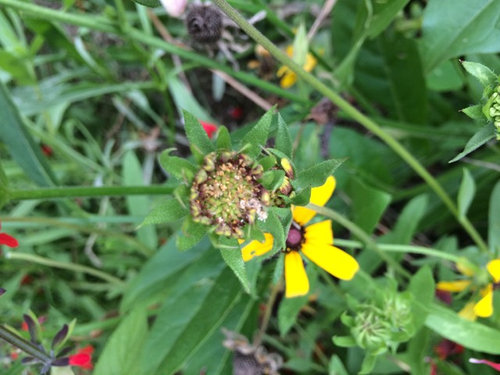
Many seedheads look fine but some end very sadly:

Comments (22)

  • 9 years ago
    last modified: 9 years ago
    Hi Rick,

    Those are ants in that first picture, but I think they are just there to get a few sips of nectar, and not the cause of the problem.

    I suspect there are small worms, probably the larva of a small moth, actually inside the body of your flower blooms. You might be able to take your fingers and part the flower head enough to discover one or more of the worms inside the flower head. If they are like the ones I have seen, they are quite fast and energetic for a small worm, and can be a little tricky to catch. There might be just one inside a flower head, or there might be several. Let us know if you can find any of the worms.

    There are no "good" moths, because their larvae all feed on plants of one kind or another, so I keep a bug zapper going in my garden during the Spring and Summer months, which attracts and kills moths of all sorts, including some fairly small ones that can cause worms like the ones that I suspect your Gaillardias have. I prefer the zapper as an alternative to spraying insecticides. Let us know if you find any of the small worms. You might even try to take pictures of them.

    ZM

  • 9 years ago

    this years plague rarely returns next year .. in my experience ...


    cut the plant down when appropriate.. and get the refuse off the property.. just in case of eggs ... and dont worry about it next year ... its just too late in the year to act on it .. other than for knowledge ...


    earlier in the year.. you could have probably cut back the plant.. and removed the refuse.. and it would have popped back ...


    ken


  • 9 years ago
    last modified: 9 years ago
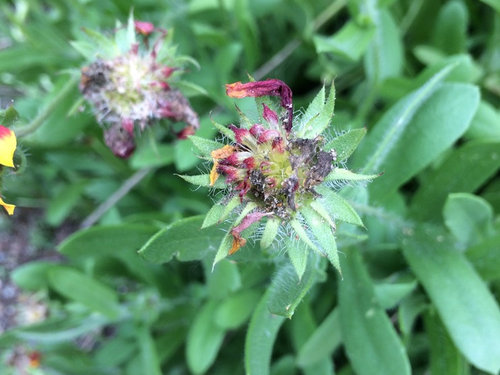
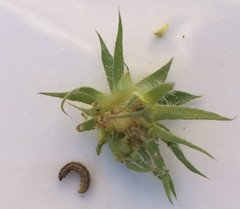
    zen_man, you were absolutely right. I had to look through a few of the blooms and buds but finally found a bud with this fellow nestled happily inside, presumably having a late lunch. I thought I'd do an experiment and have saved him and his precious Gaillardia pulchella flower bud in a small glass jar. I doubt it'll happen, but I almost hope I'll see him morph into a moth so I can better identify him. He wasn't fast-moving, and actually didn't move at all but just lay there and let me catch him. Maybe he's dormant now.

    If these insects do return next year -- and thanks for the suggestion that they may not, ken_adrian -- I'd like to be prepared to fight back. zen_man, you've had good luck with a bug zapper?

  • 9 years ago
    last modified: 9 years ago
    Hi Rick,

    Those pictures have been all too familiar to me. Incidentally, good job on finding and photographing the guilty worms.

    " If these insects do return next year -- and thanks for the suggestion
    that they may not, ken_adrian -- I'd like to be prepared to fight back.
    zen_man, you've had good luck with a bug zapper? "

    The bug zapper was very effective against the female moths that otherwise lay the eggs in my zinnia flower heads. Before I got the bug zapper, about half of my zinnia heads had at least one worm in them. Some flowers had two or more worms. And that was every year -- no skipped years. In fact, the problem with those worms seemed to be getting worse each year, which prompted me to do something in desperation. Which wound up being purchasing the bug zapper and a 100-foot extension cord so that I could hang the zapper in the middle of my zinnia garden. And a photoelectric switch to turn the zapper on at dusk and off at dawn.

    I did have misgivings that the zapper would attract even more of the moths to my zinnias and make the problem even worse. But that didn't happen. The zapper attracted the moths to it before they laid their eggs. Since the zapper has a powerful high voltage electric grid, the smaller moths were sort of vaporized. They left an impressive mulch of their wings underneath the zapper. I didn't see any worm damage this year, and last year only a couple of flower heads were affected. I went after them with a vengeance, just to make sure that some kind of "resistant" version wasn't getting a foothold.

    There are systemic insecticide sprays that would control these worms, but I don't want to do anything that would jeopardize the many butterflies and bees that "work" my zinnias. I am not an organic gardener, but I agree with them on some things, and not killing my butterflies is one of them. Incidentally, to my knowledge, the bug zapper has never killed a single butterfly.

    ZM

    Rick (zone 6b, MA) thanked zen_man
  • 9 years ago

    zen_man, thanks for this. Did you ever get a name for the worms/moths that infected your zinnia? Any idea what mine are?

  • 9 years ago
    last modified: 9 years ago
    Hi Rick,

    I think that both of our worms are different species of budworms.

    This is a link to a picture posted by Alex back in Part 33 of the It can be fun to breed your own zinnias message thread:a budworm in a zinnia

    This is another link to the same picture:Alex's zinnia budworm picture

    Either of those green links should get you to Alex's zinnia budworm picture. I think your Gaillardia budworm is a slightly different species, but a budworm nevertheless. There are many species of budworms, but their behavior is similar. And all of them are larva of small moths.

    ZM

  • 9 years ago

    Fantastic; great information to know. I know nothing about budworms. I've browsed around on the internet and seen a few articles highly critical of bug zappers, suggesting that they kill beneficial insects as well (just like insecticides, I suppose). Well, I have all of this winter to research control of budworms, or maybe I'll get lucky and as Ken suggested not see them next year.

    I greatly appreciate this forum and all the help and education I've received.

  • 9 years ago

    I'm reading here and there about using Bt to control budworms. Wonder if that might be worth a try next year if they return.

  • 9 years ago
    last modified: 9 years ago

    Hi Rick,

    Bt can control budworms, but since it kills pretty much all Lepidoptera, it could possibly be a hazard to butterflies. I don't use it for that reason. The genetically modified corn that contains its own Bt to prevent corn earworm and stalkborer has been criticized for killing butterflies (Monarchs in particular). I don't know if that criticism is valid. It might be that the Bt doesn't find its way into the zinnia nectar, and that might make Bt reasonably safe for butterflies. Butterfly larva don't commonly use zinnias as food plants. The same might be true for gaillardias.

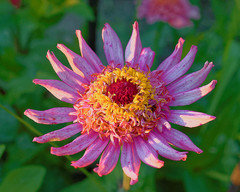
    Incidentally, by coincidence I happen to have a zinnia that looks a bit like some gaillardias.

    It also reminds me a little of an Echinacea. Whatever, it is kind of weird.

    ZM

  • 9 years ago

    Right, I forgot about that. I knew there were different strains of Bt targeted for different types of insects, and I'd falsely assumed they were targeted to different species. But the kurstaki strain is targeted for all caterpillars. Oh well. Interesting article on the subject here.

    Some worms are caterpillars and some aren't, yes? We use the term 'worm' to describe both earthworm and budworm, but the former is not a caterpillar and the latter is.

  • 9 years ago

    I think there are good moths.Some like the Cecropia and Luna are very big and beautiful.All these insects are part of the web of life and benefit each other in some way or another.If just one species of moth should perish it affects the entire natural order of things. I would get rid of the zapper and spray all flowers you want to protect with an organic oil that keeps bugs off,but that won't kill indiscriminately, like neem.Zappers will also kill night flying insects that are beneficial to the garden like fireflies and soldier beetles. Mosquitoes can be kept away with scented geranium and lemon grass.I had a problem with my annual gaillardias this year too.The blue salvias and tall zinnias shaded them to the point that they never bloomed. I'm fixing that next year. I've been growing the annual one because the hybrids that are usually sold don't survive the winter here in zone 6a Illinois. I'm going to try growing the true perennial one next year and see how that goes.Blanketflowers are one of my most favorite.The colors and the scent are truly awesome.


    Rick (zone 6b, MA) thanked Jay 6a Chicago
  • 9 years ago

    zen_man, THANK YOU for that note. Jaybirdy, if my problem with the budworm reappears next year, considering that they seem to infect the bud right from the beginning, do you think an application of neem oil right on the bud would be effective? Would the neem be able to penetrate down into the (still-closed) bud?

    Our exchange made me curious to know more about the lifecycle of how a budworm gets into a bud. I'm growing these from seed, so does the moth lay her egg on the very small bud right there in June or July or wherever the very beginnings of bud appears?

  • 9 years ago

    I'm not sure how the moth gets the egg into the bud,but the organ that lays the egg is minute so either they push it inside or lay it near a spot where the newly hatched caterpillar can bore its way in. I would hit the ripe buds right before they are ready to open and a second time when they just begin to open and one last time when they're fully opened.There are a multitude of moth species that use flowers this way so as far as pinpointing the specific one,that's anyone's guess.

  • 9 years ago
    last modified: 9 years ago

    Hi jaybirdyj,

    " Zappers will also kill night flying insects that are beneficial to the garden like fireflies ... "

    I'm going to stop you right there. We have a lot of fireflies, and none of them are attracted to our house lights or the bug zapper. They do put on a beautiful nighttime display, but it is questionable whether they are beneficial to the garden plants. However, in either case, the zapper doesn't attract or kill them.

    " If just one species of moth should perish it affects the entire natural order of things. "

    My 80-watt bug zapper is in no danger of affecting the entire natural order of things.

    I have no intention of jeopardizing my butterflies with Neem oil. I like butterflies, and won't kill them with some organic concoction.

    ZM

  • 9 years ago

    Yes you are right Zen.Rick I apologize for the solution I gave you.Neem oil will do damage to butterflies and spraying an open flower is a really bad idea. I just read up and found this out. I've never used it on flowers,only on grapes to keep the Japanese beetles from eating up the leaves.I think the b.t. idea is better.It will still kill any kind of butterfly or moth larva but it's probably just one species of moth laying on your gaillardias.As far as keeping them away the only thing that comes to mind is row covers.I love my butterflies too Zen. I added lots of nectar flowers for them this year,planted several native host plants like chelone, sweetfern,New Jersey Tea,native grasses,zizia,asters,solidagos,native grasses, milkweeds,ect. I guess I should have done more reading up on Neem. I was sort of influenced by some propaganda that I was reading in an "organic" pest control magazine that I was getting sent.Actually Zen, I don't spray or use anything anymore.When I see some nibbled leaves or flowers I feel blessed that I'm feeding some beautiful creature.And to me now, all creatures are beautiful.I even leave some "weeds" growing now if I see nibbles or read it's a host plant.Sorry for the bad info Rick,Zen and everybody else.God bless and keep you all. I'm going to drop my Neem oil and other "organic" pest products off at the next city toxic chemical drop-off.Thanks for the wake up call Zen! I needed it!

  • 9 years ago

    Zen,thanks again.If you hadn't stepped in and said something my words could have done a lot of damage to butterflies and the rest of the environment.I totally understand and welcome your righteous anger. I'm sitting here really shocked at thinking about what an ignorant thing I did and the impact what I say can have. I need to do a lot more reading up on current information from now on before giving any more advice to people.As for the zapper,yes it's a no brainer that one zapper in a guy's back yard won't bring about the extinction of an entire species,but if I had a zapper it would be terrible to go out one morning and find a beautiful Luna moth laying dead underneath it,realizing I was responsible.Ive had similar things like that happen in the past and know I will carry that sadness and regret with me the rest of my life.In my experience,whenever I use some method to kill what I ignorantly consider a "pest" some other beautiful creature walks into the trap and gets killed instead.

  • 9 years ago
    last modified: 9 years ago

    Hi Jaybirdyj,

    " ...but if I had a zapper it would be terrible to go out one morning and
    find a beautiful Luna moth laying dead underneath it, realizing I was
    responsible. "

    This is kind of funny. We do have Luna moths here, big ones, and they are very much attracted to our house lights and the bug zapper, and I frequently do go out in the morning and find a Luna moth on the bug zapper. Always completely unharmed and just sleeping. I always disturb it so it will wake up and fly away and not remain to be in danger from a bird. Bug zappers have an outer plastic grid that prevents larger creatures from getting access to the interior high voltage metal grid. And that includes larger moths like Luna moths and Hawk moths. It would include Cecropia moths, but I haven't seen one of those in Kansas.

    I wake the Luna moths up and let them fly away for their own good, and I would do the same for a Cecropia moth. But I do kill the sleeping Hawk moths for my own good. (They lay eggs that hatch into hornworms -- so they are the enemy.) There are several sizes of hawk moths in this area, and the largest is heavier than a hummingbird. They can be huge. And so can their hornworms.

    " I've had similar things like that happen in the past and know I will carry that sadness and regret with me the rest of my life. In
    my experience, whenever I use some method to kill what I ignorantly
    consider a "pest" some other beautiful creature walks into the trap and
    gets killed instead. "

    We use Havahart catch-and-release traps to make sure that doesn't happen. But you shouldn't be carrying sadness and regret for the rest of your life. That doesn't do anybody any good. Just file those unfortunate events under lessons learned, and resolve not to repeat the mistakes.

    ZM

  • 9 years ago

    You are right, but I still feel sadness and regret sometimes.It taught me a lesson. I was trying to kill ants and voles and ended up accidentally killing a wren and a crowned sparrow. I think hawk moths are beautiful and I try to share my tomatoes with them.So far I haven't had any caterpillars using my host pants so it's nice to have any cat using my plant's.I love watching the adults feeding when I'm lucky enough to see it.There's many different kinds of hawk moths with different kinds of host plants. I just read about one who's cats feed on gallium and are black with red horns. I'm just feeding me, and always have more tomatoes than I need.If I had a problem I would try moving the cats to some native solanacea plants in the area.About a month ago I noticed a population of yellow oleander aphids were beginning to grow on my asclepius incarnata and curassavica . I also saw a couple ladybird beetles on the plants. I decided to do absolutely nothing about it,not even spray with the hose.Two or three weeks later when I checked them again,the plants were completely clean and undamaged with no signs of aphids at all. I plant carrot family plants which have small flowers, that small parasitic wasps that prey on aphids need. I try to keep in mind that some butterfly caterpillars feed inside the seed pods of certain flowers so I don't deadhead those plants like senna that I have.When I was a kid fifty years ago, large moths were common in my area,but now they've all vanished.Cecropia were abundant here,but Luna's were never present Thanks for the info on zappers.It's a relief know they can't kill large things.Thanks again for the wake up slap.It helped me a lot.Peace......Jay


  • 9 years ago

    Rick, I wouldn't worry too much about what's eating your blanket flowers.Like Ken said,it will probably be gone by next year.If it's only a few flowers that it's happening to, then I would'nt mind at all.The best thing I can think of doing would be to cut off any eaten flowers as soon as you see them and throw in trash, or burn to prevent a new generation. The plants will be stimulated to make more flowers, and at some point the moth's egg laying period will end,but you will have more blanket flowers blooming later into the season.That reminds me, I need to order more gaillardia puchella seeds for next spring.

  • 9 years ago

    Thanks for the ideas, jaybirdyj, which are much appreciated. I think it's not so much that I'm worried about it but rather that I enjoy the learning and analyzing and understanding.


    A thought just hit me. Back in July when the problem first started happening someone in my local garden group thought it might be caused by Oriental Beetles. Is it possible that these budworms are the larvae of the Oriental Beetle? Or is a budworm always the larvae of a moth?

  • 9 years ago

    It's very possible they are beetle larva.The eggs laid on your blanket flowers may have been laid by just one lone moth or beetle. I don't know a lot about beetles so I can't give a positive I.d. on the larva species.

    Rick (zone 6b, MA) thanked Jay 6a Chicago