Software
Houzz Logo Print
hairmetal4ever

Soil test results

10 years ago
last modified: 10 years ago

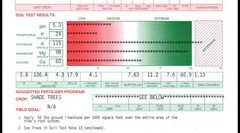
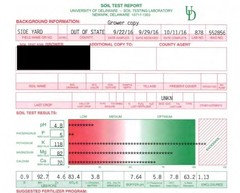
Got soil samples from two parts of the yard.

We just bought the property this past winter. Our lawn is a mix of tall fescue, fine fescue, I think some KBG, Zoysia, and a bunch of other crap I can't identify.

There are some areas of our 1.1 acres, where I would like a nice lawn.

However, fairly large parts will be converted to non-lawn, whether it's just ground covers, shade trees with mulch underneath, or a vegetable garden.

I just want some general advice on how to balance everything out. My soil is quite acidic, so we probably need some work there, but a lot of the other plants I like to grow would prefer acid, like azaleas, blueberries, even most Eastern North American and Asian trees prefer acidic soils.

For areas where I wanted to be lawn, I'll probably replant in sections. I'm still trying to side between fescue, which will be green a greater part of the year, or Zoysia, which would stay greener during the summer when we're actually out there using it, and as a rhizomatous grass, would "repair" itself better.

I will post the soil test results for both areas below, it doesn't include any textural analysis, but as far as I can tell, it's a silty clay loam.

Comments (30)

  • 10 years ago

  • 10 years ago

    That Phosphorus is almost catastrophically low!

  • 10 years ago

    High magnesium has been known to make hard crusty soils. With that much area, plan twice & seed once

  • 10 years ago
    It was good advice, yardtractor, but one suggestion was to post at this forum, so I did that as well.
  • 10 years ago
    last modified: 10 years ago

    Like I said, np. :)

    P: FIV 5= 10lbs.-5ppm, a FIV of 100=200lbs./acre

    K: FIV 118= 429lbs./acre-214.5ppm, a FIV of 100= 364lbs./acre

    Mg: FIV 82= 214.8lbs/acre-107ppm, a FIV of 100= 131lbs/acre

    Ca: FIV 70= 1400lbs./acre-700ppm, a FIV of 100= 2000lbs/acre

  • 10 years ago

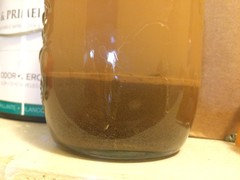
    I did a mason jar test to try to get a handle on the texture.

    After 8 hours:

    The water is still cloudy, but so far it looks like about a 3-1 ratio of silt to sand and just a tiny bit of clay. Even at 10% clay, which is far more than what has settled, that is silt loam.

  • 10 years ago

    This test is very inconsistent internally; there's no way optimal calcium, optimal magnesium, and high potassium are producing a pH of 4.8 (which indicates an extreme lack of alkaline cations). We have the same problem, but not quite so extreme, on the other soil sample.

    I won't give a read here because something is very, very wrong, and I can't tell if it's the pH test or the cation tests. Plus the fact that this passed their quality assurance indicates that no other reading can be called trustworthy!

    So it'd be unsafe (and extremely irresponsible) to offer much advice based on this test as we can't trust it too much.

    I'd have this re-done using Logan Labs or UMass (Logan preferable but UMass is perfectly fine).

  • 10 years ago

    It's not totally inconsistent with the area for the pH to be in the high 4's to mid 5's.

  • 10 years ago

    Here is the mason jar sample in the meantime.

  • 10 years ago
    last modified: 10 years ago

    >>It's not totally inconsistent with the area for the pH to be in the high 4's to mid 5's.

    Correct, that's quite common through the region.

    However, it's inconsistent for that to happen when the calcium, magnesium, and potassium levels are showing as optimal. In fact, that's impossible.

    Without seeing the 2 minute photo it's tougher to determine the consistency, but I'd say that this is definitely a silt loam. It's a nice soil, reminiscent of my own, actually.

  • 10 years ago
    Good point, I'll get another test, and will probably use Logan.
  • 10 years ago

    Here’s a question:

    As far as lime, how far does it “travel?” If we accept at the moment that my soil is indeed a silt loam, how much lime do I need, and, how far away from the rootzone of acid-lovers like azaleas, blueberries, even red maple or pin oak, etc do I need to stay to where the lime won’t “runoff”, especially if they’re downhill from a limed area?

    I was also thinking my pH goals staying on the lower side, maybe upper 5’s, so I don’t accidentally go too high for other things I’m growing, but if I have a planting of azaleas that’s a bit downhill, how far away do I need to stay from them with the lime?

  • 10 years ago

    Lime's a very slow and limited traveler. I grow rhododendrons two feet away from common annuals that require a much higher pH. I also grow azaleas in my gardens, at a pH of 6.3 (the argument that they absolutely require a lower pH is actually a myth).

    Grasses, on the other hand, won't be entirely thrilled with a pH of 5.7, but they're not going to be as unhappy as they will be a point lower. I'd say stay five feet away from the root zones (which are a bit wider than the greenery) and there's absolutely no risk. Or just lime the whole thing and apply ferrous sulfate to counter that.

  • 10 years ago
    last modified: 10 years ago

    The jar is conclusive.

    You have been so consistent, almost adamant, that you had a silt clay soil that Once I realized you were in Maryland, I was second guessing my earlier opinion that it was a sandy silt. To eliminate the possibility that it could be a heavily weathered clay, I checked Md.'s soil survey. To my surprise, nearly 75% of Maryland's soil is classified as Utisol.

    A sandy silt loam will be easier for you to adjust.

    On its face, there is nothing impossible, wrong, inconsistent or inaccurate with this soil test. Making such statements based on a lack of understanding of FIV (SLAN) is, to put it kindly, nonsense.

    Due to sampling errors, innate differences that can exist between soil just a few feet away from one another and the limitations of the test methods, test results can and will very by as much as 10-20%, even with the very same soil sample sent twice to the same test lab. Even with the "best" labs.

    If you decide to re-test, consider using one of these accredited labs (they all meet minimum standards for accuracy and precision as required by the NRCS for soil analysis laboratories analyzing soils for
    federal government programs involved with the development of nutrient
    management plans) to help ensure "valid" results, if that is a concern:

    My choices would be either A&L Western (first on list) or Brookside.

    A&L Western Agricultural Labs
    1311 Woodland Ave. Ste. 1
    Modesto, CA 95351
    209-529-4080
    http://www.al-labs-west.com

    AgroLab, Inc.
    101 Cluckey Dr
    Harrington, DE 19952
    302-566-6094
    http://www.agrolab.us

    AgSource - Bonduel
    106 N. Cecil St., PO Box 7
    Bonduel, WI 54107
    715-758-2178
    http://www.agsource.com

    AgSource - Harris
    300 Speedway Circle Ste 2
    Lincoln, NE 68502
    402-476-0300
    http://www.agsource.com

    AgSource Laboratories - Umatilla
    323 6th Street, PO Box 1350
    Umatilla, OR 97882
    541-922-4894
    http://www.agsource.com

    AGVISE Laboratories - Benson
    902 13th St N
    PO Box 187
    Benson, MN 56215
    320-843-4109
    http://www.agvise.com

    AGVISE Laboratories - Northwood
    604 Hwy 15
    PO Box 510
    Northwood, ND 58267
    701-587-6010
    http://www.agvise.com

    American Agricultural Lab - Olsen's Agricultural Lab
    210 East First St
    PO Box 370
    McCook, NE 69001-0370
    308-345-3670
    http://www.amaglab.com

    Brookside Labs Inc.
    200 White Mountain Dr
    New Bremen, OH 45869
    419-977-2766
    http://www.blinc.com

    Cascade Analytical
    3019 GS Center Rd
    Wenatchee, WA 98801
    509-662-1888
    http://www.cascadeanalytical.com

    CSU Soil Water & Plant Testing Laboratory
    200 W Lake St
    Campus Delivery 1120, NESB A-319
    Fort Collins, CO 80523-1120
    970-491-5061
    http://www.soiltestinglab.colostate.edu

    Dairy One Soil Testing Laboratory
    730 Warren Rd
    Ithaca, NY 14850
    607-257-1272
    http://www.dairyone.com

    Dellavalle Laboratory Inc.
    1910 W McKinley #110
    Fresno, CA 93728-1221
    559-233-6129
    http://www.dellavallelab.com

    Metro Wastewater Lab

    6450 York St.
    Denver, CO 80229-7499
    303-286-3223
    http://www.metrowastewater.com

    Midwest Laboratories
    13611 B St
    Omaha, NE 68144-3617
    402-334-7770
    http://www.midwestlabs.com

    Northwest Agricultural Consultants
    2545 W Falls Ave
    Kennewick, WA 99336
    509-783-7450
    http://www.nwag.com

    SoilTest Farm Consultants
    2925 Driggs Dr
    Moses Lake, WA 98837
    509-765-1622
    http://www.soiltestlab.com

    Stukenholtz Laboratory, Inc.
    2924 Addison Ave E
    PO Box 353
    Twin Falls, ID 83301
    208-734-3050
    http://stukenholtz.com

    The Farm Clinic, Inc.
    2574 S State Rd 39
    Frankfort, IN 46041
    765-659-1783
    http://thefarmclinic.com

    Twiss Analytical Lab
    26276 Twelve Trees Lane C
    Poulsbo, WA 98370
    360-779-5141
    http://www.twisslabs.com

    University of Idaho Analytical Sciences Laboratory
    Holm Research Center
    2222 West Sixth Street
    Moscow, ID 83844-2201
    208-885-7900
    http://www.uidaho.edu/asl

    USU Analytical Lab
    1541 N 800 E
    9400 Old Main Hill
    Logan, UT 84322-9400
    435-797-2217
    http://www.usual.usu.edu

    Ward Laboratories, Inc.
    4007 Cherry Ave
    PO Box 788
    Kearney, NE 68847
    308-234-2418
    http://www.wardlab.com

    West Virginina Dept of Ag
    60B Industrial Park Road
    Moorefield, WV 26836
    304-538-2397
    http://www.agriculture.wv.gov

  • 10 years ago
    last modified: 10 years ago

    >>On its face, there is nothing impossible, wrong, inconsistent or inaccurate with this soil test. Making such statements based on a lack of understanding of FIV (SLAN) is, to put it kindly, nonsense.

    Alas, making such statements indicates a lack of understanding of chemistry and is, not kindly and not intended to be (just as your statement wasn't intended to be kind) nonsense.

    You should enjoy doing all future soil test reads, I won't be back. I don't need the bullshit. The hours of work and all the delicious, delicious, continuous thanks are all yours.

  • 10 years ago

    Er, no Morpheus. You just can't up and leave us because of yardtractor - that is nonsense. You can't leave us here with that guy in control, it just will not end well.

  • 10 years ago

    I don't take sides in these things, but nobody wants to see morpheus go--So much great knowledge has been shared over the years! Maybe this will cheer you up, thanks to J4 creativity.


  • 10 years ago

    I and many others would be upset to see Morph go. Please reconsider Morph!

  • 10 years ago

    Unfortunately I find the need to defend my position.

    First, this is an open forum, to my knowledge, no poster has the right or power to be in control.

    Second, I have no desire to regularly do soil test interpretation, but I will continue to do reads when and if I have the urge.

    Third, I have made an effort over the last few months to bite my tongue and not be confrontational with morpheuspa. However, some things are so inaccurate, that I feel compelled to not allow misinformation to stand. This is a case in point.

    For the second time, morpheuspa has dismissed and denigrated a respected testing service based on completely defective assumptions. He is entitled to his personal opinions, but he isn't entitled to his own facts. His argument is that to raise pH, base cations must increase. True. In fact the only way to "permanently" raise pH is by adding carbonate and our available sources for carbonate is lime and that will necessarily raise calcium or both calcium and magnesium. On that basis, he argues that calcium, mg. etc CANNOT be classified as optimal when increases in those base cations are needed to raise pH. Therefore, on that basis alone, he concludes the values of those base cations CANNOT possibly be properly classified optimal and any test that does classify them as such can ONLY be assessed as "wrong", "not worth the paper it's written on", totally INACCURATE! There is no other conclusion possible!!!

    What he misses is the classification of "optimal" is used for the sole purpose of indexing fertility/SLAN values. Optimal means that years and thousands of tests have shown that amounts above optimal result in very little to no increase in soil fertility. That's what it means. Get used to it, SLAN is here and more and more testing services are reporting FIV/SLAN indexes. More and more State's are passing laws limiting nutrient applications based on SLAN values. But, the mere reporting of FIV (even if one cant convert them) and labeling them as low, medium or optimal does not make a test report or the raw values invalid. Sorry. I don't know why he doesn't understand this. It would be much more understandable if he had just said "I only do reads for Logan tests." He didn't, he chose this route of false logic and deflection.

    That he considers Umass tests to be valid and will read them, defies logic as they should be just as "internally inaccurate" as the test at hand under the very same "rational" he has given for denigrating the Delaware test.

    See here and take note of the Ca., Mg. P values on the bar graph and note the pH. Then take note of the lab.

    Fourth, morpheuspa can leave or stay, that's his choice. I couldn't care less either way.

  • 10 years ago

    the point you miss is morph is a person most would want to invite for a beer and a steak. That counts for a lot in this world.......even on an open forum

  • 10 years ago

    Darin,

    No offense intended, but you miss two important points:

    1. This is not a dating forum. If the OP follows morpheuspa's advice he is going to spend the price of a beer and a steak unnecessarily (other than to get morph to give him a read) for a new test.

    2. People come here looking for useful, accurate information.

  • 10 years ago

    I'd really like to thank the people who sent me notes today, they're much appreciated and I'm very grateful that you enjoy my advice (and rather sarcastic personality!) that much.

    But no, the time has come to take my leave. The level of irresponsible soil test advice has gotten too extreme, to the point where deeply sub-normal pH levels are considered fine and poundage calculations as supplied by the claimant literally do not support the soil pH to begin with. Yet somehow this set of errors receives vehement defense because the methodology is somehow not to be questioned.

    I can't--and won't--be a party to that level of incompetence and stupidity.

    This says nothing of the manner in which this supposed advice is delivered and "defended." I'm not in the habit of tolerating temper tantrums from whining children and I'm not going to start now.

    I did receive the nicest invitation from another site--which one should be obvious as I used to post there--to return. I'm considering that, so please look for me. If it's not clear, knock me a note and I'll tell you flat out.

    But other than that, I cannot ethically remain here and certainly don't need the annoyance inherent in doing so.

    Best of luck...because frankly, from the looks of things, you're going to need it.

    Thanks for the kind words, and goodbye.

  • 10 years ago

    Yardtractor - really?

    Hairmetal, sorry your request for info got lost here. FWIW, I (and many others here) used Logan Labs and was pleased.

  • 10 years ago

    If I really have silt loam with 4% OM, shouldn't I have better tilth?

  • 10 years ago

    @morpheuspa

    Sorry to see you go, especially to Mordor. Thank you for the unselfish help you have provided to all of us for so long.

    @yardtractor1

    I see the same heated debate on SLAN happening over on the other site as well. I haven't studied the issue much but I think I understand what you're saying, the "optimum" values are determined based on what the plant needs and responds to, they're not necessarily "optimum" for achieving proper pH. So it's plant first vs. soil first. I do have a few questions since this is an interesting topic:

    • Is there any situation where SLAN "optimum" values will result in a proper soil pH?
    • Are these values specific for turf or are they generic agricultural?
    • In relation to the above, when we talk about plant response, how is that measured, is it in yield (e.g. increasing past this point doesn't result in more corn per acre) or any visual difference?
  • 10 years ago

    When I'm attacked with ad hominen and vitriol I have the ugly habit of responding in kind with mustard. In retrospect, I'm not proud of that post and it has been deleted.

    I'll post separately on other topics.


  • 10 years ago
    last modified: 10 years ago

    If I really have silt loam with 4% OM, shouldn't I have better tilth?

    Hard to say. Think of it as a building site with all the necessary materials sitting on it. All the block, wood, windows, bricks, shingles, nails, siding, etc. It wont be a house until all the proper craftsman go to work and they never seem to finish when you want.

  • 10 years ago
    last modified: 10 years ago

    Is there any situation where SLAN "optimum" values will result in a proper soil pH?

    Yes it is possible to have optimum index values for cations which would result in a "proper" pH soil. Using maximum optimum index values and 8% of base cations allocated to "other cations" and sodium can result in a soil with a pH of 6.4. but the CEC would be less than 7. By dropping down the index scale towards 50 (still in the optimal range) you could raise the pH, but the CEC would be incrementally lower. Not very practical :) and soil CEC that low aren't very common.

    Are these values specific for turf or are they generic agricultural?

    I believe soil test supplied index values are based on a crop studies. I'm unaware if any index has incorporated turf studies into the category of "crop". I doubt it. I'm not aware of any low medium optimum index that is solely based on turf values.

    That's the reason I ignore them. For the most part, I employ the SLAN values developed for turf by PACE and apply that to the ppm lbs/ac values given in the soil test.

    In relation to the above, when we talk about plant response, how is
    that measured, is it in yield (e.g. increasing past this point doesn't
    result in more corn per acre) or any visual difference?

    SLAN is Sufficiency Level of Available Nutrients. It is defined as the level at which an addition of nutrient results in no further crop response. I know that yield is the primary determinant for crop response. I don't know if any other factors are considered.

    SLAN is a tool. For farmers with a bottom line and high costs, it can be a very important tool. For us and our lawns, we don't really have a bottom line. For a few dollars we can apply nutrients to our heart's desire. For our purposes, SLAN is just another tool in the box. I don't use it as my guide in adjusting the soil cations like Ca. and Mg. as I strongly believe that that balancing is important to soil structure and I use BCSR. I use it as a "warning" light for two purposes: 1. if I'm having an issue and my soil test shows a nutrient below SLAN, I'm going to make a note to address it. If a soil test reveals no SLAN nutrient deficiency, I'm going to balance per BCSR. 2. Unless, when I'm balancing and I desire to raise K to 4 or 5% and I note that the Mg. is over 300ppm., I'm going to leave the K where it is at SLAN sufficiency and avoid any chance of soil structure issues.

    Supposedly, PACE SLAN levels were adjusted by Carro for turf purposes.

  • 10 years ago

    Great info thank you.

Sponsored
Peabody Landscape Group
Average rating: 3.5 out of 5 stars8 Reviews
Columbus' Reliable Landscape Design & Contracting