Software
Houzz Logo Print
fall50

Capitata Yew

10 years ago

I cannot for the life of me understand how high this gets. Every site seems to have a different answer. I have seen 10 height all the way up to 35 ft. How can this even be possible. I have gone to the confiersociety.com site which wasnt that much help.

If the below link is correct that would be great. I am looking for something around 8-10" tall. This will be in space that is north facing with limited sunlight


http://bordines.com/plant-library/plant/?plant_id=22232&slug=yew-capitata

Comments (11)

  • 10 years ago

    confers are trees ... trees never stop growing.. in your life time at least ...


    your link states: Growth Rate: Slow to moderate (4-8" per year)


    that range takes into acct.. as gal suggests that location matters ... once established ...


    that only leaves you to multiply your brains out.. over the decades ...


    where are you ... bordines is MI ... here.. you have to recall.. that conifers are dormant for 4 to 5 months per year .... which slows them down significantly ...


    ken

  • 10 years ago

    Very long-lived species...in comparison to human lifespans, can start to look "indefinite". It's not, of course, just seems that way, because they can last so much longer than us. All plants apparently eventually grow beyond their ability to maintain all tissues, then slowly decline, barring other event. Just takes a long, long time! Inconceivable that there are "permanent" lifeforms out there. Some conifers make you wonder, lol.

  • 10 years ago
    last modified: 10 years ago

    Thank you Ken and Wisconsintom. As a fellow Wisconsinite now transplanted to the Twin Cities, its good to have input from folks in the same zone. What everyone said all makes perfect sense. I have more of a "engineers mindset" and realize things will not always fall within set parameters when it comes to mother nature. That being said the variance in sites suggesting this upright Yew gets 35' tall where as others say 10-12' is still hard to fathom. Perhaps a better question would have been how tall and wide does this thing typically get under non-aggressive growing conditions.

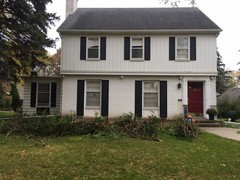
    At the end of the day, my concern on sizing is I am putting this next to the house where spacing away from the foundation becomes critical, unless I want this it growing through my widows :).

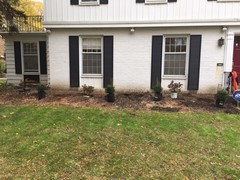
    Here is the space that I plan in putting in. (between the windows). Centered on the windows will be 2 quick fire hydrangeas and I was contemplating putting a little lime hydrangea in front of the Capitata Yew, but not sure if I have the space. As evident in the second picture, which was after I disposed of the old scraggly yews, I will also have 4 boxwoods, which are placed in front of the quickfires and then have a smattering of perneials placed in bewteen these.

    Thoughts suggestions?

  • 10 years ago
    last modified: 10 years ago

    'Capitata' appears to simply be a nursery name for typical wild type, tree form Japanese yew - probably used primarily to distinguish such from the dwarf 'Nana' version. North American records for Japanese yew include one 36 ft. high with an average crown spread of 33 ft. in Wellesley, MA during 1983 and another 23 ft. high with an average crown spread of 28 ft. in Kenosha, WI during 1988.

    If it were mine I would design and install a visually compatible, geometrically symmetric planting that extended out some distance in front of that house - instead of having only a foundation bed. A layout that echoed the house facade, served to integrate the house with its surroundings, yet also made the house look bigger and more important.

  • 10 years ago

    agreed.. if you are going to have to paint that house .... insure at least 3 clear feet ... which means plant this thing out 6 to 9 feet from the foundation ... i cant really tell from the pic ...


    this also helps with gutter cleaning.. xmas lights.. window washing..e tc ...


    we need a process engineer .. lol .. ken


  • 10 years ago
    last modified: 10 years ago

    I'm talking about an actual garden as big as or bigger than the house facade, that produces a zone of intermediacy between the building and the setting. Except in congested urban locations where architecture is all you see rectilinear formal houses set among grass and trees contrast in a distracting way from these softer landscape elements, need formal gardens in front of them to reduce their impact. When the geometry of the house is mirrored using natural materials from the surrounding environment like plants and gravel on the ground in front of it then a resolving blending of the two principal visual elements present is produced.

  • 10 years ago

    It's hard for the non gardener to give up lawn space. Real hard, but in this case I think it's the way to go. You won't have enough room unless you do. Get away from the straight lines and give the planting area depth, rather than plant boring yews you will eventually have to shear that didn't work out in the first place. Hydrangeas and any deciduous shrubs make poor foundation plants, especially interspersed with evergreens. They look like missing teeth in the winter.

    You can go two ways. Formal or informal. As an engineer, you probably want to go formal. I prefer informal to set the house off. (Different strokes and all that.) Formal houses don't necessarily require formal landscapes.

    Mike


  • 10 years ago
    last modified: 10 years ago

    Informal planting concentrated in front of formal house facades makes them look additionally at odds with their surroundings - you are making the contrast between the visual character of natural habit (those not sheared) plants and the geometric facade of the house all the more apparent.

    When a sheared hedge, fence or wall is used as a contrasting backdrop to a mixed border the backdrop is not the dominant feature - unlike when a house or other building is visible.

  • 10 years ago

    "A layout that echoed the house facade, served to integrate the house with its surroundings, yet also made the house look bigger and more important."

    Embothrium can you expound on this? I was thinking the boxwoods would provide some symmetry with the hydrgeas behind it giving the house much needed pop. The upright yew in the center would be primarily for balance in the winter months. Of course the flowers on the hydrangeas can be left on over the winter as well.


  • 10 years ago
    last modified: 10 years ago

    If you wanted to use hydrangeas something like squares of clipped box with hydrangeas in the center would be more like what I was talking about. For the general idea picture an approximation of the house facade having been laid onto the ground in front of the house, its pattern fleshed out with sheared shrubs, raked gravel, that kind of thing. A formal garden scene at least as big as the house facade - and not just a strip of planting running across in front of the base of the house. Otherwise it won't really look like you have done anything to enhance the house, which might almost be just as well with nothing but grass in front of it.