Software
Houzz Logo Print
dasher540

Multiple Stemmed Small Tree / Shrub

9 years ago

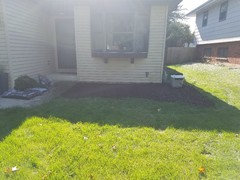
I'm looking for types of small tress or shrubs that are multi stemmed and reach no more then 15' in height. I'm located in zone 5 and will be using it as a foundation plant at the end corner of my house.

Comments (25)

  • 9 years ago

    See what you think of these:

    Japanese Stewartia

    Japanese Maple 'Waterfall'

    Japanese Maple 'Crimson Queen'

    Is there any specific reason it must be multi-stemmed? I assume you are planting only 1 at the corner of your house, and not a row of them along your foundation.

  • 9 years ago
    last modified: 9 years ago

    Preferably something evergreen, pyramidal and low branching at a house corner. All the more so if it is supposed to be concealing a conspicuous and homely foundation.

  • 9 years ago

    Embothrium, that is a matter of personal opinion.

  • 9 years ago
    last modified: 9 years ago

    No, actually it is a matter of what reads well visually in specific situations - same as with any other designing. Architecture, landscape architecture, planting design, interior design - all utilize physical materials to create visual impressions.

  • 9 years ago

    Well, It also depends on the way the rest of your landscape is designed. I like the idea of a small tree or multi-stemmed shrub. I gave my neighbors a plaited rose of sharon, and it looks beautiful on the corner of their house.

  • 9 years ago

    I'm not sure any of the suggestions made by Logan are at all suitable. The Stewartia will grow much larger than 15' and is not often available as a multi-trunked specimen. Those that are multi-trunked tend to spread rather widely as well. And both the Japanese maples will be grafted and grafted JM's are virtually always single trunked!! They will keep within your height limitations but unlikely to offer any multi-stemmed appeal.

    There are any number of shrubs that will grow naturally in a multi-stemmed habit and will stay within bounds height-wise but may become too wide with time. And the vast majority will be deciduous rather than evergreen. You could look at ninebark (Physocarpus opulifolius), Hydrangea paniculata, various viburnums, the rose of Sharon (may be invasive in some areas) or from an assortment of spring blooming, caning shrubs - forsythia, lilac, beautybush, deutzia, flowering quince, etc.

    All of these will tolerate periodic pruning to size, if necessary.

  • 9 years ago

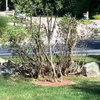
    I like the look of multi stemmed but am open to ideas. There is currently nothing planted in the area and I have about 6-7' of area to the right of the corner of the house. I will attach a picture for reference.

  • 9 years ago

    Are you going for a formal or more natural look? If formal, a pyramidal shrub would be a good idea (or if you want to get fancy, an outdoor topiary). If informal, I would go with a weeping JM. Stewartia will not work in this situation.

  • 9 years ago

    Also, not the biggest fan of evergreens as they tend to look a little 80's to me

  • 9 years ago

    Only thing I have 80% committed to was boxwoods under the window

  • 9 years ago
    last modified: 9 years ago

    Box under the window won't stay under the window unless very dwarf. Which could be fine.

    Since you do not actually have homely exposed foundations you don't need to do foundation plantings per se.

    The solidity and year-round presence of evergreen shrubs does not come and go with fashions. And deciduous shrubs always fail to provide the same total value, something that is again not a factor of trends.

    If this is truly USDA 5 (and not Sunset 5, a mistake people posting here as being in "Zone 5" sometimes make) then the main limitation on using evergreen shrubs will be the reduced selection due to winter cold. But even if there are only a comparative few hardy box, yews and so forth on the general market I would definitely not make the mistake of putting what will become a clump or tuft of leafless twigs ("brush") all winter at the corner, where straightness of the house needs to be softened by a plant with some meat on it, throughout the year.

  • 9 years ago
    last modified: 9 years ago

    I would love to recreate a look like this but am so unfamiliar with landscaping and names of plants I don't know where to start.

  • 9 years ago

    Located in the Chicago suburbs

  • 9 years ago

    The Japanese maple sounds like your best choice.

  • 9 years ago

    Which direction does the house face? If it faces south, box will winter burn badly.

    The inspiration picture has too much mulch for most gardener's taste. For a new planting that will fill in over time, it is fine. But it isn't finished by any stretch of the imagination. It also takes up a lot more space. Running evergreens across the front of the house, then placing a tree off the corner works fine. However the tree is going to have to be placed in front of the house because there isn't enough room off the side. I'd be thinking in terms of birches, if you can grow those there, and not a mini-tree.

  • 9 years ago
    last modified: 9 years ago

    Katie, for your multi trunked small tree, Google Autumn Brilliance serviceberry. White flowers in spring, berries for the birds, beautiful fall colors. It's native and will grow well in z5 Chicago. I'm not processing your space very well, so you will have to decide if it will fit.

  • 9 years ago

    It faces the south. The space is awkward to me so thought this would be a good place to start. I am willing to make the area smaller or larger and am appreciating everyone's input.

  • 9 years ago

    Katie, I might be assuming you are newer to gardening/landscaping than you actually are, but keep in mind that not all evergreens are conifers -- the term just refers to shrubs that keep their leaves (or needles) year-round. Rhododendrons, holly, camellias, to name just a few. If you're looking for impact, you won't want it to go dormant in winter, although deciduous shrubs with winter berries or beautiful bark provide year-round interest. As for rejecting all conifers -- while some shrubs are overused and may seem passé, there is such a variety available that you can one that doesn't offend your sense of style. Look beyond arbor vita and big box store offerings.

  • 9 years ago
    last modified: 9 years ago

    Since you are in Chicago, you could take a wander around the Chicago Botanical Garden along with some good nurseries to get some ideas, and you would be able to judge fall color if you go this weekend. I often look up plants on the Missouri Botanical Garden's plant finder website while I am wandering to see if its size and habit will work in my space. I try to consider long term appeal - flowers, fall color, overall plant shape and structure, and winter silhouette in a spot like yours. Check disease resistance, and if you have Japanese beetles or other insects that can cause issues, see how badly they effect the plants.

    From what others have said on GW, there seems to be some range of soils in the Chicago area from sandy to those with quite a bit of clay. What's yours like? Have you had a soil test done so you know the soil pH? That will effect what will grow well.

    Also, is there any chance you could post a photo of a larger view such as from the curb or across the street so we can see the entire front of the house and the property from side to side? Your inspiration photo shows a much larger space with the tree set farther from the house, and I wonder if your small tree/shrub might be better placed farther from the house also. Would the bed look better if extended forward to the outer edge of the walkway and with a wider spot for the tree as in the inspiration photo?

    Some ideas to consider:

    Tree form Hydrangea paniculata (panicle hydrangea) has a several month season of bloom and I like the dried flowers in winter as well. You could get one and train it through pruning to be multistemmed and it would be less expensive than buying a tree form one which is usually single trunked. Look at the larger ones like Limelight and Pinky Winky, and consider if you want stiffer stems that hold the flowers more upright or a more weeping form. Also look at the shape, color, and density of the flower panicles since they vary from almost rounded and lacy to dense and conical. There are many photos on the Hydrangea forum. (Pinky Winky vs Vanilla Strawberry and Pinky Winky vs Quickfire and Limelight)

    If you would consider a single stem, that would be a great spot for one of the smaller, disease resistant crabapples such as Sparkling Sprite, Sargent, Pink Princess, Firebird or Adirondack. All of those I listed should stay within 15' and have excellent disease resistance, though some other crabs are disease prone or much larger, so choose carefully. Be sure to set it far enough from the house to accommodate width.

    Look at some of the smaller magnolias such as Ann, Betty, Jane, and Susan (all from the Girls collection bred at the National Arboretum in the 1950s) which tend bloom late enough so that they don't get zapped by late spring frosts. In addition to spring flowers, I enjoy the winter look of pale bark and large silvery fuzzy buds. There are others in the series as well (Pinky, Randi, Judy, and Ricki) but I've never seen them offered. Check out some of the smaller Magnolia stellata (star magnolia) such as 'Waterlily' and smaller M. x loebneri such as 'Leonard Messel'. In my garden Leonard Messel blooms late enough to not get hit by spring frosts and has gorgeous clear yellow fall color as well as the blooms and winter attributes. I don't grow the others, so don't know about fall color. They may get to 20', but my LM at ~10 years old hasn't yet hit 10', so it would be quite a number of years. Some of the star and Loebner magnolias get bigger so be sure to check on MOBOT listed above. Plant tags tend to give size at 5-10 years.

    Japanese tree lilac (Syringa reticulata) 'Ivory Silk' has creamy spring flowers and pretty bark. Be sure you like the scent of the flowers since it isn't the same as regular lilacs.

    Some of the larger Viburnums may work there, though would need pruning to be more tree-like. Spring flowers, great fall color.

    I like Indianagardengirl's suggestion of Autumn Brilliance, though it may get larger than you want. I'd research to see if there are smaller serviceberries (or if you can pull it away from the house more and use a larger plant like this.) In some areas they may be disease prone, but where they aren't they are stunning - spring flowers and lightly colored spring foliage just as the buds open, berries that the birds love, and gorgeous fall color. I like the winter look as well.

    Before looking seriously at Logan's suggestion of Japanese maples, see how they do in your area. Where I am, some of the hardier types do OK in city heat islands, but only a very few are hardy enough here in my more rural setting, and they may get killed back in harsh winters even in cities. You don't want an easily damaged tree in such a prominent spot. You will also need to choose a cultivar that stays small - many get much bigger than 15'. Not multistemmed, but interesting form.

    For your evergreens, be sure you like the smell of boxwoods before planting them near the door and window. Some folks find the scent unappealing. How far is the window above the ground? As Embothrium said, you don't need to cover up the foundation, so low-growing evergreens such as perennials could work as well as shrubs there. As mad gallica commented, with a south-facing exposure here, many broad-leafed evergreens will winter burn (Leucothoe, box, Rhododendrons, Pieris/andromeda, etc) so you may be restricted to perennials or conifers. The low conifers in your inspiration photo around the tree look to be low junipers.

  • 9 years ago

    I would plant a row of the golden mop cypress (that can be sheared if desired, but the natural mounding look is better) with the japanese maple 'crimson queen'.

  • 9 years ago
    last modified: 9 years ago

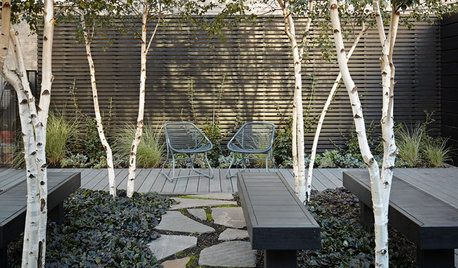
    betula utilis var. Jaquemontii or b..septentrionale. I love multi-stemmed birch - mannerly, architectural and with careful placing, utterly dramatic. And amenable to pruning. I have a little fantasy vignette of birch, ophiogon, cornus sanguinea or Midwinter Beauty, galanthus elwesii.

  • 9 years ago

    Such Asian birches make full sized trees, birches are not amenable to pruning at all and borers are hammering Himalayan birch and certain others in North America at this time.

    As is often the case the planting scheme in the picture has the shrubs mis-placed with the lower growing, finer textured Microbiota (?) around the accent point (the tree) and the larger leaved, taller rhododendrons in the narrow part of the bed in front of the house. It should be the other way around, with smaller growing, smaller leaved choices in narrow parts of the bed and where there are windows the planting needs to stay beneath, and taller, bolder shrubs where the bed is wider and there is a tree that needs to be faced down. Also one or two rhododendrons of that leaf size type is plenty for an area of this size.

  • 9 years ago

    Gosh - well that's a stinging rebuttal Embo. Still, I ought to butt out of making suggestions on subjects I know little - economies of size and scale meant that after the very first flush when I thought shrubs were a terrific wheeze and filled my garden in one season, then facing a long and painful cull in subsequent years, I selected tiny plants for tiny gardens as the obvious choice and had a long swooning love affair with minuscule alpines. Still, gardening is a lifelong learning thing, hey?

  • 9 years ago

    Camp's suggestion of birch got me thinking . . . How about Betula nigra 'Little King' AKA Fox Valley river birch. Stays within Kate Miller's size guidelines, multistemmed, Chicago Bot has good things to say about it as far as health and appropriateness for Chicago, and quite ornamental between bark, catkins, typical birch yellow fall color, and overall form. It looks good here all season - I've been watching a field of them for a number of years at a defunct wholesale nursery next door.