Software
Houzz Logo Print
gjcore

The new compost pile

9 years ago
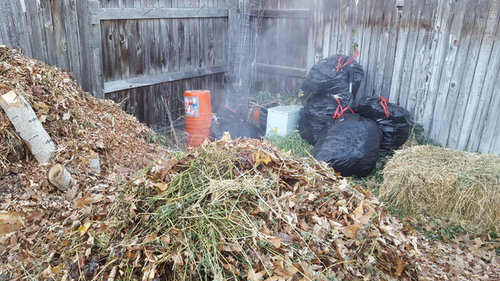
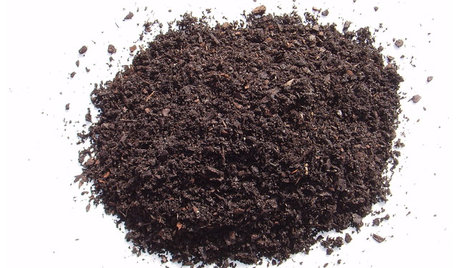
It's steaming hot this morning. Put it together Sunday morning. Ingredients included leaves, alfalfa, coffe grounds and food scraps.

Comments (5)

  • 9 years ago

    Alfalfa is a good compost ingredient with those leaves, Greg . Actually, the coffee grounds and kitchen scraps are too if enough of them can be found.


    I used to live not all that far from a feed lot. Before they began turning their alfalfa into silage in those huge plastic bags, they had plenty of rain-spoiled bales. Cow manure could be had just shoveling along the outside of the corral, since it was pushed under the fence by the cattle. I had to show up when the workers were there and could get as much as I wanted of either.


    I used about 8" flakes and laid them out in a square, open in the middle. Layering a shovel full of manure on each flake of hay, I built what was almost a chimney as tall as I was. They steamed like chimneys all winter! A couple of these were at the end of the garden. Material fell into the middle but, they stayed a mound, at least.


    I'm really lazy about turning compost. I should have turned that stuff but it would have taken on into warm weather to finish. It was okay by spring and I was digging out beds to fill even back in those days.


    Now, I just add and add through the growing season and then cover with soil and leave it for a year. Some of the material at one end of the pile is 18 months old. I used to have side-by-side bins and the compost didn't come out into the garden until it was 18+ months old. That was in earlier gardens. Now, I have the main pile and 2 more locations "secreted" under the greenhouse and chicken coop decks in my backyard. I wish I felt more comfortable making compost within view of the neighbors ... oh well, at least those bins are outta the way.


    Steve

  • 9 years ago
    last modified: 9 years ago

    Mine’s never been hot enough to steam! I do it strictly the Lazy Compost Style, and
    never turn it anymore—and even when I first started I only turned it once a
    year, IF I got around to it.

    Looks like you’re gonna have a pretty good quantity of The
    Homegrown Stuff for next year, Greg!
    Altho it’s ALWAYS surprising how much the stuff keeps “going down!” I keep adding and adding and adding to the
    top of mine, and it always seems to wind up being pretty much the same
    height! Next spring I am gonna need to
    move “the top” off of mine to get at the finished and mostly finished stuff on
    the bottom. That amounts to “turning” it
    by the time I put the undecomposed stuff back where it belongs—and it’ll heat
    up for a while after that. But at this
    point I’m pretty much convinced that the advantage of having a Vermiculture
    Farm to keep me supplied with worms to transplant here and there makes it worth
    the extra “wait time” of having a cooler Lazy Style pile! If it heats up too much the worms need to
    either migrate back down into the soil (where I can’t get them!), or they DIE!

    For the last couple years I’ve been turning most of the fall
    leaves I manage to snag directly into the soil, most of them, so far, into my
    tomato area, and this fall for the very first time when I was turning it over a
    few weeks ago I finally have something that I consider to be “usable gardening
    soil!” I mixed several more bags of
    leaves in when I turned it over, and this is the first time I didn’t need to
    sit and break up every single clump of CLAY by hand. For almost all of it I could just turn it
    over and whack it a couple times with the shovel and it broke up all by
    itself! With the leaves I just mixed in
    I’m expecting it to not be the Usual Ordeal when I turn it over to plant next
    spring!

    In the last few weeks I’ve scored about 45 (big!) bags of
    leaves from the neighbors across the street—and I think there will be a few
    more bags yet. But almost all of my
    bagged leaves nowadays get mixed directly into the soil. I dumped all the leaves I got from my own
    yard on top of the soil and then put all the bags on top of the “loose” leaves
    to make a cozy home for the worms over winter, then, in spring the “loose” ones
    will be mixed into the soil along with a bunch of the bagged ones. Then more bags of what’s left get used for a
    thick leaf mulch around the tomatoes over summer, and then they get mixed in in
    fall. It’s taken about four years—maybe
    five—of doing that for me to FINALLY get to the point where the soil is
    now! Before I started doing that I was
    mixing in “finished” or “mostly finished” compost and it really didn’t seem to
    be helping the soil much at all! It was
    after YOU, Digit, started talking about “direct composting” that I started
    mixing the whole leaves directly into the soil.

    Some of the leaves that don’t get “otherwise used” do
    eventually wind up on the compost pile, but most of My Pile now is composed of
    “kitchen scraps” and “summer yard waste” which is mostly the debris from
    cutting down perennials and cleaning up spring bulbs and stuff. I mostly put my grass clippings on the
    compost pile now too, but I don’t have that much lawn! I used to use the grass clippings to mulch
    the tomatoes, but they “go away” too quickly, and, also, I have a Weed Lot
    Neighbor now and there’s so many weeds, a/k/a weed seeds, in my lawn now that I
    don’t trust using the clippings directly on the garden anymore! Weed seeds are DANGEROUS things! But I’m always surprised at how many kitchen
    scraps I wind up with to put on the pile!
    Cooking for just one person, one would think, wouldn’t add up to “that
    much,” but somehow it does! I just keep
    a “produce bag” by my kitchen sink and throw any/everything “decomposable” in it
    and then take it out either when it gets full—or when it starts to stink—or
    gets “too soupy” for a plastic bag, a/k/a starts to “compost in the bag!” Somehow I manage to come up with a pile
    that’s about 6’ x 3’ and about 3’ high. The
    mostly finished compost from the pile I pretty much use up when planting or
    replanting perennials—and when I do that now I dig up as big an area as I can
    without disturbing other plants and throw most of the potter’s clay in the
    dumpster and incorporate a LOT of Homegrown Compost—AND worms! Doing it that way means that the soil “sinks
    down in” as it finishes decomposing and I need to go back “later” to fill in
    the area to make it level again, but I’m trying really hard to eventually come
    up with some usable soil in my perennial beds too!

    Now that we’ve finally had a hard freeze I have a bunch more
    of the “last” perennials to cut down, so more Good Eats For Future Plants
    coming up! Saturday is supposed to be
    really nice around here so maybe I can Feed My Pile then!

    Skybird

  • 9 years ago

    I do the same thing with digging in leaves in my beds. It really seems to help a lot.

    This year so far I'm taking a break from the winter gardening. So most of my Aurora beds have cover crop mixes. When the time comes I might just smother the cover crops with mulch.

    Westminster beds I dug in leaves and then layered chopped leaves as mulch. On top I put the rolled fencing pieces to keep the mulch in place. The newest bed has 4 inches of compost on top. I decided to sow the cover crop mix. Maybe it too late but they seem to be at least slowly growing.

    We use recycled Costco cashew jars to keep kitchen scraps in. Seems to work pretty good. No odor, flies or gnats to deal with.

  • 9 years ago

    Greg, if you have some leaf bags and put them on top of the places where you have the chopped leaves they'll insulate the soil well enough that you'll have the worms eating and pooping--and procreating--under them all winter, helping to "digest" the chopped leaves and work them into the soil for you. Or, if you have some "extra" bales of something and break them down into fairly thick "flakes" I suspect that would provide the same insulation the worms need to stay active. (Since "flakes" from a bale of hay/straw/alfalfa would be pretty small, I think you'd need to put several of them side by side to provide insulation in a large enough area to keep the soil warm enough!)

    I have thousands of worms in my tomato bed soil by now, and I really do believe that they've been a major contributor to the "good soil" I finally have. If you can try it in a small place this winter I think you'll be convinced! If you try it, wait a few weeks after you put the bags or "flakes" on top of the soil and then lift one of them up and look and you'll probably be amazed at how many worms you see--almost no matter how cold it is. I know I was the first time I lifted up a bag to look--and when I first put the leaf bags out there I was just doing it to "store them" and didn't even realize that I was creating a "Vermiculture Farm!"

    Skybird


  • 9 years ago

    Yes I'll do that soon enough with the bags. I've done it the last few winters in Aurora and I've seen the worm farm in action plus plenty of other bugs under there. Here in Westminster that's not so many worms yet but that will happen eventually.