Software
Houzz Logo Print
bankhawk2002

Gritty mix

I think I want to use a 5:1:1 ratio of pine bark fines, pumice, and chicken grit. I have seen several suggesting this mix. My question is are these ratios by weight or volume? I am assuming by volume.

Comments (35)

  • 9 years ago

    last modified: 9 years ago
    Bill, I use it by volume. I have a pale that I use as a 1 Part measure. Tweek it a bit sometimes by appearance.

    Rick

    Bill. USA Georgia usda zone 8b thanked rcharles_gw (Canada)
  • 9 years ago
    or you could use a clay pot … and divvy up the mix … using the pot … or a coffee can … or a thimble … or pretend you are splitting your pile of gold coins three ways … five for me, one for you and one for you ...

    Bill. USA Georgia usda zone 8b thanked bragu_DSM 5
  • 9 years ago
    In that zone, I recommend 7 gold coins. These plants are very thirsty in summer.

    Pagan

  • 9 years ago
    last modified: 9 years ago
    Bill,

    I'm so glad you asked that question. I've wondered that since putting together gritty mix the 1st time but was too embarrased to ask. Using the 1:1:1 ratio, the amount of bark seemed way too little.

    Thank you,

    Tyler

  • 9 years ago

    I have to confess that many years ago finding most commercial potting mixes much too heavy and overly wet for long periods since they seemed to use composted peat moss as their main ingredient, I did choose to make my own mix and found adding lots of perlite and some vermiculite did work for those that loved to stay evenly moist and not dry out too much between watering , but not at all of course free draining enough to use as any type of cactus or succulent mix , but later found sharp builders sand seemed to suit many types of plants and especially the cacti and succulents . Problem here is , it's not too easy to get smaller amounts of builders sand here anywhere in garden centers to mix in, and of course I doubt most building supply companies would sell in the relatively small amounts us hobbyists would require . I found "hobby, or play"? sand available just too fine a particle .

  • 9 years ago
    last modified: 9 years ago

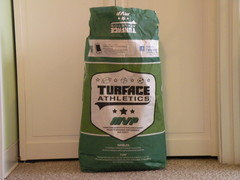
    Gary - The Blue bucket in my pics contains "Turface MVP", a calcined clay granual.

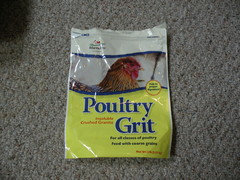
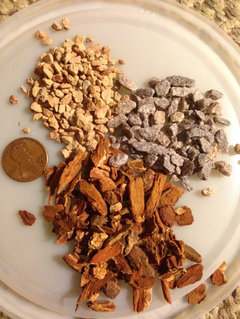
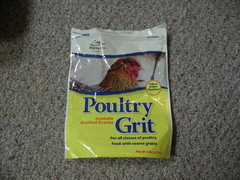
    It has water retention properties, and after screening, I don't use anything smaller than 2mm in my soils. Ideal is about .125". If you're looking for something w/o water retention, I use Poultry Grit.

    It comes screened to size, just give it a good rinse.

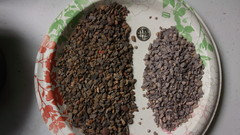
    Grit on the right, Haydite on the Left.


    Rob

    Bill. USA Georgia usda zone 8b thanked halocline
  • 9 years ago

    Thank you so much for the suggestion, and have to confess I nearly killed mine lone specimen a few years back with the very bad habit to conserve space in my crowded plant collection, I'd set a small pot of some plant " can't remember what" lol, on top of the big pot my adenium is in and watered that lone tiny pot very frequently , thinking there'd only be very small amounts of water draining into the much bigger adenium pot , and suspected about spring the adenium looked slightly ill, and unpotted it to do a root check only to find one of several very large tap roots out the base had rotted all the way to the base , but peeled away cleanly when I put a light tug on the rotted portion , but seemed to spread no further I'd guess with the caudex remaining firm after that , so I believe the rot had stopped. It' is in a very free draining commercial cactus and succulent mix , but has never has grown quite as full or floriferous as before . Maybe time for another root check, and no longer watering small pots sitting right atop that rootball lol.

  • 9 years ago

    Rob, what do you do with your leftovers of the bark and turface?

  • 9 years ago

    Rob H - A lot of people say they use their Turface fines for seed germination, Cacti etc... Although I have a 4 Gal. bucket of fines, I have yet to find any use for them. There's also a lot of people that screen their Turface all the way down to the size of "Insect Screen"; because they want the most bang for their buck, and the smallest amount of waste. (I used to be one of those people.)

    The fact of the matter is, the entire concept behind the "Gritty Mix"; boils down to size, and if you cut corners, there's really no point in making it.

    I myself; don't use anything smaller than 2mm. However, the optimal size is .125" (or 3mm).

    After seeing first hand; the poor performance of soils made w/ Turface fines, I have just come to accept; that there's going to be some waste (and some bags are better than others). The way I figure it, at $10 per 50lbs bag, it's not that big of a deal.

    With Pine Bark; you have more options. Larger pieces (3/8") can be used to make the 5:1:1 mix. Even the fines can be used in the 5:1:1 to regulate water retention.

    I have found that the Gritty Mix work's great for my Bonsai trees, but after a lot of experimenting, I've ended up omitting Turface from my Adenium mix all together.

    If you'd like, I can go into more detail about that later.

    Rob


  • 9 years ago

    Rob - Thanks for the reply! I've just sifted my reptibark thru a 1/4" inch screen (keeping what falls through) and will have over half the bag that is "too big." But if you say 3/8" is acceptable then I'd probably have much less waste.

    I sifted my turface and poultry grit through 1/8" screen and am keeping what doesn't fall through. Almost no leftovers from the poultry grit (just dust, mostly). More leftovers from the turface, but as you said, at $10/50lbs, I'm not worried.

    My biggest interest is using more of the bark. And after reading, I had come to the conclusion that Gritty Mix was all about a uniformity of size, so if the size range can be 1/8" up to 3/8" I might resift my bark. Here's my current mix...

  • 9 years ago

    Rob - P.S. I would be interested in more details about omitting turface from your gritty mix. Also, do you use 1:1:1 for your Adenium and 5:1:1 for other plants? I was thinking about using a higher ratio of bark (and maybe turface?), since I will be gone twice this summer for a week at a time and less able to monitor watering (although the plants should get water from an automatic sprinkler, so maybe I don't need to worry). Thanks for your thoughts. First time working with this and I wanna do it right :-)

  • 9 years ago
    1. Rob Take out the turface or stone put in some cactus / suclent mix maybe course perlite or remove turface and stones mix up cactus / suclent mix,course perlite, medium coco choir and aged cow manure all equal parts. It works for me I get temperaturesome 40+ degrees Celsius I just drenched them than went away for two weeks. When i returned the small plants were wrinkly I gave the a good drink they came good the large ones look like I had not went away i go away all the time.
  • 9 years ago

    Rob H - I haven't got much time to write right now however, I didn't mean that 3/8" bark is ok to use in the "Gritty Mix", but rather; 3/8" bark is recommended for use in "tapla's" 5:1:1 soil mix recipe. So don't re-screen your bark.

    After screening the Turface, and Granite, I do recommend that you also give them a good rinse to remove the remaining dust.

    I use this product for my grit, and like you mentioned, it doesn't really need much in the way of screening. It's pretty uniform right out of the bag.

    I assumed that you've read "tapla's" thread about soils. If not, here's the link.

    http://forums2.gardenweb.com/discussions/1403195/container-soils-water-movement-and-retention-xvii?n=155

    Rob

  • 9 years ago

    Thanks, Rob. I hadn't found the original post up to this point, so thanks for providing the link. That brings together a lot of stuff I've read here in bits and pieces. So, I'll leave my bark screened as it is. Yes, I've noticed all the dust - will definitely rinse. And yes, that's the poultry grit I have found to use as well. Thanks for the help!

  • 9 years ago

    I TEND forego the bark, except for older plants. i just use a 1:1 poultry grit (No. 2 cherrystone) and floor dry (Napa part No. 8822). It wets nicely, dries out fast, and can be watered every day or two. I find if I use perlite, it 'floats' to the top unless I top dress with a layer of cherrystone. I start my seeds in MG mixed with extra perlite. When they start getting true leaves, I transplant them into the 1:1. mix in a community pot ...


  • 9 years ago

    Rob H - Sorry for the delay in my reply.

    I've transplanted Adeniums after 3 months of age in a number of different soil mixes. Surprisingly , the ones in the Gritty Mix were the poorest performers. I've found that Adeniums prefer a coarser soil, perhaps due to their large root structure (caudex).

    After several test batch mixes, I've settled on the following materials:

    Lava Rock (Scoria) 3-4mm

    Fir Bark 0.25"

    Pine Bark 6.5mm-8mm

    Coarse Perlite

    FoxFarm Ocean Forest Potting Soil (Small amount)

    I don't have any set ratios, I just eyeball it until the feel is right.

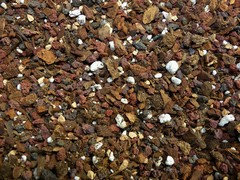
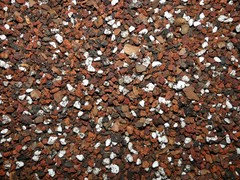
    These pics were taken back in December, so there is still a small amount of Turface in this mix, but it has the right look.


    Rob


  • 9 years ago

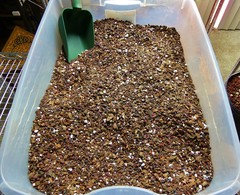
    Here's a photo I took of some soil I made today.


    Rob

  • 9 years ago

    Rob - thanks for the pictures. Do you think the 3 month seedlings didn't do as well in the gritty mix because seedlings generally need more water available than older (1+ years) plants (or at least I think I've read that)?

  • 9 years ago

    What is Napa 8822 where to buy? Napa store?

    any one try "grit" from a paper mill? Great stuff. Ground up bark/dirt and sand.


  • 9 years ago

    What does Napa do?

  • 9 years ago

    Rob - I've grown mature Adeniums in the Gritty
    Mix. Before I got into Adeniums, I grew mainly Bonsai, and the Gritty Mix was
    all I used, So, the first Adeniums I ever had; were ones I bought (mature).

    But yes, you're
    right. Adenium seedlings can take more water. When I began growing from seed, I
    used "Miracle-Gro Seed Starter Mix" (which worked fine). Now I make
    my germination soil w/ 2:1 "Pro-Mix HP", "FoxFarm Ocean Forest
    Potting Soil"

    I'll either sow
    single seeds in really small pots, or 2-3 seeds in 2 1/2" pots.


    I usually try to
    transplant at 3 months of age. At this age; they're ready for a sharper
    draining mix. You can even begin root training by removing just the tap root,
    or cut the caudex off all the way up to the "Tan Line".


    At this time (first
    transplant), I'll move them up to 4" pots, then 6", 8" etc…

    I'm actually
    transplanting an "Emerald Crown" that's being root trained right now;
    as I'm writing this. ;-)


    I'll finish up & post the results in a while

    Rob

  • 9 years ago

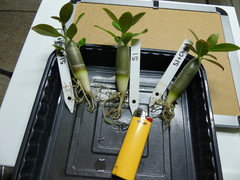
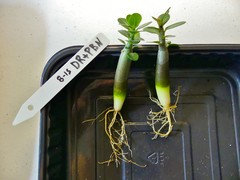
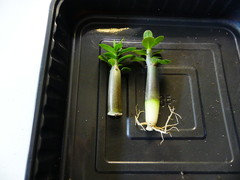
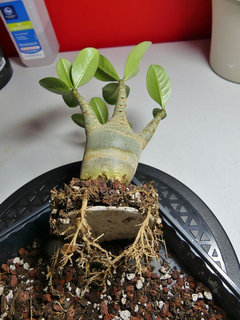
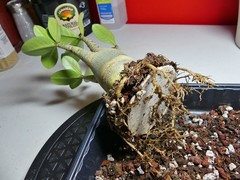
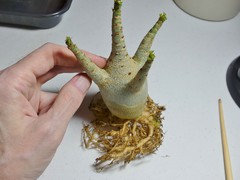
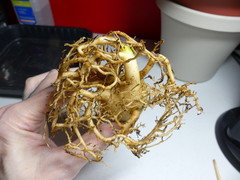
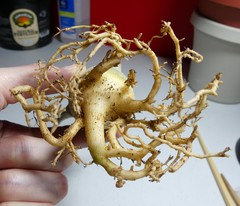
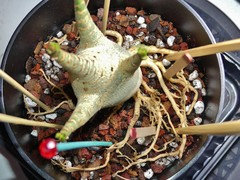
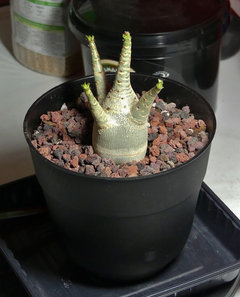
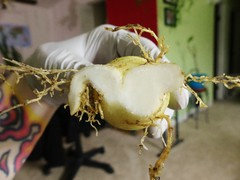
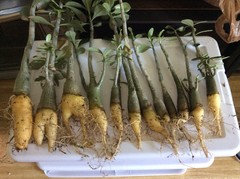
    This is an example of a plant that just had the tap root removed.


    (Before root pruning)

    (After)

    (Root placement)
    (Uneven root proportion)


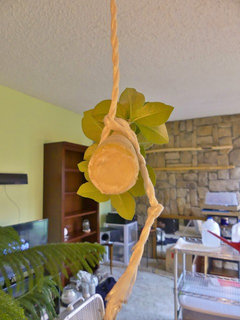
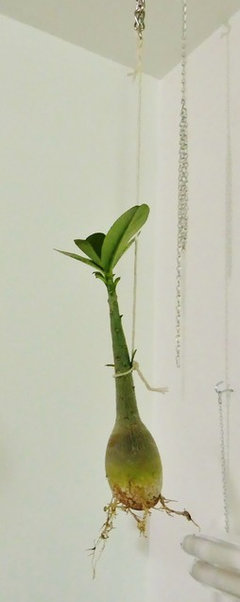
    Since I pruned the roots, I could have hung the plant overnight to let the cuts callous; to prevent rot.


    But I potted it up, and won't water for at least 24 hours.

    Rob

  • 9 years ago

    Hi Halocline Rob, very nice uniform gritty mix there! How often do you have to water and fertilise for your gritty mix during hot season? Any problem with the perlite floating to the top? Thanks

  • 9 years ago

    tan - Watering depends on the size of the pot, and the temps. Usually; I like to fertilize at every watering by reducing the recommended amount per Gallon, but when the temps get above 85*F, I hold off on fertilizing.

    With Coarse Perlite, I don't see much of a problem with it migrating to the top. However, I usually top dress w/ Lava Rock, Granite, or both. It helps with evaporation, and it look's nice. :-)


    Rob

  • 9 years ago

    Hi Rob, thanks for the info. Both the fatty arabicums and the rocky top dressings are nice!

  • 9 years ago
    last modified: 9 years ago

    jo: napa floor dry is a substitute for turface. it absorbs water, and the the plant can pick up the moisture as the product dries out.

    watch that 'grit' from the mill, the sand/soil can bollux things up, and create a drainage issue, by establishing a perched water level, which is conducive to root rot. a better grit is chicken grit, or no.2 cherrystone. don't get the oyster shell. a substitute for the chix grit would be the smaller fish tank gravel, the small pumice, or ground up lava rock … i'd use the mill grit for my hosta ...

  • 9 years ago

    Thanks bragu, grit from paper mill is good for broms etc. just didn't want to loose my desert rose.

    thanks again

    jo

  • 9 years ago

    Rob, I love that you were doing all of that on your carpeting. You've got your priorities straight.

    Carol

  • 9 years ago

    I've since had new carpet installed, so I've set myself up w/ a proper work station.

    Rob

  • 9 years ago

    Thanks for all these pictures, Rob. I've got a bunch of 1+ year old seedlings I might try some of this with.

  • 9 years ago

    Yeah, when you have a substantial number of plants, it's fun to experiment with a few. I try to keep a journal, or color code the plant tag; to keep track of what I did to the roots/caudex. Once the Adenium goes into the soil, it's easy to forget what you did a year ago. Then you get a cool surprise when you see the unexpected results upon your next repot. :-)

    Rob


  • 9 years ago

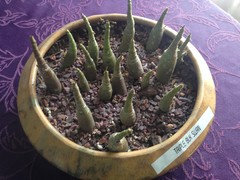
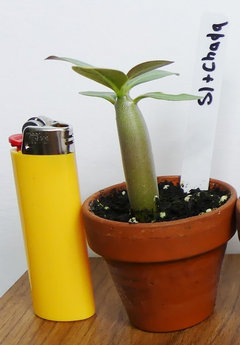
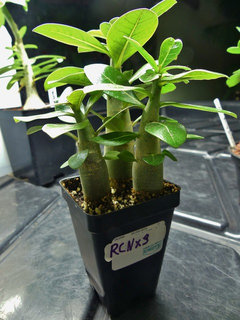
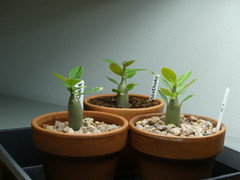
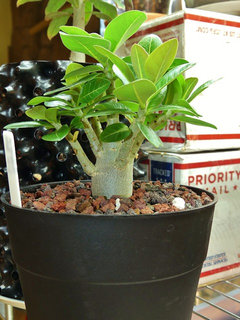
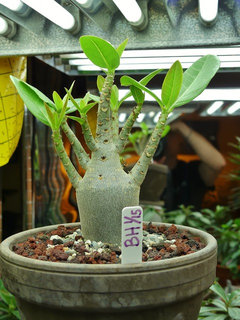
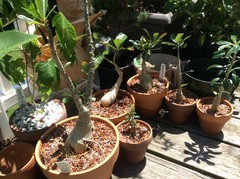
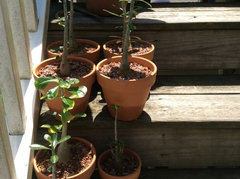
    I'm trying to get all of mine in gritty mix so I figured I'd take some pictures about halfway thru the process. I want to play with the roots at some point, but due to moving them to their first gritty mix and an upcoming move halfway across the country, I figured I'd let them be. Perhaps towards the end of the season would be a good time to do some pruning anyways.

  • 9 years ago

    Question for someone: in the second picture, the plant in the clay pot furthest away (a little right of center, with the plant tag) is obviously grafted. There are several growth shoots emerging below the graft. Should I be removing these? Do I just pinch them off?

  • 9 years ago

    pinch them off, yes