Software
Houzz Logo Print
raymondranch

Shrub as tree form?

9 years ago

I have seen it mentioned several times in this forum about using a shrub as a tree form, by pruning it as a tree. Can anyone give me examples of the type of shrubs you could use and how that pruning is done? I would love to see pictures of some that have been successfully done that way!

Comments (10)

  • 9 years ago

    Here is California people train Oleander as trees and they are stunning.

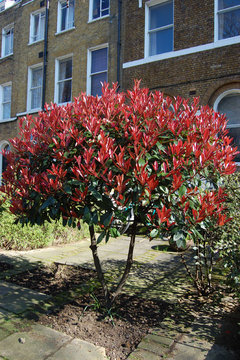
    I have Myrtus and Xylosma as trees in my yard. Ligustrum can be done also. At a different house I had Photinia fraseri as a tree, several of them actually.
    They were nice to look at but I learned they were not ideal. The roots were not adequate to support the heavy canopy. After heavy rain they would lean and require support. It was fun while it lasted. What I learned is that not all tall shrubs make a reliable tree, even if one can prune them to that shape.

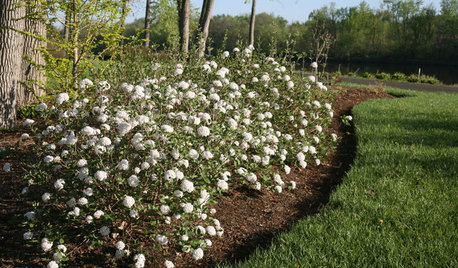
    I have Viburnum that was somewhat a tree form but I tired of it and let the shrub fill out again. It was not that attractive as a tree.

    You could get more specific advice if you mention your growing zone.

    raymondranch thanked emmarene9
  • 9 years ago
    last modified: 9 years ago

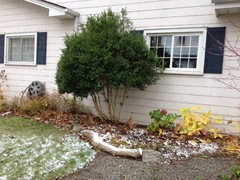
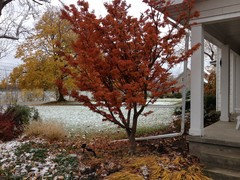
    Envious Canadian here Yaardvark! I have used boxwood, privet, both golden elders and black elder, and many of the upright forms of Japanese Maple which some would consider a small tree but I always look for a multistem. Oh, and Amelanchier, sometimes sold already started as multistem tree form, beautiful.

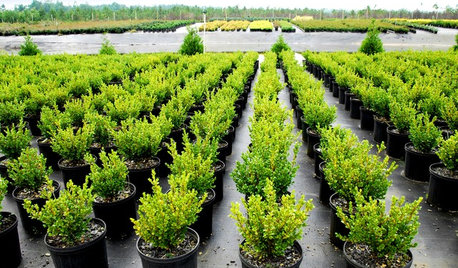
    Boxwood, yes that is today with the snow on the ground:

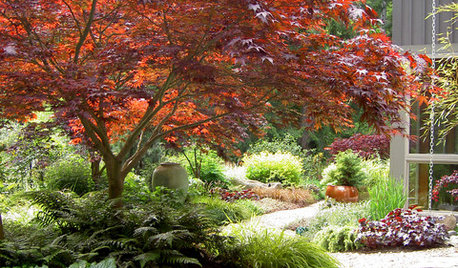
    Japanese Maple 'Shishigashira', probably won't get more than 10' height.

  • PRO
    9 years ago

    I want to mention a couple of things about the form and structure. About 99% of the time I think of the small tree, made of what would otherwise be called a shrub, as being multi-trunk, primarily because it is an exquisitely handsome form when well done, and because it's typically the proclivity of a shrub to form multiple trunks. Good examples are rare. Adding more of them to the world is an asset for all.

    I think of a multi-trunk specimen as a giant bouquet, and as such it follows those rules. If a bouquet is 2 or 3 stems in a glass I would call it skimpy. One that has a dozen or 50 stems would look much fuller and better. For various reasons most of the examples of small, multi-trunk trees that we see have very few trunks and that portion of them look anemic to me. Especially because they are often in the a-truck-backed-into-me arrangement! At least, there ought to be enough in a uniform distribution to suggest a complete cone shape, which is probably 5. But it's a lot easier to have more and not need to fuss with the exact arrangement of them. (For me, the minimum is about a dozen with no upward limit other than what practicality dictates.)

    Insofar as a tree having the ability to stand on its own, that's more or less a product of the tree species and rate of growth. If a tree is top heavy in its young phase it may be subject to bending over under the weight of its own head. One either needs to give it temporary support or cut it back and let it achieve height more slowly. In the case of the Bougainvillea above, I knew going in that it would not stand on its own while young so added the post, which is set in concrete. Over a period of years, the trunks will thicken and become stronger. At least annually, they (there are two) will be beheaded, removing all the weight the trunks must carry. If a tree is not to be beheaded, it will have a different pruning strategy of removing lower branches while allowing top growth.

    Another thing is that for many small trees, bloom is a major factor that must be considered. If a plant blooms on new growth, it can be subjected to annual beheading, which really makes things easier. Crape myrtle is an obvious example. Don't misunderstand and think I am suggesting that in the beheading process it is acceptable to disfigure the form. To the contrary, it must be used in a way that enhances, of which the first consideration is the height at which beheading occurs. Commonly, people trim off the head at chest height, ONLY because that is the height at which loppers can be raised comfortably for cutting. Wow! What a lame excuse for a place to cut! They forget that people should probably be able to walk under it! So, 9' or 10' would be a better height, depending on what the branches are going to do when they return. For trees that bloom on old wood, they are pruned as needed right after bloom finishes.

    One needs to choose a plant species that will work with the design intent. If a canopy must be maintained at a specific size, one would need to pick a plant that either naturally ends up at that size, or one that can be trimmed easily without destroying its character.

    raymondranch thanked Yardvaark
  • 9 years ago

    I like the idea of this especially since there seems to be so many places where this form would be useful. I must admit the process seems complicated and easy to mess up.

  • PRO
    9 years ago

    Most of the process is not difficult. It begins with having a good idea in mind of what you are creating, beginning with a ball park number of trunks that are arranged in a cone shape. I've tried a couple of different methods and prefer to cut off the whole tree to the ground (within 6") and let the number of trunks come as they may. If not enough come, I cut it to the ground a second year. And on rare occasions, a third. It depends on the plant you're starting with and your intentions, but usually satisfactory results can be achieved within one or two years. If the plant has an already established root system, it's quick. If it's a new plant, it takes longer. It's the case when new trunks return, they will likely be arranged as a ball instead of a cone. When they become firm enough, I tie them up into a cone shape with cords around their perimeter at vertical intervals. After a year or two the branches retain their position. I just let them grow in this shape, annually removing lower branches and twigs up to 50% of total tree height. Once the tree gets to the height that the bottom of the permanent canopy would form, what you do would depend on your intentions for the foliage. If it was a tree that formed flowers on new wood, you'd probably cut the head completely off, flat across the top and regrow it every year. If it was an evergreen you'd probably allow it to naturally (with help) form a nice dome shape. If it was a tree forming flowers on old wood, you'd probably do what you could to encourage the dome shape and trim it moderately, annually, after blooming. In some cases, you might start a nicely shaped head and then let it grow however large it wanted, only removing lower foliage to keep it tidy. It's all about what your overall goals for it are.

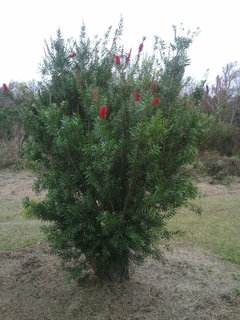
    Here's a bottlebrush tree that had about 2 or 3 trunks. I cut it down to about 2' in Spring and here's what it was after growing all summer ... about 6'-7' height. You can see that there are easily a lot of potential trunks that have returned and they are well arranged in the bouquet form due to light being all around. The trunks would not need tying up because they are already in a nice cone shape. All that need to happen is to lightly trim the top into a dome shape and remove all the scrappy twigs and branches from the lower portion. (If a trunk is to remain, you can't remove more than 50% of its lower foliage. Therefore, if the trunk is short compared to other trunks, you have to make a call if you wish to keep it, or just get rid of it so the other trunks can move on and the overall tree can progress with being limbed up. It depends on how many trunks you want and need.

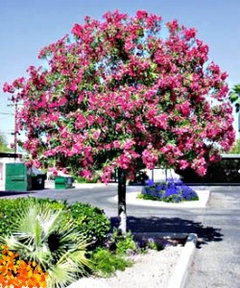
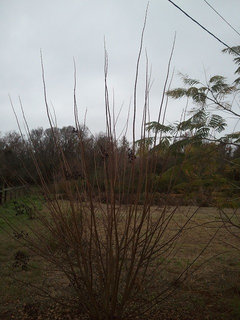
    Below is a crape myrtle that I cut to the ground. The new trunks that regrew that summer ended up as tall or taller than the original plant (tipping out at about 8'.) While there wasn't as much total vegetative mass, what came back was well organized and arranged with great potential. You can see that there are easily a couple of dozen possible trunks in the group.

    Both of the above examples were existing plants with established root systems. For a newly installed plant, one might let it grow for a year, trying to achieve as much root system growth as possible before cutting it back severely. Overall, I prefer trunks that are more or less straight without knotty looking zig-zagging from ground to canopy. One look I don't care for is a single or double trunk for the first few feet out of the ground, that breaks into a multi-trunk about halfway up to the canopy. They just look homely to me. The break should begin at or very near the ground.

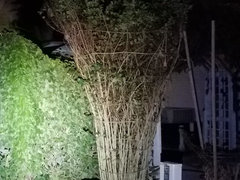
    Below is an example of a crape that was cut in the early spring 2 years ago and that is tied to keep it from being too wide spread. It's tipping out at a little over 9'. Not any of it is yet to the height where the "permanent" canopy will begin. Next spring there will be several feet of new shoots. These can stick out sideways any way they want to form the head that will be temporary for next summer. At the season's end, trunks will be confined to the cone arrangement. Each spring, I untie and trim off ALL twigs and branches -- anything that is not a trunk. As soon as it gets big enough (end of next summer) I will trim the trunks every spring to 10' height. From their tops will come all the branches that make up the head of the tree. Because they will be fresh, long and willowy with a monster flower head at their terminal end, they will create a weeping or semi-weeping character for the tree, which is also what gives it a nice fat, spreading head. It has about 50 trunks (testing the extreme!) Once they fatten up, I don't think one could see through the trunk portion of the tree. )

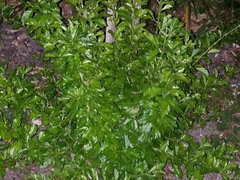
    Below is dewdrop which is commonly grown in Florida as a shrub. Though I've never seen it grown as a tree, just by observing it I'm sure it will get large enough. This one has been 6' tall twice and I've cut it to the ground twice, the last time about 6 weeks ago. It is about 30" high again. The outer trunks splay wide so this plant will require being tied up to if I want to incorporate them into the system, which I do. The central trunks have branched out but I cut all those side branches off (as well as a bit of the leading tips) in order to give the outer trunks, which are slower to develop, some time to catch up. If I'm wrong and the outer trunks won't ever catch up or get in shape, they will be gone as soon as I discover this fact. Since it blooms on new wood it will get the crape myrtle style annual beheading (at about 10' above grade.) Next summer it will be over my head again and there'll be no reason to cut back its height any more. It was a 1-gallon plant to start with, put in last year.

    raymondranch thanked Yardvaark
  • 9 years ago

    Thank you for the pictures and very detailed explanations!

  • 9 years ago
    last modified: 9 years ago

    Most of the examples shown here are shrubs that were limbed up - or tied up - often not to any great benefit, with the part that looks good being that which is above the portion that consists only of bare and often slender stems.

    Photinia etc. that had ever been in containers during the nursery production cycle - as all evergreen photinia would have been - are very likely to be falling over later due to deformed root systems. And not because of some inherent flaw in how the shrub grows.

    Seattle had multiple Fraser Photinia over 30 ft. tall by 2015. At least several Chinese Photinia over 40 ft. tall were also known there at that time, with in additional at least one present there having been determined to be about 50 ft. tall.

    Such size development would not be possible if it were natural for these to topple when small.

  • PRO
    9 years ago

    Em ... you do know you're looking at things all in some young, formative, unfinished stage ... right? My posts in this thread are intended for those with the power to envision possibilities that come later, so the negative criticism seems premature. If this thread was about jewelry, this is talk about the mining stage.

  • 9 years ago

    Yardvaark - Thank you for the detailed examples.

    Very much like cutting a precious gemstone! Study it from all angles, polish small window to check the interior for flaws and envision the finished product before making a single cut.

    April