Software
Houzz Logo Print
ontario_canada5a_usda4b

Hardy JM look-alikes

9 years ago
last modified: 9 years ago

Some of the hardiest Japanese Maple
cultivars are hardy in USDA zone 5, just outside of my zone 4 :-( The Korean Maple
Acer pseudosieboldianum is often recommended as a JM look-alike that is hardy
in zone 4. To my eyes, some staghorn sumac Rhus typhina cultivars are JM look-alikes too, and they are hardy
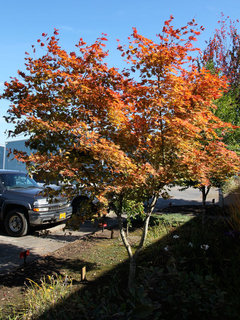
in zone 4 or colder. Compared to the Acer pseudosieboldianum, the Rhus typhina
'Dissecta' in the pic below has even squigglier branches and the branches are
more visible through the foliage, but it suckers like all Rhus do.
(The Rhus typhina 'Bailtiger' TIGER EYES is said to sucker minimally, but that
has been disputed.)

I wonder if there
are any other JM look-alikes that are hardy in zone 4 or colder.

Comments (34)

  • 9 years ago

    Take a look at sambucus 'Black Lace". The foliage is similar to a JM but the trunk isn't squiggly.

  • 9 years ago
    last modified: 9 years ago

    You have A. sieboldianum to grow too. Acer micranthum is zone 5a hardy for sure and should be ok in 4b. Getting A. micranthum is a whole another story. I have access to seed each fall but I rarely go collect it unless someone really wants it.

    There are Madison Arboretum hybrids from Ed Hasselkus. 'Northern Glow' is one of them.

    Dax

  • 9 years ago
    last modified: 9 years ago

    Thanks,
    the black elder Sambucus nigra 'Eva' BLACK LACE in pic #1 below has even quite
    showy and fragrant (lemon-scented) flowers, the shrub grows to 6'-8' x 6'-8',
    it does sucker http://www.missouribotanicalgarden.org/PlantFinder/PlantFinderDetails.aspx?kempercode=c596

    Pic #2 below shows the hybrid Acer pseudosieboldianum x palmatum
    'Haselkus' NORTHERN GLOW, said to grow to 7-10' tall, 5-8' wide in 10 years. Looks like its Korean parent to me (?)

    Acer micrantum would require a sheltered location in my SE facing front yard, would not risk it in my NW facing backyard.


  • 9 years ago
    last modified: 9 years ago

    There are a great many folks who successful grow Japanese maples (Acer palmatum ctvs) in zone 4, so I wouldn't necessarily discount them completely :-) And the paperbark maple, Acer griseum, is typically listed to z4 as well.

  • 9 years ago
    last modified: 9 years ago

    Hey, GG I think you need a 'P' in there somewhere ;-)

    BTW, whoever decided elder flowers smell of lemon has a very different nose from mine.

  • 9 years ago
    last modified: 9 years ago

    'Trost' birch - unless borers might get into it eventually

    Cut-leaved forms of Caragana arborescens

  • 9 years ago

    LOL!! Took me a few to figure out what you meant, floral :-) Edited to correct.

  • 9 years ago

    Never seen a sumac grow very large. I often think of acer platanoides 'Royal Red' looking like large purple-leaf japanese maples. Although, they still don't have the same form and size.

  • 9 years ago
    last modified: 9 years ago

    I am responding to
    several postings with this one post.

    I'd rather not
    attempt any zone pushing with my limited gardening skills. Paperbark maple Acer
    griseum
    has exfoliating bark that reminds me of human skin disease :-(

    Do the flowers of
    the black lace elder smell offensive to some people? If so, it's worth taking a
    note.

    "The bronze
    birch borer Agrilus anxius is distributed across the range of birches in Canada
    and most of the United States ... can also be a serious pest of ornamental
    birches ..." :-(

    I found the Caragana arborescens
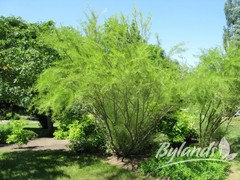
    'Lobergii' with very delicate, feathery fern-like foliage, how beautiful! http://www.bylands.com/plant/fernleaf-caragana-caragana-arborescens-lobergii

    Edit: Others on the net spell it 'Lorbergii'

  • 9 years ago
    last modified: 9 years ago

    Elder flowers in quantity make me feel sick. I've had to put them outside the kitchen on occasion because I couldn't stand the concentrated smell of a bag full.

  • 9 years ago

    A few comments based on my experience in my USDA zone 4b.

    Nice looking Japanese maple specimens are few and far between. Mostly in the sheltered part of the urban core.

    Acer griseum is not fully zone 4 hardy. Unfortunate you done like it. Acer triflorum is hardier with more reliable fall color up here.

    Sambucus 'Black Lace' is a dieback shrub up here to varying degrees every year.

    Look at some Iseli's Japanese x Korean hybrids.

  • 9 years ago

    Unless top grafted 'Trost' is a shrub so I don't know whether or not borers would go after it the same as a normal tree sized birch with a nice trunk to tunnel out.

  • 9 years ago

    "Paperbark Maple Acer Griseum has exfoliating bark that reminds me of human skin disease :-("

    LOL!! I have never heard of exfoliating bark described in quite that manner!! Many folks favor trees that specifically offer this unique characteristic - the paperbark maple, Chinese red birch (and some other birch species), sycamores, stewartias, some dogwoods, crape myrtles, Pacific madrones, eucalyptus, etc. But if not your cup of tea...........:-))

    When planted in the garden, I have never found elderberry flowers to be unpleasantly scented. And the Black Lace cultivar is truly a very attractive JM look-alike but will act more like a die back perennial in your climate.

    While not offering a twisted or squiggly branching structure, ninebarks, Physocarpus opulifolius, can offer coloring and leaf shape very similar to maples and are very hardy - z2. But they also have exfoliating bark, although not nearly as pronounced as the paperbark.

  • 9 years ago

    How about viburnum trilobum? The leaves do look like maple leaves to some degree and it should be quite hardy

  • 9 years ago
    last modified: 9 years ago

    Viburnum trilobum 'Bailey Compact' is hardy to USDA zone 3, rounded shrub grows to 5-6'
    x 5-6'

  • 9 years ago

    Acer griseum is often listed as being hardy into z4, but this is a stretch. I've tried it a few times and a fairly normal cold winter (-25F or colder) will do major damage to the plant. Even in the Twin Cities heat island they will suffer. It seems to me that -20 to -22 is about the limit of their cold hardiness. They'll grow nicely for a few years, but a return to normalcy will inflict substantial dieback. I wonder if someone has ever tried to source seed from a northerly part of their natural range?

    The OP asks for "Japanese Maple look-alikes," but doesn't explain exactly what it is about them they like. There is so much variation within the species due to a dizzying array of cultivars, it might be wise to narrow it down to what you're looking for.

  • 9 years ago
    last modified: 9 years ago

    I wonder if someone has ever tried to source seed from a northerly part of their natural range?

    Apparently doesn't grow above a comparatively low altitude; don't know where all of these provinces are on the map, if any are significantly colder than the others.

    Mixed forests; 1500-2000 m. SE Gansu, SW Henan, W Hubei, NW Hunan, S Shaanxi, S Shanxi, E Sichuan.

    http://www.efloras.org/florataxon.aspx?flora_id=2&taxon_id=200012991

    Have read elsewhere that the species now exists in the wild primarily as solitary individuals or small groupings here and there.

  • 9 years ago
    last modified: 9 years ago

    OP here, I did say and show what I like from a JM
    look-alike, but it is a good idea to repeat and enhance it, so here goes. The
    feature I like most from a JM look-alike is the squiggly wood and the visibility of the squiggly
    wood through the foliage
    .

    The Rhus typhina
    'Dissecta' in the pic below does have the feature (at least to some degree), and it is hardy in USDA zone 3 (desired is
    hardy in my zone 4 or colder). Unfortunately, the Rhus suckers. So, the search
    is for a hardy JM look-alike that does not sucker, and if possible, has even
    squigglier wood, and even airier foliage through which you can see the
    squigglier wood even better :-)

    Or, using the Acer pseudosieboldianum as a reference, the search is for squigglier wood and less dense foliage through which the squigglier wood can be seen even better. FWIW, all hybrids x palmatum that I have seen so far merely look like the Korean parent in this regard :-(

  • 9 years ago
    last modified: 9 years ago

    Yeah, I
    am also looking at the Acer spicatum, the Acer pensylvanicum, and even the much maligned
    Acer ginnala 'Flame'. They are not really JM look-alikes, but it is for a
    different (isolated) planting site in the backyard. I have already a couple of threads going in the
    'Maples' forum that I intend to re-invigorate as soon as I have a chance
    to research the issues a bit better.

    Thanks
    for all the real life experiences, it looks like I can shorten
    my list :-)

  • 9 years ago
    last modified: 9 years ago

    Me again. The Caragana arborescens 'Lorbergii' is not really a JM look-alike either. But it struck me that the beautiful airy shrub in the pic of a previous posting (with wood visible through foliage, BTW :-)) is ideal for contrasting to the dense foliage of a conifer, or as a background for rockery, statuary, etc. Perhaps I should open a thread in the 'Shrubs' forum after doing some research.

  • 9 years ago

    'Flame' as represented in commerce is a variable seed strain so it would probably be better to look at other selections that may be clonal and uniform.

  • 9 years ago

    We can be more specific as to what is being looked for: the branching structure typical of the WEEPING japanese maples.

    Alas, the very name Japanese maple is misleading: While we like to think of names as being specific labels we attach to things in a systematic manner, those who know understand that unless you are using the proper binomial, a name may be grossly misleading...and even if you are using a binomial, there is almost always a variable degree of uncertainty.

    If you were to ask me about Japanese maple substitutes for the far north, I'd be talking primarily about upright growers...Emperor I and A. psuedosibolianum, for example. I'd also mention Imperial Alder, due to leaf shape. Further mentions would be of some of the smaller statured Acer species native to the part of the world that comprises China and Japan.

    To be asking the question in a way and manner as to specifically limit the conversation only to growth habit and branch structure? That's a question I'm not sure I've run across before.

    In that case, I'd be mentioning certain plant selection programs. NDSU in the states, Morden in Canada. I'd talk about the U of MN arboretum in Chaska and their Japanese garden installation. I'd be talking about breeding programs for some the more sever weather in North America, and places where they've tried to replicate Japanese garden styles in public gardens from as far north as I know of.

    I'd have a passing reference to a conversation I was once in where someone tried to convince me that Rhus was every bit as valuable a landscape plant as A. palmatum.

    Then I'd try to answer the question, thinking in terms of some of the more notable architectural forms I've seen in plants from zone 4 and colder, and what it takes to have the structure that seems to be so sought after.

    The list of specific plants I'd be mentioning is limited. Contorted filberts, uncle fogy jack pine, weeping scotch pine. (just to muddle waters with that name confusing issue).

    There are a few more I'd talk about that could, given enough time and a little pruning from time to time, develop into a plant that would have a certain amount of inherent structural interest in the branching. Viburnums would be on this part of the list. We'd be back to revisiting the upright Japanese cultivars...just because it takes a while to develop, even more so when trying to grow at the edges of the range, doesn't mean that it won't eventually...if you are patient enough. I'd be looking at some the larger growing mugo pine...just because it's evergreen and slow growing doesn't mean it can't eventually achieve your goal.

    Then I'd talk about what you can find locally, and I'm not talking about nurseries. I'd be talking about garden tours, parks, campuses, public gardens and arboretums. You're searching for answers at the edges of the map...there's going to be answers people provide thinking they are helpful that you are going to dismiss out of hand. And the best resource I can point you to is to tell you to keep your eyes open. Old specimens are what you are really looking for, but the question is patience and care...a little pruning a long time ago can mean a completely different appearance now. A novel utilization of a pedestrian plant.

  • 9 years ago
    last modified: 9 years ago

    Yeah, as
    the OP I have deliberately let the discussion run open-ended, and I am
    especially grateful for being made aware of the beautiful Siberian pea shrub
    Caragana arborescens 'Lorbergii'.

    Then, a
    couple of posters justifiably asked where the discussion was heading. So, I
    repeated that the most important feature that I am looking for is the squiggly
    wood and the visibility of the squiggly wood through the foliage. (Sure, I like the fern-like foliage and other
    features of some JM cultivars too, and that is part of the reason why a
    discussion like this cannot be too close-ended.)

    I am not sure if the 'squiggly wood' feature is
    strongly correlated to weeping cultivars of Acer palmatum, a counter-example would be the famous and
    often photographed upright tree in the Portland Japanese Garden.

    Let's
    continue with the virtual arboretum, thanks for the suggestions!

    ---------------------------------------------------------------------

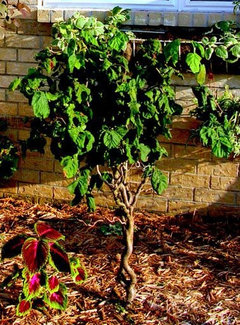
    Contorted
    Filbert Corylus avellana

    All of
    the squiggly wood is visible in the cold season.

    ---------------------------------------------------------------------

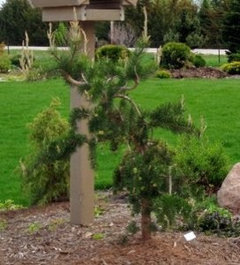
    Pinus
    banksiana
    'Uncle Fogy'

    The
    specimen below has a more or less upright overall structure and sparse foliage
    so that you can see the attractive squiggly detail structure. There are many
    bizarre google images though, and my guess is that you may need to train your
    particular specimen if you don't want your neighbors to throw stares at you :-)

  • 9 years ago

    Just an FYI, but that famous tree in the Portland, OR Japanese Garden IS a weeping dissectum, not an upright cultivar. It is just a very old and venerable specimen that has been carefully trained and pruned to achieve that very sculptural look. Most uprights do not develop that very twisted, gnarly sculptural appearance regardless of pruning or training methods.

    Ontario_Canada5a_USDA4b thanked gardengal48 (PNW Z8/9)
  • 9 years ago
    last modified: 9 years ago

    Ah, thanks! I understand now where squiggly wood comes from. I inherited a 30+ year old creeping Juniper of some
    kind that was completely overgrown. I lopped off the lowest branches and worked
    my way up until it looked good. There is nice squiggly wood there, but only 1' or
    so, o je! 30+ years for 1' of squiggly wood :-( I'm beginning to like the Rhus
    in the above pic, just kidding!

    Kidding aside, here is a nice article about squiggly wood http://gardeninggonewild.com/?p=10734 Hardy in my area is the Corylus avellana ‘Red Majestic’ (scroll down the page for pics and descriptions)

  • 9 years ago

    I have ordinary Rhus typhina, and while I love it, it doesn't grow in the form of your photo, so I am starting to think that anything with the squiggly branches and openness of foliage will take a good amount of pruning to maintain.

  • 9 years ago
    last modified: 9 years ago

    I found
    only 2 cultivars of the Rhus typhina so far that have squiggly wood, the
    'Dissecta' and the 'Laciniata'. I posted a pic of the former cultivar (twice), below is a
    beautiful pic of the latter cultivar Rhus typhina 'Laciniata'. Not sure, but the squiggly wood may
    partly be a natural to those 2 cultivars, plus some pruning perhaps.

    How do you deal with
    the suckering Rhus ?

    (FWIW, my neighbor has a
    small (about 7') old lilac tree of some kind in his front yard that he never prunes, it has some squiggly
    wood but is nonetheless ugly looking to my eyes, it does not sucker, it flowers (and is fragrant) in some years.)

    Rhus typhina 'Laciniata'

  • 9 years ago

    I pull the Tiger Eyes suckers I don't want from the garden once a year and it's not that many. Definitely with it for this plant.

  • 9 years ago

    For zones 5b/maybe 5a I don't know, Rhus chinensis 'September Beauty' is a dandy of a tree. I drowned mine accidentally after five or so years in-ground not knowing it wouldn't handle being soggy.

    I planted it at the bottom of a natural erosion ditch and it died during summer monsoon-type, rains. Super tree though - I really liked it a lot. It doesn't sucker heavily and I just mowed any suckers off.

    That 'Laciniata' is pretty super-looking, too. And 'Tiger Eyes' is an eye-catcher anytime I come across one. Never have seen a tall one in person. I usually see them at 4-6' w/o a distinguishable, single trunk.

    Dax


  • 9 years ago

    We maintain the size of our Rhus typhina clump by mowing around it. I wouldn't plant it in a garden, but surrounded by grass that gets mown keeps it under control. I particularly like the almost psychedelically bright fall color and the tall candles of seeds that decorate it for much of the winter.

  • 9 years ago
    last modified: 9 years ago

    I
    did not find any berries of the tiger eyes sumac on google images ... is it
    just me or are the berries of this particular cultivar that inconspicuous?

    Related: how do you make sure that the Rhus you buy in early spring is a female plant?

  • Ontario_Canada5a_USDA4b thanked floral_uk z.8/9 SW UK
  • 9 years ago

    Looks like giant ferns that dinosaurs dined on, not that I was there myself. Anyway, nice squiggly wood!

    Rhus typhina 'Bailtiger' TIGER EYES