Software
Houzz Logo Print
ontario_canada5a_usda4b

Will a raised and walled bed control suckering?

I am considering
planting either a dwarf Korean lilac shrub Syringa meyeri 'Palibin' or a tiger
eyes sumac. They are said to sucker less, but they do sucker, and I wonder if I
can contain the suckering to within a raised and walled bed. How deep do the roots
go?


I could easily build a dry-stacked wall of 3 layers of 3-4" stones for
a 9-12" tall and 3-4" thick wall with a batter (backward slant) of
1-2", perhaps with some gravel backfill for even more slant in case I like a contoured wall. The diameter of the bed will be 5-6'. I will prune the plants small,
essentially to not overhang the bed and to 4-5' tall.


Will that contain
the lilac or sumac to inside the raised bed? I don't mind maintaining the area inside the bed, but I want to avoid spreading to outside the bed.

Comments (33)

  • 9 years ago

    Thanks for the
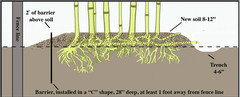
    reference to bamboos! I found the schematic below from the bamboos planting
    site http://www.bamboogarden.com/barrier%20installation.htm

    Applying the
    schematic to my case, the above grade portion of the root/rhizome barrier would
    be hidden behind the stone wall, which acts as a mere
    decorative brick veneer.

    The schematic applies to bamboos that grows 20' and taller. I wonder how I should
    scale that down for the Sumac (or Lilac) that I will maintain at 5' or shorter.
    Mere mathematically scaling down by a factor of 4 says that the barrier does
    not have to go down below grade. Of course, that does not take into account how
    deeply below soil level the roots of the Sumac (or Lilac) can tunnel under.

    Or can the roots of the Sumac (or Lilac) tunnel under 8" of soil? 12"? 16"? On the one hand, I don't want to raise the bed unnecessarily high (or dig too deep), on the other hand, I want to be reasonably sure to prevent any tunneling under.

  • 9 years ago

    The height of the plant isn't relevant to how deep the root barrier needs to be. It is the propensity of roots to run along and under the surface that is relevant. Placing the barrier doesn't really involve much digging, just the making of a slit to the required depth. As your diagram shows only 2 inches of barrier needs to be above the soil surface so a wall isn't really required.

  • 9 years ago

    There is this thing called a lawnmower. One of its purposes is the restraint of aggressive plants that don't like being 4 inches tall.

    Bamboo is somewhat unusual in that the culms that do the actual spreading are very shallow. I know running roses can go under a barrier a foot deep and escape, and I have no reason to believe sumac isn't as bad.

    I agree that as far as lilacs go, only Syringa vulgaris spreads by suckers. And yes, whenever it gets a bit rambunctious, it meets Mr. John Deere, and that is the end of that.

  • 9 years ago

    The taller bamboos have bigger roots than the shorter bamboos. And can get under a barrier of some depth.

    Ask me how I know.

  • 9 years ago

    Flora, you overlook that the new soil in the schematic is 8-12" above grade. That's the raised soil level for the plants. The stone wall hides the sides (and the barrier and the gravel backfill and whatever else may be needed for the construction) of the raised 8-12" of soil above grade.

    Anyway, the above is a red herring.

    The key question is this: how deep can the plant tunnel under to grow suckers 'on the other side'? According to the schematic, bamboo can no longer tunnel under 36-40".

    How many inches deep is that for the given Sumac and the given Lilac?

  • 9 years ago

    Like all other sumacs, has a relatively shallow root system so your standard bamboo barrier (30") should work fine. The lilac doesn't sucker to any significant extent so is not a concern in this regard.

  • 9 years ago

    LOL, I have the
    infamous 4" builder's top soil, below it is construction rubble. Most local
    stores here sell only 4" edging strips, you usually can't get them any deeper, let
    alone 30"! Hence the raised bed in my original post of 9-12". And
    hence pruning the plant to 5' or shorter so that it has a smaller root system
    that won't be able to tunnel as deeply.

    The issue comes down to whether the
    given plants pruned to 5' or shorter can tunnel under 13-16" of top soil +
    an undefined layer of construction rubble. (Raising the bed more than 12" becomes a cost, my DIY labour and an aesthetics issue. If 12" is not enough, then different plants are needed.)

    Maybe the given
    Lilac is a safer planting than the given Sumac, I am not quite convinced yet.
    Reading through many, many postings, the plants behave well (few suckers if
    any) and that's when people are all smiles and post happy postings. Then, one
    day, the plants follow their natural reproductive habits and sucker wildly, and
    that's when people are all frowns and post unhappy postings.

  • 9 years ago

    I think you are making this out to be a much bigger/more complicated project than it is. Line your raised bed with whatever barrier material you wish and plant the dang plants!! The lilac will NOT sucker enough to be any sort of concern and the sumac roots are unlikely to be deep enough to tunnel under the wall but you can just mow them off if they do.

    Or plant something else entirely that won't pose these concerns.

  • 9 years ago

    Thanks,
    whenever I can, I always consider 10+ options before choosing the best one, there is 4-5 months
    time anyway. But back on topic, it is really strange that tunnel depth is such
    a great unknown.

  • 9 years ago

    You can use 'flashing' for a root barrier. Go to a big box store that sells roofing materials. When installing it be sure to angle the top out so if a sucker grows up against the flashing it will curve up rather than down and possibly under it.


  • 9 years ago

    Maybe I didn't express my thoughts clearly. I didn't overlook anything. The height of the barrier above the soil surface is not affected by how high that soil is piled up. And it is not possible to extrapolate how deep a barrier needs to be for one species by looking at another, different species. Different height bamboos might need different depth barriers but that fact doesn't help one determine the necessary depth for sumac. Pruning the sumac down won't affect the depth of its roots. And that depth is not going to be a fixed figure. It depends a lot on what the substrate is and the health of the plant. However, I agree with GG that this being made far more complicated than need be. I would suggest that building a raised bed and retaining wall is a disproportionate effort compared with mowing or digging out some suckers when, or if, they arise.

  • 9 years ago

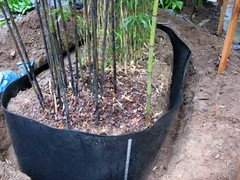
    Angling the top out may not help, see the photo below that has 2-4" vertical above soil level to prevent over the air bridging. That's for bamboo, not sure how that translates for the given Sumac and the given Lilac.

    In any case, angling out or vertical, various materials, etc., the most basic requirement is depth, hence the inches that I keep mentioning.

  • 9 years ago
    last modified: 9 years ago

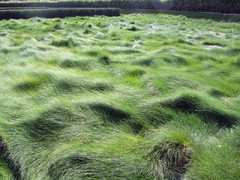
    I have a beautiful unmowed fescue lawn in my backyard that automatically keeps weeds down and is home to small wildlife that I love. I don't want to disturb all that. I will merely reclaim a small patch of about 100 sq ft for this project. Let's discuss facts and figures, including inches, mere assertions don't do it for me, thanks!

  • 9 years ago

    I've had Palibin for many years--close to 15, and suckering is practically non existant. A few suckers may appear, but they are quite close to the plant. S. vulgaris suckers much more.

  • 9 years ago
    last modified: 9 years ago

    Thanks for the testimonial! This is part of a bigger project, BTW. For example, I have a 30" tall pagoda that will be part of the stonewall. This thread is about the most important plant in the project. Big headache if the plant misbehaves.

    FWIW, here is an earlier planning version of the same project http://forums.gardenweb.com/discussions/4242435/your-gardening-plans-and-dreams?n=18

  • 9 years ago
    last modified: 9 years ago

    On the issue of the
    Palibin and the tiger eyes sumac suckering or not, one important variable could be the
    various unknown rootstocks the scions are grafted on. I am just trying to
    reconcile the differing accounts that actual gardeners are posting.

    If so, then the
    discussion on suckering ought to focus on rootstocks. Discussing scions would be discussing the wrong thing.

  • 9 years ago

    To my knowledge, neither of these plants is typically grafted.

  • 9 years ago
    last modified: 9 years ago

    Thanks GG, and it is true that in this thread, I focussed on the Palibin shrub. In the previous planning version of the same project that I linked to, I have considered (and still have not completely discarded yet) the Palibin tree which is grafted, usually on a 4' standard in local nurseries around here, and it never says on the label what the rootstock is that the scion is grafted on. If the rootstock is vulgaris then the suckering habit is presumably that of the vulgaris. Hope I am wrong.

    In the greater scheme of things, I see 'own root vs graft' distinctions being mentioned only in discussing roses, at least in my readings so far. The 'own root vs graft' distinction is typically not mentioned for other plants. If, for example, a reputable grower is confident that its Palibin shrub does not sucker, why not mention that plus mention 'own root' on the label?

  • 9 years ago

    Because the vast majority of woody plants - trees and shrubs - are grown on their own roots. It is only when you get to dwarfing issues (like with fruits trees) or unusual presentations (like grafted standards) that one typically encounters grafted plants. Roses and Japanese maples are different, generally to preserve cultivar identity or in the case of roses, to increase hardiness. There is also work being done on grafting certain conifers to disease resistant rootstocks, but that's a completely different issue.

  • 9 years ago

    Palibin

    Missouri Botanical
    Garden: non-suckering

    Monrovia (large
    grower): says only 'spreading'

    Gardeners' accounts:
    mixed, from non-suckering to suckering wildly

    -------------------------------------------

    Tiger eyes sumac

    Missouri Botanical
    Garden: will slowly spread by suckering

    Monrovia (large
    grower): says nothing about suckering or spreading

    Gardeners' accounts:
    mixed, from non-suckering to suckering wildly

  • 9 years ago

    In any event, I'd put in a root barrier just to be safe and put your mind at ease. Why take a chance?

    To clarify my previous post I'd like say that when installing the barrier the whole thing should be slanted up and out, not just the top. \ / You wouldn't have to buy very much flashing so you should get the widest possible for your application to prevent roots going under it.


  • 9 years ago
    last modified: 9 years ago

    Thanks, Mike, the
    most basic issue is depth. I can only dig 4" below grade (the infamous
    4" of builders' top soil), deeper than 4" (at that location) is
    construction rubble. I can only raise the soil 9-12" above grade because of the rest
    of the project. I'm not sure if 13-16" (4" plus 9-12") is
    sufficient depth to prevent tunnelling under. The bamboo site that I linked to
    has a root barrier depth of 36-40" to prevent tunnelling under but that's bamboo, not sure how to
    translate that to the tunnelling under depth of the given Lilac and the given Sumac.

    The \ / may deflect roots below soil level, but it may encourage 'over the air bridging' above soil level. Maybe straightening up the top of the root barrier above soil level or even bending the top of the root barrier above soil level inwardly will help prevent 'over the air bridging', not sure.

    Then there are root
    bound issues if the root barrier completely encircles the planting. The bamboo
    site therefore recommends an open C-shape of the root barrier and doing regular root
    pruning at the opening of the root barrier ... sounds like high maintenance ...

    One could conceivably do \__/ with or without straightening up the top of the root barrier above soil level or even bending the top of the root barrier above soil level inwardly ... essentially putting a huge pot in the ground ... more root bound issues ...

    Most or all of the above could be avoided if the tunnel depth of the given Lilac and the given Sumac is known ... but it is not ...

  • 9 years ago

    The barrier will deflect the roots upward and over, where they're visible and easily cut.

    Can you describe 'construction rubble'. I'm kinda vague on that. It could be anything.

  • 9 years ago

    The
    roots that are deflected are those above the root barrier, it may be part of
    the solution. However, there are other issues, the most basic issue being if the tunnelling depth of
    the roots is below the root barrier, then those roots will tunnel under the
    root barrier.

    Construction rubble IS anything, look at the rubble scattered around at a typical building
    construction site. Construction rubble is bulldozed flat with the subsoil and 4" of top
    soil is spread on top of it (or 1" of top soil plus sod) right before the property is put up for sale.

  • 9 years ago

    It is highly unlikely that the shrubs' roots will be able to tunnel deeply enough to pose an issue. Shrubs by and large do not have deeply penetrating roots - even most trees have 85% or more their root system within the top 12" of the soil. Bamboos are a unique case, hence the width of the barriers.

  • 9 years ago

    "... standard
    bamboo barrier (30") should work fine ..."

    "... even most
    trees have 85% or more their root system within the top 12" of the soil
    ..."

    ^^ considerable
    uncertainty as to tunnel depth in inches, which is very strange, as I said
    before.

    Maybe I should elaborate a
    little on 'strange'. Root barriers are basic tools, and one could expect it to
    have been systematically researched long, long time ago. For example, tunnel depth
    is almost certainly deeper for a thin barrier material like sheet metal. Tunnel
    depth is almost certainly shallower for a thick barrier material like 1' thick
    concrete, because the roots not only have to dive, but also have to traverse
    the 1' before being able to move upwardly to sucker on the other side of the
    thick barrier. High school level science would graph that as a dependency curve
    depicting the dependency of tunnel depth vs thickness of barrier material ...
    for the various species ... for the various parameters of growing conditions
    ... etc. Maybe you don't even agree with what I just said, frankly it doesn't really matter. Rather, the point is this: 'if you can't put numbers to the facts, you can't really use the facts' ... strange for such a basic tool as a root barrier ... one could not really use nuts and bolts without putting numbers to those nuts and bolts either ...

    Not that I am in distress or something, I still have 4-5 months of planning time :-)

  • 9 years ago

    Barrier thickness has little to do with the ability of bamboo roots to tunnel under it. Once it's under the barrier, one foot won't slow it down at all.

    You sound like an engineer that needs to see things in numbers only. Landscaping is not an exact science and deals more in generalities. From my point of view you're over thinking the problem and resisting our advice. I gave you the pertinent information from what I know after forty years in the business. That includes design, installation, and growing the plants myself. I have groves of three different kinds of bamboo totally more than 5,000 sq. ft.

    Gardengal48 is a horticulturist with a degree and impeccable credentials in the nursery, installation and design fields.

    'Nuff said.

  • 9 years ago

    No need to get upset because of different views - there are different views from Missouri Botanical Gardens, Monrovia, etc.

  • 9 years ago

    There are a lot more variables to consider, which is why 'hard' information isn't easy to get. Root depth is not only a function of species, but also soil type, and water availability. There also seems to be a climate variable in how badly species sucker. So there are plants that will sucker in eastern Ontario that will not sucker in western Ontario. Also, aside from bamboo, there aren't all that many plants where root barriers are used. The more typical route is to not use that plant, but substitute something that avoids that issue. That may be why the shrubby lilacs have become quite popular. They are very well behaved regarding size. It is also why there are many people, myself included, who would never plant a sumac in a garden bed.

  • 9 years ago

    This^. We're discussing variables as if they are set points. Plants do not perform to a set of specifications. Further, as mad states above, we're talking here as if a given plant acts exactly the same regardless where it gets planted. This whole conversation has an edge of unreality to it, as if plants are widgets that can be expected to behave in exactly a certain manner. But this is biology, things happen across a range of conditions. Were this not so, not only would there be no plants for us to be discussing, but we ourselves also would not be here. Living organisms succeed when they are adapted to a range of conditions.

    I wish this whole thing had started out with a different paradigm than "tunneling". That misses what roots really do, which is colonize soil. Roots are not "tunneling" around for the hell of it. They are actively seeking out cracks and lenses in the soil where there is some feature that makes the root tip want to travel in that direction. Any barrier, so long as it really is a solid obstruction, should serve your purpose here. The key is that the material be truly solid with no breaks. Anything less than this, the roots will find a way. And over time, with practices like mulching, etc. roots can escape from the top. Hence the mentions of the barrier shape at top.

  • 9 years ago

    Any barrier, so long as it really is a solid obstruction, should serve your purpose here.

    ^ can't be correct without mentioning barrier depth.

    If your doctor varies the dosage of your medication as much as barrier depth in this thread, you would be long dead.

    Anyway, let's agree to disagree, I have no desire to continue this discussion.

  • 9 years ago

    "I have no desire to continue this discussion."

    That does seem best, as it appears you have no need to consider the advice and experience from folk who have gardened under a lot of different conditions with a lot of different plants in a lot of different areas. Not sure why you feel the need to overly complicate things - try it. If it doesn't work, remove and try something else. Much of gardening IS trial and error - that's why taking advice from those who might be more experienced than you can be beneficial. There are really no absolutes in gardening as Tom mentioned above. Plants will respond differently to different conditions and there is often no way to predict what they will be under your specific conditions other than giving it a try.