

best hydronic radiant floor heating for new 2-story with basement?
We are planning to build a 2 story 3500 sf house with a finished 1500 sf walk out basement. The foyer and the living/great room are open to the second floor. Basement will likely use engineering wood. Main floor will be hardwood plank and second floor will be carpet.
ideally, I would like to only use radiant heat for the whole house and forego the forced air. We will just install the AC system. We plan to build a house that is pretty tight with insulation. Cost is definitely a big factor in deciding what to do. We are pretty set on radiant floor heating for basement. I would like to have the main floor with radiant heat but understand the limitation with hardwood floor. of course, carpet is not ideal for radiant heat. I am trying to figure out what is the most cost effective but also reliable and well performed system. I want to know if it will fit our budget to have radiant heat on main and/or second floor. We live in northwest Indiana.
Any advices or suggestions will be greatly appreciated. Thanks!
Comments (25)
 9 years ago
We are doing hydronic radiant throughout the house, basement and garage. It will be in the concrete through the basement and garages and using warmboard on upper two stories. Multiple zones, 12-14 if I recall, in a duplex. Estimating about 84,000 for about 3200 sq ft basement and garage, and 5177 finished main and upper. The warmboard was $41,818 alone so it adds to the cost significantly over staple up pex, but also serves as subfloor and greatly enhances comfort and cuts operating costs. Carpet and hardwoods are fine over this, but need an upgraded special pad. Fortunately, AC is unnecessary in our climate (High in the Rockies) -- there are about 5-10 summer afternoons a year when AC would be nice to have upstairs, but with ceiling fans not bad at all.
Rebecca L thanked mojomom 9 years ago
For larger homes hydronic heating can be very economical to run unless you need to add AC too. I received a hydronic radiant quote covering ,my initial design 7800 sq ft finished main (no basement included at that time) equipment only for boiler, valves etc. and pex for Eleven Zone Closed System with Polaris Water Heater is around $17,000, a very keen quote I may add. Please note $17k is for material only. To that, one would add cost of AC $30k plus warmboard,some silly number, which is also under consideration. Now that I've cut finished area by 1500sq ft to 6300sq ft, I am still pursuing the same goals however now also considering electric radiant floors (with since AC install is firm and cheap solar power.
Rebecca L thanked PinebaronRelated Professionals
Charlottesville Architects & Building Designers · Sioux City Architects & Building Designers · Marquette Architects & Building Designers · Watertown Architects & Building Designers · La Grande Architects & Building Designers · Pullman Architects & Building Designers · Amherstburg Architects & Building Designers · Queens Architects & Building Designers · West Palm Beach Design-Build Firms · Frisco Design-Build Firms · Dalton Home Builders · Beaumont Home Builders · Hartford Home Builders · Syracuse Home Builders · Spokane Home BuildersRebecca L
Original Author9 years agoThanks so much for sharing your projects and insights with me!
Mojomom - I have looked into warmboard and they are so much more expensive. I like the product but not sure if it's really worth that much more. What is your main reason to go with warmboard? Do you have pex in the concrete slab in the basement? Do you use one boiler for the whole house?
PineBaron - If I don't install forced air heating system, how much am I saving on the HVAC system by installing AC only? I am trying to figure out how much more the radiant heat system is going to cost me comparing to the traditional system. Are you using warmboard?
- 9 years ago
Warmboard is more efficient and heats up faster and uses a lower temperature for the same heat, so lower cost to operate. The one negative to any hydronic syytem is the time it takes to heat up, if you have it down while out of town, it takes time to heat back up and warmboard cuts that lag significantly. Also warmboard serves as the subfloor, you do get to cut the subfloor at about 1.00 a square foot saving and running the tubes is quicker with warmboard rather than staple up so slightly less labor cost,
Looking at staple-up being installed at a house down the street was a deciding factor. It just lucked sloppy and less effective. Yes, we did pex in the basement slab as well as in the garage slab. It's a duplex, so two boilers, it helps that our SIL is a master plumber (exclusively buildining, and primarily high end and very high end homes). He has installed all types of systems and recommends the warm board. Also without him, the price would have been about 20% higher, it is a splurge for us, but feel that it's the right splurge.
Rebecca L thanked mojomom - 9 years ago
Rebecca, Perhaps not the answer you're looking for, any
type of professionally installed whole house radiant floor heating is
expensive, even if not using hydronic and warmboard. But
assuming for a moment you are fine with its costs, an alternative to
central AC is a ductless AC system which is not cheap either, how much
more or less depends on how many zones and BTU needed to cool your home;
a local professional can advise best.Overall, if you need
both heating and cooling and if just looking at installation and up
front costs, the cheapest by far will be a standard central forced air
AC system, a little more if using high quality heat pumps. Ignoring hydronic heating for a moment, you
can still have electric radiant floor heating in bathrooms and other
critical tiled areas, carbon film heating if heating hardwood, although
radiant heating efficiencies drop off rapidly beneath carpet or hardwood floors.Consider
paying $7-$10/sq ft installation or $15-$18/sq ft inclusive for baths,
entry ways etc. Rates vary by location and size of job no doubt.Rebecca L thanked Pinebaron - 9 years ago
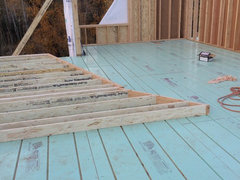
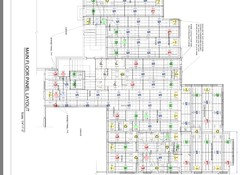
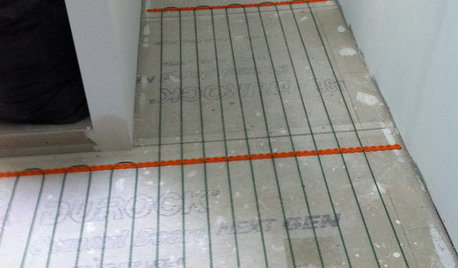
Here here are pics of the pex going in in the basement and the warmboard installed on the second story. I'll also see if I can find the warmboard plan from the company for the main floor.

 Rebecca L thanked mojomom
 Rebecca L
Original Author9 years agoMojomom. Thanks so much for the picture. I really wish I can splurge on warmboard because I like the product a lot. We don't have the final budget for the house yet since we are still at the planning stage. But I doubt that we could afford it. What kind of flooring are you putting over it?
I don't like the idea of putting concrete slab on the main and second floor. And I am not sure about putting it between the joist. It does not seem to be very efficient. Does your SIL know of any similar system to warmboard at a cheaper price?
Rebecca L
Original Author9 years agoPineBaron - What make you decide to use water heater instead of boiler? Is it gas or electric? I am trying to learn about the pros and cons of each. It seems like boiler is more popular option but I heard the argument that boiler are engineered to make very hot water.
- 9 years agolast modified: 9 years ago
Rebecca, while warmboard was a splurge, we actually are skimping on the flooring because I fell in love with a LVP flooring -- Cortec Blackstone Oak. I've had beautiful hardwoods for the last 36 years, but with dogs we've had to refinish a few times in the main traffic rooms and we are moving to a snowy climate and with big arctic dogs who insist on a doggie door to go in and out as they please, I wanted something that could handle wet/snowy paws better. We considered tile, but we have an open plan, I like to cook and at my age I am noticing how hard tile is on my back standing in the kitchen, so cork backed LVP really was the best choice for us and a welcome savings. We are putting carpet in the bedrooms because that's what we prefer and tile in baths and laundry. Also to be honest, if we needed AC we probably would have looked at something different. I'm actually thrilled not to have AC, because I spend more time cold in the summers in the house down in the humid south than I do in the mountains in the cold, but not humid, winters, and I don't like forced air (but that's just my personal comfort preferences).
Edited to add, our builder mentioned Viega as a lower cost alternative and SIL said it looked fine but he preferred warmboard simply because he was more familiar with it and knows how nice it is.
Rebecca L thanked mojomom - 9 years ago
Rebecca, Thats a misnomer; Polaris Water Heater is actually a boiler dedicated to radiant heating, I just cut and paste the name from the quote. Home water heaters will be a two tankless water heaters with circulating pumps. All heaters will be gas though I considered electric, however gas is cheap in this region.
Rebecca L thanked Pinebaron - 9 years agolast modified: 9 years ago
Polaris Water Heater is actually a boiler dedicated to radiant heating
A water heater (even the Polaris) is not a boiler. To be honest I thought the only companies that were peddling Polaris Water Heaters were some of the canned DIY internet radiant guys (radiantcompany and radiantec), mostly because they want you buy from them and have a system that any plumber could install, rather than someone who specializes in boilers and radiant systems. I don't like Polaris Water Heaters, nor do I like businesses that peddle them. They are ridiculously expensive, they cost twice as much as boilers and ten times more than a comparable water heater. They are good quality but businesses recommend them because they have a very high retail markup and good warranty coverage. Of course, when you pay for 10 water heaters up front the company is fine with giving you another one in 8 years.
Water heaters are designed a lot differently than a boiler. Boilers are much better at heating water a few degrees very quickly and water heaters are designed to heat water many more degrees and much slower. Boilers are much more efficient than water heaters at doing this. Those Polaris water heaters are not running 95% efficient unless your water coming in is like 80 degrees, which it will not be.
For a really small home water heaters can be fine, the extra cost for a boiler doesn't make much sense when you are heating a 1,000 square foot home. However, in any sizable home a boiler will make more sense. Most professionals will go with boilers at any size but with larger systems they are just better.
To the OP: I love radiant heat. It is the most comfortable heat I have ever had and I do miss it, but if you live in a climate that has to have central air conditioning, then radiant doesn't make sense. I have used warmboard and I do love it, but I will never have another home with it.
Rebecca L thanked bry911 - 9 years ago
bry911 I'll certainly look into it but specs looked quite impressive.
The Polaris
is a “tank-type” water heater. It heats water at 96% efficiency,
slightly better than the Takagi on-demand unit. But because the Polaris
stores 50 gallons of hot water, it suffers from “stand-by heat loss” and
that fact lowers its overall efficiency.Polaris Water Heater
The upfront cost of a Polaris is also high due to its stainless steel
tank. However, the Polaris has proved to be a consistently reliable
machine and if your heating requirements approach 100,000 BTU’s or
greater, the Polaris will start to pay for itself with fuel savings from
the moment you fire it up.Its many excellent features include, as mentioned, an all stainless
steel tank, an igniter instead of a wasteful pilot light, a rating of
130,000 BTUs (or up to 199,000 on some models) and, of course, its
amazing efficiency. The Polaris is a high recovery water heater, making
over 160 gallons of hot water per hour! In most homes, one Polaris can
heat plenty of water for all domestic needs AND provide 100% of the
home’s heating. The Polaris comes with a 10 year warranty on the
stainless steel tank and shipping is free.Rebecca L thanked Pinebaron  9 years agolast modified: 9 years ago
Economics be damned. Radiant basement heating has become a de facto "luxury" home feature in this part of the world. Personally, I've opted for insulating under the slab instead; any extra winter heat is easily supplied by the gas fireplaces. Since AC is also a requirement in this climate, radiant is not an economic choice. Clients have instead used electrical under bathroom floors.
Rebecca L thanked worthy- 9 years agolast modified: 9 years ago
PineBaron - The specs are garbage. I am very familiar with Polaris water heaters and don't like them. They have ridiculous installation requirements - 3/4" gas line to the water heater is silly in a home.
Water heaters are not boilers - the physics involved are completely different. While they both heat water - they do so in completely different ways. To think everything designed to provide heated water is the same is like saying a bicycle and a car are the same because they are both designed to get you someplace else. In this analogy you are using a car instead of a bicycle but you are only going 200' to your neighbor's house and maybe the car will take longer.
Water heaters operate differently than many people think. Water heaters take a lot of cold water - apply a lot of heat and warm it up somewhat quickly, the water in the water heater is actually different temperatures - the hottest water is at the top and the coolest at the bottom. When you demand hot water, it is taken from the top and new cool water is brought into the bottom and immediately starts mixing with the hot water in the tank, but stays at the bottom of the tank. Tanks never empty - a 50 gallon tank always has 50 gallons of water, the water at the bottom is cool but the water provided to the home is warm because it comes off the top. The gas fires up and that cold water is heated.
The idea that a 150,000 btu burner is the most efficient way to heat a steady small flow of water 20 degrees is crazy. Polaris have been criticized many times for inflating their efficiency but they even note that the intake temperature has to be under 90 degrees to get that efficiency. This will never happen in a properly designed radiant system. They are quoting an AFUE of 95% but that is a worthless number for radiant heating. They are really getting much less efficiency. Some people will tell you close to 90% but I doubt they are even getting that really.
In the end, a water heater is designed to intermittently turn lots of cold water into lots of hot water and keep it there, while a boiler is meant to turn a steady amount of hot water into hotter water and ship it out. You are using either on a system that sends out steady amounts of hot water. The idea that a water heater will be better at it defies logic.
Polaris are very good at doing what they were designed to do. Provide hot water in small commercial environments that have more frequent hot water demands than a home. They are good at getting water up to temp pretty fast. Even their savings analysis is done vs. commercial installations. They compare the average $4,500 installed Polaris cost to the average "$4,100" traditional water heater. But a 50 gallon home water heater bought at a big box store is less than $800 installed. However, really they are overkill for a home. Even redundant smaller water heaters will be cheaper and more reliable for home water and way way better for a radiant system.
In the end, the only difference is cost to operate. Anything that will provide hot water will work. But a boiler will be cheaper to operate than a water heater for most homes and cost less. Even if the efficiency is what they claim the payback period for the Polaris is crazy.
Rebecca L thanked bry911 Rebecca L
Original Author9 years agoI want to thank everyone who has been posting on this thread. This is my first post and I am so thankful for everyone's input. I have learned so much in the last few days and really appreciate your time in sharing your experience and insights with me. What a great community!!!
It is difficult to get unbiased information from the manufacturer / installer's website as everyone is trying to sell their product. We unfortunately need an AC system even though we only have about 2-3 months of summer. We live in northwest Indiana. I don't know how to figure out how much extra we will be paying for the radiant heat instead of a traditional HVAC system. Do you save any money for not installing forced air heat for the basement and/or main floor and or second floor?
Mojomom - I am looking into Viega. Thanks for the tips. I wish I can do a cheaper flooring but husband is set on having hardwood floor.
bry911 - how long did you have the warmboard system? did you have any problem with it?
Rebecca L
Original Author9 years agoBry911. Thanks for the education. I have been trying to understand the differences and you really explain it very well to me.
- 9 years agolast modified: 9 years ago
Rebecca -
I don't know how to figure out how much extra we will be paying for the radiant heat instead of a traditional HVAC system. Do you save any money for not installing forced air heat for the basement and/or main floor and or second floor?
Yes, but it is a very small amount. Split air conditioning has three components - (1) A condenser - the outside part (2) the evaporator coil (the inside part that cools the air) (3) the air handler that blows the air.
In a system that cools and heats using a gas furnace the air handler is combined with the furnace, so you still have three parts. A good air handler will cost about $1,200 to $1,800 while a good furnace (with the same air handler) would cost about $1,800 to $3,000. So in the end, you don't save that much.
how long did you have the warmboard system? did you have any problem with it?
About 3 years - no problems with it and I loved it. They are actually excellent people to work with and I like them. Whether it is worth the money really depends on your heating needs. If you have varying on demand heating needs and want to take advantage of energy savings when you are not home then Warmboard is great.
I encourage you to find someone experienced in your area. There are some people who prefer properly designed gypcrete overpour which is a lot cheaper and good in a different way. Warmboard gives you very responsive (for radiant) heat because it has high transfer but low mass. Gypcrete systems give you low transfer but high mass. You are essentially comparing cooking on a gas grill to cooking on charcoal. The charcoal is harder to heat but once heated stays hot for a long period of time, the gas heats up when you need it but doesn't maintain that heat.
Rebecca L thanked bry911 Rebecca L
Original Author9 years agoI am now looking at several different systems. Love the warmboard but price is too high for my budget. I think I am leaning towards something similar, a panel board with aluminum over subfloor for the main and second floor. Anyone have any experiences or opinions on sunboard panel, thermofin (radiantengineering), raupanel (warmzone), viega and uponor?
- 9 years ago
Springtime Builders was suggesting that air sealing, insulation and good windows would have a much quicker and better return. He is on to something. When we were building DH had it in his head that he wanted geothermal for both heating and air conditioning. Our builder crunched the numbers with us both in relation to cost to build and cost to operate. Air sealing, spray insulation and really good windows blew it away. These items are passive and you only pay for them once. We learned a valuable lesson and I think it may translate to this situation, too.
If money is not object, go ahead with the radiant floor heating. I've had it in another home. It's lovely, comfortable and expensive.
Rebecca L thanked homechef59 Rebecca L
Original Author9 years agoHomechef59- thanks for the feedback.
I agree that a tight house is going to be a better return. I have to admit that the radiant heat is more for comfort than money saving. I may have talked myself into it initially by thinking it's energy saving and therefore equal to cost saving. We do plan to have good insulation and hopefully with a goal of HERS rating between 50-60. Our builder will use the zip system and spray foam insulation. We plan to have double pane window with low-e coating but may consider triple pane for the large windows in the great room. Not sure about the cost effectiveness of that. It is another area I have to research about. So much to learn about house building.
I do want to splurge a bit on the radiant floor heating but still within the budget. I guess I am trying to find a good quality system without breaking the bank. I am not looking for the cheapest system but something mid-range and still reliable. I also need something that is durable so I don't need to deal with any major headache in 10-20 years. Any advices on that? What system did you have?
Rebecca L
Original Author9 years agobry911 - forgot to thank you for the education on the HVAC system. It really helps me figuring out that this project is not about cost saving on the overall budget. It is about finding the most cost effective system in order to provide additional comfort. I am trying to find out whether I can afford such a luxury in the first place.
I looked at the Gypcrete system and somehow feels uneasy about it. Doing a concrete pour over first and second floor does not sound structurally sound to me. But then I have limited understanding on how the structure of the house works. I don't need a very responsive system. Since you have chosen warmboard over gypcrete, what was your reasoning behind it besides responsiveness? Sunboard panel looks like similar to warmboard at a much cheaper price. Do you think it will perform well?
- 9 years agolast modified: 9 years ago
Since you have chosen warmboard over gypcrete, what was your reasoning behind it besides responsiveness?
I am sorry for the confusion. I didn't build a house with Warmboard, I had it in a house where original owner had installed it. It wasn't a house I built. I used it in the sense that I heated the house with it.
I looked at the Gypcrete system and somehow feels uneasy about it. Doing a concrete pour over first and second floor does not sound structurally sound to me.
Gypcrete has positives and negatives but shouldn't be overlooked because of structurally sound. I think a competent and knowledgeable designer is much more important than which type of system you use. So if you don't have a lot of experienced local people, you have to find experienced people who can help design at a distance. I would start with Radiant Engineering (talk to many companies though).
A long somewhat unbiased discussion of radiant:
First, it should be noted that radiant heat isn't an efficiency discussion. As people have pointed out many times hydronic radiant systems rarely have a positive payback. They are simply too expensive to install and they never payback if you are installing central air. However, every decision in your house isn't about payback. There are many decisions, such as paint color, cabinet color, cabinet design, many fixtures, etc., that are about your enjoyment of your home. No one has a pool installed because they want it to add value to their house. Radiant fits soundly into that category.
Next: A discussion of trade-offs between the different systems. It is important to note that ALL radiant floor systems will provide a comfortable environment to a home that other heating methods struggle to achieve.
There are basically five considerations in radiant heat (1) installation costs, (2) operating costs, (3) responsiveness (4) allowable customization and (5) noise (as hot water passes through cold aluminum plates it makes noise). If we look at the different systems we can typically see how they handle each of these things.
- Warmboard is (1) very expensive to install, (2) it has a low operating cost as it is a warm water system rather than a hot water system, (3) incredibly responsive for radiant heat (able to heat a structure in hours rather than days), (4) low customization and (5) low noise.
- Underfloor transfer plate systems are (1) moderately expensive to install, (2) low operating costs as they are also warm rather than hot water systems, (3) are somewhat responsive (4) highly customizable and (5) have more expansion noise.
- Gypcrete overpour is (1) moderately expensive (still cheaper than the two above), (2) have low costs as,they too are warm water systems, (3) not responsive at all, (4) are highly customizable and (5) eliminate almost all noise.
- Staple up systems are (1) pretty cheap (2) high operating costs as they are a hot water system, (3) not responsive at all, (4) limited customization (they are more limited by physics than design), and (5) are pretty noisy.
So looking at Warmboard vs. similar systems - the only real concern from using any aluminum covered plywood system is the noise. Warmboard eliminates expansion noise because of the "special" glue they use to adhere the aluminum to the wood. I can't really tell you how special their glue is, I feel confident they will say super special and their competition will disagree.
Warmboard type systems vs. underfloor transfer plate systems - Warmboard is quieter but the loops are not really customizable. Loops are 8" apart with Warmboard, so you can choose not to put warmboard in places but you can't get the loops closer together. With transfer plate systems you can customize the heat of a room by simply moving the loops closer together. This means that you can make the floor right outside the shower warmer than the floor beside the toilet (not many people spend a lot of time standing beside their toilet), but there is more expansion noise. Warmboard is a bit more responsive than transfer plates.
Warmboard vs, gypcrete overpour - Gypcrete overpour gives you almost unlimited customization without the noise associated with aluminum transfer plate systems. However, it is not at all responsive.
Staple up systems - They are more expensive to operate than any of the above systems but are cheaper to install and easier to maintain. You are not likely to nail through a staple up system with a nice thick transfer plate. Also easier to remodel with staple up systems.
TL:DR
In the end, if I was ranking a radiant system today - I would probably rank it - underfloor transfer plates > gypcrete > Warmboard. But it is a three way photo finish so it wouldn't take a lot to change the order. Also noisy houses don't bother me at all.
- 9 years agolast modified: 9 years ago
The house we are re-building ourselves while we live in it, will have hydronic in-floor heat. So far, the basement level (that has the tubing inside the concrete slab) is working and is wonderful. On the main level staple up with transfer plates has been installed, but the system is not yet functional. On our second level, we will have Uponor quik trak in the bedrooms and halls, and staple up with plates under the two baths. Our reason doing a mix of Quik Trak and plate/staple up was to keep the flooring height consistent. The baths are to have thicker ceramics, and the bedrooms halls will have thin LVT flooring with area carpets. Uponor's Quik Trak, I am guessing is similar to Warmboard?
We explored the option of an over pour on the main and upper levels, but the framing was done at the stage where we were exploring in-floor heat, and we were building on an existing foundation and the structural engineer was less confident that we had the structural integrity to cope with the extra weight of the concrete. So the over pour option was off the table.
We also require AC in our climate. We ended up installing a high velocity AC system, that cost around $13 000 USD. In addition to the AC, the cost included an HRV and humidifier. This system can be installed with 4 inch ducts, so saved the need for bulky duct work. It can be used as a forced heat system or an AC system. We are using the forced heat function at present as we are living in the house.
Would I follow a similar plan again? No way. The costs have been huge, and very labour intensive to install. We had to part company with the original installer, who over designed for our house (insisted on very space age main controls that no other installers have ever worked with), and then wanted way more $$$ than what was in our contract. DH has since gone for his own Uponor training, and is trying to complete the install himself.
Sorry, for the long post. In floor heat is lovely (we are enjoying it in the basement), but it is a major headache to install and pay for. I can't imagine when it is all running, that I will think it was all worth it.
Carol
- 6 years ago
Hi Rebecca, I too am looking at entire home radiant heating for new construction in Northwest Indiana and was wondering on what you finally ended up doing and if you had any lessons learned



Springtime Builders