Software
Houzz Logo Print
ontario_canada5a_usda4b

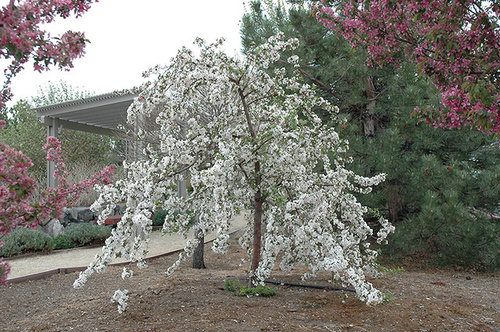
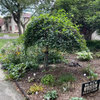
Giant curved feather

How did they
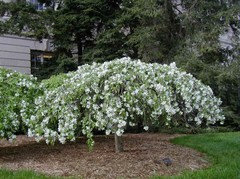
prune/train the specimen below into such graceful shape of a giant curved
feather? Other specimens of this weeping crabapple look like an ugly mophead on
a stick!

Malus 'Red Jade'

Comments (29)

  • 9 years ago

    My guess is that it just grew like that. Red Jade is a weeper and I suspect that for many growers the one in the picture would be considered lopsided.

  • 9 years ago

    No way it just grew
    like that, no other Google Image is even remotely similar. The photo is
    nurture, not nature. If you just buy and grow the plant, it will look
    completely different, it will look like a version of a mophead on a stick, with
    a bigger or smaller head, denser or sparser head, thicker or thinner stick,
    etc.

    The photo is
    unfortunately in the searchable database of the NetPS Plant Finder Tool which
    many nurseries subscribe to for showing and describing plants on the nurseries'
    websites. If you see identical photos and descriptions of a plant on nurseries' websites,
    they are likely subscribers of the tool, check the subscriber list of the tool.
    It is mostly a useful tool, but in this case it leads to mass misinfo :-( Always double and triple check with Google or another general purpose search engine and compare with reliable data from University Arboretums, Missouri and other Botanical Gardens, Iseli, Monrovia, etc.

  • 9 years ago

    I'm not sure why you feel the need to lecture us. floral is quite right - the tree has just grown in that fashion. If you look at the trunk diameter, you will see that it is still quite young and therefore still flexible and has not yet developed a firm branching structure. Nor does it appear to have been pruned. This cultivar is described as having "long, graceful, slender
    weeping branches", which this young example amply illustrates, and if you do further image searches, you will find a number of other examples that share a very similar appearance. Many are NOT just a "mophead on a stick"!! And I'd venture to say that those that do resemble a mophead on a stick may have been pruned to encourage that appearance.

    Plants are not pieces of furniture and are not popped out according to a mold. They can vary widely from vendor to vendor in initial appearance as a result of different growing conditions and propagation methods and naturally weeping forms can often be extremely lax in habit. No doubt this example will straighten up and even out to some degree over time and with maturity. And whatever pruning the owner cares to engage.


  • 9 years ago
    last modified: 9 years ago

    Just show photo of other Malus 'Red Jade' specimens that look similar to the original photo.

  • 9 years ago
    last modified: 9 years ago

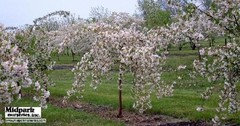
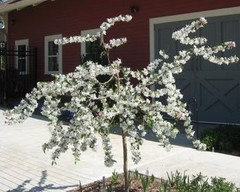
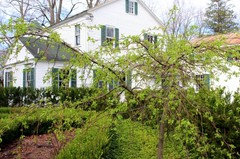
    Try this. Or this. Or this one. And finally, this.

    None of these looks remotely like a mophead on a stick.

  • 9 years ago
    last modified: 9 years ago

    None of what you linked to look even remotely similar to the original photo. Maybe your household mops look different than mine :-)

    In any case, the specimen in the original photo is highly trained over the years. The thickness of the trunk, the height of the plant (compare to building in the background) indicate that the specimen in the original photo is not that young.

    If you just buy and grow a Malus 'Red Jade' then it will look like any of your mops below :-)


  • 9 years ago

    in the original pic.. it looks .. at the top.. that it is starting to get the typical mop top as you guys call it...


    so i might SUSPECT.... that it was trained to the limit of staking ... and the staking then failed... its really.. really hard.. to stake to extreme height ... sooner or later.. you simply outgrow your ability to do much more ....


    once the method/attempt failed... the 'lean' you are seeing ... is the mop top outgrowing.. on an annual basis.. the sturdiness of the trunk way up there ... so its starting to lean ...


    who knows.. all speculation ...


    ken


  • 9 years ago

    Well, there is always a need to go with the facts, otherwise we have to agree to disagree, which is fine with me.

    Season's Greetings!

  • 9 years ago

    ken, yes, definitely trained, the original photo shows that most of the main trunk has side-ways branching, like a feather. Moreover, the main trunk is curved.

    In contrast, all other Malus 'Red Jade' specimens have the branches more concentrated at the top of a straight trunk. The branches weep and grow in all directions, not just side-ways.

  • 9 years ago

    Whatever happened with that one the way to get the same effect would be to select a lead and train it up a secure stake. The same thing is done to produce weeping lace-leaf Japanese maples that are not hummocks or mounds, and so on.

    Trees trained to have branches dispersed throughout instead of concentrated near one point are even called "feathered".

  • 9 years ago

    Enlarge that first photo on your computer - that is not an old tree. If it has been in place more than 3-5 years I would be very surprised. That trunk is still very narrow for a tree to have any serious age on it and the branches are very whippy, not stiffened like a more mature specimen. And I would bet good money that it has NOT been trained at all. But feel free to adhere to your own beliefs.

    As did floral, I seem to note a very confrontational aspect to your posts and an unusual desire to make plants conform to some sort of artificial form or standard as opposed to appreciating them for what they are. It is really not worth my aggravation to respond when any response just seems to engender an argument.

  • 9 years ago
    last modified: 9 years ago

    The one straight trunk going about half way up the center makes it look likely to have been trained.

    The continued straightness of the main branches for a time beyond where the center stem forks also seems like something the tree wouldn't do on its own. But the forking consisting of two equal halves makes staking above this point not seem likely.

  • 9 years ago

    It depends on pruning. If they are properly pruned, they should take on the beautiful form (or at least similar to) the photo in your post. The others have most likely been improperly pruned (bowl-cut) sometime in their lives.

    https://caldwellhg.blogspot.com/2016/10/avoid-these-common-pruning-mistakes.html

    (I redesigned my blog, so it is much easier to read now)

    It has not been "trained". You cannot just simply "train" a tree to look like the one above. Another example (I am not sure of the cause) is that I have noticed some 'bradford' pears in my area do not have the pyramidal canopy, but have a spreading canopy like that of a redbud. Maybe somewhere along the line another cultivar was accidentally marked as 'bradford' and both cultivars circulated with the same name. Most of the wider, spreading ones were planted sometime around late 80's through the 90's by the builder. I have seen these at shopping centers in parking lots (at walmart, sam's club) and at my local burger king.

  • 9 years ago
    last modified: 9 years ago

    Yeah, Embo, I think it likely that the tree in
    the original photo was created with a modified orchard training method, see
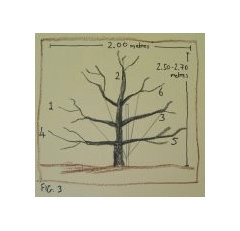
    'The free-standing tree' section on this webpage http://realenglishfruit.co.uk/tree-training/
    If the ties are modified to bend the tree forward, then you have the curved
    feather.

    FWIW, I started a
    similar thread in the orchard grower forum, but orchard growers are not really
    interested in growing ornamental trees :-)

  • 9 years ago

    It has not been "trained". You cannot just simply "train" a tree to look like the one above

    All it takes to get a weeping tree growing up straight is selecting a lead and tying it to a secure support, keeping it tied in until the desired height is reached.

    The combination of activities used to cause the development of young trees etc. to have particular structures they wouldn't on their own is called Pruning and Training. This is why there are manuals and other expositions with this phrase in their titles.

  • 9 years ago

    Have you bothered to enlarge that photograph? With higher resolution, that tree looks no more like a feather than I do!! There are obvious branches coming out in all directions, including one coming out almost directly towards the camera not quite half way up the tree and a junction of what looks like three good sized branches right where the top/leader begins to lean, each heading in a different direction. They are just not spaced out very evenly.

    "All it takes to get a weeping tree growing up straight is selecting a lead and tying it to a secure support, keeping it tied in until the desired height is reached."

    But that is not at all what is happening here - the tree is not being trained to grow straight up - it is being left to its own devices. And who "trains" a weeping tree like a crabapple (or a redbud or a dogwood) specifically to lean?? They do so on their own. If anything, one might be inclined to "train" it to be straighter!!

  • 9 years ago
    last modified: 9 years ago

    For once, I actually agree. with gardengal. You can see it much better if you enlarge the photo. Even better would be a picture of this tree without leaves (or flowers).

  • 9 years ago
    last modified: 9 years ago

    Whatever happened here when staking is used to train plants that are intended to form free standing specimens later the staking is eventually removed. This is commonly done.

  • 9 years ago
    last modified: 9 years ago

    The conifer and other trees behind it might also be contributing to a lean towards the greatest amount of light.

  • 9 years ago
    last modified: 9 years ago

    A
    3 year old orchard trained tree, the only difference is to run the ties to bend the tree forward
    instead of straight up, then remove the ties to let the tree grow more
    naturally. That's the curved feather of the original photo. Non-trained trees
    all look like the 3 mopheads-on-a-stick that GG linked to and whose pictures I posted in the
    above.

  • 9 years ago

    It appears to me that you are interpreting the image in a manner that doesn't seem to match up with reality. This particular specimen looks quite natual to me....some nurseries grow them like that while others snip and nip them to create the mop-like appearance so many of us dislike.

  • 9 years ago
    last modified: 9 years ago

    I have a weeping cherry that I transplanted this summer from a roadside that was about to be cut. It died back near the base (because I couldn't get all of the roots) and re-sprouted from there. This spring I will cut it near the base (before it leafs out) and choose one sprout to be the leader. It looked much like this when I dug it up, just a bit smaller. (still not 100% sure about what type of cherry) but it has beautiful form. Found this growing in a grove of ailanthus. Couldn't find my thread

  • 9 years ago

    The photo below shows the natural growth habit of the 'Red Jade' specimen at the Missouri Botanical Garden. This is consistent with the 3 photos that I posted further above, and more significantly, it was not me who selected those 3 photos :-) There is no global collusion including the Missouri Botanical Garden to malform all 'Red Jade' specimens into ugly mopheads on a stick, it is simply their natural growth habit.

    In any case, if the original photo shows a 'Red Jade' at all, it is highly trained, it looks completely different from all other 'Red Jade' specimens.

  • 9 years ago
    last modified: 9 years ago

    With that elevated central axis at this point my money is still on it having been trained up a stake.

    At any rate I do think it would be easy enough to duplicate this effect by training another 'Red Jade' to a stake, using selection of a leader and keeping it tied in.

  • 9 years ago

    You may not even need to train an expensive 'Red Jade' if you only want to achieve the general appearance of a curved feather, a cheap M26 or M9 apple rootstock may do the trick.

  • 9 years ago

    The tree you seen at the missouri botanical garden has cleary been bowl-cut at some time. The branches on one side are exactly the same length. I assume that if they would bowl-cut it they would also do any other unnecessary/improper pruning.

  • 9 years ago
    last modified: 9 years ago

    Developed 'Red Jade' I have seen in person have also been broad and low. Surely the only visually significant thing being done to the MOBOT trees is snipping at the bottoms, to make their crowns float above the ground instead of cascading down to it.

    Thereby detracting from the weeping effect, of course. The MOBOT planting would be much more affecting if the trees had raised tops from which the branches could descend, as with the example first asked about here. This is the main reason to train up pendulous forms - so that the branches have somewhere to go. Otherwise these need to be planted next to water (such as a pool or pond) to create the visual impression of there being a space for the growth to tumble into. Or near an actual physical space for this, as in the open air next to a tall wall.