Software
Houzz Logo Print
rdak

Question on Leaf Mold

9 years ago

I moved into a new home and now have 2 acres plus a creek easement going for a LONG ways up past the property.

Our township supervisor gave me the go ahead in planting trees and other stuff up the easement to tidy it up a bit fairly near my property line.

So now I have room to do things like the following..............

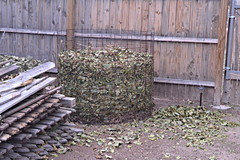
I made a 10 foot wire bin circle, four feet high and it holds about 75 bags of leaves. (Those rather large paper bags many people use to put leaves out at their curbs.)

I sprinkled some store bought manure compost on each layer at 1 foot intervals to just give it a little "starting boost".

That's it........that is all I did..........now I have a lot of leaves decomposing in the wire bin, and it looks proper, etc., but how long do you estimate it will be to start using that stuff?

Any opinions appreciated.

Comments (33)

  • 9 years ago

    I have piled leaves before in a 'great' pile. Without stirring, the center would not rot down in a very long time, but would be dry and unchanged a year later.

  • 9 years ago

    Agreed. Without stirring, the top will dry out, and nothing will happen there. Note that shredding the leaves will greatly speed up the process. Whole leaves will be there undecomposed for a long time. Several years, probably. My shredded leaf piles, turned weekly and moistened, are ready in a few months. That way, fall leaves are ready to be incorporated for spring crops.

  • 9 years ago

    Thanks for the info everyone!

  • 9 years ago

    How long it takes leaves to be digested depends on the leaves. Maple leaves are digested much faster than Oak because the Oak leaves have a preservative, tannic acid, in them. Shredded leaves are digested much quicker than whole leaves because small bits are more easily chowed on by the bacteria than large pieces.
    If the manure to leaves ratio was about 1 to 3 (difficult to determine from your description) the digestion will be faster than just a pile of leaves, but even some Nitrogen will speed the process.

    You can use those leaves as mulch next spring, no matter where in the digestion process they are. If you plan on tilling them into the soil that may not be a good idea next spring if more than half are not digested since they could tie up to many nutrients.

    kimmq is kimmsr

  • 9 years ago

    You mean 10 feet across and 4 feet high? You might want to make smaller ones so you can have one being filled with kitchen scraps and yard waste, one or more sitting and composting, and one being broken down for use. It gives you better air supply in the middle. I found a good size is about 3 feet across and 3-4 feet high, whichtakes 2 sheets of remesh for strength and something (plastic poultry netting? chicken wire?) to keep the leaves in. (see picture ... remesh lined with black plastic)

    If you keep it damp it will decompose in the middle - just put a small sprinkler on it for a bit every week or so if the pile is not damp (not soggy, just damp like a well-squeezed sponge) several inches down.

    here's what happens to my bins when they are full of leaves:

    1. First it will collapse to less than half the height (the picture is about a week after the bin was filled to the top with mulberry leaves mashed firmly down with a rake after every load. It's sunk down even more now because we had heavy rains.)

    2. Nothing visible will happen over the winter. They might freeze solid, get snowed on ... winter stuff. Microbial activity will be happening in the middle with freezing and thawing breaking up the leaves.

    3. When it warms up in the spring, you will see more sinking. Check what's happening a foot down in the pile, as far as you can reach toward the middle in a couple of spots.

    Possible outcomes:

    • If the leaves are falling apart, if it's brownish and smells like dirt, it's ready to use. Dump the unfinished outer layer into a new bin to finish and use what looks like "compost" out of the middle of the bin.
    • If you have mats of leaves, still intact, you needed more coarse stuff and air and maybe more moisture. Make smaller bins and shovel them into them. breaking up the mats and mixing in coarse weeds and straw
    • If you have a slimy, stinky mess you had too much water and too little air. Make smaller bins and shovel the mess into them. mixing in coarse weeds and straw for aeration.

    I use a sifter to remove the unfinished twigs, pine cones, trash and other stuff. What doesn't fall through the mesh goes into the bin being filled.

  • 9 years ago

    It's not as neat as a pile with walls, but I just use self-supporting mounds for my leaf mold. That makes it really easy to turn the pile with a fork or shovel. As long as the pile is moist, you won't get material blowing away. Turning the pile not only redistributes the material so it gets chewed on more uniformly, but aerates the pile as well. I should say that it's unlikely that your pile will ever actually freeze while the decomposition is active. It will self-heat very effectively. I run a temperature probe down the middle of the pile to watch it work. When it starts to cool, maybe to just ten or so degrees above outside ambient temperature, the inside is probably fully cooked. These probes are amazingly cheap. You can get them on e-bay for a few bucks. Put a cup over it to protect it from rain. As noted, if the stuff looks brown and smells like dirt, that's another good way to tell that it's done.

    I actually don't add any compost to get the pile started. It seems to start well all by itself. The air is full of bacteria that has effectively seeded the leaves you grind up to put in the pile. Fresh manure and or urine will, however, give it a nitrogen kick.

  • 9 years ago

    Are you adding your food scraps to the pile as well?


    While manure and leaves will break down just fine (and quickly given the right conditions), I'd be excited to add all of my food scraps to it as well.


    Also, 10' by 4' is pretty huge- if you're getting even close to filling that bin, you'll be able to cook all winter long, no problem. Adding a layer of straw for even more insulation will help.

    Oh right- how long until you can use the material? When the pile is at ambient temperature. Use a compost thermometer to get an idea of how well the pile is performing. Build a second bin and start filling that...leave the first bin sit for at least 3 to 6 months. The longer you wait, the better.


  • 9 years ago
    last modified: 9 years ago

    Leaf mould and compost are different animals. To make leaf mould you only need Autumn leaves and moisture. It is a slow business - up to two years - and it isn't supposed to produce heat, although it might. However once you have begun the cycle and continued for a couple of years there will always be a pile ready to use. Making and using leaf mould

  • 9 years ago
    last modified: 9 years ago

    Actually, as I said, if you turn the pile weekly and shred the leaves, it'll be done in a few months. Really. It helps if outside temps aren't too low. Mine usually aren't. My last pile got up to 46C. Not exactly "hot" composting, but pretty toasty.

    I can imagine that if you don't shred the leaves, and just leave them in a pile unturned, it might take a few years.

  • 9 years ago

    Yes, it takes some work. But as I said, if you don't mind doing that
    work, putting walls around your pile is a hindrance. That's a good idea
    to have multiple piles going, so there will always be one ready. I just
    don't have room.

  • 9 years ago

    Re "compost thermometers", which can be several tens of bucks, let me say again that ebay has marvelous digital thermometers with a probe on the end of a cord for a couple of bucks (buy now) each. Mostly celsius, but who cares? Compost thermometers have a stick that reaches only a few inches into the pile. These probe cords are a yard long. You can bury the probe right in the middle of the pile, and just leave it there. Note that the cheap ones come from China and Malaysia, and shipping will take a month or so. I have a couple. None have failed yet.

  • 9 years ago

    i have an reotemp that i got for $20 and it does the trick.

  • 9 years ago

    If you want to bid for it, the latest bids are up to $0.01. Got a penny?

  • 9 years ago

    I actually thought I replied to this thread yesterday but my battery died before I posted. First I would say don't worry about temp. You are not going to heat up much with just fall leaves. Next you might want to invest in some chicken wire and set up somthing similar to lazy_gardens. I have a similar setup for several reasons. The first is it keeps the leaves in a specific location no matter the weather. The second is it takes up less space in my yard because the pile is going higher instead of wider. The third reason is it allows the pile to be both well drained while keeping the interior moist. I am going to stop here as my battery is getting low again.

  • 9 years ago

    I would just reiterate my previous comment that leaf mould and compost are different products. Leaf mould is broken down by fungi rather than bacteria and heat is not a part of that process. If your leaf pile has a mix of materials and is heating up significantly you're making compost, not leaf mould.

  • 9 years ago


    By adding manure to the leaves rdak has crossed over form just making leaf mold to making compost.. Out in the forest Ma Nature sees to it that animal manure is added to the fallen leaves as the various critters wander around the area.

    kimmq is kimmsr

  • 9 years ago
    last modified: 9 years ago

    Leaf mould and compost are different products mainly because of what they contain. Leaf mould is all leaves. Compost can have lots of stuff. That's true that leaf mould is largely a fungal product and compost is largely a bacterial product, but I think what you end up with is pretty much the same. Decomposed cellulose and lignin. I made a yard-ish pile of shredded fallen cedar elm and red oak leaves this weekend. Nothing else. Moistened it. Walked away. Temperature is 45C this morning (with air temp of 14C). Decomposition will be largely complete in a few months.

    But I'll phrase that as a question. Are leaf mould and leaf compost fundamentally different when decomposition is complete? It is true that fungal action over many years may be required to completely digest cellulose. Bacteria may be unable to do that. But the bacteria feast on the sugar-rich parts between the cellulose structural elements. That's most of the leaves.

    Seems to me that leaf mould is what you get when you make a pile of unshredded leaves and walk away for two years. It is true that turning the pile favors bacteria and not fungi. That tillage encourages bacteria, but destroys fungal hyphae. So walking away for two years pretty much guarantees that fungi will be the main decomposers. But it will take a lot of time.

  • 9 years ago

    I think that the initial rotting is mostly fungal and the digestion further is more bacterial.

    I have gotten a couple of yards of city leaf mold more than once. It was very good except for a consistent 10% content of small rock.

  • 9 years ago

    I wouldn't think there is a way to just have a fungal pile without the bacteria doing there own thing as well. I get one year old shredded leaves from a township collection... and they are just shredded leaves with no yard waste. In the following spring, when I am digging out the bin to spread onto my gardens for mulch, the pile will be hot in the center... putting off steam and a good amount of heat. I don't turn the pile at all either. At the bottom of the bin at the end of the season (before i get more leaves, I would call the fine crumbled material leaf mold since it was originally pure leaves.

  • 9 years ago
    last modified: 9 years ago

    Agreed that both bacterial and fungal activity are important in both cases. As I said, bacterial activity rapidly decomposes the higher N parts of leaves, which is the inter-vein stuff. That makes the heat. Fungal activity concentrates on the high carbon parts, which are mostly the structural parts of the leaves. Mostly lignin. That latter, I believe, is a small fraction of the leaf mass. Now, it's the intact structural parts of the leaves that partly constitute humus. The other part of humus is organic polymers that reform during decomposition. Humus acts as a sponge to hold moisture, and thus is a great soil amendment. So it may be that part of the distinction here between compost and leaf mould is how much organic material ends up as reformed polymers, and how much lignin stays as residual leaf structure. If you leave the stuff for years, everything breaks down and turns into the former. Not clear what advantages that brings.

    Nutrient wise, there can't be any difference. To the extent volatiles like ammonia are nitrified in the soil, everything that was there is still there. Bacteria gobble up the N, but when they die, the N in them remains in the soil.

    Frankly, it's all composting. One is hot/warm, the other is cold. Pretty much the same result.

  • 9 years ago

    I find the leaf mold is more fluffy than my compost, more like peat almost. It's a great soil texture lightener.

    What I do is have two larger wire fence bins which I fill and compact in the fall. By the next spring they are shrunk down to about a foot high. At some point I combine them into a third smaller bin which is completely filled up to 3-4 ft high. By fall, there may be some gorgeous leaf mold under there. Or I wait till the next spring, depending. Every fall I refill the big bins though, so each year there is a batch ready that was started 1-2 years ago. I have a lot of oak and hickory and I don't shred, so it's fairly slow.

    Store bought manure is most likely already composted so it will not add much except maybe some microbes, but there are plenty on the ground already. It will not heat up the pile, but you don't want or need that for slow leaf composting.

    I also add processed beverages to the pile whenever it's convenient, if you know what I mean. It adds a little nitrogen.

  • 9 years ago

    Well, the fluffiness of leaf mold is the result of what you put into it. Leaves are fluffy. General kitchen waste isn't. So composted kitchen waste isn't going to be either. As I said, I have piles of only shredded leaves, nothing else, that get close to 60C. When they are done, in a few months, they'll be very fluffy. Fluffiness is not a property of slow composting. I'm actually kind of astonished at these piles. This is the first year I've been looking carefully at pile temperatures. Common wisdom is that to compost leaves you absolutely need to add nitrogen. "Greens" and the like. I didn't. Maybe it's my particular tree leaves, and it could also be that there is an admixture of partly broken up acorns in there. But my leaf piles are nearly hot composting.

  • 9 years ago
    last modified: 9 years ago

    I agree that the OP would be better off having 3 smaller diameter piles than one 10' diameter pile if they are in a relative hurry to have a finished product.

    I have 3 piles 4' diameter and 4' tall made from hardware cloth that are configured in a triangle to ease turning a pile into the adjacent one. Each pile has a 'door' that I wire shut with twist ties which makes it easier to access and turn.

    Like Tox, most of my leaves are oak and hickory. I do shred the leaves for these piles so they will be ready to use earlier the next season. My nitrogen components are kitchen waste, chicken manure, granular urea, garden waste, and the occasional recycled adult beverage. The piles shrink by about a third in the first few weeks and then don't do much after Thanksgiving. When they thaw out in early spring I turn and combine the 3 bins into 2 and start a new pile in the empty one. By Memorial day the 2 original piles are combined into 1 and are pretty much ready to use when needed although I wouldn't consider it 'finished' compost yet. It would have to go into fall to fully finish up.

    I also have a 6' diameter mesh bin and a 6'x8' rectangular bin made from scrap lumber that are for whole leaf storage. I don't add any extra nitrogen to these bins. I use a lot of it as mulch for my garden in the spring and what is remaining is shredded and made into new compost piles throughout the summer. I still haven't finished filling these bins yet this year but hope to get that done over the long New Years weekend.

  • 9 years ago
    last modified: 9 years ago

    It occurs to me that one unique attribute of leaf mould is that it is formed with whole leaves. In fact, NOT shredding the leaves is what makes the degradation go lots slower which, for all practical purposes, seems to be what defines leaf mould. So what you end up with in leaf mould is a medium that probably has a lot more connected lignin than you do in fast-composted shredded leaves. I can imagine that this would result in a medium that holds water especially well, by surface tension between the tangled strands. With shredded leaves you won't end up with as many tangled strands.

  • 9 years ago

    A lot of good advice.........thank you everyone.

    The pile is big and took roughly 75 of those big paper yard waste bags to fill. It is BIG though.

    The bags were collected from an old subdivision a few miles away and a lot of them were collected by the home owners when they mowed their lawns and emptying the grass catcher. So most of the bags were chopped leaves with some grass clippings mixed in.

    I would estimate 75 percent chopped leaves with the total pile maybe 5 percent grass clippings. 25 percent were full leaves I would estimate.

    The pile is about 150 yards from the house so I had to use the cart attached to the riding mower to get the bags out there.

    I am not adding any kitchen scraps but did add a 40lb pound bag of store bought manure/compost to get some microbes in there.

    After a few days it did start shrinking/compressing and I put my hand down a couple of feet and it was warm but not hot.

    This stuff will be used mainly as mulch and not into the soil. I planted 50 trees and 30 shrubs roughly and they were small........next spring will be the 3rd year after planting for most them...........some planted last spring though.

    Thanks again everyone for the advice, I'll start turning it and put a bit of nitrogen rich fertilizer on it.

  • 9 years ago

    That sounds marvelous. But as defined here, I think you're shooting for compost rather than leaf mould. With the mix you report here, especially mostly shredded as opposed to unshredded leaves, it's going to get hot. Real hot. As I said, my all-leaf pile gets to almost 140F, and stays that way for several days without turning. The grass clippings and manure add nitrogen, and throwing some nitrogen fertilizer on will just kick that up. I don't think adding microbes is necessary, really. The leaves have loads of those. Now, what you haven't said anything here is about moisture. You need to soak the pile thoroughly. A dry pile will compost slowly. You could put a sprinkler on the top of the pile and leave it there for a while.

  • 9 years ago

    You may find this article by Lee Reich that appeared in an issue of Fine Gardening magazine of interest.

    http://www.finegardening.com/making-leaf-mold

    kimmq is kimmsr

  • 9 years ago

    Thanks kimmq.

    I watered it in pretty well when it was made and it is still damp throughout. Put a bit of molasses into the water to give it a further boost. I guess about a cup of blackstrap molasses is all I used. Which ain't much on this BIG pile.

    I can't water now, it is 150 yards from the house and my hoses are all put away for the winter. But the pile is pretty damp and will probably stay that way for the remainder of the winter I assume.

    I guess it is somewhat a "compost" mix but the VAST majority of the pile is leaves so it is a "bit compost". Either way that stuff will be used as quickly as I can come spring. Time will tell.....................

  • 9 years ago

    Oh, off topic but I forgot to mention that I did plant 5 Dawn Redwoods that I bought off a nurseryman from ebay.

    They all took off very well and if you are interested in this old large fast growing deciduous cypress type of tree I HIGHLY recommend it.

    It is suitable up to zone 5 which is very unusual for a redwood type of tree.

    Here's the link...........he sells good stuff. Bought a couple sawtooth oak also........took very well and is growing fine.

    http://www.ebay.com/itm/1-dawn-redwood-tree-Metasequoia-glyptostroboides-3-ft-tall-8-99-each-/182362803176?hash=item2a75ab8be8:g:57QAAOSwImRYNKbV

  • 9 years ago

    I've heard that application of sugars to a compost pile to speed composting is pretty much a myth. The applied sugar causes a rapid increase in the number of bacteria, which, when the sugar is gone, simply die. That is, they increase in number specifically to eat the sugar. Minus the sugar, the bacterial population will naturally rise to what the compost itself can support. I'm not aware of any real research evidence that sugar application speeds composting.

    That being said, there is no question that bagasse composts faster than household waste because it naturally contains lots of sugars.

    To those of you who are desperate to apply sugar to your compost pile, molasses probably isn't the cheapest way to do it.

  • 9 years ago

    RDAK ... The freezing and thawing and snow melting helps break down the pile. There are cold-preferring fungi and bacteria that remain active all winter while the ones that make "hot compost" are dormant.

  • 9 years ago

    But the "hot compost" bacteria are self-heating the pile. We've all seen piles in sub-freezing temps that are steaming away. Those piles aren't going to come close to freezing. But with unshredded leaves, those bacteria won't be very active, and the whole leaves might well see freeze-thaw cycles.