Software
Houzz Logo Print
sally_berry

Karndean is bubbling

9 years ago

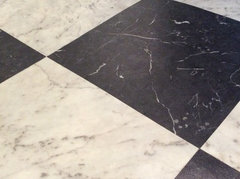
Anyone else had a problem with Karndean vinyl floor tiles bubbling and pushing up on the edges? What can be done to correct this? Laid over new plywood. No one wants to accept blame.

Comments (16)

  • 9 years ago

    Pictures? What kind of plywood? How long since installation? How has it been maintained?

    Sally Berry thanked glennsfc
  • PRO
    9 years ago

    Yes, can you provide some pics? There's no way to assess the issue until we can see the surroundings... also what room of the house is it installed in? Is it ground level? Are there moisture-issues anywhere? More info is definitely needed.

    Sally Berry thanked User
  • 9 years ago

    Does sound like an installation over a wet slab.

  • 9 years ago

    The contractor laid new Plywood over an existing subfloor with felt barrier between the subfloor and the plywood. This subfloor is original to the house, heart pine and solid. This is a 120 year home that is about three feet off the ground. We live in the south. There is a dishwasher in the room (kitchen). Had no problem with the old vinyl tile that had been down for 20 plus years. Contractor could not remove old vinyl tile without tearing up the plywood it had been layed on so he removed the old floor and plywood, taking it down to the subfloor which had felt over it. The old plywood was not wet or soft. He laid the new plywood one day and came back the next day and glued the new Karndean tile onto it. Called him the night of installation and told him we had problems. He had us pull up 4 files that were pushing up in the corner where they met. He came the next day, put more nails in the plywood under those 4 tiles but said that should not have been necessary--plenty of nails put in during instillation of plywood. He relaid the 4 tiles. We Had the store salesman come out with the installer a week later. They tried to get one of the new tiles with bubbles in it up and finally it came up after breaking it. So the glue is working. Said the plywood contained moisture and said the moisture was coming from under the house. Wasn't his fault and we would have to seal under the house. We already have plastic ground barrier under the house. No problem with the old plywood, subfloor, and old vinyl tiles so why were the New tiles bubbling the same day he laid it. My husband felt the moisture was coming from the glue. Temp was in high 50s, around 60 high the day it was installed. Door stayed open the whole time he worked on it so we turned heat off. Don't know if temperature had anything to do with it. Beautiful floor other than the waves and bubbles. Will try to upload pictures. Again, bubbling started that same day as installed. Bubbles over the entire floor in various spots, not just one bubble.

  • 9 years ago

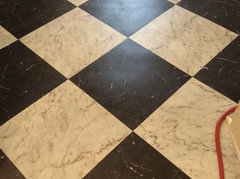
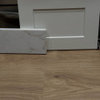
    Hard to see but really noticeable when you walk on floor. Not just in areas where plywood meets. Bubbling on these black tiles.

  • PRO
    9 years ago

    Q. When the tile that was broken to be removed was finally pulled up, was the adhesive completely dry?

    Sally Berry thanked User
  • 9 years ago

    Another area.

  • 9 years ago

    Not completely dry. We were told by the installer it should have stayed tacky and that it was drier than it should have been.

  • PRO
    9 years ago

    You said that your husband thought that the moisture may have come from the glue. Do you know if the correct adhesive was used? And in the correct amounts? If installed properly, the issue should not have been caused by the glue.

    Sally Berry thanked User
  • 9 years ago

    Yes,the correct adhesive was used. Karndean K91A. Husband felt sufficient amounts were used

  • PRO
    9 years ago

    I'm going to ask about the Elephant in the room: crawl space under the house. It sounds like there is one of those "three feet off the ground" - as per OP's description.

    So...we have OLD subfloor (with original felt) over an OLD crawlspace (in the Southern US). Excellent. Let's start there: is there a moisture barrier OVER the exposed earth of the crawlspace? Did anyone CHECK to see if this dirt was covered? How about ventilation and cross ventilation? What have we go for ventilation?

    Ok...that's a start. Onto the NEXT set of concerns: new plywood. Did the plywood, the tile and the adhesive ACCLIMATE in the space for several DAYS (as much as 2 weeks of that plywood got wet)? Anyone check temperatures, RH (relative humidity) and MC (moisture content) of the plywood? Awesome! Get those numbers! Quick!

    And now the adhesive. The type? The amount used (known as "coverage") can be figured out by finding out how many gallons were used during the installation - was it appropriate for the type of tile? How about the METHOD of application. What about the installer's approach to installation (trowel, roller, tube, contact cement, wet, dry, pressure sensitive???)??? Was it correct for the adhesive AND the tile and the crawlspace?

    Whew! As you can see, there are SOOOOO many things to check when a floor goes wrong like this. Lifting like that usually indicates "bond failure" (yah...I know it is obvious...but you need to make obvious statements in today's world). But HOW did the bond fail??? Excess moisture??? Big possibility! Not enough adhesive??? - Sure. Too much adhesive (too wet)? Why not. Wrong application with the wrong adhesive??? Positively absolutely! Crawlspace that was NOT properly dealt with by the GENERAL CONTRACTOR (this is BEYOND the work of a mere floor layer...but a GOOD floor layer will ASK about it...just to cover his butt)? Massive chance this has SOMETHING to do with a crawlspace.

    Lots of things that need to be looked at here. When a floor fails (as this one did) you need to start from the GROUND and work your way UP....sigh. That means you need to start with the CRAWLSPACE and start eliminating ALL of these things before we get to land this at the feet of Karndean...or even the adhesive.

    Sally Berry thanked Cancork Floor Inc.
  • 9 years ago

    Ground is covered with plastic moisture barrier under the house. Ventilation and cross ventilation is fine. We have lattice work covering the areas open. You can see under the house. We have a termite bond and that guy checks for moisture and any potential problems. Haven't had any. The plywood was purchased on day of installation and installed immediately. The tile and adhesive were brought to the house the day he installed it. To my knowledge, nothing was mentioned about temperature (house was probably around 60 degrees). No mention or checking on moisture by installer until he came back a week later. We didn't because it didn't cross our minds there would be a problem. If problem with crawl space, then it looks like it would be a problem with the old plywood that was removed. We didn't have a general contractor. We purchased the tile from a Karndean store(not a discount store either) and used their installer. We paid to have him take old tile up but it was bonded to the plywood and would not come up. That's when we paid to have new plywood installed and removal of old by the same installer. Oh my. I guess I will have to live with it. I am not willing to fork out more money to put in a moisture barrier against the bottom floor, underneath the house (not on the ground). I don't think that is the problem or we would see mold in that room and the old tile would be popping off, and we would have had soft spots, which we didn't. Thanks for your help. If you hear about anyone else having the same problem let me know the solution.

  • PRO
    9 years ago

    Sounds like the acclimation process for the plywood AND the materials (including adhesive and the Karndean) did not occur. The crawlspace is probably off the list if "issues". The temperature of install would also be considered a little 'low'. An install at 60F is not considered "ideal" but can be done. The temperature AFFECTS the curing of the adhesive and the initial BOND...which is what you are concerned about.

    The temperature of the living space (before, during and AFTER acclimation) should have been VERY close to "living temperature" as possible. That means closer to 70F than 60F.

    My guess is that things were a little too "cool", too damp (the plywood), and not properly acclimated. This sounds like it is a combination of improper acclimation of materials, failure to test moisture content in the plywood and the conditions at the time of the installation. In theory, the installer SHOULD have rebooked the install because of the of the change of the job requirements. The homeowner would have been responsible for the conditions before, during and after acclimation.

    If you decide to push for cost of repairs from the installer, it would most likely be a 50:50 split of costs because of a few things with the living conditions (60F).

  • 9 years ago

    Thank you to the forum experts for providing their information. I have new construction and am likely to be doing glue down LVT. The info here makes it clear that a top notch installer is essential and that all steps must be done properly to avoid problems. I wonder how many installers (even if they have been doing things for years) actually know the above and actually take the time to do it properly? On the flip side, I expect that many installations might not do all of what is preferred, and yet the finished result performs quite well, otherwise the number of problem/complaints here on the forum would probably be higher.

  • 9 years ago

    Is there a rolling schedule with this adhesive sysytem?