

Is my Camellia sick?
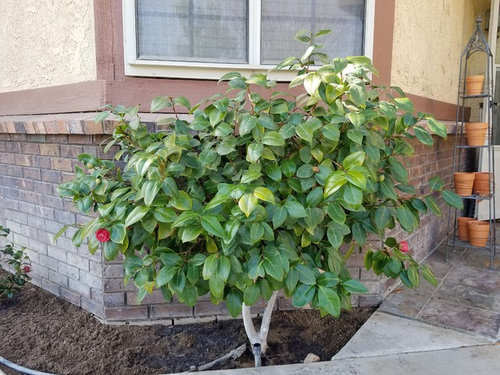
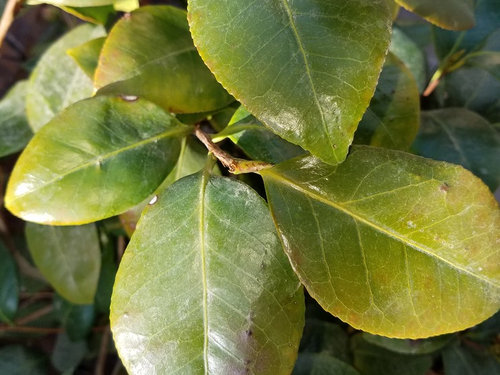
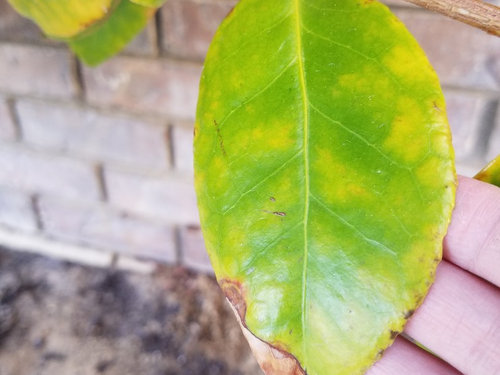
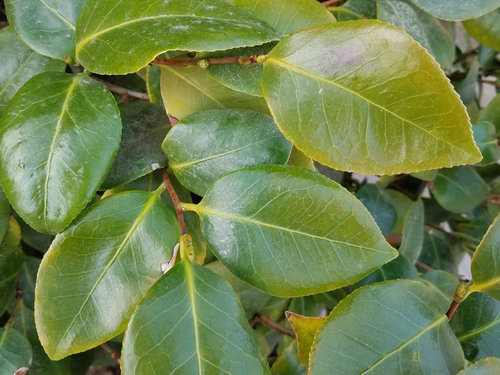
I don't know the history of this camellia. It came with the house we bought last year. I think its about 8 or 9 years old. Its located in a spot that gets a little bit more filtered sun than I would like it to. The leaves were never dark green because of the amount of sun it gets at that spot but in the last few weeks I noticed the leaves turned to a light green with some yellow undertone. We have been getting a lot of rain this winter in southern california and I'm not sure if that has something to do with it. The soil drains well and the Camellia does not sit in water. I just added some compost for the winter and the last time it was fertilized was in the fall. Can someone please let me know if this Camellia is sick or not?
Comments (16)
 9 years ago
In SoCal, I'd be concerned about soil pH. Is your soil sufficiently acidic? That - much more than sun exposure - is the reason foliage on acid loving plants tends to fade or discolor.

allymoo510
Original Author9 years agoI just ordered a PH reader from Amazon that will arrive on Thursday. If it is PH inbalance, how do I correct it?
Related Professionals
Bainbridge Landscape Architects & Landscape Designers · Madison Landscape Architects & Landscape Designers · San Marcos Landscape Architects & Landscape Designers · San Luis Obispo Landscape Architects & Landscape Designers · Santa Fe Landscape Architects & Landscape Designers · Atlantic City Landscape Contractors · Athens Landscape Contractors · Oklahoma City Landscape Contractors · Chambersburg Landscape Contractors · Muncie Landscape Contractors · Southaven Carpenters · Johnson City Carpenters · Lima Carpenters · Santa Maria Carpenters · Eureka Carpenters- 9 years ago
Report back with what it is and then we can tell you :-) Generally, adding sulfur is recommended suggestion for increasing soil acidity but it is not fast and the effect is temporary at best. There are other shortcuts you can take to help but we need to know what you are dealing with first.
allymoo510
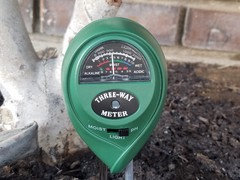
Original Author9 years agook I just received the pH probe and I tested about 5 times and all around the plant. Each time I received a reading of 5.5, which I have read that is the correct pH for camellias. So what do I do now? In your opinion do you think the plant look sickly?
- 9 years ago
Not sure I believe that, especially that close to a concrete foundation. Did you make sure it was properly calibrated before using? Generally, the best electronic pH meters are single purpose, must be calibrated accurately before use and are generally used by testing a soil slurry, not by sticking in the ground. Not familiar with that brand and suspect it is at the lower end of the accuracy spectrum (better ones run around $50 and up!!).
I would try using some chelated iron and see what happens. If pH is NOT a concern (and I'm not sure that's the case), then it's NBD. If pH is at issue, you should see a relatively rapid greening of the entire plant. Not sure when to suggest the best time for you do try this. I'd think it was a bit early now - in my area, that would be late March into April, when new growth is being pushed and root uptake active.
btw, the iron will not alter the pH. You must address that by other amendments - it is just a quick and dirty indicator of a pH issue.
allymoo510
Original Author9 years agoDo you have a brand of pH testers that you would recommend that I can purchase from a big box store? The pH probe from Amazon instructed to be stick directly into the soil. I'm new with Camelias and the only reason I thought the coloring was off was because last January when we moved into the house I remember how dark leaves were.
allymoo510
Original Author9 years agoHi Luis, I would prefer not to move the plant. By the look of the plant's base, I think it has been planted there for a while. I know the picture does not show it but there is a tree to the right of that plant that shield it from hot summer sun and that part of the house faces east. In the summer that camellia gets about 3 or 4 hours of direct sun in the early morning and the rest of the day it is shield by the tree and house shades. My question is I would like to do an acidity test on the soil so that I would know if there is anything that is deficient. I bought a probe but perhaps its not accurate. What test kit do you recommend?
- 9 years ago
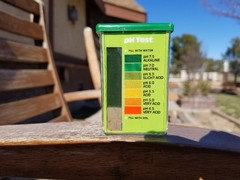
The Rapitest pH test kit (available almost anywhere plants are sold) is remarkably accurate for the cost, but you must use distilled water. Otherwise, look at the pH probes carried by your better local independent garden center. But be prepared to pay for the accuracy and to calibrate properly before using.
Camellias are far more sun tolerant than most folks think. The morning sun exposure with afternoon shade is good just about anywhere and should not result in any sun bronzing, even in winter. And lack of an adequately acidic soil will not necessarily result in obvious signs of chlorosis but can and does often manifest in just a discoloration or overall fading of the foliage color. The chelated iron acts like a tonic to "green up" the plant and works on just about any broadleaved evergreen. Miracid or Miracle Gro for Acid Lovers will do exactly the same. We would employ this quick fix at the nursery to improve color on any containerized BLE - only took a week or so to see much improved results.
Southern California is known for having non-acidic, even alkaline soil conditions. As well as alkaline irrigation water. Folks who grow acid lovers there generally have to make large accommodations for these plants. The fact this plant is located so close to a concrete foundation wall (and sidewalk) increases the concern, as the concrete will leach lime indefinitely and make soil significantly less acidic.
- 9 years agolast modified: 9 years ago
I do not spend much money on test kits -just look for dark green veins and yellowing- because I know the kits I use are not accurate and do not give me a result using numbers. I usually get an 'el cheapo' kit and use it to detect whether things are too alkaline or too acidic.
The majority of my camellias (they are not bronzing) are close to the house, planted about 1-2 feet away from the house and -knock on wood- that proximity has not been an issue. Of course, like I said, that does not mean it cannot be a problem in other houses. Indeed, that is why I suggest monitoring and not doing anything if the pH probe detects no issues. FYI, your probe looks fancier than the kit I use!
The soil test that I mentioned I did was a formal soil test that I had to do because I was going to plant fruit trees in a location not typically "used" for anything. I sent samples of the soil for the trees and decided to send another 2 samples... of the soil where the bronzing camellia was (under the deciduous tree) and where the other non-bronzing camellias are. The bronzing camellia's soil was six point something and the non-bronzing camellias close to the house were a sliver above 7. I consider camellias more tolerant of alkalinity than the hydrangeas that I have planted nearby. I always amend my soil in the Spring and maybe once again in the Fall but I let the hydrangeas tell me. The hydrangeas' leaves sometimes react in August and turn light green but I cannot even remember when was the last time the non-bronzing camellias complained about soil pH. They have but it was years ago.
Feel free to do what I did and send soil samples for a formal soil test. That is usually a nice thing to do once a decade if you have the $$ for the samples. You can also send leaves for analysis. After that, just use the probe. If you can double check the results of your pH test (with a real soil test or some other test kit) and it comes out around 5 too, there would be no reason to amend for alkalinity. But it would be rare for a location in Southern CA.
By the way, I hope you catch some of the rain that is falling in the northern areas!
allymoo510
Original Author9 years agoHi gardengal48, I took your advice and ordered a Rapitest pH tester and ran it twice in 2 spots near the camellia plant in question and both times the test came back green and dark green which means the soil is neutral or alkaline. My question is can I give the chelated iron while in bloom and during the winter resting period or should I wait until after blooming to fix this issue? Also what do you recommend as long term solution to make sure the soil is acidic? I read on the internet cottonseed meal is good for acidicity, is this true? Thank you for all your help.
- 9 years ago
I have never tried applying the chelated iron in winter so have no idea how well or fast it might work. I'd just suggest you try it and see what the results might be :-)
To properly lower the pH, you want to use agricultural sulfur, which should be available at your local garden center, and follow the directions on the label. It takes time for the reaction to occur, so I'd also do the iron chelate in the meantime. Cottonseed meal is acidic but not sufficiently so to make much of an impact on soil pH - this would be better to use as a top dressing going forward, both to maintain the acidity once you get it to where you need it to be as well as to provide nutrients. But any fertilizer formulated for camellias, rhododendrons, azaleas or other acid lovers - like Holly Tone - will work equally as well.
allymoo510
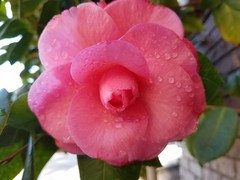
Original Author9 years agoHi Luis, thank you for your help, I'm new to camellias and since I inherited this camellia bush I don't know its history. Judging by the way it looked I would say it was well taken care of. Last year during the first spring under my care, I did not know I needed to prune it and fertilize it and I noticed there weren't many new growth during the summer and less buds this winter. I recently purchased 2 new camellias and I noticed their leaves are a dark green color and that's when I realized this camellia's color does not look right. I tried to search on the internet and surprisingly there's not much information out there about camellia care. I'm really glad I found this forum and so far getting direct answers to my concerns. Here is a photo of this camellia's bloom. It went into blooms this past week. Maybe you know the name of this camellia? I tried to email the camellia society to find out what kind of camellia I have so far they haven't replied.
allymoo510
Original Author9 years agoHi gardengal48, thanks so much for all this information! you saved me hours of trying to find it online elsewhere. I will let you know in a few weeks if this plant has improved.
- 9 years agolast modified: 9 years ago
You can get plenty of information from the American Camellia Society's website:
https://www.americancamellias.com/care-culture-resources
They also have a "Camellia Encyclopedia" with some camellias and their pictures.
https://www.americancamellias.com/care-culture-resources/camellia-encyclopedia
There are sooo many camellias that I do not try to guess names since you really need information that is usually not available (how many petals, how big the blooms are, etc).
Some that your picture reminded me are Mathotiana, Rose Dawn, Egao and (not so sure because the bloom was not fully open) Shishigashira. You can probably go to a library and check out a book with camellia pictures and then compare the pictures to your shrub.
I would not worry about needing to fertilize it or prune it. I have never pruned my camellias, except to remove dead wood or some branches that crossed "weird". I have also forgotten to fertilize on some years and the plants have not complained. But, I do try to remember and amend the soil to keep it slightly acidic. In my neck of the woods, I always amend in Spring and depending on whether other more-pH sensitive shrubs complain, I amend again between August-September.
I have amended while the shrubs were flowering in winter. The last two years, my winter has been mild so I amended in January once but typically in March. I remove the mulch, amend the soil and replace the mulch (and add more if needed). I only fertilize in March after checking the weather forecasts.

luis_pr