Software
Houzz Logo Print
gardenqueen87

unheated high hoophouse question

9 years ago

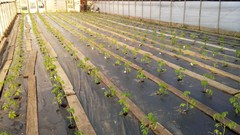
Hello. I am looking into building a high hoophouse in my garden. (I really, really, like the one one One Garden Revolution's Youtube channel. I would like mine, however, to have a dual purpose: 1. growing greens with low tunnels and floating row covers, and 2. starting all of my seeds. I am in zone 5 and have snow usually during the winter and early spring. Are these two goals comparable? I would devote one side of the greenhouse to each purpose. As another option, I could also start my seeds inside (as I do now) and put them in the 'greenhouse' when the plants have their true leaves. Any advice for me regarding this? Thank you.

Comments (6)

  • 9 years ago

    I'm zone 5 here in NH. We have a thermometer in our high tunnel which I can read from my kitchen. The big challenge is that on a sunny day, the high tunnel can be very warm but at night it's going to be just as cold inside as outside. So if it's 13 degrees outside, it's going to be 13 degrees in the high tunnel. I have successfully over-wintered rosemary and variegated sages by swaddling them in Agribon. A couple of the local market farmers have facebook pages (as does Eliot Coleman's Four Season Farm). A local farm uses several layers of Agribon over hoops. According to Four Season Farm's January posts, they are minimally heating a high tunnel to 38 degrees and growing winter hardy lettuce varieties.

    Given the temperature at night, you aren't going to be able to start any vegetable seeds that need warmer growing conditions. Also keep in mind that right now we are still in the Persephone period where plants are not getting enough hours of light during the day. Last year I started three different batches of hot peppers indoors based on their days to maturity but did not put them out until the usual end of May time because a late frost would kill the tender plants. I do think tomatoes and peppers grow bigger and better in a high tunnel (with the sides rolled up) during the summer. Around here, the market growers putting tomato plants in their high tunnels early are using supplemental heat.

    I have had some unprotected lettuce die and then grow back in the spring but only a couple of heads in a short row. Claytonia, arugula, kale and cilantro self seed and seedlings show up in the early spring. You can get a head start seeding some of the more cold hardy vegetables like sugar snap peas.

    In addition to a remote thermometer I highly recommend a close water source. My high tunnel is a ways from the house since we have trees around the house. My husband installed a yard hydrant so I can get water during the winter. It is also my source for watering the vegetable garden. If you can bury a water line, it's great.

  • 9 years ago

    Good points made, Defrost. Those alterations don't need to be very expensive either. I noticed a remote thermometer in a store for just $12. If you have a hydrant further from tunnels you can just modestly bury a garden hose and then use air to blow it out every Fall before ground freezes. The higher costs arise when one wants fully automated systems.

    My suggestion with whatever choices make is that you always have a backup plan. If losing plants is acceptable then that might even be in your plan but if you know in advance how you want to handle various situations you will have fewer disappointments.

  • 9 years ago

    Barrie, that would be a great deal on the thermometer. We paid around $50 but it has three transmitters: high tunnel, outdoors, and indoors. We heat with wood so we like to keep check on indoor temperature. Our much used driveway is on the south side of the house with only about 12' of "lawn". I had to combine at least two long hoses to reach the vegetable garden and it mean reeling everything up during the day. A neighbor's farm crew accesses fields via our driveway. Fortunately, the yard hydrant was already out in the barn left behind by someone and my husband was able to dig a deep enough trench with a backhoe. He also built the high tunnel deciding to do wood frame construction with a peaked roof because of our concerns about snow load. Snow slides right off during the day. Although it isn't large, the door is a double door for more ventilation but also large enough for a small tractor to dump compost etc although I usually do most of my toting with 5 gallon pails and a cart.

  • 9 years ago

    We have much in common; I didn't mention all details. For one, I do put the hose inside a metal pipe for under driveway and even in front of tunnels. I use tractors to deposit mulch, work soil and clean up residues so I need some hose reinforcement at some of those places. I assume that you heat your living area with wood. I have also done that in the past but now I heat my house with coal, electric backup. I do have wood stoves in each of 4 tunnels as a primary heat source but propane heaters are my backup heat in case electric is lost or when I need extra heat.

    Can't say that I don't use carts and wheelbarrows but I almost always load picked produce onto tractor loader anymore so I don't have numerous trips with the quantity of produce to pick. I have larger structures:

  • 9 years ago

    LOL I just have a home garden but I very much enjoy having an old riding lawn mower (mowing blades removed) to pull a small cart. My husband has a trailer hitch welded to the bucket so he can push a utility trailer full of split cord wood into our basement garage which puts it pretty close to the wood furnace. The furnace is ancient and started out as a coal furnace. Backup is oil heat.