Software
Houzz Logo Print
michie22

Sewing drapery question.

9 years ago

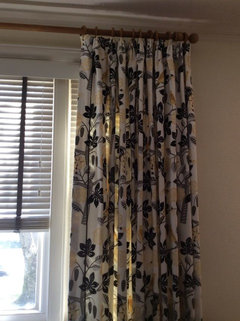
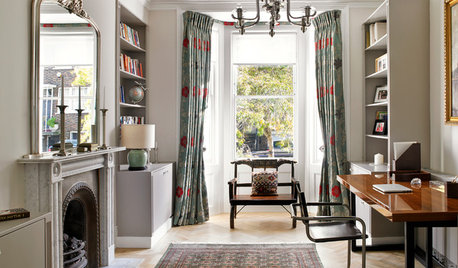
I want to have Parisian pleat drapery in my bedroom. I need help figuring out the correct ratio of pleating to space between the pleats that will provide full looking pleats with a deep return. I want the drapery to have clean vertical lines like the photo below.

Brookhaven Residence · More Info

Secondly, the drapery panels will be stationary and will only cover the wall space surrounding my bedroom windows. It is a bay window wall and I will have 4 sections of stationary panels. The wall space surrounding the middle window is 50 " inches wide on each side. Would 3 panels of standard width fabric be appropriate for each side of the middle window? Would 2 panels (2X fullness) look skimpy?

Lastly, how do you hide the seam between panels when sewing them together for wide spaces? Is there a way to arrange the seam to be at a return at the wall rather than facing the front?

Comments (12)

  • 9 years ago

    How much sewing experience do you have? Pleated drapery is not easy - you need to match the patterns, if any, and sew really long, very straight seams. With linings and buckram tape headers. Just wrangling that much fabric is a chore.

    http://www.smithandnoble.com/pip/parisian-pleat-drapery 

    "Would 3 panels of standard width fabric be appropriate for each side of
    the middle window? Would 2 panels (2X fullness) look skimpy?"

    http://alittledesignhelp.com/what-is-the-fullness-of-a-drapery/ 

    2X fullness is NOT 2 pieces of fabric sewn together. It is 2x the width of the space you want to cover (wall, window, or both). It can be part of one width or several widths.

    Lastly, how do you hide the seam between panels when sewing them
    together for wide spaces? Is there a way to arrange the seam to be at a
    return at the wall rather than facing the front?

    1. You will need extra width in the drapes - enough to make one extra pleat for each seam in the width.

    2. You match the pattern, if any, as you seam the fabric.

    3. You figure out where the pleats have to be to keep the seam from being conspicuous.

    4. Then you mark the pleats and where the side hems should be, cut the widths, make the side hems, apply the pleating buckram and sew it.

    5. Then pleat it. And hem the sides.

    OR:

    1. Before you sew the whole panel width together, you figure out where the pleats will be, and cut so the seams will fall between the pleats.

      NOTE: This can screw up your pattern matching ...
    1. Then you seam the panel, apply pleating bucktram ... etc.

    It can add a significant amount of yardage to a project, first for the pattern matching and then the stuff you lose at the sides hiding the seam.

    It is very seldom done. A good lining keeps the seams from showing through, and if you match patterns well it's inconspicuous.

    MGdecor thanked User
  • 9 years ago

    Thank you lazy_gardens for your advice. My mother will be constructing the drapes and she's an expert sewer. She has made drapes for me in the past, though for a smaller space and a single width of fabric was used.

    In terms of fullness of drapes, I understand that fullness is related to the width of the window/space rather than the width of the panels. However, since my wall space (where I will hang the stationary drapes) happens to be 50" and standard single width of fabric is typically 54" I was considering using 3 standard width sections sewn together to achieve 3X the fullness for the 50" wall space. Would 3X fullness be desirable if using a thin linen/faux linen type of material? Or would 2X or 2.5X be better?

    Thankfully, I will be using a solid fabric, and not a patterned one. This will simplify the process and I won't need to account for matching up the pattern repeat.

  • 9 years ago

    I've made pleated draperies very successfully using the old Singer Sewing for the Home series of books. There's a new one available that says it includes pleated styles. I think it would be a worthwhile investment. https://www.amazon.com/Singer-Sewing-Custom-Curtains-Treatments/dp/1589239318/ref=sr_1_9?ie=UTF8&qid=1484924323&sr=8-9&keywords=singer+sewing+for+the+home

  • 9 years ago
    Thank you clt3!
  • 9 years ago
    lazy_gardens and clt3, I looked into the resources you suggested and they are awesome. Thank you for the great tips! Much appreciated!!
  • 9 years ago

    When you sew two lengths of fabric together to get a wider panel for curtains, the standard practice is to cut one of the lengths into two sections and to sew one of the half sections to each side of the full width one. The idea is to not have a seam right in the middle of the completed panel.

    Good luck on handing that much fabric and getting it all level, straight and in place. It can be a nightmare without the proper place to handle it. It is much like building something and you really need to keep it all in proper square, just like working with a piece of wood or a tiled floor.

    I assume that they are not to be lined. Is that right?

    I have had very good and pleasing results with a linen curtain of only about 1 1/2 fullness and hung with decorative clip on rings on a wooden pole. I used one 54" wide length for a 30" wide window. So, whatever that ratio is. I lined it and hemmed it with a double turned 3" hem at top and at bottom and added the rings by beginning at the middle of the width and spacing them evenly across the width.

    They will gather up on onto the drapery pole and fold outwards (forwards) into nice rounded "pleats" between the rings. They, of course, are not actually pleated, but they serve the same look and purpose. The depth of the "pleat" will depend on the distance between the rings. The wider spaced are the rings , the deeper it will be. Once you get the rings and the curtain in place, you adjust them to look how you want. If you don't plan to open them , the "pleats" will remain just as you form them to. Even if you use them on a working curtain, they still return to a nice form.

    I love this method so much that it my default curtain construction now days. If you are not covering a glass for warmth, you do not really need a lot of material all gathered into that small space, which is one of the main purposes of pleats is to gather large amounts into small spaces. And, I have found that the lined linen is a good and functional covering even at that small ratio. You do want them to hug the wall and to not be so full that they look like a petticoat billowing out. Or, maybe you do.

    I made some beautiful linen ones. I choose an off white plain good quality linen. To add interest with something that can be changed to coordinate with changing taste, I took a pretty deco fabric and made a folded and finished strip about four inches wide, interlined with buckram, and the length of the finished curtain, complete with the same three inch folded hem as is on the curtain. I had these large vintage mother of pearl buttons from grandmas button box. So, I tacked the decorative strip to the finished edge of the curtain by overlapping the strip and the curtain by about two inches and centering and sewing on the buttons through all thicknesses. Start at the top and anchor with the first button and space them evenly. I have maybe six or so buttons down a length. It turned out to be a great use for those lovely old vintage buttons and an added feature that I can change out anytime just by sewing a new finished strip in a new fabric, or just removing it altogether. The only thing it has done to the body and fabric of your curtain is a few stitches that are holding the button in place. So, the impact is minimal. I am very pleased with it all.

    I added this strip only to the leading, inside finished edge, of my curtain. You could do both edges if you wanted to. You could also add this decorative edge strip without the buttons by tacking with some invisible stitches. It does not carry any weight, so it only needs enough to keep it up there. You could do all manner of decorative edging pieces that you could tack on.

    I also used this same method of construction ,without a decorative edge strip, on my sliding door. It works beautifully!

    It gives a more modern, cleaner, and less fussy look to a window treatment, it is easier to construct, and it is easier to hang, to take down to clean and it requires less fabric so there is less expense. Since I was using only one width per my single 30" wide window, it left me more investment to put towards a nicer fabric.

    Since you are hanging yours over wall and not window, there is not a lot of cause to use really full widths with pleats to get that look.

    I use the terms "curtains" and "drapery". I don't think it really matters much anymore.

    I am so very, very pleased with my linen curtains and the one on the door.

    That business of pleating is fraught with frustration and expense and is a little more fussy than modern. And, in your case, you don't really need that much fabric gathered up along your wall.

    You can buy the rings at Bed and Bath. I have had really good experience with them. I was afraid that the door curtain would be too heavy for them, but that has not been true, at all. They get pulled back and forth on a daily basis and it has been at least ten years, if not more. Since they are so easy to hang and to take down, I do take them down ever so often and give them a real good shake out and airing in the fresh air and sunshine. There are no small jelly fingers to stain them and no pets to add hair to them, and no smoke so it works for me.

    I did many a fussy treatment when I had my drapery business and I really love this simple and elegant method.

    Good for your mom! I am doing slip covers for my daughters sunroom furniture right now. I used to do this a business. Now, just for her.

  • 9 years ago

    One more comment---

    Lining them will add to the way they fall and will add to the body in a good way. It will also keep them dimensionally stable. Even if they are not covering a window, a lined panel will still be nice.

  • 9 years ago
    last modified: 9 years ago

    "When you sew two lengths of fabric together to get a wider panel for
    curtains, the standard practice is to cut one of the lengths into two
    sections and to sew one of the half sections to each side of the full
    width one. The idea is to not have a seam right in the middle of the
    completed panel."

    Sorry, I have to disagree with you on this. True for shades, tablecloths and bedcovers, but for curtain panels, one seam always looks better than three, and that one will be hidden towards the back. Also less work to sew 2 together, rather than 3.

  • 9 years ago

    I assume that you mean the back of a pleat? Still, you would have the seam showing through the finished panel down the length of the panel right down the middle of the window unless your fabric is dark or has a light blocking liner.

    Not all are pleated. For the type of curtain that I am talking about, the panel is of a nature that is more like a flat shade or bedspread.

    I am not sure where the market is on window treatments now days. It looks to me as if pleated drapery is a bit outdated and the aesthetic is towards a cleaner and lighter modern look.

    Yes, you could sew two panels together. But, I was doing mine on a professional basis and I wanted to adhere to standards. For my own use, I might just sew two together. When people were paying me big bucks to sew them, I did it the standard way. And, believe me, I matched those prints, perfectly!!!

  • 9 years ago

    I do it professionally and I adhere to today's standards. Yeah, I know how to match perfectly too. Pleated drapery is not outdated, just done a bit differently than in olden times.

  • 9 years ago
    last modified: 9 years ago

    Here's a two width panel, sewed down the middle, euro pleats (5 per width rather than the old 6), more unstructured with interlining folded in the heading rather than buckrum and micro cording sewn near the leading edge. The lead edge is a separate piece of fabric that I matched to the rest, after sewing in the cord. Not outdated at all.

    Using updated fabrics and methods give an updated look, even for french pleats.