Software
Houzz Logo Print
seedg2

Help! I need some advice with my seedlings wilting.

It's the first time I decided to grow some plants on my own. I bought the seeds online and did everything correctly - scarified some that needed to be, soaked some, stratified some. It seems I acquired these skills perfectly. It resulted in very good and fast germination.
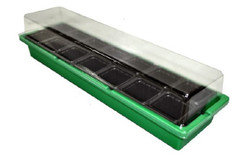
I bought a plastic propagator with holes and a lid, started them indoors on January 2. I have them in front of the north-faced window through the day and on the radiator (instead of heating mat) through the evening hours under a light. It's a led light bulb (5 W) and it's very bright. I turn it off late at night. It seemed like seedlings couldn't be more 'happy'. Many of them germinated and they grew quickly. These are:

5/5 seeds of leonotis leonurus which germinated in just three days.

6 seeds of caesalpinia pulcherrima; 2 of them have 2 pairs of the first leaves, one is still germinating, don't know what happened to the other 3.

6 seeds of echium candicans; 4 of them are about 2 cm high and look healthy.

Many seeds of callirhoe involucrata; 4 of them are currently growing, one was sprouting until yesterday.

some seeds of gaura lindheimeri; 4 of them are growing now.

Strelitzia reginae hasn't come out yet, and asclepias curassavica seeds seem to not have been viable.

Dalea purpurea which I sow in a plastic pot because I ran out of space in the propagator. I also think there was almost 100 % germination rate.

I used a plastic syringe to carefully water them every to every other day. I didn't let them dry out.

But suddenly: some seeds of dalea purpurea started to wilt and had sort of unhealthy look. I googled and found about damping off disease. I didn't really see any mould or fungi but I decided to try sprinkling the soil with cinnamon powder and cut off with watering. I also sprinkled cinnamon on the soil of seedlings in the propagator, just in case. As it didn't look to me like a damping off but more of a root problem, I suspect I was watering them too frequently and they didn't feel like developing roots. As I pulled some daleas out, their stem looked healthy but almost no roots.

Now that I quit watering there are caesalpinia seedlings which look very wilted but the stem is healthy, leonotus seedlings are growing a first pair of true leaves but otherwise are sort of leggy and their cotyledons are wilted but not the true leaves, echium seems fine, the youngest gaura seed wilted, callirhoe's leaves aren't so hard anymore... It seems to me like a story of a success turned into my worst nightmare. I have checked them daily and have done everything to fit their needs.

So here's what I decided to do: I'll gradually stop with watering as it is obvious I exaggerated, and in the meantime I put propagator without the lid on the radiator (it's never hot but warm) under a light and I'll make the excessive water evaporate. My question is: is it a right way to do it? I really don't want to lose my seedlings. Because at the moment they really aren't looking healthy but I think it's because they are shocked and not so wet anymore. Will they do fine?

Please help, I am so desperate at the moment.

Comments (13)

  • 9 years ago

    Bottom heat AND dome covers of any kind are used just for germination. Once the seeds germinate they are removed from both heat and any cover. Both cause problems for young seedlings - warm soil retards root development, excess moisture/humidity retards root development and creates fungus and bacterial problems.

    Most importantly, high levels of light, supplemental light, is necessary for effective photosynthesis and higher than normal air circulation (like a small fan) is also needed.

    When seedlings have been overly stressed from the get-go often the only solution is transplanting them deeply into fresh soil-less mix. Not only does the act of transplanting trigger new root development but also encourages new roots to develop along the now buried stem. But all is wasted effort IF adequate light is not available to the plants and window light is never sufficient.

    I suggest a reading of the many FAQs here as they cover all these basics.

    Hope this helps.

    Dave

    SeedG (Zone 9b - 10b) thanked digdirt2
  • 9 years ago
    last modified: 9 years ago

    Thanks, but I am afraid I didn't make myself clear.

    I know bottom heat and covers are used for germinating, but I have one and only propagator in which some seeds already sprouted and some haven't.

    And I used bottom heat now to remove excessive water from inside the soil, that's what I asked if it's ok to do it.

    I can provide adequate light. So you think it's the best to transplant them? I wanted to wait until 2 pairs of true leaves are formed. I think they're too stressed right now to cope with transplanting. Also, I don't think it's a good idea since they may not have roots developed.

    Thanks anyway.

  • 9 years ago
    last modified: 9 years ago

    If you are trying to grow different plants with different germination rates in the same propagator - something that is never recommended because of the problems you have discovered - then the only solution is to cut the trays apart so you can remove the ones that have germinated and leave the rest. The cell packs in your photo are easily snipped apart.

    "And I used bottom heat now to remove excessive water from inside the soil, that's what I asked if it's ok to do it."

    No moist heat, moist and warm soil, is even more stressful on rootlets than cool moist soil is. The way to remove excess moisture from soil is to mix in more dry soil and that is why we transplant seedlings ASAP.

    "So you think it's the best to transplant them? I wanted to wait until 2 pairs of true leaves are formed. I think they're too stressed right now to cope with transplanting. Also, I don't think it's a good idea since they may not have roots developed."

    It is your choice of course but it is standard practice in the industry to move seedlings out of the germination trays into their growing containers at the seed leaf stage. We do hundreds of them daily in the nursery.

    When to transplant to growing medium is a common discussion here and the "2 pairs of true leaves" is merely a guideline for the inexperienced. It is not a rule and applies only when the seedlings have had ideal conditions from the beginning. Careful transplanting is far less stressful for the plants than leaving them in overly warm, overly wet conditions. As I said above, the act of transplanting is what triggers new root development.

    Since they are not doing well as is then you have nothing to lose by at least trying it with some of them.

    Dave

    http://faq.gardenweb.com/discussions/2766573/transplanting

    SeedG (Zone 9b - 10b) thanked digdirt2
  • 9 years ago

    Dave is absolutely right about the practicality of transplanting at the cotyledon stage. It's very easy as long as you handle the seedlings carefully so as not to crush the stems. It's known as 'pricking out'. If you Google that term you'll find lots of advice.

    SeedG (Zone 9b - 10b) thanked floral_uk z.8/9 SW UK
  • 9 years ago

    Yep, I agree. At this stage, the root will still be unbranched and will slip out of the soil very easily - you can loosen the soil with a toothpick or fine dibber without worrying overmuch about root damage..make sure you have a decent depth of medium when you transplant...and only handle the cotyledons. Plantlets are tougher than they might appear..

    SeedG (Zone 9b - 10b) thanked User
  • 9 years ago
    last modified: 9 years ago

    Hey, everyone, thank you so much. I've come to report. :)

    I completely quit watering except for the smallest seedlings to which I added a few drops of water (to callirhoe and echium). I have loosened soil with a toothpick. I had also used one toothpick for a support and I noticed mold on a toothpick today! :( I removed the toothpick. Added fresh soil.

    The thing is since I quit watering only the biggest seedlings survived. I have managed to save all 5 leonotis seedlings, caesalpinia died completely as well as 2 seedlings of echium and one gaura. Also just one callirhoe survived. One question here: since I quit watering daily, the caesalpinia leaves dried up completely. How is that possible - the soil around it has been moist the whole time?

    I keep them on the drier side although the soil has remained pretty moist. They get enough supplemental light as well as natural light (I expose them to a south facing window sill every day for a few hours on direct sun).

    The other seedlings - I'd love to transplant them but they just went full flaccid. :( They literally can't stand up even with a toothpick. They seem like rotten or something. But they don't rot as far as I know. What's wrong? I may add a picture tomorrow.

    But there's something strange I encountered today. I wanted to see how strelitzias were going and started digging with a toothpick. I saw something white and thought it sprouted. However, when I looked it was something like a very very tiny white worm. Is that harmful? I noticed some fruit flies constantly flying around my propagator, though.

  • 9 years ago

    1) Seedlings need to be gradually hardened off to lower humidity conditions.

    2) Seedlings rotted or cooked (or otherwise dead/dying)

    3) Fungus gnats (feed on decomposing organic matter)


    SeedG (Zone 9b - 10b) thanked dbarron
  • 9 years ago
    last modified: 9 years ago

    I am back with the pictures.

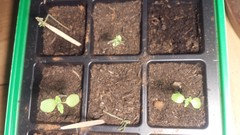
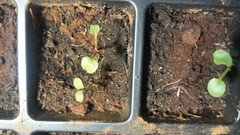
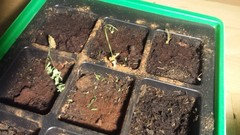
    Leonotis leonurus (5 seedlings; top right corner is empty)

    Dying leonotis

    Only one callirhoe out of over 30 seeds that is healthy

    Dying callirhoe

    3 gauras
    Three dead? caesalpinias
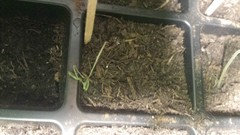
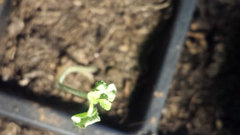
    Daleas (What should I do with them - it seems all of them are dying?)

    Leonotis with true leaves ok but cotyledons wilting

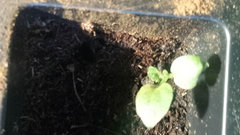
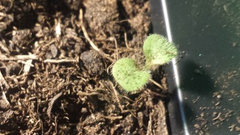
    Echium that seems ok

    Echium that's not happy


    If anyone could tell me based on these pictures, I'd be very grateful.

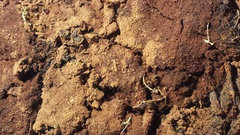
    And the brown powder on the soil is the cinnamon like I mentioned.

    Thanks again.

  • 9 years ago
    last modified: 9 years ago

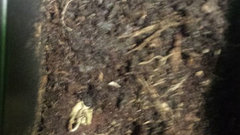
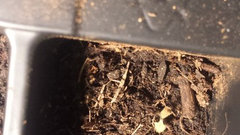
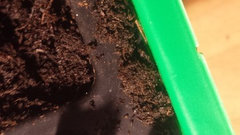
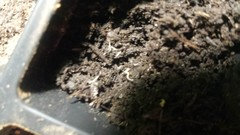
    It's me again with some very bad news. I wondered where the other 3 caesalpinias were that have never really sprouted so I dug up. I was shocked to see these little white nematodes (?) have eaten all my seed. There are hollow seed husks and inside a dozen of these white creatures. (click on the image to enlarge)


    That explains why very big and healthy caesalpinia which grew the fastest of them all has suddenly died. It had already had more than two true leaves before. The "thing" must have apparently eaten their true roots. That may explain why some of the others (including formerly helathy leonotis and echium as well as callirhoe) have suddenly fallen down. Something must have been eating their roots! Do you know this worm?

    In a deep despair, I dug on and also found the nematodes (?) have eaten 3 out of four strelitzia seeds.

    As I felt a little relieved it wasn't all my fault since I really cared of them all very much I am so disappointed an animal like this completely ruined my seedlings.

    A lesson learned, next time I'll heat the soil up in the oven at the highest temperature. It was an ordinary planting soil from the store.


    Googled it - they seem to be ENCHYTRAEIDAE? Any ideas?

  • 9 years ago

    The few times I've encountered the nematodes is when the seed has rotted due to over watering and the nematodes move in afterwards. AFAIK they don't eat healthy seeds so they didn't ruin them. They just cleaned up the remains.

    Your other photos look like damping off although the mix now seems very dry. The thick crust of cinnamon would probably prevent any seeds still to germinate from penetrating through it in much the same way as coffee grounds do.

    All in all the problems would all appear to stem from excess water and poor ventilation.

  • 9 years ago

    "All in all the problems would all appear to stem from excess water and poor ventilation."

    Agree plus too little light. Many of them are leggy with weak stems that can't support the leaf head.

    I don't know what soil mix you are using there but the photos make it appear to be of very poor quality. You can see in some pics how it won't even wick across the surface of the soil. And the hard crusting will quickly lead to stem damage and poor germination issues of any remaining seeds.

    Once young just-germinated seedlings have been exposed to excess moisture, to over-watering, it is very difficult to bring them back to health. It is time to start over.

    Dave

  • 9 years ago

    I have definitely found it imperative to use a "soil-less" seed starting mix which usually consists of peat and perlite. If u buy a quality mix like farfards or pro mix or sunshine mix (my favorites). It should be light and fluffy and if u fill a tray with water it will soak up the amount needed for starting seeds. The flats should be noticeably heavier. All of the supplemental watering should be done with misting or bottom watering . I like to mist them a few times a day until the top layer of soil is wet and then I check the weight of the tray to make sure it is still heavy. Otherwise give more water from the bottom. Also they don't need the bottom heat or domes once sprouted just lots of light. Good luck!!