Software
Houzz Logo Print
alan_waterman61

My grass is dying......

9 years ago

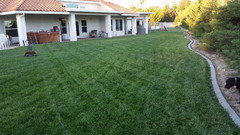
It's been very wet and my lawn is dying in patches.


Some photos in an album.

https://alana.smugmug.com/Lawn-Fungus/

I thought it might be fungus but a local UC extension employee thinks its root rot from too much water.

Some additional info:

The grass mix is vary diverse. Between all the tall fescue blends I've over seeded in the last 5 years, there's at least 5 or 6 types tall fescue with some blue grass. From the photos, you can see even the blue grass has died. Whatever it is kills nearly everything in a given patch.

The soil ph is 6.5 and well aerated despite being sandy loam with lots of clay. There are literally hundreds of earthworms in any single shovel full of dirt.


What I'm seeing now I've seen before but only on the shady strip of lawn at the back of the lot.


The sprinkler is a weather based and will pretty much not water in the winter unless it's dry and it's a day or so before a freeze. It's smart enough to know it needs to make sure the roots are wet before deep freezing, otherwise it barely waters at all. Given the recent long duration rains in the last month, my sprinklers have't been on at all in at least that long and when they were it was perhaps 5% of a normal full peak summer load.


I fertilize once a year in the spring with a 9 month Best Simplot time release fertilizer. It's VERY slow and is both temperature and moisture based(one is encased in sulfur and the the in a polymer).


Any ideas?


Comments (10)

  • 9 years ago

    Root rot is a fungus, so could be everyone is right.

    Where do you live? Don't need the zone, we need the town or zip.

    In the heat of summer, how often was the sprinkler turning on and for how long did it stay? Grass does not need frequent watering. I think I might have watered less than a handful of times in the Texas Hill Country this year.

    How high/low do you mow and how often? All the grasses you mention should be mowed at the mower's highest setting.


  • 9 years ago

    I'm using less water than I have in years prior to about 3 years ago since I got the smart irrigation controller which keys off weather data. I'm using about 500,000 gallons less water per year than I used it.

    The sprinkler hasn't been on once in probably 5 weeks. It was on a day before a freeze a while back so that the roots wouldn't freeze as it was quite dry even though it was cold.


    My location is Merced, CA.

  • 9 years ago

    Merced is a poor place to have cool season grasses. When people try to grow plants which are not suited to the area where they live, they run into issues. In your case it gets too warm in Merced for the cool season grasses. In your part of Central California, I would not recommend cool season grasses to anyone living east of Highway 101 until you get into the Sierras or at least the foothills.

    In the summer your smart sprinkler should be watering once per week for however long it takes to apply 1 inch of water. This time of year it should be watering once a month unless it has rained in the previous month. But it should also be smart enough to know that lots and lots of rain can prolong the watering effect for much more than a month. For example I have not watered in about 5 months but we got rain twice. The idea is to keep the surface of the soil dry but allow more water down deeper. That's done by deep and infrequent watering.

    Deep and infrequent is the mantra for watering. This is for all turf grass all over the place. Deep means 1 inch all at one time. Put some cat food or tuna cans around the yard, and time how long it takes your sprinkler(s) to fill all the cans. Memorize that time. That will be the time you water from now on. My hose, sprinkler and water pressure takes 8 full hours to fill the cans. Your time will likely be less. I like gentle watering. As for watering frequency, that depends on the daytime air temperature. With temps in the 90s, deep water once per week. With temps in the 80s, deep water once every 2 weeks. With temps in the 70s, deep water once every 3 weeks. With temps below 70, deep water once a month. Note that you have to keep up with quickly changing temps in the spring and fall. This deep and infrequent schedule works in Phoenix and in Vermont, so it should work for you. The reason for deep and infrequent is to grow deeper, more drought resistant roots and to allow the soil to dry completely at the surface for several days before watering again. If it rains, reset your calendar to account for the rainfall.

  • 9 years ago

    Thanks. Know all that. Lawn has been doing fine for 19 years. This is new and is not related to the 1 month of 90+ heat that we get in the summer.

    This is what it looks like in 100+ degree weather:


  • 9 years ago

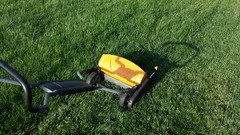
    And yes, I mow a full acre of grass with an 18" mechanical reel mower :)

  • 9 years ago

    Yea, I guess that's my biggest fear is that it isn't anything other than simply being too wet meaning that on a wet year like this, which is very rare, I'll just have to suffer with damage.

    I'm seriously considering picking up a second hand Mataway Overseeder which would reduce the labor, time, and cost of lawn repair to a fraction of what it takes now. Basically I'd just overseed with the slit seeder every February and be done with it.

  • 9 years ago

    For that matter you can just scalp and broadcast the seed. No need for a slit seeder.

  • 9 years ago

    Won't work. The birds eat up all surface seed within hours. It must be covered plus the germination rate is far higher when covered. The slit seeder will bury the seed a half an inch or so. Even then the birds will get some of it but not most of it.

  • 9 years ago

    Ha, never had a bird issue, I thought it was more of a myth.

Sponsored
Bella Casa LLC
Average rating: 5 out of 5 stars17 Reviews
The Leading Interior Design Studio in Franklin County