Software
Houzz Logo Print
lindsay_ke

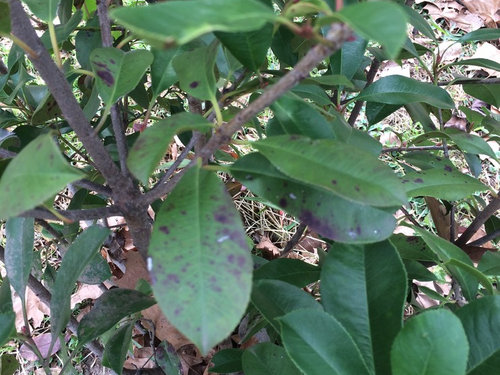
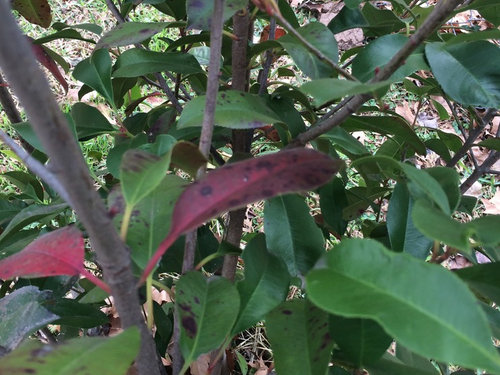
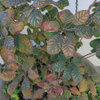
Does this Photinia have black spot?

9 years ago
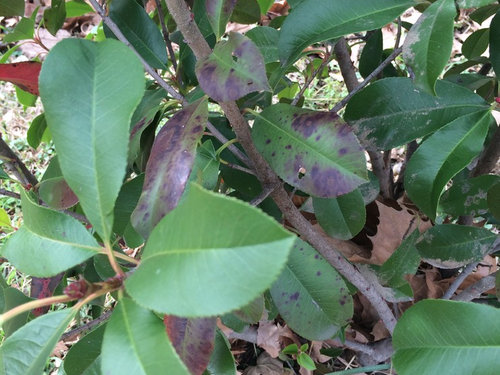
It has several of these leaves. I'd like to know if it's doomed, because need this shrub for privacy and would like to replace with something else if it is. It's only a few years old so will be easy to remove at this point. Or I could just let it keep going. Opinions?

Comments (30)

  • 9 years ago
    last modified: 9 years ago

    It is not black spot but it IS Photinia leaf spot,Entomosporium mespili. There are a good many resources out there that will provide suggestions for controlling the problem but a cure is pretty nigh impossible. Once the plant has it, it will always have it and removal and replacement with something else is often the best way to go.

    Photinia leaf spot control.

  • 9 years ago
    last modified: 9 years ago

    Ok. I'm wondering if this is because we've been having a lot of rain. I've been reading on here about people saying theirs get in the winter, but once the infected leaves fall off it's fine through the summer. I self-diagnosed it last winter (wanted more input this time) and sprayed it all through the spring with neem oil. Only a few leaves looked bad last winter, and those few leaves were not as covered. If it's going to do this every winter, and get progressively worse, I may just replace it now while it's easy.

  • 9 years ago
    last modified: 9 years ago

    here is an excerpt from the U of Miss extension service dated 2004:

    "Ten years ago, one of the most popular shrubs in the South was the Red-tip Photinia (Photinia fraseri). Everybody wanted this handsome evergreen shrub and it was widely grown by Southern nursery growers for use in both commercial and residential landscapes. Nevertheless, in the last ten years or so, Red-tip has gone from the top of the list to the bottom due to intense pressure from a devastating fungal disease.

    Red-tip is highly susceptible to the fungal pathogen known as Entomosporium that causes leaf spots and ultimately defoliation. The disease has all but eliminated Red-tip from the list of recommended shrubs for Southern landscapes. In fact, the disease is so widespread that one plant pathologist jokingly explained that there are two types of Red-tip, those that have the disease and those that are going to get it! So, even though newly planted Red-tip bushes may stay disease free for many years, ultimately they will succumb to the inevitable."

  • 9 years ago

    Sure it can be left for a while!! It actually doesn't look all that bad yet. This is a slowly progressive disease, much like dogwood anthracnose, with each year producing more spotting and more defoliation. You see fully infected redtips around here that are nothing more than bare branches with ridiculous tufts of the new red growth on the very tips and the owners have not yet figured out the plant is slowly dying. However they are not making much of a privacy screen at that stage!!

    And this is not a disease that will infect all of your garden - it is very restricted to the photinias and to Indian hawthorn (Rapheolepis) and a few other species but those two are the most readily affected. So there shouldn't be much limitation on what the OP chooses to replace it with.

    Lindsay K thanked gardengal48 (PNW Z8/9)
  • 9 years ago
    last modified: 9 years ago

    Particularly because an interest was expressed in the photinia still being small enough to come out easily when this is undertaken it would probably be best to dig it out now and get the replacement started right away.

    You have to have the budget for it of course but often the best arrangement is a wood fence behind with shrubs and other plants in front. That way the privacy (and other benefits) provided by the fence are achieved as soon it is erected, without having to depend on (and wait for) the plants to do it.

    Even a sheared hedge can have uneven development (or complete failures) and then you are left with gaps in your barrier or screen.

    Lindsay K thanked Embothrium
  • 9 years ago
    last modified: 9 years ago

    Thank you for the opinions. I'd love to plant something new to give it a head start before removing the photinia, but then will have to space it pretty far from the fence, so maybe just removal and replacement would be best.

    I would love a privacy fence for immediate coverage...It has been a constant debate since buying this house if we should get one. We have a great mature hedge in this part of the yard (un-sheared) which is a wonderful home for birds, and provides a complete screen 10 feet high and 20 feet wide. This photinia is actually at the edge of that hedge, and I planted it in hopes of extending what is already there. I have not been able to figure out what kind of shrub makes up that hedge that's already there. I put it on a plant identification board before buying the photinia and got no responses. Maybe I need to try again and just replace with that.

  • 9 years ago

    If you see it with flowers or fruits and show it then maybe it will be recognized. Or you could try clipping samples and taking them to garden centers.

  • 9 years ago
    last modified: 9 years ago

    Ok, I got a response this time. Euonymus. I think specifically euonymus Manhattan.

  • 9 years ago
    last modified: 9 years ago

    Tony Avent (from Plant Delights) mentioned that he has seen very little Entomosporium on Photinias that have NOT been trimmed, but rather just left to grow on their own untouched by human hands (shears). We tend not to have much of a problem with leaf spot up here in 7a. Maybe because we're cooler, I don't know. If you plan on eventually shearing your photinia, it may then be likely that the new growth will be more vulnerable.

    There may be some good hollies that would work there. Burford, Needlepoint. Oakland holly works well up here for screening and grows densely. Savannah, East Palatka or Eagleston hollies would work for you and are much less spiny. Ligustrum japonicum is a common hedging plant there, but reseeds. Prunus caroliniana, but it tends to reseed as well. Or Photinia serrulata which is more disease resistant than red-tip. If the area gets sufficient water, then maybe Viburnum 'Chindo' would work. Little Gem Southern magnolia, but it will get some size over time. I wonder how Ternstroemia would do there. Really a lush plant. Osmanthus fragrans or x fortunei would be wonderful. So many plants to choose from.

    If it's a dryish spot, I wonder if some of the southwestern evergreen oaks might not work -- such as Q. turbinella.

  • 9 years ago

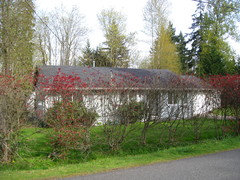
    Here's what's left a Photinia hedge in my area. It has since been removed. It doesn't look like much has been done to it as far as clipping goes and it still looks bad. I believe the house was being flipped and was vacant for awhile.

    April 7, 2015

    Lindsay K thanked Mike McGarvey
  • 9 years ago
    last modified: 9 years ago

    Hey Mike (Seattle), do you ever seen any single untrimmed specimens (trees) of Photinia out there? Do they do any better than trimmed hedges? That hedge you are showing sure looks trimmed to me. Our untrimmed photinias approach 20 to 25 feet high here.

  • 9 years ago

    On occasion, you do see large, apparently unaffected specimens. There is a massive one - 20'? - in my previous neighborhood that looks pretty spectacular in spring with the red growth and white flowers. But it is located inside a garden and I can't see the foliage clearly enough to determine if it is blemish-free. But you also see seldom (if ever) pruned privacy hedges that look just like Mike's photo. And a whole lot more of them!!

    Most local nurseries have stopped carrying this shrub because of the leaf spot issue.

  • 9 years ago

    That hedge looks like the top had been trimmed some time ago. I rarely see Photinia untrimmed. Usually because they're planted with not enough room to grow untrimmed.

    I've never been a fan of Photinia. The red new growth looks cheap. Maybe because of the large leaves. I like the new growth of Pieris japonica 'Mt. fire' much better.

  • 9 years ago
    last modified: 9 years ago

    Wow, Mike. That's bad! We have many around town where I live that are full and beautiful, but I haven't looked at them up close. They're mostly unpruned.

    All of the local nurseries here still carry them. The big box stores carry them in huge quantity, and the local places still have a handful for people that want them. I bought this one from a great local nursery. I told them I was worried about possible leaf spot and they just brushed it off and told me not to worry about it.

  • 9 years ago
    last modified: 9 years ago

    Isolated and natural habit (little, if any pruning), long established example on Camano Island picked it up and went down quickly some years ago now. Since then condition has become widespread here, making the hybrid appear obsolete. As happened previously in other parts of the country.

  • 9 years ago
    last modified: 9 years ago

    Well, I for sure won't be buying another. It's too bad the Chinese Photinia isn't available anywhere.

    Any thoughts on the manhattan spreading euonymus I mentioned replacing it with? I know it's typically considered a "gas station shrub" haha...at least that is one opinion I read. My mature ones are beautiful though and low maintenance (I'm knocking on wood), they must like the conditions in that part of the yard.

  • 9 years ago

    Photinia is usually allowed to grow as multitrunked trees in my area. I may be able to get some pics when they bloom, but the leaf spot is a big issue.

  • 9 years ago
    last modified: 9 years ago

    When I search "photinia serratifolia price" I get this grower located in Georgia on the first page, along with of course various British origin hits you won't be able to use. Maybe there is a retailer you can identify that has gotten or could get it from Bold Spring.

    Green Giant Chinese Photinia

    http://www.boldspring.com/trees/pgg-ftg

    Also there might be others offering it under the synonym P. serrulata.

    Lindsay K thanked Embothrium
  • 9 years ago

    I'll try that, Embothrium. Before buying this Photinia, I had called a few nurseries asking if they could get me the Chinese one. They all said no, but it's been a few years so maybe will try looking again with this info.

  • 9 years ago

    If there is a regional wholesale nursery source listing on the web that returns individual kinds of shrubs when searched try that to see what, if anything might be in production (in addition to what Bold Spring is saying they have).

    Lindsay K thanked Embothrium
  • 9 years ago
    last modified: 9 years ago

    You guys will never believe this. I had a landscape designer come out, to give me ideas for a completely different part of my yard. Guess what the main plant he recommended that I use is? Red Tip Photinias! Ugh! I just emailed him that I'd prefer not to use thouse, and asked for an alternative. We'll see what he says.

  • 9 years ago

    Due to the large leaf size and strongly colored new growth I would not have planted a lot of it in any one arrangement even before the disease problem became pervasive.

  • 9 years ago

    I'm thinking about getting one to plant as a specimen

  • 9 years ago
    last modified: 9 years ago

    Around here they are mostly used as hedge plants, mostly because we do not have many other native shrubs that have a fast growth rate. We'll see what alternative he gives me, probably a holly. I have a mature one as a specimen that is beautiful, Logan. Shows no signs of the leaf spot.

  • 9 years ago
    last modified: 9 years ago

    I have been reading that "Red Robin" Photinia supposedly has a lower incidence of the leaf spot, Logan. That is what they are carrying at all the big box stores here. I asked the landscape designer his thoughts on that. I know my diseased one is not Red Robin, it's the original red tip.

  • 9 years ago

    I will look into that.

  • 9 years ago
    last modified: 9 years ago

    Out here Extension tells us

    The fungus overwinters in diseased leaves and shoots. Spores are disseminated by splashing water and need 9 to 12 hours of leaf wetness to infect leaves. Bright sun reduced spore survival during dry periods. Young expanding leaves are most susceptible.

    https://pnwhandbooks.org/plantdisease/host-disease/photinia-leaf-spot

    and that the separate condition

    Physiological leaf spot is on photinia in western Washington

    https://pnwhandbooks.org/plantdisease/host-disease/photinia-physiological-leaf-spot

  • 9 years ago

    My photinia looks gorgeous now, and is all leafed out and beautiful for Spring. I don't think I can remove it just yet :/ The nursery insists that it was just struggling this winter because of the wet fall we had, and that it can still persevere and do fine. We shall see...

  • 9 years ago

    I think you may be able to spray with a fungicide, and remove already diseased branches, while sterilizing your pruning tool(s) in between cuts. I certainly wouldn't remove it just yet.

Sponsored
AIS Renovations
Average rating: 4.5 out of 5 stars15 Reviews
Custom Craftsmanship & Construction Solutions in Franklin County, Ohio