

Tile Problem - Advice Needed
We are near the end of a bath renovation, but
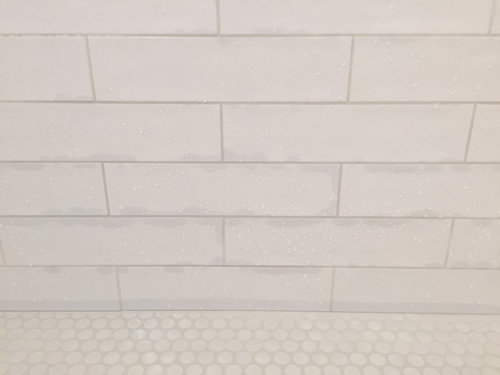
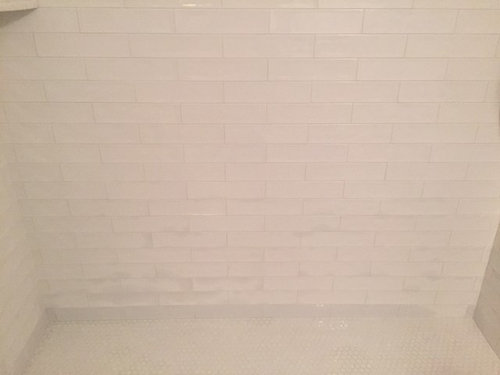
the ceramic shower tile is absorbing water and discoloring the face of the tile. Tiles near the floor take days to weeks to return to their normal color.
Tile Immediately After Getting Wet:
+6 Hours:
I have been working with our installer, retailer and tile
manufacturer to sort this out. At
this point we have hit a wall (no pun )so we are looking for additional (unbiased) advice to help us figure out next steps.
Additional info, detailed timeline and photos in comments.
Comments (47)

krasm
Original Author9 years agolast modified: 9 years agoTile: Undulated white ceramic subway tile (I was told by the
retailer this is a handmade tile, but I am not 100% certain; I do know it is
made in Italy.)Installation Location: Shower walls and ceiling
Grout Type: Unsanded, with grout additive
Joint Size: 1/16”
Substrate: Cement Backer Board
Timeline:
- Oct. 31: Tile installation began
- Nov. 4: Majority of tile installation was complete (At this point we ran
out of materials and had to halt work until the materials were received and the
installer could return to complete the installation. Notably, all of the tiles
pictured were installed in the Oct. 31 to Nov. 4 timeframe) - Nov. 23: Tile installation was completed
- Nov. 28: Tile was grouted
- Dec. 6: Shower fixtures were installed and tile was sprayed
with water for the first time. Immediately noticed the water absorption/discoloration
of tiles. Contacted the installer who indicated that should not happen.
Installer offered to contact manufacturer, who in turn recommended letting the
tile dry out completely and then sealing with 511 Impregnator. - Jan. 3: Installer returned to seal tile with 511
Impregnator. - Jan. 10: Water tested the tiles again with the same result
as before. - Jan. 28: As of today, the tiles have not been exposed to
water in 18 days and have only just within the last ~3-4 days appeared to fully
return to their usual color.
At this point, the retailer and manufacturer maintain that the tiles have not been given enough time to “dry out” although they won’t specify which stage was not long enough or how long the tiles need in order to properly dry. Looking at my timeline, I have a hard time with this rationale. The retailer has suggested humidity may be a factor, but considering it's winter in the northeastern U.S., I’m skeptical that high humidity is a factor.
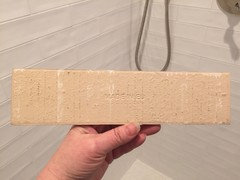
I will also mention I tested an extra tile by dipping it in a cup of water. Almost immediately the edges turn gray.
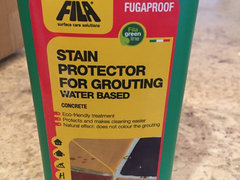
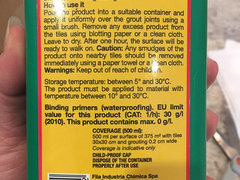
The manufacturer now recommends sealing the joints with this product. I don't plan to use it until I can get a clearer understanding as to what they hope it will achieve. At best, I’m afraid this will be a temporary solution to a long-term problem.
Everyone I have spoken to (knowledgeable sources) has said they believe the tile is defective.
I am interested in hearing about any similar circumstances and how they were resolved, or any thoughts as to what may be causing the issue. I would love to hear advice on what questions I should ask the manufacturer or what I should be asking them to do. I should add we do not have a general contractor for this project.
I LOVE this tile (when it's DRY!!) and we are beyond eager to finish this renovation project, so ripping it out and starting over is NOT appealing. I hope we can resolve it without resorting to such a drastic measure, but I also don’t want to be saddled with this problem for years to come. Thanks in advance!
Related Professionals
Lexington Kitchen & Bathroom Designers · Stamford Kitchen & Bathroom Designers · Aurora Kitchen & Bathroom Designers · Willmar Kitchen & Bathroom Designers · Hannibal Bathroom Remodelers · Gloucester Bathroom Remodelers · Traverse City Bathroom Remodelers · Oxnard Bathroom Remodelers · Sheridan Bathroom Remodelers · Toronto Bathroom Remodelers · Athens Tile and Stone Contractors · Wichita Tile and Stone Contractors · Lafayette Tile and Stone Contractors · Knoxville Tile and Stone Contractors · Tucson Tile and Stone Contractorskrasm
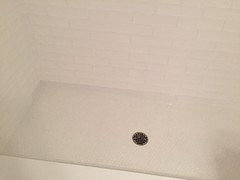
Original Author9 years agoTile +7 days after getting wet (bottom row of tile still discolored).
krasm
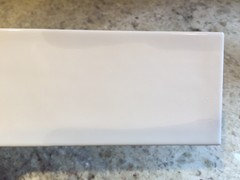
Original Author9 years agoFace of Dry Tile: (darker area on lower right is a shadow)
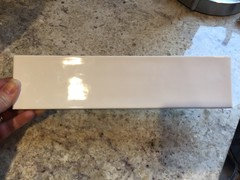
Face of Tile after dipping in water:
 9 years agolast modified: 9 years ago
I am so sorry, but I think your tile is defective. The fact that you simply put it in water and it does that seems a major problem.
ETA, I don't have the specifics, but I have subway ceramics brand white ceramic tile and had no water wicking. I would think your installer would have seen that when using the wet saw to cut them. 9 years ago
It's probably the clay body is very porous. I would use porcelain tile in a shower. Porcelain is very resistant to water infiltration. Did you have a topical water barrier applied before the tile? Such as hydroban or redguard? If not is there a poly layer behind the cement board? One or the other needs to be in place. If a poly layer is in place, then the cement board is getting soaked along with the tile. But the good news is that your wall structure is protected. If a topical membrane, such as hydroban or redguard is applied then the cementboard is not soaked and only the tile is getting wet.
krasm
Original Author9 years agoThanks to both of you for your input.
@enduring -- I will have to check with our installer to confirm what type of water barrier was used. To clarify, do you think that could be causing the issue, or are you just noting that if a barrier is in place we don't need to worry that the water is damaging our wall structure (sorry, lay person here and this is all Greek to me!). Unfortunately, even if that is the case, I cannot live with how these tiles look when they are wet.
I appreciate the sentiment in porcelain vs. ceramic, this is certainly something I wish I was aware of before :-( But my retailer has assured me they have sold this tile 'many times' for shower installations and have never had an issue before (granted, I'm not sure I could expect them to tell me if they had!) I also understand from research that many tiles absorb water but it should not change the appearance on the face of the tile.
Do either of you think there is any validity to the manufacturer and retailer's suggestion that the tile has not had ample time to 'dry out' or that this sealer is going to resolve the problem?
krasm
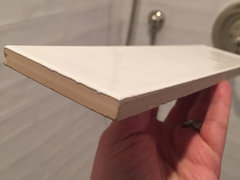
Original Author9 years agolast modified: 9 years agoAlso adding that my father-in-law (a stone mason who has also done a fair amount of tile work but did not do our installation) thinks the glaze on the tile is too thin. I believe he means it should wrap around the edges instead of just being on the face of the tile. Any thoughts on that?
 9 years ago
I can't help (except to say it's pretty tile when it's dry!). I do have handmade clay tile on the floor of my shower and it's fine. The glaze wraps a little more than yours but I don't think enough to make much of a difference.
I would not be happy having to waterproof my shower tiles. Test it on your sample tile and see what happens, I guess, but you won't be able to get the sealer to the edges of the installed tiles because of the grout, and that's clearly where the water is coming in.
If the retailer says this is shower tile, either it's a bad batch or he was wrong. I think you need new tile. I can't imagine the glaze holding up to water getting under there repeatedly...
 PRO9 years ago
I will be amazed if any sealer will prevent these tile from soaking up water.
- 9 years agolast modified: 9 years ago
That's the thing... grout is porous and does let water thru. Unless you tear the grout out and then put this sealer on you won't really seal all the edges of the tile.
I would maybe apply the sealer on one of your uninstalled tiles, let it sit per directions and then spray it down with water and see what happens. I don't know that the 'dip' test is entirely fair measure of performance.
As for dry time, we moved at a snails pace of DIY and let everything dry for exaggerated amounts of time before the next step.
 9 years ago
My uneducated guess is the glaze. Doesn't glazed tile usually have glaze around the edges?
- 9 years agolast modified: 9 years ago
No, glaze doesn't wrap the edges. It' not ''defective''. It would be fine in a dry area. You chose an incorrect product for a wet area. Many---MOST-- handmade ceramics are unsuitable for wet areas. That is one.
Your shower needs to be redone. With porcelain, or a ceramic fired at a higher temperature so as to be less porous.
krasm
Original Author9 years agolast modified: 9 years agoThanks, all.
@Sophie Wheeler, if this tile is not fit to purpose, who is liable for a mistake like that?(I know this is not a legal forum so I use that term loosely, but I do appreciate any thoughts you have on that). I purchased the tile from a high-end local tile & stone specialty retailer that recommended it knowing exactly where it would be used. They continue to insist they have used it 'many times' with no issue. The retailer, by the way, basically told me to go scratch after my last call with them because I had the audacity to question whether what she was telling me was valid in this case (that the tile hadn't been given enough time to 'dry out'.) She was nasty with me and basically said she wouldn't help me any more. She told me to go work directly with the manufacturer. It's infuriating, to be honest - I expected more from this company. But at the same time, I'm happy to work directly with the manufacturer if it gets me closer to a resolution. This has dragged on long enough.
@Kats737, our entire project has moved at a snails pace. If I count the days between steps in our timeline, I can't imagine where they feel there was not enough time for the tile to "dry out," when this install stretched over a 2+ month timeframe and most installations of this size are routinely done in less than a week. It's baffling.
- 9 years agolast modified: 9 years ago
The designer of the project should examine all of the manufacturer's product specs before certifying them as final selections. For tile, those considerations are the PEI rating, the COF rating, and the porosity rating. Handmade tile is often unable to provide standardized testing results, therefore field testing a batch before making a permanent selection is a best practice for the designer. It's not about it just being pretty choice. As anyone who has ever chosen natural stone in a bath and lived to regret it can tell you.
Who designed and project managed the project? A professional? You? A retailer merely sells product. They do not design or project manage. None of their employees does anything more than sell. They can provide the manufacturer's specs, but it's up to you to research the choices if you are the designer.
 PRO9 years agolast modified: 9 years ago
Most quality tile MFG have spec sheets for their material, Obtain one and find its rating. You may find it does not "specify" wet area use ( IE it doesn't say yes or no), but does qualify it as wall tile. Leaving you the designer, the installer all guessing and pointing fingers. It may come down to who is responsible for calling the tile MFG themselves to verify its use in a shower..
The bottom course of tiles staying that wet tells me a whole other story. Do a search on the forums wet shower floors, wicking cement board, and the like......
- 9 years ago
I believe you don't want sealer or glaze on the edges of tiles, otherwise the grout wont adhere. There might be a little bit of glaze rolling over the tile, but that is it. You will never see a tile with glaze fully wrapped around its edges, unless it is an exposed edge that is finished.
krasm
Original Author9 years ago@Sophie Wheeler, Thank you again. We did not hire a project manager or designer, so I guess that makes me the designer. I understand what you are saying, but is it not reasonable to expect some level of protection from this type of mistake from the specialty retailer? No, we did not hire them to 'design' the bathroom, per se, but they do use language like this on their website: "When you visit our showroom our staff will assist you in selecting the right material for your project."
@Tundra, uh oh. Now I'm afraid of what I'll find...
I do not have a spec sheet but I will request one from the manufacturer. In the interim, this is all that's on the product box. Does this shed any light? FWIW, the tile is made by AlysEdwards and the product is called Tongue in Chic. The label is a little hard to read in the photo, the text near the bottom reads: "Dry-pressed ceramic tiles, with water absorption EB>10% type 1. For internal walls."

- 9 years ago
I'm linking a web page that talks about absorption in tile. Your tile rating for absorption looks very high. But I am not an expert.
https://www.builddirect.com/learning-center/flooring/porcelain-tile-rated-moisture/ - PRO9 years ago
The retailer has touted himself as an expert and shares blame if these tile were used inappropriately. I'd take a screen shot their website so you could show it to the judge.
- 9 years agolast modified: 9 years ago
I agree with what Sophie and the others wrote.
i can't read exactly what the print on the label says between "absorption" and "10%", but it looks to read:
"...with water absorption >10%..."
Can't tell if it's less than 10%, greater than or equal to 10%, or greater than 10%. Regardless, by using "10%" as a reference number, the tile is in the range of a "non-vitreous tile", which means it can absorb quite a bit of moisture. Non-vitreous tile is not recommended for use in wet areas like showers or tub surrounds.
Hand pressed or dry pressed processing usually results in a less dense and a more porous tile body. The glaze may afford the face of the tile some protection from moisture absorption, but the tile body will suck up moisture from the unglazed edges and back. You can seal the portland cement based grout but the grout will still absorb and pass moisture along to the edges of the tile.
Remember, for the most part penetrating grout sealers don't protect a porous grout from absorbing moisture. In simplistic terms, they simply help delay staining. Read the label on your FILA sealer, it reinforces that point.
Your porous tiles are performing exactly as they would be expected to perform in this wet installation.
As is the porous grout.
As is the penetrating grout sealer.
I'm surprised the manufacturer's reply hasn't simply been "the product was installed in an inappropriate space" and washed their hands of it. The box is well labelled. It doesn't appear that they are keeping secrets as to what type of tile this is.I'll mention that it would have been nice if the installer had read the label and raised a red flag, but hey, who knows. Some guys and girls simply do the work and get paid.
If the shop that sold you the tile helped you pick out the tile, knowing that it was a shower surround? That's their mistake. The shop that sold you the tile should have raised a red flag. In my area, had you insisted on using this tile in a wet area, they would have had you sign a waiver/release.
Someone may come along and recommend a band-aid repair like going over the porous grout
with a true barrier, something like an epoxy grout colorant like Aqua
Mix Grout Colorant. A band-aid like that may work as a temporary
hold-over until things can be properly repaired, but I don't ever
advocate band-aid cover-ups in new construction where the wounds are
self-inflicted.Always build for the possibility of water getting
into or past the grout. Because it almost always will. Because of that,
I'd have this tile removed and have proper tile installed. - 9 years agolast modified: 9 years ago
10% is much too high for a wet area. And it's right there on the label. Easily read. It is the responsibility for the project designer to select products that are suitable for their intended use. Reliance on sales people is no substitute for doing your due diligence yourself.
If you don't know what you don't know, a paid conference with your installer for assistance in sorting through possible selections is an option. That is, if the installer is a true professional, and has the knowledge to educate you on proper showerpan construction, waterproofing, and potential pitfalls of product selections. If he were that guy, he would likely have raised objections when confronted with that product selection on the front end. Which only leads to more questions about his other abilities, and the really important stuff behind the tile.
Sales weasels are sales weasels. They'll sell you crackle tile, or terra cotta tile, or limestone tile, and only tell you how pretty it all will be. They aren't Professionals in the true sense of the word. A Professional has a responsibility beyond just performing the labor portion of the job as someone directs. They are not supposed to be mindless drones. They are supposed to educate you on the plusses and minuses of your potential choices. Like choosing a porous tile. A true Tile Professional usually wants to direct you to trusted sources for products on the front end. Too many homeowners without Professional Design assistance pick products unsuited to the task at hand. Which is why an actual Tile Pro needs to be involved. Not just a ''tile guy''.
Do you have pictures of the in progress guts behind the tile?
- 9 years ago
Krasm, you posted something earlier that I got in my email. Then you apparently took it down. The short segment that I got in my email suggested that there is no water barrier in your wall, behind the tile or the cement board. Is that true? The tiles you have are an esthetic issue and likely a mold issue in the near future. But if you don't have a water or vapor barrier on the other side of the tiles, some where, your going to get structural damage to the walls. That is why I asked the barrier question way up top, in this thread.
 9 years ago
I agree, 10% absorption is much too high. For comparison, my showers are tiled with porcelain that is rated at <0.5%.
From one person who has had to decide whether to tear out newly installed tile to another, good luck with your next steps.
 PRO9 years ago
To look at this from another view. Yes the wrong tile was selected. Yes you could live with it provided waterproofing was properly installed. If waterproofing was not installed or done incorrectly then you have someone who will be responsible for all costs to remove & replace. As Enduring inquired earlier. Is there any form of waterproofing? Remove the mixing valve cover to see what is behind the tile. Post a photo of your findings and any in progress photo's.
- 9 years ago
The retailer promised, i.e. contracted with, you to recommend a tile appropriate for a shower area. This tile so clearly is completely inappropriate. You as a consumer were within your rights to reasonably trust their claimed and promised expertise in selection, and since they failed, they will need to pay the price. Although your framing and subfloor are not at risk of water damage since tiles have nothing to do with waterproofing a correctly built shower, still, 98% of consumers observing the absorbed water area will recognize it as a significant flaw and problem area.
As someone else said, document all the promises you relied on and get ready to put together your small claims case. Make one final demand to the retailer and pout it in writing. The fix it yourself and sue for what you had to pay to fix the retailer's mistake.
- 9 years agolast modified: 9 years ago
You go car shopping and tell the salesman that you want something that gets good fuel mileage and that will haul a couple of bags of mulch every month or two. He takes you into the lot where you immediately walk up to a crew cab truck and start opening the doors to oooh and ah.
There's a 4 cylinder hatchback sitting right next to the truck. But you never even look it's way. The truck makes you feel stylish and cool. You buy the truck. You drive it for a week. Then you read in the manual that it gets 16 miles to the gallon. And you want to bring it back because "it's the salesman's fault that it doesn't get 30 miles to the gallon".
Nope. Especially in this day and age. Everything you need to know is pretty much online if you'll just do your dedicated research that you need to do in order to do a job properly.
Designing anything is only secondarily about satisfying aesthetics. It is primarily about function.
The only hope that you have if resolving this not on your dime is if the shower was not constructed with proper waterproofing. And that should have been part of your research as well. You should know what methods that they used. That is the role of someone designing a bathroom. Or a kitchen. Or a garden shed. God is in the details.
krasm
Original Author9 years agoThanks everyone. This has all been very helpful, although I admit I was feeling overwhelmed by it all yesterday so I had to disconnect from the issue for a while and try to enjoy what was left of the weekend with my kids, so apologies for the delay in responding.
@enduring, yes, I did post a brief reply about the water barrier but I took it down because what the installer texted me didn't totally jibe with what I recall seeing and discussing with him at the time, so I removed it until I could speak with him to clarify. I felt like it was better to remove it since I wasn't feeling certain about the info and I didn't want to overly muddy the waters here. My apologies if that was bad forum manners.
Unfortunately, I do not have any photos of that portion of the project. I don't think removing the mixing valve cover is going to reveal anything because the installer ran the tile flush to the internal mechanism that the plumber installed and I wouldn't even begin to know how to remove that thing...??
I appreciate everyone for taking the time to help me out. Throughout this ordeal I have tried to maintain patience and optimism, but I admit both are wearing thin. :-(
@GreenDesigns, actually, it would be more like walking in to buy an automobile and being sold a boat. Yes, they're both vehicles, but they are not both fit for the purpose. The difference of course is that the average consumer knows the difference between a boat and a truck and doesn't rely on the retailer's expertise to help them distinguish between the two.
krasm
Original Author9 years agoI spoke to the manufacturer's rep twice today and I'm feeling slightly better. She sent me the spec sheet, which lists the tile's water absorption at <0.50% and specifically identifies it as suitable for shower installations. She is going to look into why the label on the box lists a different absorption rating than the spec sheet.
She clarified that they are recommending I seal the grout using the sealer they provided (not the tile itself), so I agreed to apply it to a small area and test the results.
We'll see where this leaves us tomorrow...
- 9 years ago
Good to know the details about the post. I don't consider it bad form on the forum. Taking post down under the circumstances makes sense to me.
- 9 years ago
Btw, to be less than 0.5% absorbency, in my inderstanding would have to be really high fired. That clay body doesn't look like it could take that high of a firing. That would put it into the realm of porcelain i believe. That sample you show does not look like porcelain. Porcelains are very very fine grained. Yours looks more rough.
- 9 years agolast modified: 9 years ago
A properly waterproofed shower doesn't even need tile to not leak. You could line the walls with a porous sponge, and the rest of your structure would still be protected. in fact, that is what many people actually choose to do by choosing marble or travertine tiles. A porous handmade ceramic isn't far from natural stone in permeability.
Which is why it is imperative to know exactly how your shower was waterproofed. You have hard porous sponges on the walls. Without waterproofing, the damage behind the walls will happen quickly. Mold and rot behind the walls is much more serious than cosmetic darkening of the tile on this side of the barrier.
EDIT:BRAIN FART ON THE FOLLOWING. I knew the point went to the small number, but somehow because there was not two numbers, the brain kept thinking that the point had to go to the number. Ignore the stupidity below.
BTW, <.5 is greater than .5, which would be right in line with the 10% stated on the box. No way is any hand made tile ever fired enough to reach the porcelain stage of >.5 which is less than .5. So either another sales weasel doesn't understand terminology, or basic tile production, or permeability, or doesn't understand anything other than a sale is positive cash flow.
- 9 years ago
The label on the box sees to accurately describe a spongy tile (although I agree with OP that "<" means less than and ">" means greater than.).I hope the manufacturer's rep can figure this out and help you fix it. Darn. It's really pretty, isn't it? Maybe they'd like to do it correctly with the right tile (that you tile retailer maybe thought you were getting?) and use some photos for their web site... ¯\_(ツ)_/¯
Good luck!
- 9 years agolast modified: 9 years ago
Edited to include brain fart on the less than greater than sign. Thanks for the corrections.
 9 years ago
I believe you don't want sealer or glaze on the edges of tiles, otherwise the grout wont adhere.
Enduring, I defer to your fine tiling skills. :) However, my kitchen backsplash tile is Sonoma Tile crackle and it's got some sealer or glaze on all four edges. I think it's the main reason no grout made any inroads into the crackle. Five years later (has it really been that long?!!) and the grout is holding firm.
- 9 years ago
Linelle, I could be wrong about the glazes. Sealer directions instruct to not get seater into the grout spaces.
- PRO9 years ago
Sealer should not be on the edges of a grout joint. That would be a bond breaker. Some tiles have a over glaze on one edge. This must be noticed prior to installation or you will be in for a blotchy grout job. They must be installed with a raw edge against a over glazed edge. If some joints are glaze to glaze or unglazed to unglazed or glazed to unglazed The drying of the grout will be extremely inconsistent due to variations in absorption. Linelle's splash should continue to last as long as no one walks on it:)
- 9 years ago
"Sealer should not be on the edges of a grout joint."
And yet these are Sonoma Tile's installation instructions:
- For crackle glazes installed in wet areas, use a penetrating sealer to help prevent or delay the effects of water
staining. Soaking tile for 5 seconds in a penetrating sealer will help to minimize staining. If unsealed crackle
glaze tiles get wet, they will temporarily darken from the moisture. Allow tile to dry thoroughly before resealing
the area. Please note that unsealed tile will stain.
-For all other ceramic tiles, we recommend sealing the entire tile (especially the edges). This should first be done
once the tile is set but prior to grouting. Sealer should then be reapplied after grouting.
-Resealing the area should be repeated every 6 months and does not affect the quality or look of the tile surface.
-Dark grouts may stain tiles. If a dark grout is desired, sealer and grout must be tested on tile prior to installation.
Sealers such as Miracle Sealants 511 Porous Plus may prevent staining, but must be tested prior to using a grout
color and always follow sealer manufacturer’s instructions.And from Miracle Sealants' instructions for 511 Porous Plus:
"Be careful not to
saturate the open grout joints".So is wiping the sides of the tiles considered saturation? And is saturation required from Sonoma?
- PRO9 years ago
Crackle tile, and porous tile is not suited to a wet location. Despite many retailer's attempts to sell it to you. That type of tile, in the real world, will continue to craze, and have open invitations to everything you're trying to wash down the drain the in the shower.
- 9 years ago
Creative Tile, whew. You don't know how close I came to trying to walk on my backsplash. :-)
- PRO9 years agolast modified: 9 years ago
@ catbuilder - Under usage on the Sonoma tech page it states use in wet areas staining could result. Under installation it states sealer can minimize or delay staining. How long would you like to delay your staining in the shower? Crackle finish simply does not belong in a wet area.
- 9 years ago
Well I am sorry for that outcome but really glad it was solved and the manufacturer is standing up for his materials.
And yes, now is your chance to make sure th next install meets TCNA specs. - 9 years ago
That's good news! PITA and all, but eventually good! It's nice when a manufacturer does the right thing and it sounds like they were on it as soon as they heard about it. (I bet the tile retailer is incredibly relieved, too!)







krasmOriginal Author