Software
Houzz Logo Print
missionmom

Broad leaved evergreen hedge?

9 years ago
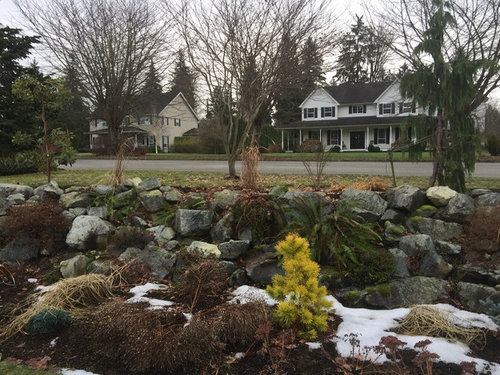
Hi there,

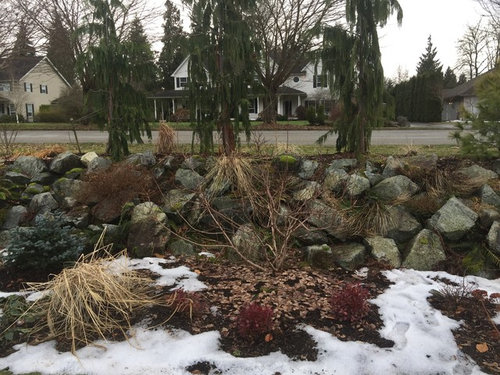
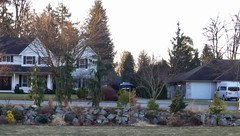
I am having trouble or more like disappointed in my mixed coniferous hedge. I'm thinking it's not too late to take out my plants (only been one year) and simply install a uniform hedge along the front of my property which borders the road. I am thinking a Portuguese laurel hedge, would any of you good people be able to recommend this? Perhaps you have a better idea?

I am zone 7/8 in the PNW. The spot is southern exposure and near our road but even when we get the occasional snow, it doesn't get salted!

(I have taken out a few trees already hence the bare spots...call me impatient!)

Comments (48)

  • 9 years ago

    And to clarify, the hedge is at the top of my rock wall. The garden below will remain. I am thinking a uniform hedge which I can control the height and width within reason will be a nicer backdrop for the garden in front.

  • 9 years ago

    Burkwood osmanthus. Portugal laurel is weedy in this region. And wants to grow multiple meters across.

  • 9 years ago

    Thank you embo! Have you heard of prunus laurocerasus genolia? It's supposed to be a narrow version...

  • 9 years ago
    last modified: 9 years ago

    That coarse textured species is seriously weedy in this region. Also subject to Prunus Shot Hole in horticultural settings.

    Another good one is Viburnum tinus Spring Bouquet ('Compactum'). Unfortunately local outlets in later years have had more than one cultivar under the name. I am talking about the apparently self-fertile, noticeably purple stemmed, dull dark green leaved form supplied to retailers by Monrovia, which I am long used to seeing under the name. This produces a shrub with an excellent size, shape and density.

  • 9 years ago

    The viburnum Tinus is beautiful. I wonder how it would respond to pruning? What do you think about a camellia sansqua, perhaps setsugekka? Or rather than a cherry laurel a Portuguese laurel?

  • 9 years ago

    The viburnum responds to pruning well - in fact, there is a sheared V.t. Spring Bouquet hedge at the end of my block that is bursting with buds right now. Although maybe slower growing initially, the osmanthus would make a great hedge as well.

    The Portuguese laurel has invasive tendencies here and can get massive without routine pruning, which you would need to do religiously every spring to avoid any flowering and therefore berry production to avoid birds spreading the seeds.

    I have not seen a Camellia sasanqua hedge locally but guess it could be done (rather more informally). Camellia japonica might work a bit better - they are somewhat more common as a hedge plant.

    missionmom thanked gardengal48 (PNW Z8/9)
  • 9 years ago

    I like the gold pine. is it Chief Joseph?

  • 9 years ago
    last modified: 9 years ago

    Yes with its often denser and more uniform habit Camellia japonica would be much more suitable. However the flowers are prone to damage in exposed positions and leaf color can be poor in full sun. Also the mess the fallen flowers make can be quite something.

    Speaking of the pine if that is to be kept there you will want to use a backdrop that will be compatible with its coloring. For instance red flowered camellias would be pretty unpleasant behind it. Really it needs something blue or silvery - like Blue Arizona Cypress - to tone it down.

    missionmom thanked Embothrium
  • 9 years ago

    Ilex opaca little used here, as it is visually inferior to other hollies - and we don't need its hardiness.

  • 9 years ago

    Other hollies would work as well, I just suggested using american holly because it is a place such an underused native plant would fit.

  • 9 years ago

    Hmmm thank you for some good ideas. Most front yard hedges in this neighborhood are emerald cedars odly enough. I understand what you guys are saying about the laurel and it's invasiveness and long term issues.

    The pine is a chief Joseph, it's quite a boring green all summer but come winter look out. I could move it if necessary, or I could plant some blue nearer to it on the lower level? I do have a Picea pungens globosa (I think?) nearby but it's not in the shot.

    the reccomendation of the viburnum is most likely my best shot here, but I can't say I've had the privilege to see one in action. Could it reach 10ft in height?

    Also does anyone have any tips on moving the nootkas? I tried to move one last year and it died on me, apparently temperamental lateral roots are to blame?

  • 9 years ago
    last modified: 9 years ago

    I like the 3 Weeping Alaskan Cedars as a backdrop. If it were me I would leave them.

    If you moved them the best time would be in the fall when there's cooler weather. Also try to dig up as much root ball as possible.

  • 9 years ago

    GG and Embo - is it too cold there for Griselinia littoralis?


  • 9 years ago
    last modified: 9 years ago

    For someone describing their location as "zone 7/8", probably. It suggests they are in a colder than typical area of the PNW.

  • 9 years ago
    last modified: 9 years ago

    Floral, that looks like more of a zone 9 plant so subject to winter foliar damage here at the very least. Also, never seen it for sale locally :-)

    David, it depends how far away one is from the Sound - further inland and up into the Cascade foothills IS a generally colder zone than at sea level or closer to the Sound.

  • 9 years ago
    last modified: 9 years ago

    Embo will know, probably...but I think I saw Griselinia in Mike Lee's Colvos catalog years ago. He sorta took over the mantle of 'rarest stuff in the PNW' for a while after Heronswood declined. Don't recall noticing them on my travels but surely walked past a few. What did stand out in AU & NZ were the hedges of Pittosporums undulatum and eugenioides, and possibly others which are also zone 9ers as well. VERY ornamental.

  • 9 years ago

    I *THINK* that I have seen it planted in my area. Of course, I could just be confused with some type of privet because there is a lot of similarity in the leaf.

  • 9 years ago
    last modified: 9 years ago

    If you mean Griselinia, no you wouldn't have seen it in NC. (in a thread where various plants are being discussed, you need to clarify what you mean by "it")

    "David, it depends how far away one is from the Sound - further inland
    and up into the Cascade foothills IS a generally colder zone than at sea
    level or closer to the Sound."

    Well of course...what I meant was just that the plurality of people in the "PNW" live in zone 8, not 7/8 whatever that is. In spite of, as Embo has discussed at length, varying degrees (no pun intended!) of misunderstanding about the zone system. Like the way Heronswood used to say their garden was in "zone 7". Speaking of which...I don't reference my vintage catalog collection as often as I could. Was looking at a 2000 Heronswood catalog. Not to speak ill of the no longer in business as a national mail order nursery...but some of their hardiness ratings were outlandish. They listed Pittosporum eugenioides as zone 7! The reality? As the Sean Hogan article I linked to notes, it's not really fully hardy in the PNW and is therefore zone 9. But that's ok, we can forgive Dan Hinkley because of the outstanding contribution he's made to horticulture! (article) At least you can grow Pittosporum tenuifolium.

  • 9 years ago

    Ok, I probably got the griselinia confused with some type of privet.

  • 9 years ago

    OK, what about Escallonia? Any chance that would survive for the OP? Hardier than Griselinia littoralis.

    missionmom thanked floral_uk z.8/9 SW UK
  • 9 years ago
    last modified: 9 years ago

    Most front yard hedges in this neighborhood are emerald cedars oddly enough

    Easily found green fence with a history of being offered for low prices by warehouse stores.

    I could move it if necessary, or I could plant some blue nearer to it on the lower level?

    More than one blue or silvery kind flanking the pine with an all green backdrop would be a good mix.

    the viburnum is most likely my best shot here, but I can't say I've had the privilege to see one in action

    Inquire locally about cold tolerance in your district.

    Could it reach 10ft in height?

    One in downtown Edmonds that appears to be the same clone is probably about that tall.

    I tried to move one last year and it died on me, apparently temperamental lateral roots are to blame?

    Much will depend on the specifics of the method you used.


  • 9 years ago

    I like the Alaskan cedars too, but it's not quite the privacy screen I envisioned. Plus it's been a never ending plant merry go round trying to finish this mixed hedge. The more I think about it I feel that a solid hedge will be a nice uniform backdrop to the garden below. I can trim it so it doesn't get too tall (like the nootkas) and block sun light in the winter when it is so precious in the PNW...which by the way last time I checked the outskirts of Vancouver BC is? I say zone 7/8 because I'm not 100% sure which zone I really am. We rarely go below -10c, with windchill this winter we got -15c. I can't remember going below that, but I was born in the 80s so I may not remember some epically cold winters.

    i will definitely plant some cooling blue next to the chief Joseph, thanks for the suggestion. I will also be inquiring about and on the lookout for the viburnum tinus. My method of transplanting isn't scientific, it's jam my shovel in and go. I think I broke a shovel moving the last nootka. Their rootball is clay since they seem to commercially grow (which these trees are Wholesale) a lot of them along the flats near the river. Someone told me I must've cracked the clay rootball, hence killing the tree.

  • 9 years ago
    last modified: 9 years ago

    Someone told me I must've cracked the clay root ball, hence killing the tree.

    The Myth of Collapsing Root Balls

    https://puyallup.wsu.edu/wp-content/uploads/sites/403/2015/03/bb-root-balls.pdf

  • 9 years ago

    Well that was a good read. Very interesting. I thought they grew our b&b stuff around here in clay because they had no choice. Didn't know it was a preference.

    Lesson learned here is that I didn't deal with these nootkas properly from get go. I have a 'forest pansy' in the back still in a wire cage. Some of these root balls are just to large to deal with without machinery. Another friend/grower of ours did mention though that the nootkas were especially irritating because they often have one side root that if you happen to slash through when digging from the field there isn't much else for it to survive with. It's not going to be the end of my world if I lose these trees. I'd rather fix my mistake now than 5 years from now.

    Aesthetically Speaking do you think that a uniform clipped broad leaved evergreen hedge would be a better choice than a mostly mixed evergreen hedge or all the other options?

  • 9 years ago

    I would go with the camellias ;)

    missionmom thanked Logan L Johnson
  • 9 years ago

    What about rhododendrons?

    I also like the Viburnum tinus. The straight species would reach 10ft. faster than the V. t. 'compactum'. I think they should be used more in our area.

  • 9 years ago

    Another viburnum option: V. cinnamomifolium.

  • 9 years ago
    last modified: 9 years ago

    Big-leaved shrubs such as that particular viburnum don't make good backdrops. Also, like the Laurustinus it is not 100% hardy in this region. When shrubs are used as architectural features such as clipped hedges winter damage becomes more of an issue.

    Of course, it might be better in the setting being discussed to prune the hedge informally anyway.

  • 9 years ago

    "Also, like the Laurustinus it is not 100% hardy in this region."

    Really? But Heronswood and Cistus have always been rating them zone 7 hardy since the 1990s!


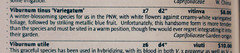
    (Kidding...I trust your assessment in this case. My experience was that it definitely behaved as a zone 8 plant...and that was a form Cistus was saying "gently scraped zone 6" or some such nonsense. This image is from the 2000 Heronswood catalog. Not to denigrate those two nurseries that have made huge contributions to American horticulture. But let's face it sometimes their ratings were overly optimistic.)


  • 9 years ago
    last modified: 9 years ago

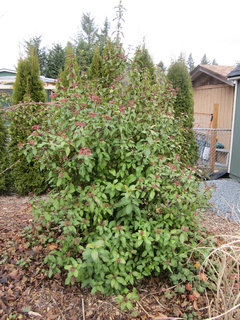
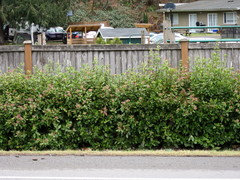
    I have a Laurustinus in a really sheltered area that I'm going to move into a more exposed place before Spring. I know of two others near me that seem unaffected by our cold weather. I'll take some pics tomorrow when it's light.

    OK, I went out and found a couple. We're a week or two behind Seattle in the Spring.


    Looks like it should be a little taller. It won't be long.

    missionmom thanked Mike McGarvey
  • 9 years ago

    I think it depends a lot on how one defines hardiness. Root hardiness is different from overall hardiness, and especially as how it applies to foliage. Foliage damage in the occasional bad winter is IMO not really a hardiness issue - loss of ALL foliage (if a BLE) or dieback to the ground is but to also to a much lesser extent than death of the root system.

    I consider a plant to be hardy to my zone if it makes through even rough winters with just some foliage burning or leaf loss, if a BLE. That is probably the consideration being made by these catalogs. Some folks seem to take a much narrower view and consider any winter damage a sign of insufficient hardiness :-) Much more of a personal interpretation.

    missionmom thanked gardengal48 (PNW Z8/9)
  • 9 years ago
    last modified: 9 years ago

    Why not mix it up a bit? Contrast large-leaved plants with small leaved. Conifers with broad-leafed evergreens.

    Also, is Myrica californica hardy up there?

    missionmom thanked Dave in NoVA • N. Virginia • zone 7A
  • 9 years ago
    last modified: 9 years ago

    "Hardy" has no practical application if it does not mean lack of significant damage for an indefinite period. "Semi-hardy" has been used to refer to plants that are consistently less hardy but still not completely tender. So where Abelia x grandiflora keeps its top this might be indicated by saying it is hardy and where it is apt to freeze off, come back from the roots this could be differentiated by calling it semi-hardy.

    If somebody living in one of those areas where it freezes to the ground repeatedly were told it was hardy there, this recurring loss of the top is not likely to be what they were expecting, when talking about a shrub.

    If you read through (pre Burpee) Heronswood (and through Cistus) plant listings with knowledge of local temperature history and specific plant performance it soon becomes apparent the usual mistake of equating average lows with absolute lows was made. For instance it sometimes gets between 0 and 10 degrees F. at the Heronswood site so it was decided the property was in Zone 7. A plant started to fail between 0 and 10 degrees F so it was deemed hardy to Zone 7. And so on.

    missionmom thanked Embothrium
  • 9 years ago

    Most published sources define plant hardiness as being able to survive a "normal" winter. Very few, if any, take it as far as coming through completely unscathed. That is entirely a personal application of the terminology! For example, a great many plants are described as being hardy in colder zones, even though they may function as a dieback perennial rather than a shrub with a permanent woody framework (i.e. various hydrangeas, caryopteris, etc.). There is obvious winter damage but more than sufficient root hardiness, ergo the plants are considered "hardy" even in those zones where they may fully die back to the ground.

    "For instance it sometimes gets between 0 and 10 degrees F. at the Heronswood site so the property is in Zone 7." By that same theory, anywhere in Seattle (other than maybe along Lake Washington or Alki Beach) is also a zone 7 location, yet you are quick to point out all of Seattle is a zone 8. The USDA hardiness zones are by definition based on the AVERAGE minimum low winter temperature over a period of time (usually 30 years), not the absolute minimum low. Anywhere has the potential to get a freak winter weather occurrence that may drop temps well below the average minimum but that is generally NOT considered to be an overriding hardiness factor as it is not a common or routine occurrence. Based on this most widely accepted interpretation, Heronswood is definitely a zone 8 location, probably a zone 8b due to its proximity to Port Gamble Bay and the surrounding heavily wooded topography.

  • 9 years ago

    You apparently didn't read what I posted successfully, are stating back to me what I have posted on this site a dozen times. I said

    the usual mistake of equating average lows with absolute lows was made

  • 9 years ago

    Well this info clarifies and confuses me at the same time regarding hardiness zones...is that even possible lol?

    Assessing some post cold weather damage this week and my large pot of pyllostachys nigra "hale" not only split in two, it appears after 5 years it's been killed. I've divided it many times over the years, its defoliated on cold winters before but the roots (having the opportunity to observe) are brownish soft not white and crisp (when I broke one). My arbutus marina isn't looking great since we last spoke either. It's started browning significantly, hoping this may be the BLE burn Gal was talking about.

    Starting to feel defeated... but part of this whole hobby has to be a balance between optimism and realism I suppose.

  • 9 years ago

    Potted stock is roughly 20 degrees F. less hardy than same item established in ground.

  • 9 years ago

    Flora, Escallonia will get burned in our worst weather. Usually just the tips. Missionmom is in a little bit colder area as far as the winters go because of the Frazier River outflow of cold air in the winter. The cold would probably disfigure the Escallonia even further there. My neighbor has some Abelia that seems to stand up a bit better than Escallonia. We're up in the foothills SE of Seattle with a little colder winters than Seattle because of higher altitude and further from Puget Sound.


  • 9 years ago
    last modified: 9 years ago

    Tall 'Frades' escallonia planting along 9th Avenue in Edmonds froze to the ground in 1990. Quite a bummer when you are trying to use a plant as a living architectural feature - it was screening the street and then poof! no screen.

    Neighbor's long established escallonia hedge consisting of another kind circulated in the past, that I never identified also froze back severely then. Afterward she pruned at it a bit, then finally had it removed - probably because it was still looking skeletal.

  • 9 years ago

    Hmm... I'm all for taking chances in the garden but probably not best to do so in fairly large hedge installation, especially given that it will be a visitors first impression of our home. The mixed hedge has been a disappointment since it will take so many years to fill in, and given my limited sqft to work with they are planted like soldiers in a straight line. Too bad it took me a year to figure that one out :(

    I thought about deciduous options, like euonymus alatus compactus or a mass planting of Annabelle hydrangeas but it won't provide the privacy and/or height we would enjoy. Fargesia robusta might be too modern for our semi traditional house and neighborhood....although I have quite a few planted as single specimens in the landscape.

  • 9 years ago

    Here is a better photo of the site

  • 9 years ago

    According to most sources, the lower BC mainland is a zone 7 (USDA zone 8) and close to the water, possibly a zone 8 (our 9). I would think a mixed planting of various BLE shrubs would provide a very attractive and relatively quick to establish privacy screen. In addition to the viburnum and/or camellia, I'd also consider elaeagnus and Mexican orange, Choisya ternata. I have yet to see a choisya seriously damaged by an abrupt winter cold spell here (mine of more than 20 years has remained unblemished) and any peripheral leaf burn is easily removed and will rapidly grow back.

    missionmom thanked gardengal48 (PNW Z8/9)
  • 9 years ago
    last modified: 9 years ago

    What I've seen called "mixed hedges" in print were sheared hedges with active mixtures of leaf colors producing a calico effect. And hedges usually are linear. And very closely planted from the start. What you have is more like mixed border planting, with a grouping of this and a grouping of that. In an informal, flowing shape bed these would be drifts. This is why the trees being in a straight line is bothersome, it doesn't jibe with them having been placed in sets of several of each kind. And there is a considerable height differential between the Nootka cypress and the others.

    A good method is to choose shrubs that you expect to grow about 1 1/2 times as tall as the bed or other defined space they occupy is wide. Much beyond that and plantings can appear too tall. Your Nootka cypresses for instance, in this particular case.

    In time these will grow as big as the native conifers behind the houses in the last picture anyway. Not just too tall for the bed, but too wide. One I've mentioned that was bought as 'Pendula', planted at the entrance to my place shot right up and was soon hanging out over the street, left behind a stump about 18 in. across when I had it cut down awhile back.

    missionmom thanked Embothrium
  • 9 years ago

    Thank you both! This info is wildly helpful. I guess it is better late than never to wake up and smell the coffee so to speak. Now all I can see is how off my mixed border looks...


  • 9 years ago
    last modified: 9 years ago

    Because you have so much going on below street level - even the rocks are producing an appearance of movement - a contrastingly crisp and uniform sheared hedge of one kind of plant could be a good idea. Maybe Osmanthus x burkwoodii.

    Or continuing with the conifer theme, yew. (As long as drainage is adequate for yew).

  • 9 years ago

    I think with the rocks, and the garden bed below, a sheared hedge would look out of place. Did you really just suggest yew? Nobody plants yews here because they are just plain boring. I think the rhododendrons or camellias would make a nice, informal, evergreen hedge that provides early or late spring flowers. I have seen camellias rated for z8, while where I am is technically 7b. If I travel about 45 minutes I end up in zone 8. You seem to be in a similar situation, with a really good opportunity. I just think a uniform hedge would be a waste of this beautiful space.

  • 6 years ago

    Holly is invasive. Plant Tall Oregon Grape, if you want that sort of look.