

Fungus/ Compost/ Core aeration… Spring
Is it 'high risk' for developing weeds if I core aerate in early Spring? I want to apply a layer of compost in early Spring, partly to help prevent fungus issues, but also to help with compaction and thatch (which I know core aeration will help treat)
I do not have issues with weeds/crabgrass (I might pull out a handful all growing season) so I do not want to invite a new problem…FYI I have applied corn gluten meal when the forsythia is about to bloom the last couple of years - which I know many do not believe in… maybe a coincidence I do not get crabgrass like my neighbors… maybe not but that's another discussion entirely
Comments (61)
 9 years ago
I haven't used any fungicides, and use synthetics when needed to balance soil minerals and for winterizing. My impression, as I've only been at this a few years, is that a good, strong organic program to get the soil in top shape is a good preventive measure against imbalances that lead to insect or fungal problems. This, of course, along with proper mowing and watering. However, once you have something like a fungal problem, you need the chemicals to stop it. I don't think things like cornmeal are particularly effective once the problem exists.
On the other hand, Morpheus doesn't use fungicides and he rarely has a problem in over 10 years. He recalls having one dead patch (fungal? I'm not sure) the size of a trash can that recovered completely within a couple of months. In my case, the dead areas recovered maybe half way between late August and the end of the season here in NJ. I am going to continue with my normal ferts and organics as needed this year and just observe what happens to those affected areas from last year. Sometimes experience is the only way to learn for better or worse.
 9 years ago
Watering: Deep and infrequent is the mantra for watering.
This is for all turf grass all over the place. Deep means 1 inch all at
one time. Put some cat food or tuna cans around the yard, and time how
long it takes your sprinkler(s) to fill all the cans. Memorize that
time. That will be the time you water from now on. My hose, sprinkler
and water pressure takes 8 full hours to fill the cans. Your time will
likely be less. I like gentle watering. As for watering frequency,
that depends on the daytime air temperature. With temps in the 90s,
deep water once per week. With temps in the 80s, deep water once every 2
weeks. With temps in the 70s, deep water once every 3 weeks. With
temps below 70, deep water once a month. Note that you have to keep up
with quickly changing temps in the spring and fall. This deep and
infrequent schedule works in Phoenix and in Vermont, so it should work
for you. The reason for deep and infrequent is to grow deeper, more
drought resistant roots and to allow the soil to dry completely at the
surface for several days before watering again. If it rains, reset your
calendar to account for the rainfall.If you water like that
you should never see fungus except under a very few special
circumstances. Those include Mother Nature over watering as well as
cutting off the air flow to the grass by covering it with something like
cardboard for several days. That watering plan is the starting
point. In my case when I water once at one inch, My lawn can go much
longer than the 3/2/1 week calendar. You should adjust from there.Instead
of core aerating I would suggest spraying with shampoo at a rate of 3
ounces per 1,000 square feet. Wait until the grass is growing to ensure
the soil microbes are awake. Follow the shampoo with 1/2 to 1 inch of
water or rain. Give that 3 weeks to work and your soil should feel much
softer when it is wet.The point of the soil test is to get the
soil chemistry working so the soil biology will work at it's top
speed. You might have perfect chemistry in the soil but it might have
gotten compacted. That soil can be fixed with repeated apps of
shampoo. Hard soil is almost always due to the salt imbalance that
daniel mentioned. Too much magnesium (Epsom salts) will give you hard
soil wet or dry. Adding compost is the most expensive thing you
can do to your lawn. In my neighborhood it costs $75 per 1,000 square
feet. Whereas feeding with organic fertilizer like alfalfa pellets cost
more like $3 per 1,000 square feet.Pippin thanked dchall_san_antonioRelated Professionals
Pine Bluff Landscape Architects & Landscape Designers · Williamsburg Landscape Architects & Landscape Designers · Allentown Landscape Architects & Landscape Designers · Hudson Landscape Architects & Landscape Designers · Victoria Landscape Architects & Landscape Designers · Florence Landscape Contractors · Galveston Landscape Contractors · Houston Landscape Contractors · Newport News Landscape Contractors · Concord Landscape Contractors · London Landscape Contractors · Martinsburg Home Builders · Aurora Home Builders · Leominster Home Builders · Coeur d'Alene Home Builders- 9 years agolast modified: 9 years ago
Is it 'high risk' for developing weeds if I core aerate in early Spring?
I want to apply a layer of compost in early Spring, partly to help
prevent fungus issues, but also to help with compaction and thatch
(which I know core aeration will help treat)If you have weeds, you aren't going to have less weeds after core aerating, but I know of no study that core aeration creates a risk of developing weeds, Nearly every one of my neighbors core aerate every fall and some have it done both fall and spring and Ive never observed any increase in weeds in any of their lawns. (they are all well fertilized and thick) The one's that don't core aerate, do very little to no lawn care other than mowing and their lawns are the weediest. I surmise it's due to the poor health and thinnest of their lawn which provides long term opportunity for weed establishment.
Core aeration has two benefits.
One is to break up the soil which allows better air, water and nutrient penetration all of which will promote more extensive root growth. Once root development is established, the roots themselves should promote a healthy soil eliminating the need for continued aeration. Core aeration is short term. The soil will remain broken up for 4- 6 weeks. Root growth occurs in the spring and fall. So to take advantage of the benefits of core aeration it should be done in the spring or fall.
Two is thatch elimination. Although core aeration is useful, it is far from effective in the elimination of thatch. At the rate of 20-30 holes per square foot, a rate that far exceeds that which is usually performed, you are only removing 20-30% of the thatch. Theoretically, at that rate you need to core aerate every fall and spring for two years to remove all of a lawn's thatch. Better to use a dethatcher or power rake to remove all of the thatch.
I've never heard of compost reducing fungus problems. One of the known issues of thatch is that the layer of organic matter holds moisture and makes for a breeding ground for problem fungi. My gut tells me that adding a layer of compost could create or exacerbate the same detrimental environment if a fungus problem already exists.
Pippin thanked User - 9 years ago
Ridge: Theoretically, at that rate you need to core aerate every fall and
spring for two years to remove all of a lawn's thatch. Better to use a
dethatcher or power rake to remove all of the thatch.Consider that this is sod laid down only 2.5 years ago. The lawn is barely settled in and there is a thatch problem? I'd sure like a confirmation that there really is a problem, and if so, to address the cause for such speedy thatch formation.
- 9 years agolast modified: 9 years ago
Consider that this is sod laid down only 2.5 years ago. The lawn is
barely settled in and there is a thatch problem? I'd sure like a
confirmation that there really is a problem, and if so, to address the
cause for such speedy thatch formation.Agree. I make no assumption whether thatch exists or not. Most people have a hard time assessing the existence of a detrimental quantity vs an acceptable/beneficial amount of thatch. My advice was given as generic information regarding core aeration and thatch to clarify what core aeration can and cannot do.
- 9 years ago
My bermuda lawn developed 2 inches of thatch in the first few years we were here. The sod farms down here use a heavy clay & peat base to grow their product, which helps roots survive the heat while on the truck & keeps the squares intact. The downside is that it's almost impossible for the worms to break it down & get to the clippings, plus it gets very hydrophobic. The result is a dry thatchy layer in no time, thinning Grass, weed issues, water runoff, etc.
Pippin
Original Author9 years agoreeljake where did you get your sod? I was told ours was from Vermont (though I had some issues with the guys who put it down so who knows if that is accurate though I live in MA)… if the info helps it was put down in mid July during I think the hottest week of summer (I know I know - worst time of year but the 'landscapers' were behind schedule) So I do think that this has contributed to the fungus issue… re thatch I don't know exactly but surmise because our lawn is very 'bouncy' to walk on, very 'lush' which may be because it's so thick but perhaps due to a thick layer of thatch? - our lawn looks fantastic besides when the fungus issue surfaces
Pippin
Original Author9 years agoI had our soil tested and the results are as follows:
PH excellent - 6.6
Amount of organic matter decent but CEC a bit low - org matter 3.5% / CEC 7.6
Potassium low - 85 (range 130-220)
Magnesium low - 79 (range 140-280)
Phosphorus high - 147 (range 50-80) the person who ran the test said that phosphorus tends to run a little high in these gets due to how they measure it
K / MG / Ca saturation in range
Calcium in range
Thoughts?
Wondering if I am having issues with fungus because potassium low?
How should I add back the potassium to 'quickly' raise the levels? And how much at a time?
- Pippin thanked danielj_2009
Pippin
Original Author9 years agoIt looks like it was a pretty simple test done - I can copy it all out when I get a moment but what I posted is basically it… the organic soil guy I had come out tested the soil before I gave the OK
- 9 years agolast modified: 9 years ago
If you requested Spectrum's enhanced Turf and Ornamental Soil Analysis Report, it will also contain micronutrient analysis, base saturation percentages and pH buffer along with recs. It would be helpful to see a copy. I don't believe their standard test includes the micros. They are widely used by people in agriculture and consider a very good lab--at least as of a couple of years ago.
Would you mind revealing what they charge now for the standard and enhanced tests?
FWIW, their tests are one of my favorites.
Pippin thanked User Pippin
Original Author9 years agoI don't know what they charge - the organic garden guy submitted it and charged me $50 …I'm hopeless with uploading pics so I will copy out the report as it is:
PH: 6.6 (6-6.8)
Buffer PH: 7
Organic matter: 3.5%
CEC: 7.6
K Saturation: 2.4% (2-4)
MG Saturation: 7.6% (10-20)
Ca Saturation: 70 (50-70)
K/Mg ratio: 1.1
Ca/Mg ration: 18.1
Potassium: 85 (range 130-220)
Magnesium: 79 (range 140-280)
Phosphorus: 147 (range 50-80)
Calcium: 1428 (900-1500)
- 9 years agolast modified: 9 years ago
Per Spectrum's site all tests are assumed to be M3 and reported as ppm.
We'll assume that the lawn guy did the sampling correctly. BTW this is Spectrum's basic test ($18), $50 isn't too bad as the lawn guy took the samples for you and paid postage.
PH: 6.6 (6-6.8) A nice sweet spot to be for nutrient availability and microbial activity.
Buffer PH: 7 Unimportant at your pH 6.6 level as no pH adjustment is necessary. (Spectrum just moved down a couple of notches IMO as their site doesn't specify the method used-at least not that I could find--they do have a rudimentary table though. Sorry, I'm rambling.
Organic matter: 3.5% about right for a sand soil. for other soils 4-6% is desirable.
CEC: 7.6 Most likely a sandy loam as sand is < 5. Probably a fair amount of silt. 7.6 isn't bad it will hold a fair amount of nutrients, however it will probably require small additions every year or two. If you test yearly for a couple of years, you'll get a feel for how much and how often you need to add amendments.
K Saturation: 2.4% (2-4) Lowish. Self explanatory.
MG Saturation: 7.6% (10-20) ditto
Ca Saturation: 70 (50-70) Perfect, but this will change some with the adjustments I recommend.
K/Mg ratio: 1.1 I don't use this, but for a sand it's perfect. If you're using your lawn as a grazing pasture, your animals my develop tetany. :)
Ca/Mg ration: 18.1 In a perfect world, this is considered high (perfect would be 5:1 to 10:1, but research shows that as long as you have sufficient levels of Mg, this is not a big issue for plant health. It can have an affect of soil structure though. Bottom line: Not a problem for you at this ratio
Potassium: 85 (range 130-220) Meh, lowish. Above minimums and barely into sufficient range. Shouldn't cause any turf issues but I would strive for > 110 (optimum range) and a BS of 4-5%( see percentages above in the report. See below.
Magnesium: 79 (range 140-280) Like potassium: Meh, low. Above bare minimum level of 50 and above the low end of sufficiency. Much preferred to be >140 and10% of BS percentage. See % in above report.
Phosphorus: 147 (range 50-80) Whoa, step away from the phosphorous source. Very high regardless of the test used. Optimum levels top out at 80ppm. Generally, excessive P is not detrimental to plants, but at very high levels, it can reduce micronutrient availability to the roots, reduce tilth quality of the soil due to hyphea reduction and increase the likelihood of water pollution. Avoid any fertilizer containing P, this includes manures, Milorganite and Bay State.
Calcium: 1428 (900-1500) Perfect.
Post whether you want to adjust magnesium and potassium, just one- either K or Mg, or none and we can develop recommendations.
It would help to know what and how much you have treated (fertilized) your lawn with since the sod has been laid. You may have thatch, if so, I'd recommend aeration (at least two to three passes) before the last week of March.
Pippin
Original Author9 years agoThis has been my application history (on average)
end March/April:
Jonathan Green (JG) - Organic weed preventer 9-0-0 (organic corn gluten) …usually 4 weeks after the first application
JG Magical - 'soil food' PH adjuster
JG Love your lawn love your soil - soil enhancer (I have used this to add organic matter to soil as well as to treat soil compaction)
End of Spring:
JG Black beauty Org lawn fertiliser - 8-0-3 or JG Natural Beauty org lawn fertilizer 10-0-1 (whichever one is available though last year I think I used the black beauty)
Summer:
Milorganite
Spring/Summer/Fall:
Milky Spore
Fall:
Overseed week before Labor Day (depending on weather) with JG Black Beauty seed
JG Organic Fertiliser 8-0-3 / JG seed starter fertilizer 12-18-8 (one or the other depending on whether I had anything left over from Spring)
JG Magical
JG Love your lawn love your soil
Sometimes milorganite half way between early Fall and late Fall - the last 2 years I have been mowing in to December due to the mild Fall so when lawn was growing over a longer Fall cycle I fertilized more since I use slow release organics and wanted to get it in before ground froze/first real frost
Late Fall/ last lawn mow:
JG Fall fertiliser 10-0-20
Last year I tried to cut back on the fertilizer because of the fungus issue which was worsePippin
Original Author9 years agoMy biggest issue and what I want to address is the fungus which is why I thought I should increase the Potassium levels given the soil test ?
Also thought that applying a layer of compost would help add more organic matter and I have read it helps with the fungus
Core aeration to address compaction and to reduce thatch - hopefully reducing the thatch would also help minimize the fungus issue
- 9 years agolast modified: 9 years ago
Unhealthy turf is more susceptible to disease and insect damage than healthy turf.
Turf health: Most common sources of unhealthy turf is drought stress (from lack of water or fertilizer burn or thatch), over watering, nutrient imbalance (either due to a lack of a nutrient or an excess of a nutrient which thatch can interfere with), or improper mowing ( too short, dull blades, or chopping off more than 1/3 of the grass blade ).
Turf disease (fungus): The disease and fungus thrives in moist warm habitats Such as thatch layers. or in lawns that are kept so tall that airflow is diminished. They thrive on fresh tender turf blades that are most common in the spring and which too early of an N application can exacerbate.
Disease/fungi spores are everywhere, they travel by air and every lawn has them. every lawn to some extent provides the right conditions for them to spawn. When weather conditions become such as to promote spore growth, any lawn in going to get infected. Period.
There is no sure fire preventative, but (1) we can help reduce the opportunity for infection by reducing the conditions that are most conducive and (2) do what we can to raise healthy turf as the healthier the turf grass, the better it will weather an infection when infection (often unavoidably) does occur.
As your soil test reveals, your nutrient values are such that it is less likely than not that it would create an unhealthy lawn, but there is room for improvement. Additions of nutrient to soils with levels in the sufficient range are more likely than not to show improvement. Once levels reach the optimum level, additions are very, very unlikely to result in improvement of the turf grass and may, at some level, result in detrimental excesses. Mg is important to photosynthesis. K, among other things, is important in cell wall structure may help reduce infection or damage. It may be advantageous for you to raise both of these. Either with K-Mag, or with Epsom salts and Potassium sulfate applications at a rate of 2#/k sq ft every 90 days.
Removing/reducing a thatch layer should help reduce the likelihood of an infection by reducing a prime fungi breeding ground. As you have a sandier soil, it is less likely that you have compaction, so core aeration will help reduce thatch by removing bits that the tines remove. Either core or spike aeration will help water and fertilizer penetrate deeper and will help promote root growth and improved turf grass health. Follow-up aeration with an app of prodiamine or similar. Dethatching is the only way to remove thatch, but it should be done in the fall.
It's evident that you prefer organics, but at the first sign of fungus infection, apply a chemical fungicide. It's the only cure.
EDIT: "Magical" is the Mag-i-cal the lime or something else? If lime, you may want to avoid that, at least until after you retest in a year or so. Your pH is fine. Do avoid anything with phosphorous. You may want to bite the bullet and go straight chemical fertilizers this until you get your thatch/disease problem taken care of.
Good luck.
Pippin thanked User Pippin
Original Author9 years agoThanks Ridgerunner
I have kids/dogs/neighborhood kids over on our lawn so I am very resistant to applying anything that might be potentially harmful - this is non-negotiable unless it's so critical that I will lose the lawn
Weighing up the situation it seems that core aeration in March could provide many benefits and possibly reduce the fungus issue… thoughts on this and applying compost at the same time? The downside? Are weeds a real threat by doing this? FYI I have none now and haven't in the past
PS The magical is the lime and I don't plan to put that down given the test results
- 9 years ago
On the aeration/weed issue. I can't make guaranties. I can only tell you what my experience has been with my own lawn and my neighbor's lawns has been over the years. I haven't observed any increase in weed incidence. Having said that, you may end up being the exception to the rule. You need to get to Alaska and I tell you the best way to travel that far is by plane. You don't like to fly for fear of a plane crash. I explain to you that the odds of a commercial plane crash are far less than the odds of getting hit by lightning. So you fly and your plane crashes. :/
Same with chemical fertilizers, pre-ms and fungicides. Follow instructions. Water them in if directed or don't go on the grass until they have dried or for X days as instructed and they are considered safe for children and pets.
Without a fungicide, you can only reduce the incidence/chance or the severity of an infection. If you get an infection (very dependent on weather) anyway and can't use a fungicide, you'll need to accept the damage. We all make judgment calls. It is what it is.
Sorry that I can't be more reassuring.
- 9 years agolast modified: 9 years ago
I forgot this:
thoughts on this and applying compost at the same time?
Normally adding a very degraded compost (peat moss) after core aeration would be advantageous to get the OM into the soil. However, with a thatch problem, I'd avoid it as you don't want to be adding to the water retention in the thatch layer any worse.
Given your desires, you need the advice of an organic person, but most will admit that in some cases chemicals are the only choice until you get problems cured. Organics can be great at maintaining a health lawn and as a preventative for avoiding issues if you start with ideal conditions, but IMO, they are practically worthless as a curative- especially in cases of disease, thatch or significant soil imbalances.
Cut a wedge of sod and look at the cross-section to confirm the presence of thatch.
- 9 years ago
"Cut a wedge of sod and look at the cross-section to confirm the presence of thatch."
.., and if possible post a close up photo of the wedge to get some opinions on how much thatch you really have.
Pippin
Original Author9 years agoThe organic guy I had come out (who has a good reputation) agreed that there is thatch … I think given the fungus problem I want to minimize it
- 9 years agolast modified: 9 years ago
danielj,
If this was a new lawn from scratch or a renovation, I'd be in your corner with a bucket giving you a sponge bath between rounds.
However, this is sod and it isn't unusual for sod farmers to push growth. It isn't unheard of for sod farmers to go overboard with fertilizers that would produce a quick crop and create a thick root system to aid in sod cutting. What particularly strikes me here is the 147ppm level for P. That's about 400lbs of P2O5 beyond even what would be needed for optimum levels. Just to put that in perspective, you wold need to apply 4 lbs of a 24-25-9 starter fertilizer every month, twelve months a year, for over 30 years to get those levels. Something isn't right. Whether that was the doing of the sod farmer or the post installation caretaker, or sampling error, there is very likely a high amount of P there. Some turf scientist have determined that P promotes root growth and tillering. Excess root growth and tillering near the soil surface creates thatch. Consequently, I'm strongly leaning towards a very real possibility of thatch being present and only physical (wedge) examination will determine if that is the case.
Pippin
Original Author9 years agoHard to cut the lawn up now since it's so compressed given this time of year - I'm an amateur for sure but I know that there is a thatch issue from looking at it last year ... Ridgerunner you make some very good points which totally makes sense to me esp given my suspect thoughts about the guys who sourced and put this in
so let's play hypothetical- if everybody agrees there is a thatch issue then what?
- 9 years ago
@Ridgerunner: I'll defer to your experience on how often sod comes in with thatch build up.
As tempting as a sponge bath from an anonymous dude on the internet sounds, I think I'll pass... :o)
- 9 years agolast modified: 9 years ago
Hypothetical:
if everybody were to ASSUME there is a thatch issue then what?
The plant tissues that make up the vast majority of thatch are very slow to decompose, consequently the only effective and timely method to remove it is through mechanical means. Aeration is akin to triage. It's not very effective as your only pulling up 5 to 10% of the thatch at a time and it would take repeated aeration fall and spring to remove most of the thatch (see my earlier post), however an initial aeration can punch enough holes to improve water and nutrient infiltration into the soil to encourage deeper roots and healthier turf for improved survival/resistance against disease (i.e. "triage"). The most effective method is dethatching (aka verticutting, scarifying or vertical mowing) This should be done in the fall as it is very aggressive. Performing in fall gives the turf the fall, winter and spring to recover and fill back in.
Follow dchall's recommendations for watering an avoid over fertilizing.
One other point that I forgot to mention earlier. With cools season grasses, you should not fertilize before May 30 with N. Studies have shown that earlier N fertilization creates a greater incidence of disease in cool season grasses.
- 9 years agolast modified: 9 years ago
I'll defer to your experience on how often sod comes in with thatch build up.
It shouldn't, but the fertilizer schedule and amounts farmers use can make it very susceptible and I can't tell you how often I've seen installers put down a pound or more of NPK or starter after install "to insure rooting". Then add the owner adding daily short waterings for a couple of weeks/months and...
As tempting as a sponge bath from an anonymous dude on the internet sounds, I think I'll pass... :o)
Curses! :)
Pippin thanked User - 9 years ago
And if anyone is up to checking the guaranteed analysis of each product to try and add up what Pippin has been adding:
http://www.jonathangreen.com/jonathan-green-fertilizer-product-labels.html
- 9 years ago
@Pippin: Exactly how thick was the thatch in the sample that you saw last year? Does that measurement include the loose dead leaves and grass on the surface?
Pippin thanked danielj_2009 Pippin
Original Author9 years agoI will try to get a wedge this weekend while the weather is 'warmer' here …will it still be easy to see given winter weather? Re fertilizers applied to sod after it was put down - the 'landscapers' wanted to fertilize after a week or so before the roots had really taken hold and I said No (from everything I read this was bad practice and I waited about 8 weeks and used an organic fertilizer in Fall) FWIW I do not leave leaves/dead leaves on the lawn - especially during Fall and rake daily during that time, do not leave grass cuttings and I mow high (2.75 inches)
- 9 years ago
Ground might be too hard to dig down much, but it's worth a try. I would try to get at least 4 inches down. Alternatively, you can push a shovel down as far as you can at an angle and then lift the shovel forward in order to lift a section of turf. I'm actually not a thatch expert, (though I might come of as one), so I don't know what you'll see with wet winter soil. I see no reason it won't look the same. Might have to let it dry out some to get a better look, though. There are many people in these forums who have never dethatched their KBG. They put literally tons of organics/ molasses, etc. to keep the microbes happy, and also fertilize with plenty of nitrogen to assist in the breakdown of the lignins in the thatch. I suppose that could compete with fungal issues, which is something I want to investigate for myself this year.
You should be mulching every bit of leaves and grass into your lawn. I don't recall your exact grass mix, but for KBG 2.75 inches is pretty short. I mow at 4". Most mow at the highest setting their mower will allow, often 3.5" or so. I should say I had my own fungus break out last year so I might play around with the height a little. I'm considering either 3.5 or 3 at least until August.
Pippin thanked danielj_2009 Pippin
Original Author9 years agoOh I got that wrong - 3.75 inches mowing height ... I wanted 4 inches but my husband bought the mower before I could discuss !!
Pippin
Original Author9 years agolast modified: 9 years ago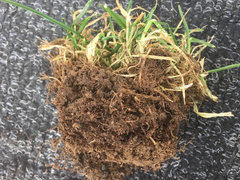
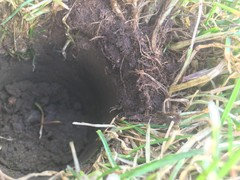
The soil fell away from the bottom of this since it was quite hard to get out but pretty much what is shown is what I believe is thatch and then at the bottom was where the soil started (which isn't there)
Pippin
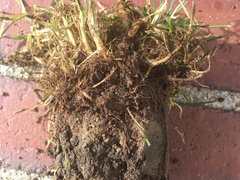
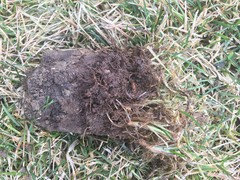
Original Author9 years agoSo I've done my best to get samples - the ground is still fairly hard … I used an instrument that digs holes for bulbs so clearly not ideal but that's all I have… seems to me from what I could measure maybe .75 to 1 inch but that's rough - started raining before I could take photo with tape measure
- 9 years ago
Nice photos. We already knew you had thatch, so why did you bother taking these pics? :o) just kidding! It looks like a pretty good layer of thatch, but is it so thick that it cannot be remedied without resorting to chewing up the lawn? I don't know enough to say, but it sounds like Ridgerunner thinks that's your only option. I'm sure he'll chime in and comment. Maybe we can get some other thatch experts to chime in.
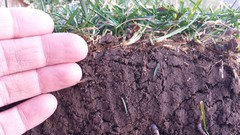
I'm in NJ and I just went out to the yard with a shovel and pried up a couple of sections of turf. I have almost no thatch at all, and this is after mulching a mountain of leaves in the fall. I know if you change some of your practices you will be able to maintain a KBG lawn without worrying about thatch.
Note the worms hanging out of the soil at the bottom of the photo. If you can create an environment where you have tens of thousands of these guys in your soil you'll be on your way.
Pippin
Original Author9 years agoLOL Danielj … I know how you guys like your soil tests and photos ;)
Nice pic too - that gives me a good idea of what it is supposed to look like!
I have no intention of ripping up the lawn with a de-thatching machine! This discussion has been helpful to confirm that the thatch is contributing to the fungus problem and that I need to address that as well as the soil condition
I am going to core aerate come March and hope for the best re weeds (I have a fairly thick lawn so there aren't a lot of patches where weeds can take hold) I do believe in the corn gluten for weed prevention - can I still put that down April given that the recommendation is no N in Spring?
More importantly when I core aerate would it pose a problem to put down compost at the same time? Wouldn't this help increase the organic matter in to the soil?
- 9 years ago
I got nothing more.
There is no preventative (well other than constant preemptive fungicide application which I oppose).
All you can do is try to reduce the conditions that are conducive to fungus, improve the conditions that promote a healthy turf and give your lawn the best chance resist or survive an infection.
The only effective cure once you have an infection is a fungicide. Otherwise all that you can do is hope that your turf can get through it without too much damage.
Best to you , Pippin.
Pippin thanked User - 9 years ago
If you're interested in a preventive regimen for fungus that does not involve fungicides, take a look at Serenade - it is an organic solution which contains a special strain of Bacillus subtilis that directly attacks the most common fungal strains. People say it's effective, I'm thinking of giving it a try myself this year. With KBG Summer Patch is the big problem and that's a root fungus, so I'm not sure how effective it would be against that, but it should help with other nasty stuff like Brown Patch.
I also want to point out that what works for others may not work for you. Cultivars vary wildly in genetic resistance to fungus, so while someone may be able to get by with no fungicide, your lawn may get wiped out in a week using the exact same regimen in the exact same location.
Bottom line, try Serenade, but it's only good as a preventive. It may be all you need to get you over the hump. If you get a fungus breakout, you will have to decide what your priorities are - staying organic or having a lawn, because fungicide is going to be the only option.
Pippin
Original Author9 years agoI will look in to the serenade ... if I went the fungicide route i.e. Potentially if the whole family is away for a period of time could it be possible to only use it once as a preventative and kill what ever is there that has been dormant over winter... and if so, when should I put it down
- 9 years ago
It doesn't work that way, a preventive fungus regimen means you have to apply fungicide about every 30 days through summer. Keep the big guns for when you get an outbreak. A granular fungicide like Headway G is perfectly safe for your family, you water it in and it goes straight into the soil without anyone getting in contact with it (unless you dig into the dirt I guess). But I understand your concern.
For now, there's a number of things you can do to significantly reduce the chance of fungus:
- Get the watering right - deep and infrequent is key. Here's my take on watering : http://lawniac.com/lawn-watering
- Do not water in the evening.
- Limit spring fertilizer applications - do not fertilize until late May and even then use a slow release or organic fertilizer. The key is to not create a flush of young tender growth that the fungus can easily attack.
- Mow often enough that you only remove 1/3 of the blade in any one session. This reduces stress on the grass.
- Keep your mower blades sharp so as to not tear up the grass and make it susceptible to fungus infection.
- Try Serenade.
- Keep a bag of Headway G on hand to have if things go sour. If you see patches of grass dying act swiftly, none of that "maybe it will get better on its own, let's wait and see".
- 9 years agolast modified: 9 years ago
I didn't address the thatch debate as you understandably refocused on disease.
Although you have prolific root mass near the soil surface, but still in the soil, that is not considered thatch. Adjusting your lawn care regimen will help those roots to grow deeper. Rather than concentrating on the pictures of the wedge and looking at the picture of the hole instead, I don't see any significant sign of thatch, if any.
Detrimental thatch is a "mat" of organic material. I don't see that in your lawn.
Here is a site with some decent pictures you can click through for comparison.
j4c11 has given you some great suggestions and take note of what danielj said:
First, it is not a given that your thatch is causing the fungal problem.
I recognize that it may well be a strong contributing factor, but also
consider that I had my first fungal outbreak last summer, with hardly
any thatch.Ok, now I really got nothing else. :)
 9 years ago
I don't see a thatch issue either. Besides, thatch is easily remedied by replacing a couple of synthetic fertilizer apps each year with organic fertilizer of your choice. I happen to love Milorganite or soy bean meal.
As far as core aerating, I stopped needing pre-emergent in the spring when I discontinued the practice. That is proof positive.
Pippin
Original Author9 years agomishmosh I only use organic fertilizer and never pre-emergent pesticides
Pippin
Original Author9 years agoSo back to the original question and after some great comments here to help me think through all the issues and possible solutions - core aerating in March and applying compost at the same time? (To help add organic matter and aerate) And given the comments about avoiding fertilizer till end May do you think it would be that detrimental to apply the corn gluten meal beginning of April (I still believe that it acts as an organic pre-emergent - I know I know not everybody agrees) I am definitely going to concentrate on better practices this coming season to address all the issues I have







danielj_2009