Software
Houzz Logo Print
marie_ball1

Hidden undercabinet electrical & lighting -- your recommendations?

9 years ago

Hello Fellow Houzzers, for those of you who have installed under-cabinet electrical so that it does not show when looking at your cabinets, I'd appreciate knowing what products you've used and how they were installed. I don't want to take anything away from the look of my backsplash with having outlets splattered all over the place. My contractor recommends the angled power strips, but every photo I see looks like they are very visible. If you've had a recess built into the back of the underside of your cabinets, or had your cabinets otherwise modified with a rail at the bottom front or something, I'd sure love to see photos. I am in California -- Silicon Valley -- and it's my understanding we have lots of code regulations, so if you're in this area, even better. Also, seems these products are evolving and there is more on the market these days, so recent experience is also greatly appreciated. I've read through quite a number of posts here on this topic, but many of them aren't very recent.

Same goes for lighting. I'll want under-cabinet dimmable LEDs. All thoughts, advice, suggestions, recommendations (and photos!!!) are welcome. Thanks!

Comments (13)

  • 9 years ago

    One thing to consider is that if you go with one of the high-mounted outlet solutions you not only have the hassle of having to bend way over to see what you're doing whenever you plug anything in, but also the snake effect of the cords hanging down. To me, I'd rather have plain old regular outlets done in a way to make them less conspicuous, like the outlet covers that can be hand-painted or that allow you to take a photo of your backsplash and put that behind the clear cover.

  • 9 years ago

    Yes, I do understand it can be a little awkward to look up under the cabinet to find the outlet, but I'm willing to deal with what for me would be small inconvenience in order not to have a bunch of holes punched through my backsplash. As in all things, personal preference comes into play, and I appreciate all points of view. @buehl, are you able to see your Plugmold when looking at your cabinets? If you were able to hide them in some manner, I'd love to know what you did to accomplish that.

  • 9 years ago

    I used Plugmold on a previous kitchen remodel and plan on using it in my new kitchen. I love it!! I makes the backsplash very neat and clean and I'd having all the outlet options. For me, there are never enough plugs! Looking under the cabinet to use the plug never bothered me. In fact, I know of others that copied the under counter idea after using mine :-)

  • 9 years ago
    last modified: 9 years ago

    For undercabinet lighting, the secret to not seeing the actual lights is to install them toward the front of the upper cabinets, not toward the back. Electricians like to install them toward the back because it's easier for them; meanwhile you have to live with it for years. When you install the lights toward the back, you will be able to see them. When you install toward the front, they are just behind the light rail. The "light rail" is called a "light rail" for a reason--you are supposed to install UCLs just behind them. The other advantage to installing the UCLs toward the front is that they will be lighting the center of the counters, instead of the backsplash.

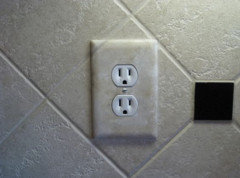
    Regarding the outlets, I installed mine in the backsplash, but closer to the counter. That way, you can hide them behind the paper towel holder, coffee maker, etc. I also installed them horizontally, not vertically, which also makes them less visible, and if you are tiling your backsplash, will fit the tile better. Local Code required a minimum distance of 4" from counter to center of the receptacle (again, I installed horizontally). Some Codes may have a different distance required, and some localities have no Code for this at all.

    There is also Cloud_Swift's solution to hiding outlets in the backsplash. It's pretty impressive:

    http://ths.gardenweb.com/discussions/2575553/cloud-swiftyour-outlet-covers?n=5

  • 9 years ago
    last modified: 9 years ago

    I used plug mold on the most prominent wall of my kitchen to avoid breaking up the back splash with outlets, but put one outlet on the side wall where our coffee station will be where the coffee machine and the toaster will stay plugged to avoid the snake effect.

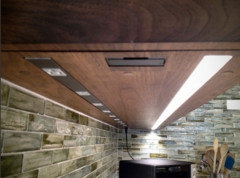
    For our plug mold, this is along the lines of what we are doing -- it's not installed yet otherwise I would share a photo. Our kitchen is modern/minimalist so we didn't want the angled plug mold which we felt would be visible in our space. The outlet strip is notched into the cabinetry, and the tape lights are are in a channel which diffuses the light. The fixtures we went with are Alloy LED.

    I am also in CA and we passed electrical inspection with this configuration. But it should be noted that we really had to push our contractor/electrician to do this -- it was complicated and we had to consult with our cabinet maker to build a space for the mold. They wanted to use the angled plug mold because it is apparently significantly easier to install, but we much preferred this low-profile look with the outlets flush with the cabinets, especially for our style kitchen.

  • 9 years ago

    I'm planning on using plug molds in my new build.

  • 9 years ago
    last modified: 9 years ago

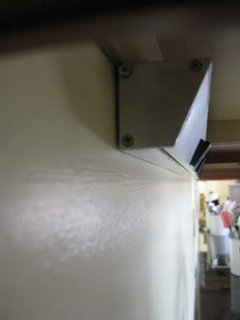
    Angled Plugmold from side (looking under the cabinet):

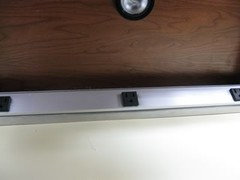
    Angled Plugmold looking under the cabinet from the front:

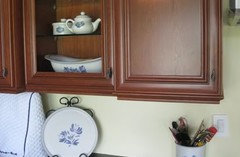
    View while standing in front of the cabinets:

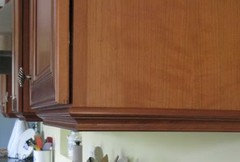
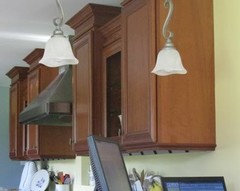
    Note that I do have "light rail" on the bottoms of my cabinets - so that helps to hide the lights and the Plugmold. It also makes the cabinets look more "finished".

    View while sitting at the peninsula counter:

    View when sitting down in the DR (right next to the peninsula) - yes, you can see the Plugmold b/c now you're looking up into the underside.

  • 9 years ago

    Just saw cloud_swift's stone outlet covers. My contractor had initially suggested faux painted outlet covers when I told him we wanted hidden outlets and didn't want to break up the back splash. I personally do not like them but he says he has clients who have done this and they love it.

  • 9 years ago
    last modified: 9 years ago

    We did the same as pipdog. It's a relatively straightforward modification if your contractor has the right tools. I will try to snap a photo when we get home. It is essentially a tape light that fits into an aluminum bracket which slides into the notched cabinet. Once the tape light is in, there is a frosted plastic strip that covers it to diffuse the light.


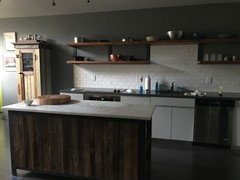
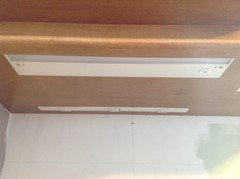
    Edited to add a photo. There is a strip of LED lighting under the lower shelf and it is invisible.

  • 9 years ago

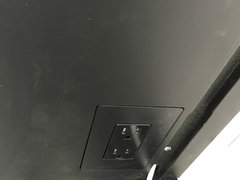
    Similar to recessed plugmold but I used a single low profile box and recessed the trim plate flush also. don't have a finished picture but the LED goes in the flush in the channel next to it.

  • 9 years ago

    Just want to point out recessing the plugmold strip has to be planned ahead. An extra 3/4" finished bottom piece needs to be added under the cabinets (something I always do anyway for a more finished look). Door has to be longer to cover unless there is a light bridge molding depending on style. Cabinet maker has to notch out for the plugmlod along with a channel (on top not seen) for the wire to connect. Wire coming out the wall has to be in the correct location as well. Same goes for recessed LED strip. Use an opaque or milk finish on the plastic lens to avoid "hot spots" the disco light effect.

  • 9 years ago

    I spent quite a bit of time looking at modular systems, but decided it wasn't where I wanted to bust our budget, so we used plain old plugmold and decent quality undercabinet lights, we didn't bother installing dimmer switches this time around as I never used them.