Software
Houzz Logo Print
everado

Moaic Virus Resistance

9 years ago

Hi everyone,

I live in a part of Florida where mosaic virus spreads very quickly. A lot of people have Hippeastrums planted in their yards here because we don't get hard frosts. I believe that these plants are serving as a local reservoir for the virus. We also have so many bugs that will attack any kind of plant, so the virus gets transmitted very quickly. Most of the hybrids I have tried to grow have gotten the virus, some of them very severely. In my experience, the virus significantly detracts from the appearance of the flowers, so I do whatever I can to keep a "clean" collection.

I strongly suspect that ploidy is a major risk factor for the virus. I have collected mostly species bulbs, and most of them have not been infected. Species bulbs are mostly 2n, and hybrids are mostly 4n. There are exceptions to this, but there does seem to be a correlation.

I'd like to create a comprehensive list of which species and hybrids have shown resistance or susceptibility. That way, people can make an informed choice about which bulbs are safe to bring into close contact with uninfected bulbs, or are safe to place outside in areas where the virus is endemic.

Here's what I have so far. If anyone has more info, please share!

Known to be resistant:

H. brasilianum
H. papilio

Suspected to be reistant:

E. blumenavium
H. ambiguum
H. angustifolium
H. anzaldoi
H. argentinum
H. aulicum
H. bukasovii
H. calyptratum
H. caupolicanense
H. curitibanum
H. evansiae
H. glaucescens
H. guarapauvicum
H. harisonii
H. iguazuanum
H. lapacense
H. leonardii
H. mandonii
H. machupijchensis
H. morelianum
H. nelsonii
H. pardinum
H. parodii
H. petiolatum
H. psittacinum
H. solandriflorum
H. stylosum
H. traubii
H. yungacense
H. ex. ‘Cardoso Moreira’
'Sophisticate'

Suspected to be susceptible:

H. reginae
H. puniceum
H. vittatum
'Apple Blossom'

Known to be susceptible:

H. cybister
H. doraniae
H. reticulatum v. stratifolium
H. starkiorum
H. striatum
'Half and Half'
'Lemon Lime'
'Red Lion'
'Susan'
'Star of Holland'

Most of the "suspected to be resistant" entries are bulbs that I have grown outside for at least a few months here, and they did not become infected. I'm being conservative about declaring anything "known to be resistant" and not including anything unless other people can agree on that conclusion. If a cultivar/species has ever contracted the virus in my experience, I placed it under "known to be susceptible." If you have any info or experience about the virus, please share!

Justin

Comments (15)

  • 9 years ago

    Hi Justin,

    This is a wonderfully informative list, thanks for compiling it.

    Fred

  • 9 years ago

    Wow, thanks, Justin! This is great list. A couple of years ago I sadly lost a decades old striatum to mosaic virus.

    Dee

  • 9 years ago

    Justin, Thanks for sharing and I am sorry you are having such a problem with mosaic virus infecting your bulbs.

    Can you tell us a little bit more about how you classified your bulbs. Are these your personal observations of bulbs you have grown outside? Are you growing all the species on the list - if so you have an amazing collection!- J

  • PRO
    9 years ago

    What are your growing conditions and how are you diagnosing virus infection? Have you had any plants tested for virus?

  • 9 years ago

    These are my personal observations combined with what I learned from reading about some breeding work done in the 1980s-1990s. These are all species/hybrids that I have had at some point, and I still have most of them. The "suspected to be resistant" bulbs are all in my collection, and grown outside under a screen enclosure for a couple of months. We left the door to the enclosure open 24/7 for the dog to be able to go out to the rest of the yard, so bugs were still able to come in. I found caterpillars and slugs chewing on leaves, and lots of small insects hanging out in the pots that I couldn't identify. So they were still open to sources of infection, but the enclosure probably cut down on the pest load to some extent. That was the only place I kept my bulbs until I moved. The "known to be susceptible" bulbs are ones that I had that were definitely affected, or that I saw/heard of someone else who definitely had a case of infection. I had one bad outbreak when I first started collecting, and a few of my bulbs developed some pale streaks in their leaves. At the time I thought they had the virus, but after seeing more cases of it I'm not totally sure. Those are the ones in the "suspected to be susceptible" category. The ones that I am sure had the virus had it severely enough that it was unambiguous. I have been identifying infection visually by inspecting the leaves. I sent pictures of some of the infected leaves to Alan Meerow, and he confirmed that they were infected with the virus. I have not had anything tested yet and I don't know of any testing facilities for this particular virus. If anyone does and it isn't too expensive, it would be worth having a few of mine tested to check. As far as growing conditions go, I was using the screen enclosure previously, and now I have everything on a screened balcony. The balcony is totally sealed, so only tiny things like spider mites can get through (which I did have an issue with at one point). Because of that I am going off of what I observed previously, since now my bulbs are fairly well protected and I have not seen any symptoms of infection since the move in July (knock on wood). I have grown all of my bulbs in clay pots, and I have used two different versions of Al's gritty mix. So the soil conditions are pretty dry. If I wasn't specific enough on any of these points, I'd be happy to elaborate.

  • 9 years ago

    And Dee, I'm so sorry to hear about your striatum! I lost all of my oldest bulbs too. I feel like you get to know a plant that you've had for a long time.

  • 9 years ago

    Thanks, fortunately I haven't had the same virus problems that you have had. My biggest problem is lubbers each spring and I am on constant watch for these locust relatives. Also I have grown Lemon Lime outside for many years and would classify it as resistant. I grow mainly in plastic pots and it multiplies and flowers easily. It has been exposed to highly stressful and various (unintentionally) conditions (such as direct sun, shade high rainfall and almost drought like conditions and just keeps marching on. With its unassuming yellow flower, it is not the most impressive hippi I have in looks, but I can't help but admire its determination to grow (virus free) reproduce and flower reliably. Hence my question on how you made your selection in each category.

    Also, do you now own the species in you list? If you don't could you list the ones you do have as I am just starting to grow some and would love to get some advice on successfully cultivating them and also ask if you woul share your sources of others.

    Really glad you joined us as some of us are just starting to expand into species and would love to hear from you!

  • 9 years ago

    I'm glad to be here! You all have given me quite the warm welcome. I didn't know lubbers were just grasshoppers, so I had to google the name...They're huge! I imagine that they could ruin all of the leaves really quickly. Out of the hybrids I had, lemon lime was the most severely affected! Where did you get yours from? I wonder if mine came with the virus or picked it up after I got it. I do have almost all of the species on that list, except for the ones on the "known to be susceptible" part. I got what I could from Diana's nursery and Mauro's seeds since they are reliable, and for the rest I took a gamble and bought them off of eBay. It's impossible to know what you got until it flowers, so I hope people aren't taking advantage of that to scam collectors. The bulbs I've bought have come from a wide variety of people and places. I keep detailed notes on all of the bulbs in my collection, including who I bought them from. There's a couple of species bulbs on eBay right now, but they are expensive. People will bid them as high as the sky too. As far as cultivation goes, there isn't much information on a lot of these so I have been trying to experiment a little to find conditions that the bulbs seem happy with. I grow all of them in clay pots with the gritty mix. The bulbs love the excellent drainage. I haven't had anything but seedlings rot. I was giving everything more or less the same treatment, but now that I have a feel for my plants I have been trying to more closely replicate each species' natural conditions. I have been watering sparingly since New Year's so that the bulbs that need a dry dormancy will go ahead and start that process. It doesn't get cold here, but as long as it isn't too wet it seems like the bulbs just know when they need to go dormant. When I was using the screen enclosure, everything had full sun all day even in the summer, and I didn't see any negative effects. They did need to be watered often though. My balcony faces southwest, so my plants still get a decent amount of sun but it's not as intense. I haven't had many flowers yet because most of my bulbs are young. Also I haven't heard whether this happens to other people, but some species produce a LOT of offsets. I'm not sure how much of that is due to growing conditions. Temperature is also a factor because some of these species are from regions with a cool winter. I haven't even started to play with that aspect yet.

  • 9 years ago

    Justin,


    I have had Lemon Lime for so many years that I don't remember exactly where I bought it, Could of been any one of - ETGB, Edensblooms, RC, Brent & Becky's, John Scheepers etc. as I have bought from them and others over the years. I have heard that there may be more than one cultivar called Lemon Lime so that is something else to consider.

    Re the species you are growing, could you share your source and growing conditions for;

    H. Caupolicanense

    H. lapacense

    H. Traubii

    H. morelianum

    H. pardinum

    H. psittacinum

    Some I have and would like to compare growing conditions and some I would just love to have :)

    Anyway, thanks again!. - J


  • 9 years ago

    I grew H. Morelianum and H. psittacinum from seeds I got from Mauro. The others are all from eBay. I added controlled release fertilizer to the soil mix when I reported everything in July, and have started watering with diluted orchid fertilizer now that the mix is probably depleted. Here's how I've been caring for them:

    H. caupolicanense - I have a 2" in diameter offset growing in a 4" clay pot. I give it a little more water than my other bulbs. It is a vigorous clone, with 10ish offsets growing off of it, and abundant leaves.

    H. Lapacense - mine is about 2" in diameter. I'm not sure why I did this, but I put it in a 10" clay pot instead of a more appropriate size. I have heard that it likes to be on the dry side, so I let the pot totally dry out before I give it a thorough watering. Last week the leaves died back, and I stopped watering for the dormancy. Do you know how long it should remain dormant?

    H. Traubii - small offset in a 4" pot. The pot is too large, but I don't plant things in pots smaller than 4" because they fall over too easily. I don't give this one any special treatment. Do you know what it's natural habitat is like?

    H. Morelianum - I planted these seeds in a version of the gritty mix with perlite added to it, so it was equal parts pine bark, perlite, floor dry, and gravel. I sowed the seeds directly in the mix in a 4" clay pot. The floor dry broke down into a clay like substance after a year, which has been adversely affecting drainage. I'm afraid to dig them out because they are still small. I water it with tap water, and I let the pot stay very dry on the surface for a couple of days before I water it again. I keep these under my shelving unit, where they get partial shade. They go dormant for a couple months this time of year.

    H. Pardinum - I treat this like my H. Lapascense, but it has not gone dormant yet. It is about an inch in diameter. Do you have anymore info about this one?

    H. Psittacinum - I have one group of seeds that I treat like H. Morelianum, and another that is planted in the same version of the gritty mix minus the floor dry. These I keep fairly moist. I haven't seen them go dormant.

  • PRO
    9 years ago

    Is it possible to send private messages on this board?

  • 9 years ago

    Yes, click on the name, which should send you to the persons home page then click on the 'contact me' button on the right.

  • 9 years ago

    How old are your seedlings? I have some H. morelianum that are almost two years old and are still quite small. I know they aren't happy in the mixture I planted them in, but I don't want to break their roots digging them up.

    H. caupolicanense is the most vigorous species that I have except for maybe H. papilio. Hopefully it flowers easily too. Does yours produce a lot of offsets? Mine produced a bunch immediately after I planted it, and they are growing pretty rapidly. Hopefully I'll have some to trade soon! Do you know whether individual Hippeastrum clones are fairly consistent about how many offsets they produce? I've been wondering whether that could possibly be a way to determine if two plants are the same clone or not.I was able to find out that H. caupolicanense is from the Yungas in Bolivia, growing from 1000 to 1500 m. H. yungacense is from the same region. It is a warm and wet forest, so we were right that it likes some extra moisture!

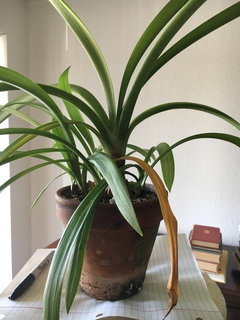
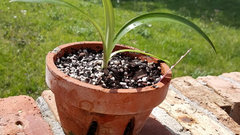
    I took a picture of mine this morning. It is in a 6" pot. For those who haven't seen one in person, the leaves are thin, pointed, and have long ridges. They are not like any other Hippeastrum that I have seen.


  • 9 years ago

    Here is my baby :)

Sponsored
Peabody Landscape Group
Average rating: 3.5 out of 5 stars8 Reviews
Franklin County's Reliable Landscape Design & Contracting