Software
Houzz Logo Print
paula_finn10

Need ideas for front yard!

9 years ago
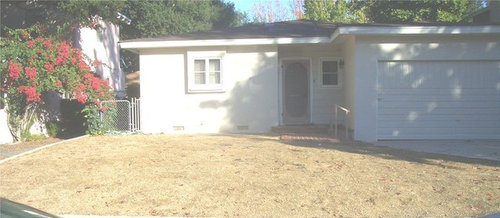
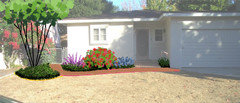
I want to keep things really simple, with only a few elements at this point. I'm in Zone 10 with full sun. I want something drought tolerant and low maintenance. I want flowering shrubs under the larger window, for one thing. I'm considering salvia greggi or Ceanothus Concha. I thought of adding two circular brick edged areas, each with a dwarf crape myrtle and blue queen salvia. Or Concha and salvia. I like the idea of limiting the colors to pinks and blues. Your ideas will be most welcome!

Comments (13)

  • 9 years ago
    last modified: 9 years ago

    According to San Marcos Growers, Ceanothus 'Concha' will grow (slowly) to a mature size of 8' x 10', so plan accordingly. Blue salvia blooms from early to late summer, perhaps include a mix of plants that bloom Feb. to May and late fall to extend your color display?

    Brick circles -- I have my doubts they are needed, and won't contribute successfully to a simple design. You won't often find them in a professional design. Trench around your plantings to separate ground cover from beds for a simple, visually uncluttered division. Mulch heavily with organic compost in any bare areas.

    Site your trees so they do not hide your door, and be sure they are out away from the house so as not to block light and sight lines from your windows and doors.

    Perhaps use a dwarf Leptospermum (common name New Zealand Tea tree, tiny pink or white flowers) to the left of your large window? Choose clumps of Anigozanthos (Kangaroo paws) in a shade of pink along the entire front? They make a dramatic display and are easy to grow in a dry garden. Blue fescue makes a nice counterpoint to flowering areas; plant in groups of 5-9 or more, needs some water to look good. Maybe separate your plantings with closely laid stepping stones to permit ease of maintenance.

  • PRO
    9 years ago

    You might think about using Thai crown of thorns (the large flowered dark pink) for below the window. One would do it. Here's a suggestion for a layout scheme. I'm not saying you should put a walk in to the side yard. Just showing you a path and how it cuts through a bed.

  • 9 years ago

    kiminpl, Thanks so much for responding, and for talking me out of the brick circles! :) I'll check out the plants you suggest.

    Yardvaark, I love your design. What are the purple and blue

    Does anyone like salvia greggi red star autumn sage for a hedge on one or two sides of the yard?

  • PRO
    9 years ago
    last modified: 9 years ago

    The purple is a perennial that could be maintained at 2' ht. x 3' spread. The blue is annuals that would be changed 2 - 3 times/year. The dark green is a groundcover probably not higher than 8" inside the walk and not higher than 12" outside the walk. (OK to be same -- shorter -- at both sides.)

  • 9 years ago

    Thank you!

  • PRO
    9 years ago

    Kentc, what is a Concha?

  • 9 years ago

    Ceanothus 'Concha' - see the first post.

  • 9 years ago

    Yard, 'Concha' is a cultivar of Ceanothus, aka California lilac. It is a fast growing medium sized evergreen shrub that prefers lean, well draining soil and little to no supplemental irrigation when established, so makes an excellent flowering shrub choice in any water deprived CA garden :-)) This variety typically grows much wider than tall and generally does not have the appearance of an ice cream cone - it is usually fully clad in dense, small evergreen foliage all the way to the base. In flower, it should look like this.

    I grew a similar cultivar in my old garden in Seattle in a neglected area that received no irrigation. It is still there, doing well and is currently more than 30 years old.

    Louisa thanked gardengal48 (PNW Z8/9)
  • PRO
    9 years ago

    Thanks for quick answers. (If some time passes --and usually not VERY much! -- I forget the things said in the earlier posts.)

    That IS pretty! If it grew here I know I would be growing it. But would probably not grow it under that window, given the plant spread.

    Sometimes (many times) shrubs turning into the ice cream cone shape is a product of incorrect pruning. If combined with not enough light available, the problem is exacerbated.


  • 9 years ago
    last modified: 9 years ago

    I originally bought it based on descriptions of it being a rounded ball shape. Maybe the cultivars got mixed up at the nursery, Theodore Payne Society. It was never pruned and was growing in full sun. It was a tough plant that was never given supplemental water and would no doubt still be thriving in the location but 90% of what you could see from downslope was sticks and branches, not foliage.

    Louisa thanked kentc
  • 9 years ago

    If you're going to go with a CA native like ceanothus, you will need to plan the rest of your yard accordingly. Ceanothus, like many other CA natives, are very particular about summer water. I've killed countless ceanothus because I've watered them during the summer. Natives like plenty of mulch, and generally don't respond well to drip irrigation. Also, if their roots spread to a neighbor's yard over time and your neighbors water during summer, you may lose it at no fault of your own. This also means they tend to be short-lived if they're surrounded by a lawn.

    Theodore Payne is a great nursery to find companion plants. Some Arcostaphylos and baccharis can be great groundcovers for summer-dry landscapes. There are some ceanothus species that are low-growing as well. If you want some annual color, many penstemon (heterophyllus, eatonii...) species and zauschernia californica are excellent companion plants, having similar cultural requirements. Others that come to mind are native salvias like mellifera and apiana. If you are looking for a large, perennial flowering plant, romneya coulteri is spectacular in bloom.

  • 9 years ago

    Thank you Josue, for the great information on the Concha. I'll check out your other suggestions. Thanks.