Software
Houzz Logo Print
jessica_schweppe

Pool landscaping conundrum...

9 years ago
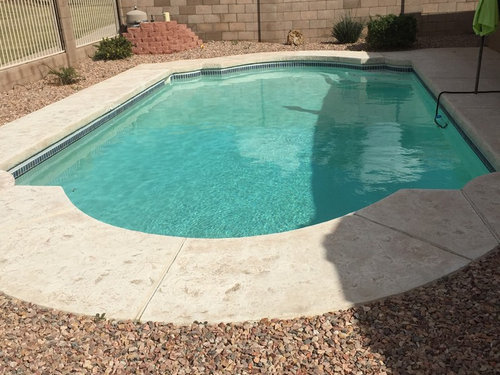
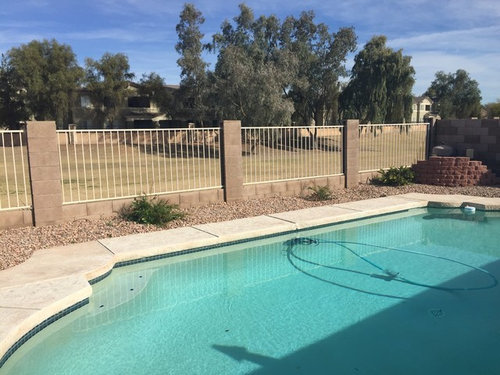
My husband and I are going to do some landscaping in our backyard. Our pool is situated about four feet away from an open fence that faces a greenbelt, and we want to plant something that will give us privacy. The challenge is, we don't want to plant anything that will a) drop too many leaves b) get too tall c) be too expensive or d) have invasive roots that will damage the pool.

We've had three different landscapers come in to give us estimates and design ideas. The first one suggested planting Mediterranean palm trees by the fence. However, another landscaper told us the roots would cause havoc, the trees won't cover much of the fence and eventually, the trees will get too tall.

Another landscaper suggested bougainvilleas. While those would be pretty, I think they'll be a nightmare by the pool with how much they litter. Our neighbor has one on their side of the house and we catch some of the flowers from their bush in our pool sometimes.

The third landscaper suggested hibiscus columns - which of the three options, seems like the most logical even though they'll require some ongoing maintenance.

But before we decide, does anyone have feedback on planting rules near pools when it comes to root systems? One landscaper is all about palms, another says they are a terrible idea. And just to further confuse myself, I asked a pool builder and he said if the palm's root system is a ball, it's fine.

So, gardeners, can I plant palms 4 feet from my pool or not? If yes, what kinds do you suggest? If no, what other options do you suggest for privacy? I'm ok with flowering plants if they don't litter much but would like to stick with things that are relatively easy to keep alive and that aren't known to attract pests. Photos for your consideration.

I appreciate your help and ideas!


Comments (7)

  • 9 years ago

    First, RUN from the landscaper who suggested bougainvilla. Does he also have a pool cleaning service???

    You could weave some sort of slats through the fencing instead of plants. There really is not much room along there for anything. Maybe an evergreen vine that will crawl up the fence but you would need to add something vertical for it to grab on to. Instead of a landscaper I would contact a landscape *designer*. Landscapers just blow cut the grass and then blow dust all around the 'hood.

    I have used Deana Chiavola from Bella Fiore Landscape Design for a project in my yard recently. six 2 3 866 two five zero one. She sometimes posts on this forum, you could search for her name here. Or, view my recent thread re "Looking for a Landscape Designer", there were a couple of comments. Good luck.

  • 9 years ago

    Re the slats - you could paint them after weaving through - those slats are often used in chain link fencing. I've also used this bamboo fencing stuff that comes in rolls at HD or Lowes. What are the HOA restrictions???

  • 9 years ago

    Thank you!! We've been trying to get in touch with the HOA to find out what we can and can't do but they've been hard to reach. Hopefully, we'll hear back soon and will have a better idea! I'm really leaning towards an ivy if they approve that option. I think it'll look lovely on the fenceline - and we can dress it up with a couple of pretty potted plants!

  • 9 years ago

    Sour orange citrus hedge.


    Jessica thanked AJBB
  • 9 years ago

    Be picky if you get a palm. A friend has one that is way too tall (IMO) like a telephone pole in the yard. Plus it gets horrible seed pods that have to be trimmed and inevitably some drop in the pool anyway. I have no idea what sort of palm it is, unfortunately.

    Jessica thanked shari13
  • 9 years ago

    Hop bush is a nice idea. Jojoba might also work well and it is indestructable. Citrus would absorb a lot of glare, and might benefit from the poolside humidity, but they have thorns, so you'd have to be attentive to keeping it in bounds.

    Mexican fan palms and Mediterranean fan palms are easily confused when they are young, as they have the same leaf shape. Most people don't notice they are unrelated. However, their growth patterns as they mature are totally different.

    Mexican fan palms will leave you with a telephone pole with a plume on top.

    Mediterranean fan palms peak at only about 15 feet, and even when small, they start send up side trunks to form a very beautiful clump. As they keep sending up these side trunks, there is always a variety of heights and sizes that can give a really good screen. A row of these could become quite beautiful while staying compact (though they do curve outward slightly as they mature. They will need some supplemental water, but not a lot. The basal part of the frond stems have thorns, but the outer fan part you might brush against does not.

    I've seen olives pruned into a tidy hedge, but I'd be wary of their roots.

    Pyracanthus (firethorn) have tremendous endurance in the low desert. Dark glossy evergreen foliage. Their creamy flower heads are short-lived, the brilliant berries long lasting. Their only messy season is when the berries drop (once a year, not a daily nuisance).

    An often forgotten plant that can do well is mediterranean myrtle, myrtus communis (no relation to the southern crepe myrtle). It can be allowed to form a loose shrub, or shorn into a tidy hedge. It's leaves are fragrant.

    Also look at "heavenly bamboo" not a true bamboo. Genus is Nandina. It has straight slim stalks with leaf clusters that stand out a few inches horizontally, dainty at the top. No thorns. Very slim and compact. creamy colored flowers, orange berries in winter into spring. Grown in sun, the evergreen leaves turn pretty colors in winter, then change back to green in spring. In climates with more moisture, it can be invasive, but that seems not to be a problem in the low desert.

    Most types of ivy will need shade in the low desert, and a lot of water... which will invite mosquitoes.

    Among vines, cross vine -- a native of the sandy pine forests of the Southeast -- are unexpectedly successful in the desert. They can become leggy as they age, but they drape back on themselves, giving rich cover. The leaves are evergreen frost and heat tolerant, and then rusty orange trumpet-shaped blossoms in spring.

    BTW, your HOA rules, regs board by-laws, and CC&Rs should all be posted online. If they are not, maybe grit your teeth and become an ad hoc committee solely for getting that done. It is a convenient place to post the board's contact info, board minutes, committee minutes, annual meeting minutes, blanks of any forms that should be used (as for landscape or architecture changes), neighborhood news, even lists of suggested/recommended/forbidden plants. There may already be such a website you could find by doing a web search of your homeowner's association name.

    Good luck finding something that will enhance your enjoyment of your pool.


    Jessica thanked Marco
Sponsored