Software
Houzz Logo Print
heruga

How many years will wooden arbors last?

9 years ago

Since it is wooden will it one day rot and go down? Then what happens to the vine plant? They have to die as well? I'm looking for an arbor that will last a lifetime so I don't need to worry about the vine having to die early because they have no support.(60 years+) Do wooden arbors last that long or should I look for a metal arbor

Comments (20)

  • 9 years ago

    Thanks. Well even if its treated, like treated cedar wooden fences, it'll eventually wear down. Even if thats in 30-40 years. I don't really have preferences as to how or which type of arbor/trellis I use as long as it lasts during my lifetime without having to cut the plant down and replace the arbor. Is there something that can last at least 60 years? I plan on growing an actinidia kolomikta on an arbor/trellis(which one is better?)

  • 9 years ago

    That plant will end up very heavy. You need something really sturdy and well-built like a pergola of oak beams on masonry foundations used as a pergola. Trellis or any off the peg structure wouldn't make 3 decades unless regularly maintained, which would involve removing the vine. Your reluctance to cut the vine down is a little misplaced since most climbers need pruning to keep them renewed and organised.

  • 9 years ago
    last modified: 9 years ago

    I would consider Actinidia kolomikta the least aggressive of any of the kiwis and also the slowest growing and producing a rather lightweight vine. IME, it doesn't require a big heavy support system like its cousins the hardy or fuzzy kiwi - I grew mine on a simple wooden trellis attached to a wooden fence.

    But there are long lasting trellises and arbors made out of metal or pvc plastic that can last indefinitely, if that is your quest.

    And I would say that expecting to live at the same single residence for your entire lifetime is a bit unrealistic. I don't know a single individual who has done that! Heruga, you are pretty young still and have no way of knowing what life is going to hand you down the road - while I love the idea you are already planning for your future, don't try to plan out your entire life. It is unlikely to unfold exactly as you envision. You need to be flexible. Maybe take it in 15-20 year increments :-))

    So rather than focusing on things - trellises AND plants - that will last your lifetime, just focus on those that give you joy and serve their purpose in the moment. I would also say that I think you may be setting yourself up for some frustration and disappointment to be designing your "forever" landscape when you don't yet even have a house or property in mind. Remember that the site defines the landscape.

  • 9 years ago

    To add to GG48's comments, you will also find that your tastes change over time - you've mentioned that you weren't even interested in gardening a year ago, so just imagine how your tastes in plants will evolve. That isn't to say that you shouldn't plant things at your folks' home or research, just that by the time you are ready to start planting in your own site, you may have different horticultural interests. Also, other factors (such as having babies and toddlers around along with a full-time job) may alter what you consider a great plant at any given time.

    That said, around here kiwis are most often grown for fruit and are often trained on wires similar to grape vines to get good fruit production. I find the look of the gnarled lower stems and the leafy fruiting upper branches to be quite ornamental. One of my neighbors trained hers along the top of a massive field stone wall using wires for a while, but now they are overhead on a wire pergola with stout wooden uprights, though I haven't looked at how the uprights are supported/anchored. Both were lovely treatments. Do you know that if you want fruit, that most are either male or female, and so you need at least one male for several females to fruit?

  • 9 years ago

    Everything you both say is spot on but I was taking Heruga's request at face value and just trying to answer the specific question. A 30 year old specimen of A. kolomikta would be pretty heavy imo. The RHS describes it as large and vigorous. This one would need a pretty sturdy support.

    If money were no object and I had the space an oak pergola a la Lutyens would be a dream.

    I didn't suggest plastic for aesthetic reasons and Heruga asked about wood.

    I took A kolomikta, perhaps wrongly, to mean the pink and white splashed ornamental vine rather than the fruiting cultivars. The ornamental one rarely produces fruit in the UK and is grown solely for its foliage so I failed to factor that consideration in.

  • 9 years ago

    The plastic arbors and trellises are really very attractive - until you touch them you would never consider them to not be wood.........you can even purchase ones that look like wood, rather than the usual white.

    I too assumed the vine to be the more ornamental variegated cultivar, which is what I grew. It is nothing like the more popular, grown-for-fruit varieties - far smaller in size overall (maybe half the size of a mature fuzzy kiwi), much slower growing and less vigorous and with a preference for at least part shade. It is also my understanding that it is only the male vines that are inclined to produce the variegation, hence the popularity for ornamental and not fruiting purposes. You would of course need a female vine as well if fruit was intended and a full sun location.

  • 9 years ago

    My interests can change overtime but when I plan things I like to plan things that go in the long run. And wouldn't it be hard to move to another home after all that week you've done in your yard? To me it will feel like a waste after all that work you did to create your beautiful garden. Because when the day comes for me to retire, I would definitely want to spend my peace time in the peaceful garden I created with my very own hands and enjoy the sight, smell, and sound of nature.

    For the hardy kiwi, I'd like to grow it primarily for fruit. So I plan on getting the arctic beauty cultivar for both male and female. I'm gonna grow both right next to each other and see how it does

  • 9 years ago

    "And wouldn't it be hard to move to another home after all that week (sic) you've done in your yard?"

    Gardeners do it all the time!! And I mean ALL the time :-) Consider it a chance to start over and create a brand new garden, which is just as fulfilling as seeing one you've planned and developed mature.

    The taxonomy of that species of kiwi is kind of muddled. There is no single cultivar known as Arctic Beauty - it is a name that is usually applied to the entire species as a group........almost a common name. So make sure when you are selecting your plants you get ones identified as to sex and with a proper cultivar name - some female selections are 'September Sun', 'Krupnoplodaya' or 'Aromatanaya'. 'Pasha' is an identified male clone and those plants often labeled (incorrectly) as the cultivar Arctic Beauty are usually - but not always - males as well.

    It is also said that the male clones develop the variegation better than the females and will do so only in some shade and with maturity.

    I have only grown this vine for ornamental purposes, not for fruit, and can attest to the need for patience and shade to develop strong variegation.

  • 9 years ago

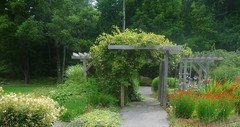
    Climate can certainly dictate experience with this vine. I have grown Actinidia k. 'Artic Beauty' on this treated wood arbour for perhaps 10 years. The arbour was built in 2003 out of 6" x 6" and is still in excellent condition.

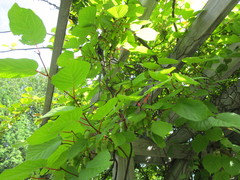
    These pics are from 2014 because they were the ones I found first. Here it grows in full sun, shaded only by the plants at its base. The colorful foliage is on the male but since I grow them side by side the foliage intertwines. The male is a much stronger vine IME.

    In the first pic Actinidia arguta 'Issai' can be seen at the far left.

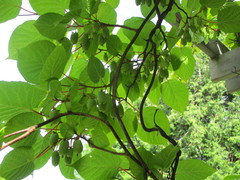
    If you click to enlarge you can see I had a wonderful crop of fruit last year. I was quite surprised that it produced fruit from its 2nd year on.

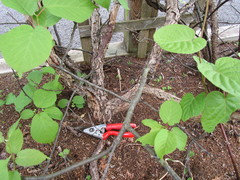
    Whatever you choose for your structure make sure it is strong! The male is on the left, female on the right. Felco secateurs for scale.


  • 9 years ago

    Nice kiwis there! Just wondering, is your arctic beauty a male or female? Or both? Also do deer or cats bother this plant at all?

  • 9 years ago

    That pergola is the kind of thing I'd like in a parallel universe - preferably made from seasoned oak.

    Heruga, all of my home moves have been dictated by life events including going where the work is. One doesn't necessarily have any choice. Only once did I move because I specifically wanted to. I'm interested in the kind of life you envisage where you never need to move. I don't know how old you are but unless you are going to live all your life on a family farm I don't think you can assume you'll stay put in one place - at least not if you are going to have relationships, an education and a career.

  • 9 years ago

    Thanks Heruga, yes it takes both to get fruit and in the last pic you can see the base of the male and female.

    They are not bothered by anything it seems. No pest or disease afflicts them. Cats do not bother them nor do the hundreds of deer that live in the forest that surrounds my garden. They ignore the Kiwi completely.

    Squirrels and Chipmunks enjoy the fruit but if you have a cat(s) that should not be an issue.

  • 9 years ago

    Floral, I'm turning 23 this month and probably going to marry my girlfriend in a few years. But my current job doesn't have any possibilities of me transferring to a different location. My boss already told me that in our interview. And this job is already my career as it is a horticultural position. So unless either me or my girlfriend- soon to be wife wants to move out by choice, I don't think there would be any worries on that. Which I don't know if either of us will, hopefully not.

    Peren.all, ok so arctic beauty is a cultivar that has both male and females. I know they have subnames on them but their main name is arctic beauty. Just wondering since many males and females have different cultivar names. And thats good to hear! I heard that deer love to eat them(I guess the deer in your area have weird preferences).

  • 9 years ago

    Oh and also what month does your arctic beauty bloom for you?

  • 9 years ago

    It depends on the weather but normally late May early June. A couple of years ago it bloomed in early April and then froze, no fruit that year.

  • 9 years ago

    Hey I got another question about this kiwi. Thought I'd ask here instead of making a completely new thread. So are these kiwis capable of climbing onto flat stuff like walls(like ivys do)? Or do they have to twine around a long pole-like object?

  • 9 years ago

    "ok so arctic beauty is a cultivar that has both male and females. I know they have subnames on them but their main name is arctic beauty"

    Once again.....Arctic Beauty is NOT a cultivar. It is the common name given to Actindia kolomikta as a group. You still need to identify and select male and female plants and they either need to be clearly identified by gender by the grower or labeled with a specific cultivar name that can be identified as to sex. As I clearly explained in my earlier post. Otherwise you are just guessing.

    Kiwis are very strongly vining woody plants, similar in growth habit to wisteria. They will not attach to a flat surface but they can drape over the top of one.

  • 9 years ago

    Hey peren.all, I forgot to ask.. is the picture you posted with the fruits on it Actinidia arguta or kolomikta? And was the fruit tasty?

  • 9 years ago

    The fruit pictured is from A. kolomikta and they are very tasty indeed.

Sponsored
Foremost Siding & Exterior Design Solutions in Columbus