Software
Houzz Logo Print
tzaluv

Help with Ailing Rhododendrons

9 years ago
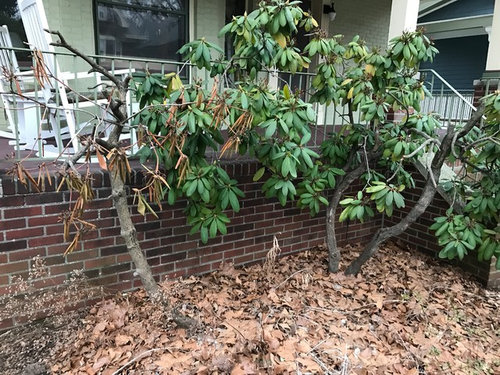
Hi everyone. We have two mature
Rhododendrons that are is in serious need of some help. We are in Zone
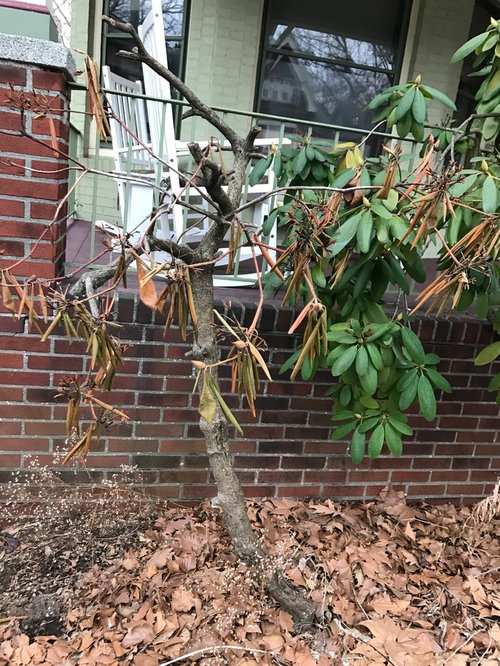
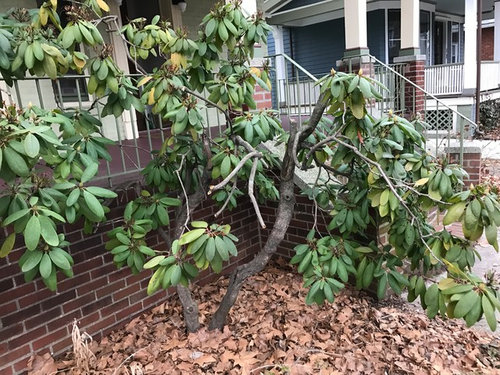
7B. As you can see from the photos below, the plant on the left seems to be
dying (or dead?). Do you think it is
possible to save it? Should we try
cutting it down to the ground?

The plant
on the right still seems to be healthy but it is also leggy and overgrown and could use some significant pruning. I'm also concerned that it may fall prey to whatever led to the demise of its partner.

I've been looking around on the Internet and have found lots of contradictory information about how to prune Rhododendrons, and when to do it. Would appreciate any insight you might be able to offer in terms of a plan of attack to help restore these two venerable shrubs. Thanks!


Comments (14)

  • 9 years ago

    The rhododendron on the left does appear to be dead. Check along the stems for tiny buds and beneath the bark for green cambium before doing anything radical, though. If there are no buds or green cambium you really don't have anything to lose by cutting it back close to the ground and waiting to see if it resprouts from the roots. This would be a long term project to develop into a plant of any size and sometimes they just don't regrow. The proper time to prune rhododendrons of this type is right after bloom when new, vigorous vegetative growth is about to commence. There are many sources online and in books showing exactly where on a large rhododendron to pinch and make pruning cuts. Leaving long leafless stems and stubs such as those in the photos is not a good idea. It looks pretty awful and leaves an entry point for infection. The rhododendron on the left shows evidence of flower buds formed last fall, so it was still alive at that point. I would suspect that a combination of too little water last summer and fall plus winter sun, cold and wind led to its demise.


  • 9 years ago

    I agree with mainegrower except for bothering with the one on the left. It is really not worth the effort involved to a) revive the plant (which may not be possible) and b) to bring it back to any semblance of attractiveness. Even with very healthy rhodies, this is a long term project.

    There is another option you could consider and that is to relocate the healthy one. It is planted much too close to the brick wall and corner for its size. Pruning it to reduce size is always an option but it will regain the current size and probably exceed it in a relatively short period and you will be faced with same situation all over again. Is there another spot in your garden (with some afternoon shade) that could accommodate a large shrub? They are relatively easy to move - even large ones - and you could do so now, leaving you a clean area (assuming you get rid of the 95% dead one) to replant with a lower growing shrub that would stay in scale with the planting area.

  • 9 years ago
    last modified: 9 years ago

    One on the left is history, one on the right may have Phytophthora on the stems. At one collection in my area this was being addressed in the past by painting infested stem sections with a copper compound made with this use or this type of use in mind. Since you can't dig the shrub up and take it to an independent garden center for commentary I would suggest good close photos of wounded or gouty looking stem sections. If there is a USDA Cooperative Extension Service branch office you can get to during open hours you might try seeking guidance there.

  • 9 years ago

    To locate your county's Extension Service office (not USDA),use this interactive map: http://npic.orst.edu/pest/countyext.htm

    If the left rhodie died of root rot, it's not wise to move anything out of that bed because you could also move the pathogen to a new place at your site.

    The remaining healthy-appearing rhodie may already be infected but not yet showing symptoms.

  • 9 years ago
    last modified: 9 years ago

    If this is on the east coast (and I remind houzz/gardenweb to somehow remind new posters of the need to inform us of their location!!!) the root rot organisms are essentially cosmopolitan, found in any normal garden soil, and will attack plants weakened by other circumstances. There's really no need to try to avoid spreading them. The east coast had the string of hottest summers since the 1930s in 2010, 2011 and 2012, and many borderline plants were damaged, wakened or killed by that. This plant (L) was obviously in decline for a couple years before dying. That rhodie might have had slightly more knotted roots, been planted slightly too deep, etc. etc, so the other one managed to survive (for now!)...even assuming they weren't different varieties. Some of which are more resistant to root rot than others!

    In front of an semi-urban brick wall (is the sidewalk just beyond view?) is NOT a good location for a rhododendron in any eastern zone 7b location. In fact that far south it's surprising they made it as long as they did.

    try to save the other one by removing dead branches, providing a cool mulch and otherwise leaving it alone - fertilizer will most likely make the problem worse. Plant something tougher in the adjacent spot to replace the dead one.

  • 9 years ago

    I think the roof of the house and nearness to the brick wall is limiting some rainfall to both of them. The one on the left is dead. The one on the right should be moved.

  • 9 years ago

    Good point Mike.
    OP seems long gone but one would also wonder if a shade tree, also just out of view of the frame, was recently removed. Newly intense heat and light could have started killing the rhodies.

  • 9 years ago

    That could be another cause. They are not happy there.

    The best time to prune is during or right after blooming.

    The worst time to move a rhododendron is when it is growing new growth. Any other time, no problem as long as normal precautions are followed. So, tzaluv, if you're going to move the one on the right, now is a good time to do it if the ground is not frozen.

  • 9 years ago
    last modified: 9 years ago

    "Any other time, no problem as long as normal precautions are followed." Maybe in the PNW, but here in (most of) the eastern US, I'd avoid moving that at all in June July or August.

  • 9 years ago

    Thanks everyone for all of the great advice!

    We are indeed located on the East Coast, in Brooklyn. I can confirm that our front walkway (concrete) is at the right edge of the last photo. There was no shade tree removed -- but the whole front yard is under a massive hundred year old London Plane tree which provides dappled shade throughout much of the spring/summer.

    The shrubs predate our buying the house in 2008 and I suspect they were planted many decades ago. It is a common sight in our neighborhood of old houses to see large overgrown rhododendron similar to ours as a foundation planting.

    Based on the advice we will go ahead and remove the left shrub. We are inclined to leave the right shrub where it is and just try and prune it down. It seems like it would be a real challenge to move considering its size and, moreover, we don't have a better spot to relocate it to anyway.

    We have always wanted to plant a mountain laurel so we are thinking about finding one to replace the left shrub. Does anyone have any suggestions for particular cultivars? And do you have any recommendations for what would be the proper size shrub for that space?

    Thanks again!

  • 9 years ago

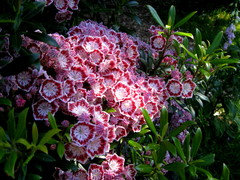
    I would recommend a Kalmia called 'Minuet'. Here's the bloom of mine.

    Ostbos Red is a good choice also.

  • 9 years ago
    last modified: 9 years ago

    Looked at as a genus vs. genus (Kalmia vs. Rhododendron), mountain laurels are indeed tougher than rhodies and might be a good choice for that location. In Cecil County MD, where I live, the roadsides are sometimes lined with them, even in almost 100% sunny positions. They are wild. You'd have to drive a hundred miles or so and rise 1000' or more feet in elevation to find rhododendrons cavorting around like that haha. Sadly recent construction has actually decimated a lot of them which is kind of a shame - Amazon is building one of their largest warehouses ever not far from here. That particular section of Rt. 40 used to have a lot of the wild ones.

    Not to say every Mt. Laurel cultivar will be that tough, but most of the standard ones like 'Bullseye', 'Sarah', etc. should be. They grow in almost full sun for me, along with the very heat resistant rhodie 'Charles Loomis'. Broken Arrow is, of course, the best place in the world buy them and get advice, as Mainegrower suggests. They surely know of extra-heat resistant cultivars.

    Just make sure you don't plant it too deeply, and check for circling roots. (to avoid being in this same place in 20 years!)

  • 9 years ago

    Most of mine are in too much shade for maximum flowering. They didn't start out that way, but over the years the surrounding trees have grown. I've been doing a lot of pruning to give them more light. Them, and a lot of other shorter plants too.

Sponsored