Software
Houzz Logo Print
femc

Decision time keep or ditch Wisteria aka Japanese Beetle feed

9 years ago
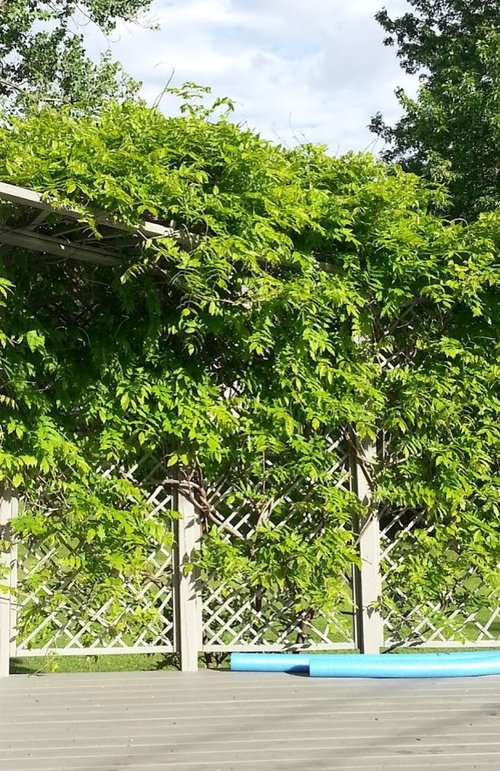

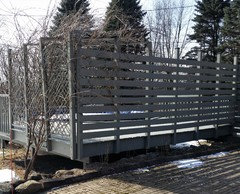
We bought a house in Montreal, QC, Canada suburbs (zone 5) almost 2 years ago. It has a Wisteria of unknown cultivar (but that has a single trunk) that has never flowered. I suspect from my research and judging from the picture above that is due to it never having been pruned. But the reason for the massive shagginess is that it serves as a privacy screen for an above-ground pool. All that would be fine by me BUT last summer it was black with Japanese Beetles and my pool deck covered in JB poo dandruff (yay!).

So having spent this cold winter planning my defense on the JB's. I am planning on taking a systematic approach including:

a) dealing with the grubs with available means & having my husband make me a Spikes of Death contraption for lawn.

b) Being on the lookout for scouts and continuing my early morning bucket kills. I tried Neem oil, no effect. I read conflicting advice about them being repelled/attracted to their decaying buddies. I'm not above making a slurry & spraying that allover my yard...

c) Not planting any of their faves and removing existing delicacies (goodbye roses & co)

d) asking my neighbors if they have them and if they have traps (please no!) and it leaves me with these questions

1) Should I get rid of the Wisteria altogether? Morning glories and such are out (yum!) and my zone is too cold for climbing hydrangeas. Clematis? What am I not thinking of?


2) Not Vine related per say but if I do chop that Wisteria I'm afraid they'll eat everything/anything else. We have a small, sad orchard but they haven't attacked anything because I think they have plenty with my Wisteria/Malva (buh-bye)/Roses (so long) & Physocarpus (so sad). Will removing their food source keep them away eventually or will they just eat everything else? They haven't really bothered my veg either.

I feel like I sound like a madwoman but honestly, they drive me batty. Do bats eat them?! ;-)


Comments (10)

  • 9 years ago


    Wouldn't it be nice if bats did eat them? Other critters do though. Skunks and raccoons tear up the lawn and eat the grubs. It has never upset me when I see the lawn disturbed since the small clawed out clods are easy to push back into place with the tip of your shoe. I know they are doing the work for me and I now have very few, if any beetles. Wild turkeys eat them too. Every time I dig a garden area I dispose of the grubs.

    a) will be your best approach. If you can break the cycle you will be ahead of the game. Clearly you have been doing your homework. I have added this link in case there is anything new that you have not seen.

    Get rid of Japanese beetle grubs

    It would be a shame for you to get rid of the Wisteria, Roses etc. If that is the route you decide to take...

    Since I am a bit SW of Ottawa we are on par zonally (important since zone 5 is huge). Climbing Hydrangea is absolutely possible for you. I have grown it for years. Clematis are wonderful too. Actinidia is also, I put up pics of it very recently on this forum Actinidia.

    Good luck!


  • 9 years ago

    In the Montreal area it's not surprising that your wisteria hasn't bloomed in the past two years! Here in southern Ontario, the past two winters before this one have had some nasty cold temperatures and windchills that have killed off the overwintering flowebuds. It's hard to tell for sure from the picture you posted but I see one place where it looks like the twining direction is clockwise, suggesting that the wisteria might be a Japanese one. The variety 'Lawrence' is considered to be quite hardy so is most likely to be the one sold in your area.

    If it is being grown mainly for screening, treat it like a hedge and sheer the foliage regularly to keep it under control and form a dense screen. (That trellis it is twining through looks awfully flimsy and it wouldn't surprise me to see the whole thing come down on a windy day!).

    We have occasionally had JB feed on our wisterias but they've never been as much of a problem on the wisterias as they were on the big white rose we had nearby. The rose is gone now....

    On the whole, you'd probably be better off with a couple of vigorous clematises I think. Mind you, it's none to easy to get rid of an established wisteria! :-)

  • 9 years ago

    Thank You both! I didn't realize that the direction the vine twists is an indication of the cultivar, mine is definitely clockwise. I think what I'll do is give it a massive trim, especially that top portion which makes it impossible to get to the JB's and serves no real purpose but to give the sweet mourning dove that has built a nest all tucked-in there (its the cutest thing). Also the whole "support" is rickety and will absolutely have to be re-built properly - it was swaying when I painted it last Spring, yikes.

    I will look more closely at climbing Hydrangeas but am worried that's also on the JB's yum-yum list. Though I have some bushes they haven't bothered too much, except Limelight. Actinidia is also a JB favorite :-( Clematis is my front-runner at the moment.

    I am thinking of planting lots of Castor Bean plants around our pool which currently has a row of 6-7 physocarpus diablo. They are supposed to be a good organic toxic weapon against JB's. We have no pets or kids so toxicity from the Castor is not a concern. Also lots of Rue.

    I really don't want to get rid of these lovely plants, its so unfair! I'll try everything else before I do. I'm hoping to at least reduce the numbers to where I don't have them flying in my face & hair while out in the garden. Plus I have the time to dedicate myself to this and hey, maybe I'll find a control formula to share with all!


  • 9 years ago

    I have J. beetles and they don't seem to bother my climbing hydrangea. I don't see any damage. The only clematis flowers they have damaged in my gardens are white ones, though that might have perhaps been done by rose chafers instead of the J. beetles, and they don't damage the leaves on any of them or the flowers on most of them in my garden.

  • 9 years ago

    I had never heard or thought if a pheromone-free trap- interesting. I wish someone (and that might be me) would test whether the dead beetle repellent really has a big effect as I've also read not to squish any bugs for fear of luring more. Maybe it has something to do with the sex of the killed JB and while I've got time, nobody has THAT MUCH time LOL!

    Very good news about the climbing Hydrangea & Clematis as I happen to love both. I think my husband wants to try preserving the Wisteria (aka not rebuild the support) for now, we'll see how summer chores line up. I'm putting together a grocery list of repellent & undesirables for my zone and plan on replacing some perennials.

    Amazingly I grew giant Zinnias from seed way in the back garden and they hardly touched them. The Zinnias provided with me with an absolutely delightful and easy supply of cut flowers for months and all for less than $4. I am hoping to be able to repeat that but realize I may be playing with fire there, we'll see.

  • 9 years ago

    You can have both the wisteria and clematis... I grow 'Henryi' clematis into our Chinese wisteria. It does surprisingly well although it sometimes gets pruned too hard when we're whacking back the wisteria! Not rebuilding the support may not be an option if he wants to keep the wisteria and the wind blows it down! The foliage gets quite dense if the wisteria is pruned regularly - as it should be! That gives the wind something to push against. The wisteria stems remain quite flexible even when they get quite thick. Our Japanese wisteria 'tree' blew down a number of years ago on a windy day in the summer, taking its wooden support with it. The support (which we knew was too weak but hasn't got around to replacing....) broke and we feared the wisteria trunk might have too, but the trunk just bent over, remaining undamaged. That wisteria is now supported by metal tie-rods between angle-iron posts. We also keep it pruned to about 6' high and 4-5' wide in a sort of up-side-down umbrella shape that displays the flowers well. Wisteria can be nice plants - but only if you manage them closely!


  • 9 years ago

    I believe it may be Bacillus thuringensis that attacks the larva Japanese Beetle in the ground, as they mature. One application to my lawn, and the population really almost disappeared. Of course many come from everywhere, but it was worth the purchase. They were not as common for several years.

  • 9 years ago

    Milky spore (Bacillus papillae) not Bt for J beetles. Bt is for caterpillars (Lepidoptera larvae such as cabbage loopers, tomato hornworms, and gypsy moth caterpillars) while J. beetles are beetles and so not susceptible to Bt. The other thing that will get beetle grubs in general, not just J beetle grubs, is a specific predatory nematode (Heterorhabditis bacteriophora). I don't think either is able to winter over in zone 5, but Milky Spore might be able to.

  • 9 years ago

    Well..... We've decided to remove the Wisteria. I'm sad but since it was planted in a really bad spot it could not have been properly supported in the long run. We will replace the flimsy trellis with horizontal boards to match the front of our deck and I plan on planting different varieties of clematis but have some concerns.

    I had read that Clematis like their roots shaded/cool and the vines sunny. There's a narrow 1' trench between the driveway and the deck. Its not terribly deep but is currently filled with thriving Hostas. Do you think I could plant Clematis there to trail onto the deck fencing? (I could relocate the Hostas) It gets some shade at the bottom but the vines would be in the sun. My husband will be concerned about their root system affecting that retaining wall.