Software
Houzz Logo Print
dan_dumont

Shrub doesn't look so good

9 years ago
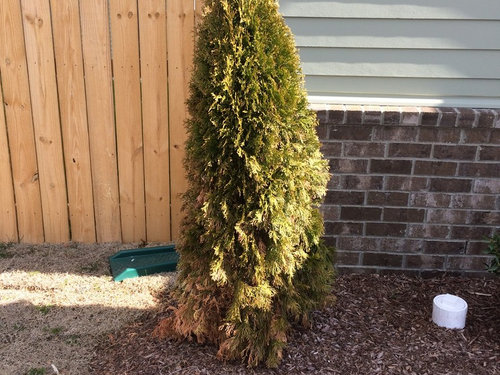
Hello! We moved into our home in November, and this bush was planted then. It's only been a few months, but it is starting to get brown and look quite sad. How can I help this bush come back to life? Does anyone know what type of plant this is? Thank you in advance for your help.

I live in Nashville Tennessee. We have been getting a good amount of rain this winter. We have not added anything whatsoever to this little landscaped area since moving in.

Comments (11)

  • 9 years ago

    where are you dan???


    its planted about 3 to 5 feet too close to the house ...


    i wonder if it was thrown in there to facilitate the house deal??? .. improper planting with perhaps... poor container stock ... that had circling roots ...


    bottom brown look like dog damage ...


    the next month or two.. will tell if the rest is just some winter stress/planting discoloration... or a slow decline to death ... only time will tell ...

    gal said:If dry, provide a couple of long, slow. deep soakings directly to the rootball.


    i would add ... let it near dry before the next good soaking ...


    do you know your native soil .... if clay.. do a perk test ... to figure out drainage ...


    ken

    https://www.google.com/search?q=perk+test&ie=utf-8&oe=utf-8

  • 9 years ago

    This is helpful, thanks. The builders were not very thorough so I'm guessing the root ball didn't get the love it really needed prior to planting. I may try to take it out, to move it further from the home, and to soak the root ball properly.

    As for the native soil, it was mostly rock under there, I believe shale? Dark grey and flaky. Pretty sure they had to add top soil to the original stuff .

  • 9 years ago
    last modified: 9 years ago

    Sorry but this one has definitely died. Looks like highly prevalent 'Smaragd' cultivar, from Denmark. For some reason it is much more touchy about soil drainage than usual for Thuja occidentalis, will rot off if there is much puddling around it.

  • 9 years ago

    i suspect death also ... wouldnt waste my time moving it.. EXCEPT to dig it up.. and diagnose all that went wrong ...


    where are you ...


    perk your soil ... drainage is imperative with conifers.. as well as trees... the speed at which your soil drains.. is the most important fact you learn.. in your new garden ...


    ken

  • 9 years ago

    That downspout may be a smoking gun, dependent on how the water drains after hitting that splash block. The roots may have drown.

    tj

  • 9 years ago

    I am in the same area as you. I have a ton of Thuja Emerald & Green Giants that we planted in a new build landscape. I've not had this problem but did notice some sun scorch on a couple when we had those crazy temperatures in the 90's last season. I kept them on a deep watering schedule while keeping up with any rain, but as you may know, we had no rain for about a month and a half during that time period. I also make sure that when I plant in our area with hard clay, I add soil conditioner, which was first recommended to us by RiverBend Nursery. I've also used peat moss as well. We have never had trouble growing anything so far. I'm in a neighborhood with a lot of new builds. Luckily our builder had a great landscape company that planted actual trees & shrubs that flourish in our area. Another builder just threw in every possible plant that has issues in our area. Our neighbor is already unhappy with a Leyland Cypress they planted up against the front of their house. Those are the ones you will see busting out wooden fences that people planted too close around our area. I mean they are cheap. I saw them at Costco last week, about 6 feet in the pot for $60. I love Thuja's in our area. I just clean out the insides during the first of Spring to open them up to "breathe" better. They seem to grow taller after doing just that. I agree with gardengal about the dryness. It may be that they just plopped it down in the clay without adding anything else. Just know that whatever you decide to plant, make sure to add something to the soil to help the plants roots. And the other things I've learned is to check with the local extension to make sure of problem trees, shrubs, and plants that cause issues in our area because the big box stores will still sell them. I see them every season.

  • 9 years ago

    "Just know that whatever you decide to plant, make sure to add something to the soil to help the plants roots."

    This is exactly what you do NOT want to do!! The roots will grow perfectly well all by themselves in the native soil provided that the rootball is not congested and any girdling roots are loosened or cut. If you think you need to add any amendments, apply them as a mulch or topdressing after planting. Never amend individual planting holes.

    Myth of Stimulating Root Growth

    Myth of Root Stimulants

  • 9 years ago

    gardengal, never? I was talking about our area which is the same of the OP. We have always been told by our local nursery to amend the soil before planting because of the clay soil we have here. We've done this and have never had any issues.

  • 9 years ago

    The problem with amending clay is you create a pocket for water to drain into while the surrounding clay holds the water there...known as the bathtub effect. As for the local nursery recommending it, that is how myths are propagated.

    tj

  • 9 years ago

    Yes - never with individual planting holes. Larger planting areas - like an entire garden or large planting bed or the full, expected mature root run for a tree - are different.

    Everyone freaks about clay soil - yes, it is sometimes difficult to work with but it also tends to be nutrient dense and is often a very good planting medium. And not all clay soils drain poorly. If they do, just dig a very wide but very shallow planting hole - like a big dish - and site the plant high so that 1/3 to 1/2 the root ball is above grade. Break up the excavated clay from the hole and backfill with that, topping off with a better soil or mulch to the top edge of the root ball, creating a small mound.

Sponsored
Bella Casa LLC
Average rating: 5 out of 5 stars17 Reviews
The Leading Interior Design Studio in Franklin County