Software
Houzz Logo Print
tim_parris64

Shrub Identification

9 years ago
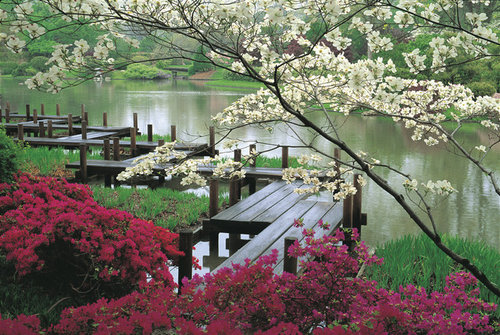
Hi everyone--

I believe that the white tree is a dogwood and below that is iris. However, I'm uncertain as to what the crimson shrub might be.


Comments (16)

  • 9 years ago

    Azaleas.

  • 9 years ago
    last modified: 9 years ago

    Yep, and quite possibly (since this picture might well have been taken in the SE US) the widespread cultivar 'Hino-Crimson'.

  • 9 years ago
    last modified: 9 years ago

    Not red enough and too open in habit.

  • 9 years ago
    last modified: 9 years ago

    They will have an open habit like that in shady spots in the south. Trust me. Seen it with my own eyes. My Mom loved that variety and planted a whole bunch of them. it's not really what a color expert would call crimson either. Much too magenta, as is often the case with Ericaceous plants called crimson. To get a true crimson azalea, you have to go with other varieties. Hershey Red is closer in person although doesn't really appear so in photographs. (I've actually been to the nursery where it originated)

    Maybe they are redder in the PNW. Some of the best red rhododendrons have poor colors here in years when it heats up too fast here, and generally all rhododendron colors seems best when we have PNW type conditions in spring. (cool, overcast)

  • 9 years ago
    last modified: 9 years ago

    And actually, now that I look closely, could be 2 different varities in the picture. My eye was drawn to the redder (though still magenta) ones to the left, which look like Hino-Crimson to me. The foreground ones could be another cultivar.

    Basically most of those older 'red' azaleas are very similar in terms of overall effect, however the slight shadings may vary. Hino-anything certainly in that category. When you see a bunch of azaleas for sale in a nursery yard, the ones that are a more acceptable red like 'Hershey Red' really pop out. (although even that is probably a notch below something like 'Vulcan') Interestingly some of the newer reblooming ones are quite good; I managed to buy a 'Floramore Red' before the patent had even been published. It's a very clear, non-bluish red and I look forward to placing it in the garden. Hoping it is hardy here, obviously it's not really tested.

  • 9 years ago
    last modified: 9 years ago

    One on the left does have a more similar structure to 'Hino Crimson' but is not red enough either - unless this is accounted for in this instance by the specimen shown happening to be quite near the end of its blooming, having faded that much in color. And at any rate if Tim was looking for the same color impression as given by the two plants in this shot and he bought 'Hino Crimson' he would find himself looking instead at a definitely red azalea most of the time it was open. If he in fact is interested in getting some similar azaleas for himself the thing to do is shop local outlets at flowering time, select from what he finds there. Instead of trying to hunt down a particular cultivar.

  • 9 years ago

    I contacted the Missouri Botanical Gardens and this is how they replied: "Yes, the white, flowering tree is a flowering dogwood. The crimson-flowered shrubs are evergreen azaleas. In this area we have Rhododendron ‘Hino-crimson’, R. ‘Boudoir’ and also some unidentified R. cultivars growing."

  • 9 years ago
    last modified: 9 years ago

    "In this area we have Rhododendron ‘Hino-crimson’,"

    Well, I'll be darned!

    'Hino-Crimson' isn't very [true] red, as anyone with a properly calibrated monitor can find out in 10 seconds using google images. Or, you know, has seen one for sale LOL. As I said before, maybe they are less magenta/purplish in the PNW.

  • 9 years ago
    last modified: 9 years ago

    and also some unidentified R. cultivars growing

    It being a standard variety at outlets here in the past I have seen 'Hino Crimson' in person a thousand times, used to have it here. Typical descriptive phrases used are "brilliant red", "crimson scarlet" and the like.

    With good reason.

  • 9 years ago

    Color perception and description is extremely subjective. Siting, lighting and photography can all have an impact on how we see and perceive color - for example, I find many flowers are described as blue that I would describe as lavender or lilac. Reds are equally difficult to photograph accurately or describe uniformly. 'Crimson' is defined as "a deep red color inclining to purple" and I see a lot of purple or blue in that variety myself.

    YMMV

  • 9 years ago
    last modified: 9 years ago

    Right, Crimson is a purplish-red ANYHOW, but if you look at the wikipedia article on 'Crimson' and compare to google images search results of Hino-Crimson, you will easily see the latter is more purplish than most shades called Crimson.

    True that color perception is extremely subjective, some people fail to grasp that actual color reality is a dictated by logic (as are most other things in the natural world) - hence the ridiculous "changing color dress" phenomena, which was easily debunked by anyone with sufficient critical reasoning skills to just color pick each part of the dress, magnify, and compare. (which was NOT 99% of journalists and the general public, apparently)

    Along the same lines - not to prolong the decidedly pointless argument with bboy but to pursue what is in fact an interesting facet of horticulture, that of color perception...I color picked the top 15 google images search results for Hino-Crimson, filled magnified and averaged them, then blended to an almost (but not quite) smooth representation.
    It is here:

    Anyone is free to compare to the textbox Crimsons: Crimson - Wikipedia and see in 5 seconds it is a more purplish/magenta shade than most, but not all of them.

    I find it interesting that, for example, Hank@Rarefind had a rhododendron he was tossing out both for being a bad plant and poor color. He said to him it looked just like 'Nova Zembla'. I saw it as a cleaner, purer shade of magenta red, more like raspberries. He let me take the plant off his junk pile. I still have it. Alas, the throwing it out for being a floppy, bad plant probably was justified. It's still floppy and sad looking! Also curious is that some rhododendron cultivars photograph a better red than they really are "in my eyes", and some photograph worse. The most extreme case is 'Grace Seabrook' that photographs a good red, but I find extremely irritating to actually look at. It's possible my eyes perceive some kind of narrow UV dye molecular florescence that other people do not recognize. It would be illustrative to cut one of my 'Grace' flowers, bring it inside, and see if I still dislike it under low UV interior light. There is genetic variance in the cones and rods. (interesting but not exactly relevant to this thread because the basis of comparison was a photograph anyhow...AND I can safely say Hino-Crimson looks just as blah in photographs as it does to me in person!)

  • 9 years ago
    last modified: 9 years ago

    I saw 'Hino Crimson' coming into bloom at the post office near hear last night, where it was planted to form a flowering ground cover beneath a Japanese Flowering Cherry. As I already knew would be the case it looks quite red, much redder than in both the garden scene photo and the color panel on this thread. So I don't consider either to be a good basic representation, if the garden photo posted above shows 'Hino Crimson' and it came out looking true to life there is something causing variation from typical peak bloom appearance in my area - and most other places, judging from image search results I get. And written descriptions I see.

    I have noticed in the past that it fades while still open. But I've also noticed confusion with 'Hinodegiri' as well. Both plant names start with Hino, and the two cultivars are of the same ilk.

  • 9 years ago

    This should be moved over to the Pilpul Forum.

  • 9 years ago

    Well, fine, if it's a better red in the PNW, more power to ya!

  • 9 years ago

    :-)