Software
Houzz Logo Print
sophannah

Help choosing a tree

9 years ago

I live in a new build, where my soil is a boggy, swamped, wet sticky mess. One corner gets particularly bad. I was thinking of using the soil to plant bog plants as opposed to fighting against it. So my question, is there a suitable tree any of you guys can think off that will withstand very wet feet for most of the year, but at the same time not choke my drains out? The corner is probably only 24 feet (7.5 meters) away from the house. Your suggestions are very much appreciated :0)

Comments (58)

  • 9 years ago

    Took a few pics, but heading to work. Here they are, after work I'll talk about them in more detail. My garden isn't as big as the American pics I've seen on here. I don't have many flower beds as some do, but I find it hard working full time, have kids....blah blah blah. Also flower bed construction comes along with drainage issues. Doesn't help I'm the only one that works in the garden.

  • 9 years ago

    It's not letting me upload.

  • 9 years ago

    I'll try again after work, sorry :0(

  • 9 years ago

    " Any of the suggestions given so far would obliterate my entire plot."

    Taxodium 'Peve Minaret' is not THAT big. But I don't know if it grows well in Scotland.

  • 9 years ago

    So what we need is a small tree or a larger shrub, that can live in waterlogged soil?

    How large will a Tupelo grow in a cool summer climate like that of Scotland?

    Sophannah thanked Huggorm
  • 9 years ago

    Taxodium 'Peve Minaret' sounds like a contender, if the OP can find one for sale. Sorry, I just saw Taxodium and didn't clock the cultivar.

    Nyssa sylvatica would grow in Scotland but would probably be much too big for the site. When we see the pictures we'll have a better idea.

    Re uploading pix. Are you using the camera icon below the text box? That takes you directly to pix stored on your computer. I don't know how it works with a phone.

  • 9 years ago
    last modified: 9 years ago

    The risk of a tree damaging the pipes in new construction is much exaggerated. It can happen, but roots will rarely do anything to modern intact pipes. It's more of a problem with old pipes. If there are already leaks in pipes, roots will "seek them out" to get water and widen the cracks. If there are no cracks, the roots won't "know" there is water there and won't be able to get in them. One problem with the internet is an observational bias. A hundred people may plant a tree four feet from their house and it works out fine...and we never hear about it. It goes wrong once and that guy is the one to frantically visit the forums and talk to landscapers and plumbers.

    However, French drains are designed to have leaks. There is a risk roots will get into those, if the tree us nearby.
    Weeping willow is probably the tree most likely to cause pipe
    problems...great for swampy areas, but not a great tree to plant near a
    house.

    Have you considered ferns or cranberry instead of grass in the wet spots?
    Also, if grass does badly there and you don't have time to garden, would it be a bad thing if a tree swallowed your whole yard? MUCH less work then a lawn or garden.

    As far as trees, you have too little space and are too hot for most of my go-to suggestions. Perhaps Ironwood (Carpinus caroliniana) River birch (Betula nigra)? Variegated Rosegold Pussy Willow?

    ? Sweetbay Magnolia (Magnolia virginiana)? Less water tolerant then my initial suggestions, but smaller and attractive. Alnus glutinosa 'Razzmatazz', Variegated Alder

    Sophannah thanked edlincoln
  • 9 years ago

    Right..gonna try again.

  • 9 years ago
    last modified: 9 years ago

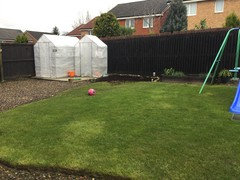
    This first one is me at my patio doors, that's the wet corner at the back next to the greenhouse . The orange bucket in the photo was filled 6 times on Saturday with water from that corner!!!!!!

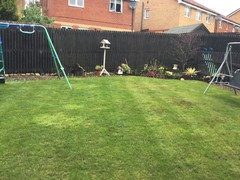
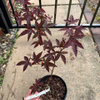
    This photo is my flowerbed which has the drainage...look at that beautiful acer tree

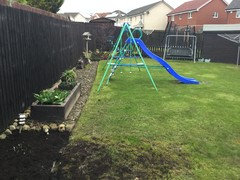
    This photo is me standing at greenhouses to give you an idea of the length of my garden, fair size considering it's a uk new build. That planter I built with very own hands is 6 foot long

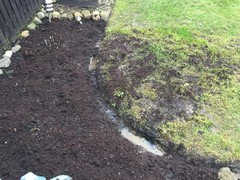
    This is my wet muddy corner. It's not bad just now but remember I took 6 buckets of water from it on Saturday.

    Me standing on the grass right at that corner, not sure if you can see all the water surrounding my feet? Can only a little actually

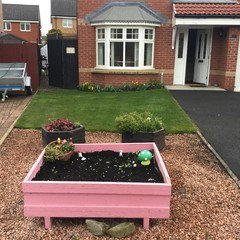
    Front garden with my girls pink planter, lol. Apparently this year it's going to be a fairy garden...lol

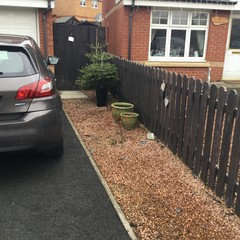
    My little side bit next to the drive way, it has a tiny acer orange dream which I planted when my dad died. And my Christmas trees, haha.

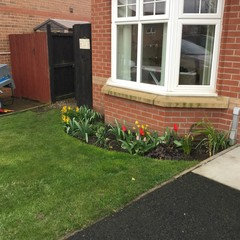
    And finally a little close up of the front flower bed, this also has drainage

    phew, done ✅

  • 9 years ago

    It would be very unneighbourly to plant a full sized tree that took up the whole garden. Everyone around would suffer and would quite possible get the council involved.

    The wet patch is mysterious. Do the neighbours over the back have it too? I'd be wondering if there was a broken water pipe under there or a spring. Have you dug down to see what's going on under the surface?

  • 9 years ago

    Huggorm I love the autumn colour of the tupelo tree, oh now there's an idea !!!

  • 9 years ago

    Not sure if the other neighbours have problems or not? Have dug down to add drainage to the other corner and it's almost solid brick underneath....makes for very hard work. I do remember my neighbours telling me though, when they were digging down they come across a coat and one shoe lol

    anyway, I'm sick of fighting it, and had planned on making it a bog wet corner, I hate the digging involved with adding drainage....I'm the only one that does it

  • 9 years ago

    Solid brick? What was there before the houses were built?

  • 9 years ago

    I've no idea tbh, we lived in a different city when these were built. Neighbours said it was farmland prior. So if that were true, there must be good soil somewhere....probably near the house foundations....think I'd rather buy a tree, lol.

    Full of brick maybe I should have said, the builders just cover the rubbish with soil....none of it is ever cleared away.

  • 9 years ago

    The musclewood is supposed to have good fall color and be a bit smaller.

    A mass of brick could easily mess with drainage. If the builders did something that incompetent, I'd watch out for other problems. Check for basement flooding and leaks the next time you have a big storm.

    Sophannah thanked edlincoln
  • 9 years ago

    Do you guys think my garden is small? I hope you like it.

    I'm away to check out musclewood. I have to say you've all been a fab help, learning now I have alternative options other than willows. Thank you all very much again

    dawn

  • 9 years ago

    Musclewood has lovely colouring in the autumn. Would an acer rubrum work?

  • 9 years ago
    last modified: 9 years ago

    Lovely space you have. I still like the 'Peve Minaret' for that space. Only six feet (two meters) tall after 10 years and a narrow habit. It originated in the Netherlands so should be available throughout western Europe as it is a popular conifer. You can see what is one of the oldest specimens HERE.

    tj

    P.S. If you cannot find one locally, Edwin Smits has a nursery in the Netherlands that I'm sure will carry it and ship it to you. You can see pix of his nursery HERE. Anyone recall the name of Edwin's nursery?

  • 9 years ago

    Red maple would probably work but they grow pretty large

  • 9 years ago
    last modified: 9 years ago

    Sophannah, these guys are all based in the US and are recommending trees which they know from their regions but which do not necessarily suit our climate, situation or garden style. Bear in mind also that we don't get anything like as good Autumn colour as in the US because of our climate. Musclewood is a type of Hornbeam and is rare in the UK. Acer rubrum can reach 30 metres tall. You really need to be looking at UK sources to get good suggestions for your garden. Have you had a look around at other gardens and parks in your area to get ideas? Here is a list of plants for wet soilsfrom the RHS. Check out the trees individually because some are far too big for your situation.

    However, personally, I really think you need to get to the bottom of why there is that boggy patch before planting anything. It is not normal and I think there must be something under the surface causing it. I've never seen anything like it in a small domestic garden. If you spend money on plants and trees and then find there is a hidden problem you will have wasted your money.

  • 9 years ago
    last modified: 9 years ago

    True, New England lends itself to Fall color more then warmer areas. Your results may vary. Tupelo has a reputation for having decent Fall color in warm areas where few things have good Fall color...but is a bit big. Is there some particular problem with hornbeam in the UK?

    Regional forums are quite useful. Visiting arboretums, older universities, and older neighborhoods to get ideas is also smart. (The problem with newer neighborhoods is they often feature trees that are recent fads and won't last, or things only maintained by the hard work of a brilliant gardener...older landscapes let you know what lasts in your area...)

    I do agree the boggy area could mean something. A layer of bricks beneath it blocking drainage could do it. It's near the street...could the street or sidewalk be draining into that spot?

  • 9 years ago

    The drainage is bad, I agree. Underneath is brick, bolders, stone and concrete. It was a building site, trucks and builders lorries have I guess also aided to compaction. The soil is clay, very heavy with no porous holes for water to seep through. It is grey in colour, and probably would make for good pottery!

    That part of the garden is the lowest point. All neighbouring gardens sit higher than mines, and as water finds its lowest point it tends to collect there. It doesn't matter where in the garden I plant and dig, it still causes drainage issues. However that particular corner as it's the lowest is the worst.

    I've been here 7yrs, dug many holes and other than the above mentioned I've seen no other issues.

    Yes my neighbours all complain but none really are into their garden as I am. I can understand why you wouldn't be on soil like this, it's disheartening and very discouraging :0(

    I would just like a tree that likes those conditions, as I mentioned in previous posts it is far easier to plant a tree than take on the added stress of fitting drains.


  • 9 years ago
    last modified: 9 years ago

    Just to add to my last post, we don't get hot summers. We have nice days during the summer but only lasts a few days before it rains again. Climate isn't as cold as some areas I agree but we are never really dry, the ground never really has the opportunity to dry out. Down south gets very hot, but us here in Scotland don't get that privilege.

  • 9 years ago
    last modified: 9 years ago

    And that is why I'm sceptical to some of the suggestions presented above. Trees from eastern US won't grow well in cold summer climates, I live in Sweden myself so I have experience. Bald cypress is one of those who need a long hot summer, even if a dwarf cultivar may do with less. Tupelo will grow but probably not get as large as in its native area. A wet, heavy clay soil will cool things down even more. European or asian trees will do much better in that kind of environment.

  • 9 years ago
    last modified: 9 years ago

    Ha, ha, Sophannah... 'down South gets very hot'. There speaks a true Scot! I feel chilly most of the year ;-)

    edlincoln, we have plenty of Hornbeams, just not Carpinus caroliniana. I can only find a few suppliers and it is described as difficult and slow growing. The cool summers Huggorm mentions are probably a key influence.

    If there is no particular cause for the wet patch I think a bog garden is the way to go.

    If you are set on trees, one option would be Salix alba Britzensis, Scarlet Willow, if you are prepared to either pollard or coppice it. Another would be Kilmarnock willow but you'd need to find a specimen with a good height trunk, otherwise they look squat and dumpy. Do not be tempted by weeping willow.

  • 9 years ago
    last modified: 9 years ago

    Oh no I won't be, there was a weeping willow in the garden when we moved...opposite the patio doors!? Crazy idea!! I've been looking and there are lovely plants and trees that would make a nice bog garden....even bulbs. So yeah think your right I should maybe stick to the bog corner idea. I'll post pics once I've revamped it. Again, thank you all very much...you've been very helpful. Any bog plants that spring to mind, please lettme ken <- Scots slang for "let me know!"

    och aye the noo....! lol

  • 9 years ago

    I *LIKE* the tree idea...

    Anyway, bog corner plants...ferns, camassia quamash, cranberry?

  • 9 years ago
    last modified: 9 years ago

    Here in the US, we have 'wild cranberry', which I believe is Vaccinium macrocarpon. It grows locally (Minn) in our floating bogs and wetlands as a slim (3/4" dia.), single trunk (about 6' high) with a wide, flat crown at the top. In winter you can see the bright red berries.

    ETA: After doing more research, I just realized, the local wild plant I am talking about is actually Viburnam trilobum, commonly known as "highbush cranberry" or "Cranberrybush" which can get up to 13' high. Not Vaccinium macrocarpon as I originally thought.

    I understand that in Britain your cranberry may be Vaccinium oxycoccos, which I know nothing about. :)

    Sophannah thanked User
  • 9 years ago

    There are much showier and more gardenworthy subjects than cranberries, of any kind, for such a small patch in a modest back garden. Candelabra Primulas, Japanese Irises, Zantedeschia aethiopica, Ligularias, Lythrum salicaria (and before the outcry, it is not invasive here, it's native), Rodgersias, Astilbes, Lobelia cardinalis .... the list is endless. The RHS site will give you ideas.

    Sophannah thanked floral_uk z.8/9 SW UK
  • 9 years ago

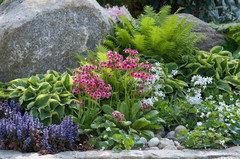
    I've been busy googling and getting ideas thanks to all of you. I like this picture which I may be able to adapt to suit my wet mess.

    I appreciate every one of your suggestions, plants and trees there I had never even heard off. I guess you can tell I'm fairly knew to the garden, and still learning a great deal.

    Ive wrote down a whole load of names, and floral uk most of your suggestions are there. I've also noted down all the tree suggestions too.

    i just wish you guys all lived near by, my garden I bet would be beautiful...the best in the estate

  • 9 years ago

    Sophannah,

    Google for images of Winterthur Quarry garden. You will see more ideas to go with those wonderful candelabra primrose in a wet spot.

  • 9 years ago

    Sophannah, maybe it's time to go over to the Perennials Forum now your ideas are moving on from trees. There are a lot of experienced gardeners over there who know a huge amount about perennials.

  • 9 years ago

    All of the trees I've mentioned can grow in fairly cold environments and a wide range of climates, so I doubt the lack of heat would seriously impair you. I wasn't suggesting any Florida trees. And if a few of these trees grow much slower in your area...on a small lot, that's actually a good thing.


    I was suggesting the low bush cranberry, Vaccinium macrocarpon largely for winter interest. I did also toss out ferns as an idea.

  • 9 years ago

    edlincoln - it's not cold in Winter which is the problem with growing some N American trees in the British Isles, it's the lack of Summer heat. That's one of the reasons that many species invasive in the US, eg Paulownia tomentosa, are not a problem here. Fruits either don't ripen or there is too little warmth for them to germinate. Virginia Creeper, for example, rarely produces berries here. All I can say, again, is that some of the species recommended just don't thrive here and are hard to source, presumably for that reason. And using any kind of cranberry in a small suburban garden is just plain boring imo. There are hundreds of small bushes, including many which are evergreen or even flower in Winter, that could be grown in this climate far more interesting to look at. There's no need to use anything with minimal visual interest.

  • 9 years ago

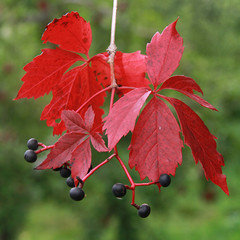
    Wait, Virginia Creeper has berries?

  • 9 years ago

    Ed, how do you think it spreads far and wide in its native habitat?

  • 9 years ago
    last modified: 9 years ago

    "Wait, Virginia Creeper has berries?"

    Yes

    "Ed, how do you think it spreads far and wide in its native habitat?"

    It "creeps" Lol

    All of that aside, virginia creeper is a very weedy, untidy, and unwanted plant here. Last year I had to eradicate several that popped up under my crepe myrtle.

  • 9 years ago

    A common roadside plant over here, but I don't know if they are planted or if they spread by themself

  • 9 years ago

    It's a lovely colour though!!

  • 9 years ago

    Sophannah, here I come pouring cold water again! In our climate the autumn colour of Virginia creeper isn't reliable. Some years you get it, some you don't. Personally, I wouldn't plant anything solely for autumn colour as it often doesn't happen. I'd want other attributes like flowers or shape too.

  • 9 years ago

    I *AM* in it's natural environment.
    As far as how it reproduces...I presume in my area it usually reproduces vegetatively, and then every so often, when the weather is just right, a mature plant produces a crop of berries to reshuffle the genetic code and spread it to new locations. I my be at the edge of it's range, or maybe people usually cut it down before it gets big enough to fruit around here.

    Anyway, I was being facetious on that one. Just pointing out that their are parts of it's native range where it rarely fruits. It's rather aggressive, I wouldn't suggest planting aggressive vines outside of their native range.

  • 9 years ago

    Would a pond not be a natural feature for that wet spot? For example, a small reflecting pond of 10 to 20 square feet, put a Japanese lantern behind it, a tea light candle in the lantern, and voila, a romantic feature that you conveniently don't have to rubber line or otherwise waterproof (just reinforce the sides and the bottom with rocks to maintain the shape), the pond can serve as a drain for the immediate vicinity so more plants can grow there, etc.

  • 9 years ago

    I'm not sure about the pond idea unfortunately. It sounds lovely it really does, but I have young kids and I would be on edge a little.

    Im thinking of bog plants, bought some today :0) and plan to play about with it tomorrow. Thing is, whenever I work on it I make it worse...obviously digging, standing etc on it compacts it even more.

    would a bog wet plant area, soak up the excess water?

  • 9 years ago

    Bog plants wouldn't soak up the water, no. It would still be boggy. We had a pond with young kids but we made a frame covered with wire mesh to cover it. You could have something like one of those millstone bubblers I suppose but it wouldn't be using the natural moisture.

  • 9 years ago
    last modified: 9 years ago

    "would a bog wet plant area, soak up the excess water?"

    I would guess that bog plants would grow well there and use all the water they need, but they won't soak up the excess water to a substantial degree as the soil with its water holding capacity is still there, getting fed by excess water from the immediate vicinity. (I realize that you have your reservations, but a pond eliminates the water holding volume of soil, and excess water from the immediate vicinity accumulates there.)

    Perhaps the following is pertinent. I had a damp (but not soggy) corner in the backyard of my previous property. I heaped a mix of crushed stone, sand and a little topsoil in that corner, sloped and contoured the surface, placed more or less flat rocks on it and created a small (about 150 square feet) rock-and-water garden. Although the highest point of the contoured area is just 1' above lawn level, I was and still am amazed at how dry the entire area became. Again, I am not sure if the rock garden part without water will work in your case.

    There should be some paper work at the city before they allowed the housing development to go ahead in the wet area, perhaps you should get some info there. I realize that you talked to your neighbours, talk to them some more.

  • 9 years ago

    I think if I am totally honest i didn't help that corner last year. It has always been soggy and wet, but i thought i could improve it with manure, chicken pellets, compost....I threw everything at it. But the more i dug down the worse the water was getting...that's when I hit all the rubble. I couldn't dig past it, the water just sat on top of it. And of course digging wet clay soil just made everything even worse. It's compacted even more so now, and it's been like that photo ever since.

    a pond would definitely work, if I were to build a pond it would be a small pond, ponds are lovely to look at in the garden.

    I've got a bit of help next weekend, a friend of mines is going to help build a french drain....just to direct some of the water else where....try and at least help the corner dry out a little.

    im away to google a pond, see how difficult or easy it is to construct. I'm open to all ideas that would obviously help, so thank you again for all of your suggestions.

  • 9 years ago
    last modified: 9 years ago

    I doubt your digging did much. The rubble may have formed an accidental, filled in pool. Look closely at where the water flows the next time you get a downpour. Given the location, I'm wondering if water fro the street is flowing there. You might be able to fi the problem with a curb/stone edging along the edge of the sidewalk. Or if you are OK with a pond you could do a brook.

  • 9 years ago

    Space issue aside certain named forms of Metasequoia and Nyssa are RHS Award of Garden Merit plants.

  • 9 years ago
    last modified: 9 years ago

    Wow, this thread has had some divarications.

    Not only does Parthenocissus have berries, they are in the grape family and taste like very sour and astringent grapes. They are toxic, but safe to taste if you spit them out. (don't do this with Aconitum LOL)

    Japanese maples do well in maritime climates; maybe that would make a good backyard tree in this case. And even have good fall color after cool summers, as far as I've read at least.

    Have to fix the water situation first, though.