Software
Houzz Logo Print
radgard

Possible phosphorus deficiency

9 years ago
last modified: 9 years ago

Last year I grew early and Roma tomatoes in a 4x8' raised bed.

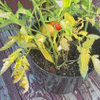
Most of my Roma tomatoes looked liked:
https://imgur.com/gallery/wGsqh
I've been told this could be phosphorus deficiency.

It was my first year growing anything in the bed. The bed had a little more 1/3 compost and the other 2/3's split between peat moss and vermiculite. Watered with drip irrigation.

So I recently did a home soil test which did say I was deficient in phosphorus (as well as nitrogen). So what's the best way to amend the soil? Already added some compost and was going to add some more when I planted as well as some other fertilizer (10-10-10). What about bone meal, triple superphosphate, etc? I'm still pretty new to all this.
Thanks,dan

Comments (13)

  • 9 years ago

    I agree with Dave. Home test to detect Phosphorus ? I won't bank on it.

    MG all purpose (24-8-16) should take care of N and P. deficiency, if it really is the case. Even any fertilized like 10-10-10 will do.

    Rad Gard thanked Seysonn_ 8a-NC/HZ-7
  • 9 years ago
    last modified: 9 years ago

    I think that home phosphate testing is a well established industry for swimming pool maintenance. There are reliable and accurate kits to do that. I'd like to believe that if it is straightforward to do it accurately with a swimming pool, it ought to be at least chemically straightforward to do accurately with garden soil, in which phosphates are the molecular carrier of phosphorus. So the premise of a good home soil test for phosphates doesn't seem unreasonable.

    Now, good soil phosphorous is something like 50 ppm, and pool test strips go up to 5 ppm, so it's just a matter of getting the dilution right on the water you use to dissolve your soil phosphate. Soil phosphates are all highly soluble.

    Maybe someone with a chemistry background could comment here?

    But yes, reddish purple leaves are a sign of phosphorus deficiency.

    And yes, don't take soil tests for nitrogen too seriously.

    Rad Gard thanked daninthedirt (USDA 9a, HZ9, CentTX, Sunset z30, Cfa)
  • 9 years ago
    last modified: 9 years ago

    So I get home tests being inferior to a dedicated, professional soil test. But I'm a hobby gardener and while the cost difference isn't that big of deal, home tests are fast and easy to do... And maybe it's good enough? I will have to see how it compares to a professional test at some point.

    Before I purchased the rapitest kit I did research reviews which seemed to be highly positive. Also stumbled acrossed an article published by scientists at UC Davis (California) who compared home tests kits for accuracy and concluded:

    "Nevertheless, commercially available kits such as Rapitest and La Motte Soil Test Kit were 92% and 94% accurate, respectively, for the soils tested and are a fast and economic means by which farmers, home gardeners, and agricultural service personnel can improve nutrient management for crop production and environmental protection." (http://horttech.ashspublications.org/content/17/3/358.full)
    I thought that 92% accurate was pretty decent.

    My other plants (jalapeno/Thai/reaper/habanero/mini bell peppers, onions, carrots, basil) did well. Maybe the Roma's are more sensitive to phosphorus deficiency?
    I did use all purpose miracle grow fertilizer last summer but I did error on the side of not giving too much. So there really isn't a need for me to add something like bone meal or super phospahte to specifically try and increase phosphorus levels? An all purpose fertilizer should cover it? I had heard that wit adding bone meal it can take awhile.for into become available plants to use, so i wanted to add it sooner than later if needed.

  • 9 years ago

    That's a useful article from UC Davis. Thank you. I've always suspected that home tests are questionable more because of the inability of some gardeners to follow detailed chemical analysis protocols than because of the chemical analysis tools they are given.

    Curious that you used all-purpose fert but still got a low P reading and low P symptoms. Also curious that your other crops did well. That's correct that bone meal and rock phosphate takes a while to work. I think some kind of soluble phosphate is the quick fix.

  • 9 years ago

    The variable that has the most impact in home test kits is the water used. Using only distilled water in carefully measured amounts has the most accurate results for measuring the free phos in the soil tested, the phos readily available to the plants. But not only do most use tap water rather than distilled but the amount of free phos, its ability to be water soluble, all depends on the ph of both the soil and the water used. So you can easily have much higher amount of phos in the soil than will show up in the test that over time will become free and available to plants.. Adding a great deal of phos based on that test can create phos toxic soil especially when plants require so little of it to begin with.

    So when using the home test kits they are basically testing the pH of your water as it is the primary component in the sample. It then test the amount of free floating, water-soluble phos in that water. Since most home tap water falls into the pH range of 7.5 to 8.5 the measured amount of phos will often show low simply because of the the Ph of the water.

    But all that is mute if you choose to follow its results as is always your choice.

    It is very subjective to say that all the other plants did well as you have no full knowledge of the symptoms to look for or a base for comparison to the results you'd get from properly balanced soil that contained all the necessary minerals - zinc, iron, magnesium, boron, calcium, bound phos, moly, copper, etc. that only soil can provide and that all plants need. Sure you can "quick-fix" most of those with Miracle Grow used heavily - that's what the maker counts on. ;-) OR you can just add some good soil to your beds and provide them all in readily usable forms over the long haul with no concerns about possible over-doing it and creating new problems. Your choice.

    Dave

  • 9 years ago
    last modified: 9 years ago

    That looks more like advanced Mg deficiency to me. Since these are Romas, did you by chance use a product designed to prevent Blossom End Rot or add extra calcium? Also, did you grow any other tomato varieties, and, if so, how did they do?

  • 9 years ago

    Not sure about that. Mg deficiency causes interveinal chlorosis. That's not what I'm seeing in the posted picture. The purplish color and necrosis is a dead ringer for P deficiency.

  • 9 years ago

    I grew early tomatoes (burpees). They seemed to do well without any leaf discoloration and a good harvest (compared to my other plants that I've grown in the ground and containers the last 5 years prior before I moved to my current location). My father grew a lot of the same vegetables that I did, although different tomato varieties, and my plants (other than the Roma's) seemed to look and do as well as his.

    So one thing I omitted is that the pH from the home test was on the border of 7 or 7.5. I was thinking it was closer to 7, but my wife thought 7.5 (this is part of the problem colorimetric tests). So, I have a pH meter from my days working in a biotech lab that I still use to make beer. So, as a tie breaker I Tested my soil's pH with it and I got 7.4 (again I used distilled water, calibrated pH meter prior to use with 2 different buffer solutions covering the expected pH range of my soil, and took several samples from around the raised bed and mixed them all together). I was surprised as I thought the peat moss would have made it more acidic.


    Apparently soil is more basic in the spring due to less microbial activity. Never the less, I think I will amend the soil's pH and maybe aim to drop it 0.5? the home test kit recommends aluminum or iron sulfate. Local garden store has something else... Espoma soil acidifier. Didn't have a chance to read what was in that other than its supposeely safer to use than aluminum sulfate.

  • 9 years ago
    last modified: 9 years ago

    daninthedirt: Not sure about that[...] The purplish color and necrosis is a dead ringer for P deficiency.

    When Mg deficiency goes on long enough, the interveinal areas on affected foliage sometimes turn brown or bronze. K deficiency sometimes gets to look like that, too.

    Of course, a lot of deficiencies, once advanced, could end up looking like that.

    The reason why I hesitate to definitely confirm that it's P is because there is zero sign of purpling on the veins and in other areas of the plant, which seems uncharacteristic for P deficiency.

    It could also be something like Tomato Purple Leaf Disorder, although, once again, it lacks the purpling elsewhere on the plant.

    But things don't always present typically.

  • 9 years ago

    On second look, I do see a ghosting of purple on newer growth at upper left. So, yeah, it's probably not Mg or K.

  • 9 years ago
    last modified: 9 years ago

    Gorbelly- thanks for the insight. I'll look and see if I have other pics.


    edit:

    darn, no other pics. my notes just say i got fruit production from the roma's through end of August then the plants died out as the more and more leaves turned that purple color then eventually darkgrey/yellowish. The fruit I did get from the Roma's was on the small side.


    If it is Tomato Purple Leaf Disorder, what's the chance of it coming back? I couldn't find much about it.

  • 9 years ago

    pH 7-7.5 is quite normal. My soil pH is 8, and I have absolutely no trouble with tomatoes. Your test shows low P, and the symptoms look a lot like low P. Although maybe it is strange that your other plants did fine. I wouldn't get distracted by a pH that is essentially neutral.

    Rad Gard thanked daninthedirt (USDA 9a, HZ9, CentTX, Sunset z30, Cfa)
Sponsored
Peabody Landscape Group
Average rating: 3.5 out of 5 stars8 Reviews
Columbus' Reliable Landscape Design & Contracting