Software
Houzz Logo Print
hzdeleted_35844888

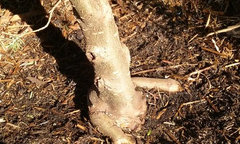
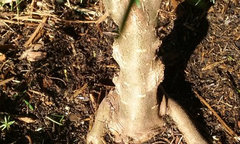
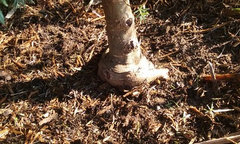
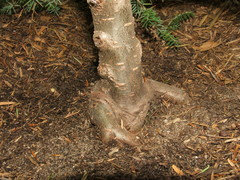
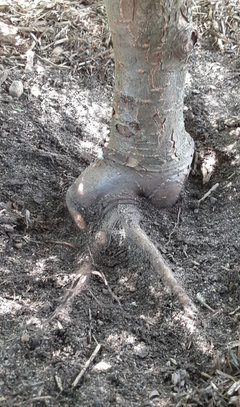
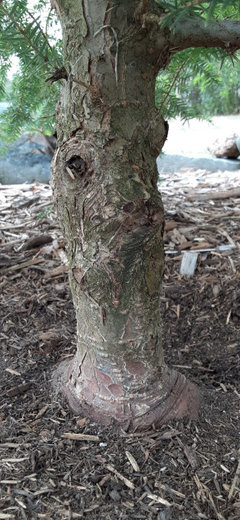
Root flare on small Eastern Hemlock.

9 years ago
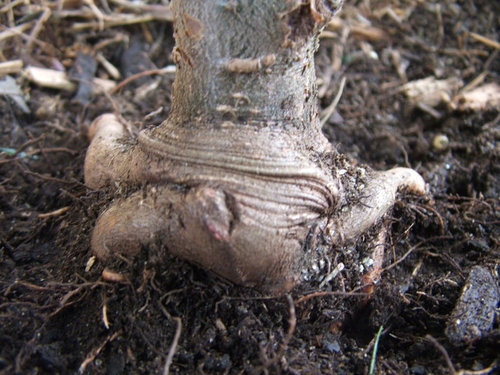
Need some advice from the experts. The weather is finally warming up and I was working around my Tsuga c. So go my first look sine planted last summer.

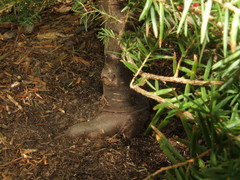
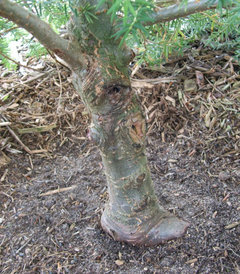
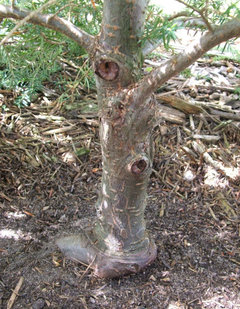
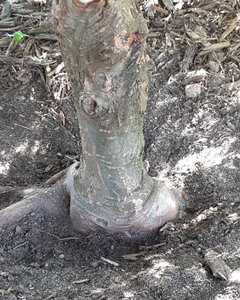
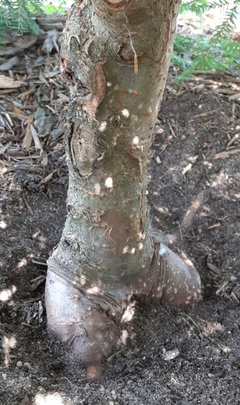
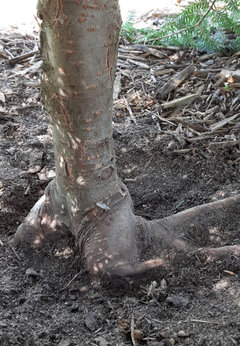
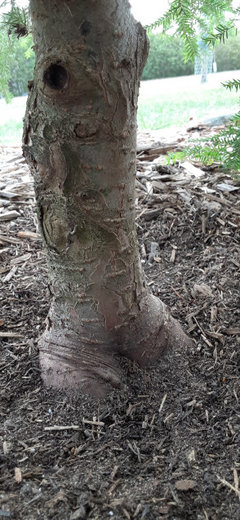
Looking at the root flare, I was intrigued by how this one looked. My first impression is that it looked more like a branch collar or a graft than a root flare. This was the way it came out of the pot from Menards last July. It has grown over a foot the remaining of the summer and made it through a fairly harsh MN winter (3b). I thought that maybe Hemlock have a different look to them being they have shallow root systems.

What do you think? Is this looking healthy or at least normal for T. canadensis? Comments?


A quarter turn around the first view.

Another quarter turn view.

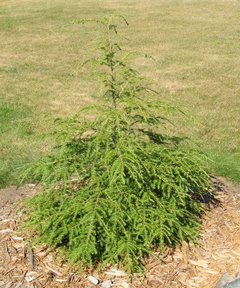
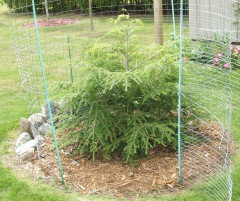
Backed off some view.

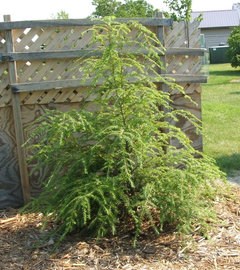
Tree.


Comments (40)

  • 9 years ago

    And to further expand the question. Does any of this look like girdling roots? Enough to dig up the plant and do some root trimming? There doesn't seem to be a lot holding this tree right now other than the large surface roots seen in the picture.

  • 9 years ago
    last modified: 9 years ago

    Left in a band or small pot too long and now quite deformed. Because this species produces a large tree if it were mine I would discard this example, as it might grow big and heavy and then topple.

    The planting site is way too small anyway.

    User thanked Embothrium
  • 9 years ago

    Thanks Embo.

    Something didn't seem right and at planting time last summer, I just didn't know enough on how to check the roots or do anything to correct it. But it sounds like it was too far gone by then anyways. I think I'll just enjoy it for a while being I don't have a replacement at the time anyways.

  • 9 years ago

    Yes it is so bad there doesn't seem much scope for correction. I see this same high amount of root diversion a lot on woody material presented to the market here, unfortunately.

    User thanked Embothrium
  • 9 years ago

    Ya, my luck. Probably why it was on sale. There's a one year guarantee on this one but I think that's only on if it survives or not.

    Maybe something will pop up locally this year to replace it. But even if it was a better specimen, there's no guarantee it would survive in our windy environment. I had to go to measures of protection that can't be continued as the tree gets larger.

    There are some fairly large Red pines and White pines around here in town, some less than a trees length away from houses. And even though I won't be around to see it, Tsuga c. could be somewhat more dangerous than trees with deeper root systems. And the Hemlock may have that happen in a few years, after the top increases, anyways.

    Oh well, no one has 100% success with this stuff. or am I missing something? :-)

    Otherwise, I really have enough trees, maybe too many for this yard and there's plenty more if I change my mind. :-)

  • 9 years ago

    The problem appears to be pandemic with woody container stock here. Whereas not with material sold by retailers bare rooted, where the roots are fully visible (when pulled out of sawdust beds) at time of purchase. Maybe there is a forestry plantings oriented source you can use that sells small hemlocks bare rooted - if bare rooting is ever done successfully with these particular trees.

  • 9 years ago

    "The problem appears to be pandemic with woody container stock here."

    Yes, it's a big problem here as well. One of the larger retail garden centers in Eau Claire has become very slack about this and I've let them know about it. I used to buy considerable woody plants from them, but now it's pretty much limited to mulch. I was there yesterday and the situation hasn't improved. Gerten's out of the Twin Cities does a much better job and gets most of my business.

    I've never worked in the nursery trade, but why is this such a problem? Is it so time consuming that they just don't have the personnel to do it?

  • 9 years ago
    last modified: 9 years ago

    Yes, it's getting to be all about the money and not so much about delivering quality. It used to be if something didn't turn out, product would get tossed and the operator would be the one taking the loss. Now if the flaw or consequences of which, will not be recognized until some time has passed, they just sell it anyways in hopes that what they make is more than what they end up having to pay out in damages. I guess it's what they nowadays call smart business practices. :? We used to call it crookery.

    If I lived further east in this state and was 30 years younger, I'd be tempted to dedicate an acre or three and buy bulk Tsuga c. for forestry planting. Just for posterity. But back then I had to make a living.

    For now, I moved the wind break back a foot and made a larger predator cage out of two hoops of 24" high rabbit fence, that should work for another few years. I'll stake it next fall.

    We had gusts to 30 mph today and Hemlock's still standing. :-) I'll check on it periodically and see if anything can be done to keep down any root girdling as it develops more. Seems healthy for now.

  • 9 years ago

    Girdling roots were present so long as to be mostly to completely embedded in the root flair. Not good IMO.

    User thanked bengz6westmd
  • 9 years ago

    Too bad, it was doing so well. :(

    I did some web searches, the sources I found either were so expensive or out of stock or weren't shipping Tsuga c. until fall. I'll keep my eyes open.

  • 9 years ago

    Species is being hammered by adelgids, perhaps that is starting to affect commercial availability.

    User thanked Embothrium
  • 9 years ago

    Agreed. This was no doubt a window of opportunity to start a T.c. some distance away from its problemed areas. It may be a more dicey proposition from now on. But I dont give up easily. ;) Only time will tell.

  • 9 years ago

    bill_minn, just got 2 Chinese hemlocks (resistant to the adelgid) from forestfarm, tho perhaps too late to order for this spring.

    User thanked bengz6westmd
  • 9 years ago

    Thanks beng. But I have to stick to my "native trees of minnesota" theme. :)

  • 9 years ago
    last modified: 9 years ago

    Because they will be in bands or pots anyone else interested can probably still get them as long as forest farm doesn't think the boxes will get too hot during shipping.

    User thanked Embothrium
  • 9 years ago

    As far as your native theme, it isn't a bad thing to consider nonnative species. Eastern hemlock provides a unique habitat and Chinese hemlock is a near identical replacement to those habitats. If I had an option, I would choose to be able to provide the habitat, which seems to be what you are going for anyhow. I have one Chinese hemlock and a bunch of Eastern hemlocks. It's kinda like the American elm and Chinese elm situation.

    User thanked josh_ky
  • 9 years ago

    Thanks, but T.chinensis won't survive 3b as far as I can tell. I'd have to go with a Mountain hemlock for zone purposes and then it would be a stretch and I don't know if it would thrive here. i'll keep looking though, sometimes the journey is more fun than the destination. :)

  • 9 years ago
    last modified: 9 years ago

    bill, you're right -- the Arnold Arboretum report says Chinese hemlock is only hardy to z5 w/certainty.


    And josh_ky, yes, Chinese elm is the only elm that can survive at my place other than pure Siberian elm. Even the Valley Forge-type Amer elm gets killed here from elm yellows. There may be a similar situation developing w/ashes.

    User thanked bengz6westmd
  • 9 years ago

    Yup, even Carolina hemlock that shares some common range with Canadian hemlock isn't zoned for my area. Zone pushing is popular up here but the results are winter killed tops with remnant growth coming from the roots. I'm just doing what I can do without all the consequences of zone pushing.

  • 9 years ago

    Can't find any thing on if I can buy a hemlock in pennsyvania and bring it back to MN. Anybody know ?

  • 9 years ago

    Are you in the Philly area? I might be wrong about this, but I believe some of the arboretums have plants for sale and Tsuga would be a likely candidate. Scott arboretum? If there are none, then shame on them. It seems as if every botanical garden we visited in Scotland offered plants for sale. This seems like a no brainer for public gardens and arboretums.

    User thanked maackia
  • 9 years ago

    Made suggestion to stop @ national aboretum. We'll see if it flies. :)

  • 9 years ago

    The Gotelli Conifer Collection is on the far side of the arboretum from the main entrance.

    User thanked Mike McGarvey
  • 9 years ago

    musserforests have (had) eastern hemlocks, but are sold out. Might have more this autumn:

    http://musserforests.com/prod.asp?p=CAH

    User thanked bengz6westmd
  • 9 years ago
    last modified: 9 years ago

    Update:

    The Tsuga c. grew quite a bit this season. Took some new pictures of the root situation. The tree seems a lot more solid in the ground than it did last spring. The roots have enlarged and look somewhat better than last spring also. I think I'll just wait and see with this tree. I've read that T.c. has been known to root graft in the wild, so maybe this tree can do something miraculous over time and possibly repair itself?


    This last picture appears to not have any roots on this side but it feels like there is a root that goes straight down like a tap root on this side. I didn't want to disturb the soil too much in case there were some feeder roots started on that side.

    I still have to figure out what to prune as there are multiple branches competing to be 'the tree'.

  • 9 years ago
    last modified: 9 years ago

    I'd guess and say enough peripheral roots have developed now that the root girdling is not so detrimental. One of my larches did this just above an embedded girdling area & now has huge surface roots from there going out in all directions & is healthy & large.


    Chopping at the root flair now would prb'ly do more harm than good.

    User thanked bengz6westmd
  • 9 years ago
    last modified: 9 years ago

    I ended up cutting off the one large branch, growing from the lower trunk. I know I should've done it back in May or June and this isn't the best time of year for pruning but I'm hoping there is enough season left for it to at least partially close the wound. I did daub the wound will some fungicide.

    This one branch was almost the same diameter as the rest of the main trunk and contained, guessing at least 20% of the entire leaf area of the tree, so I just wanted to 'make that one cut' that would make the most difference.

    There will still be more to do, as you can see in the picture. Many branches, growing out in various directions, but they are of smaller diameter and will be easier to deal with next season. Also I feel that there is no point is opening up to much of the tree at one time, especially this time of year.

    The tree doesn't look too much different. A little more 'airy' looking at the bottom half and the trunk is slightly visible now.

  • 8 years ago
    last modified: 8 years ago

    Update:

    Don't know if we're 'out of the woods' yet. The root flare doesn't look too much different than it did last fall. When I grab the trunk, I can flex the tree in the ground, more easily than I would like. But when the wind blows, the tree branches fly around like you would expect but the whole tree doesn't tilt or sway very much at all. And you can feel at least a couple directions radially, where there must be a root anchoring things. If I take my finger and dig around the base, I start hitting fine/small roots immdiately so I stopped in fear of damaging things.


    I do have two branches from this tree, slated for donor status, next winter. So there's still a chance for vegetative propagation but I'm not giving up yet. There'll be several more years before it'll get to a size that it could be a danger from falling. For now, I'm liking it! About a 4 footer now.


  • 8 years ago

    Don't mind at all. Good to see other plantings of this tree. It's Brainerd that now holds the state champion of this tree at a private residence. I collected cones off that tree a couple of weeks ago.

  • 8 years ago
    last modified: 8 years ago

    Bill, your tree sure looks great and despite those two upper roots being on a bit of a weird angle, I think whatever develops below will end up anchoring it just fine.

    Mntreegrower, nice to see you're also having success. My previous attempts had been in locations that were a bit too exposed and soil on the dry side. Come spring, I'll try planting one in deep woodsy fibrous soil in a site both protected from wind and winter sun, if it fails there I'll be forced to concede defeat!

    User thanked FrozeBudd_z3/4
  • 8 years ago

    FB,Don't you have Tsuga heterophylla where you are at?

    Wouldn't that grow better and have almost the same look as T. canadensis?


  • 8 years ago

    Just doing a bit of research and the closest they are to be found is in isolated pockets in Jasper National Park. Otherwise, I have not seen Tsuga heterophylla offered locally or by Canadian nurseries that ship, though maybe I'm just not searching diligently enough.

    User thanked FrozeBudd_z3/4
  • 8 years ago

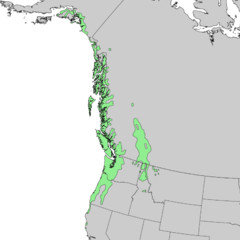
    Understood. When you look at the native range, they show a large area that looks like it's in you neighborhood, so it made me wonder. I know that these maps are NOT very accurate.

    Tsuga heterophylla native range.


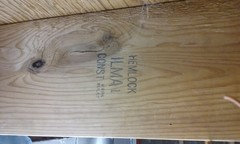
    As an aside, as I was up in the basement floor joists, I noticed a marking on the wood. I researched it and turns out to be a lumber company (Western Wood Products) out west that made it. Western Hemlock. So my house is made of it. :-)


  • 8 years ago

    Yes, I had come across the same map, the Canadian range is basically all well to the sw of me in BC and the sprinkled populations in Jasper and Banff are something like 4 to 6 hours (or more) away by vehicle.


    From 1985. Plants new to Alberta from Banff and Jasper national parks. P. L. ACHUFFI and I. G. W. CORNS2 'Alberta Institute of Pedology, University of Alberta, Edmonton, Alberta


    Canadian-Field Naturalist 99( I): 94-98. During an ecological land classification of Banff and Jasper national parks, five species of plants previously unknown to Alberta were discovered: Hippuris montana (Mountain Mare's-tail), Sedum divergens (Spreading Stonecrop), Tsuga heterophylla (Western Hemlock), Vaccinium ovali/olium (Oval-leaved Blueberry), and Arum'us sylvester (Sylvan Goat'sbeard). These Alberta occurrences extend the known ranges of all five species eastward from central British Columbia. In addition, Alberta range extensions of 22 rare vascular species were recorded.


    User thanked FrozeBudd_z3/4
  • 8 years ago

    " Bill, your tree sure looks great and despite those two upper roots being on a bit of a weird angle, I think whatever develops below will end up anchoring it just fine. "


    Thanks!

    Checked it again this week. We've had windy conditions all September and October and was a little worried. I could see it get whipped around from the house. But really, it's like the wind made it stronger. I too would think that the roots are only going to get larger and longer.

  • 8 years ago

    " These Alberta occurrences extend the known ranges of all five species eastward from central British Columbia. "

    Interesting.


    Maybe like T. canadensis in Minnesota. Years ago, there *were* a couple large stands in certain parts of NE MN. Even then considered 'outlier' populations.


    Some were logged off and a couple historic fires finished off what was left.

    Still a few scattered locations of small populations and many that were planted over the years. But even though considered 'Native' they are few and far between.


    The natives trees have never regenerated. Even where the area has been protected from deer and rabbits at the Hemlock Ravine, a MN DNR SNA refuge.

    Of coarse, mice like the tiny new seedlings also so that may be part of the problem that isn't so easy fix.

  • 7 years ago

    Update:

    I took a couple of lower branches, last winter, to use for cuttings. It's been difficult to wrap foil on that lower trunk, for winter protection, so the branch removal served two purposes. The second, is now I have about 6"-7" of clear trunk so I should be able to use a piece of 3" dia. tube, to deter mice from chewing on the lower bark. I don't know it that will happen but would rather put a tube on than wait for spring and find extensive damage on that part of the tree. It's happened to me before, on other trees I've grown.

    All the branches removed are encapsulating nicely and the tree has taken on a better form..

    The picture makes the tree a little crooked but it's not. It's just from me crawling around in the bush trying to take a snap shot. :)


    I left the fence up all summer so new sprouts at the top, coming from dormant buds, after a rough winter with die back, wouldn't temp the local animals. :-)

    Now to add a tree tube and some mulch. :-)

  • 6 years ago

    Update:

    A little early but was pruning a couple of low branches before ideal timing was over so took a few pics. I noticed some lateral 'surface roots' for the first time and the tree seems more stable than it was.

    This side doesn't look to have any roots but when I flex the tree away from me, the ground rises and cracks, indicating there must be roots lower down than I care to dig.

    This side seems to have melded multiple roots and although there doesn't appear to be the ideal root placement overall, the tree seems to be dealing with it pretty good to date.


    So far, I'm not worried about the tree falling on me, after all it's only 3 ft tall, so I'll have to keep watch on it to see what it does in the future. :-)

  • 4 years ago

    11-15-21

    Might as well give the yearly and most likely, last update on this trees condition. ;-)


    I didn't do any digging but when I went to apply the mouse protection at the base of the tree, I noticed much improvement in the looks and stability that's now seen 5 full seasons in the ground. (this pic is approx. at the same angle as the second picture above from last year).


    Another shot (approx. same as third pic above from last year).


    So all should be good with that problem.


    This post coincides with another thread I've been updating:

    https://www.houzz.com/discussions/5550505/anyone-else-growing-tsuga-canadensis-in-usda-zone-3#n=92