

WTD with new soil
As part of building two large raised beds (almost 24" high) I had 6 yards of soil trucked in. The supplier described it as "organic planting mix": "Rich in earthworm castings, kelp meal, fish bone meal and soybean meal • Contains aloe vera and yucca extract • Beneficial soil microbes plus mycorrhizae are part of the probiotic inside • Ideal for organic vegetable gardens."
I'm taking much of that with a grain of salt, though I can, in fact, see the remains of organic matter (decayed plant material).. But should I have the soil tested for specifics? The local places, from nurseries to cooperative extensions) usually do very basic testing: pH and soil texture (sand, loam, clay) but that's about it. I've already started adding additional compost, but I still have some of the original soil for testing; what things should I test for?
Since I can't really verify the provenance of the soil, I was also wondering if there's any sort of standard testing for contaminants, or am I getting into expensive tests for an unlikely situation.
Comments (36)
 9 years ago
A basic soil test gives you information about the fertility and certain physical properties of the soil (you had tested). A test for contaminants is likely unnecessary, quite expensive, and is going to be hopelessly confusing.
Speaking of confusing, a soil test is never a bad idea, although sometimes the importance is overrated. For example, the soil you purchased for your raised beds. A simple, basic soil test is going to tell you things like how much of certain nutrients you have (and how much of certain nutrients [fertilizer] you should add). It will tell you certain other information, generally...like how much organic matter (as a %), and pH, and CEC. different labs generally supply a range of similar information, and they do a good job of supply a basic range of information for a minimum price. It's not going to tell you if you have soil contaminants of any kind.
I'll assume you're in a part of the world where plants like aloe vera and yucca are part of the landscape?
More important is going to be your observations. Managing water can be critical for the first couple of years in a newly established raised bed. What grows, what doesn't, is growth stunted, what things germinate well from seed.
 9 years ago
"or am I getting into expensive tests for an unlikely situation."
Yes :-) I seriously doubt testing for any contaminants is necessary. Moreover, I doubt any testing is really required at all unless to just provide you with peace of mind and more detailed info than the provider supplied.
I work with a lot of imported soil for clients' yards and with very few exceptions, it is always a high quality product, pretty much ready to go for most gardening projects. It is in the supplier's best interests to provide a ready-to-go, problem-free soil mix and it sounds like they went an extra step or two with this mix. Almost more a description for a bagged product from a high end supplier (e.g. Dr. Earth, Gardner & Bloome) than a bulk soil mix.
I'd have a hard time accepting my local bulk soil providers have soil mixes available that are vastly superior to those offered elsewhere so have to assume similar standards and quality control are available elsewhere in the country as well.
Related Professionals
Daytona Beach Landscape Architects & Landscape Designers · Rome Landscape Architects & Landscape Designers · Bozeman Landscape Architects & Landscape Designers · Houma Landscape Contractors · Aberdeen Landscape Contractors · Charleston Landscape Contractors · Waco Landscape Contractors · Waterbury Landscape Contractors · Fort Wayne Landscape Contractors · Amherst Landscape Contractors · Keene Landscape Contractors · Billings Landscape Contractors · Hot Springs Stone, Pavers & Concrete · Harrisburg Stone, Pavers & Concrete · Victoria Stone, Pavers & Concrete- 9 years agolast modified: 9 years ago
Contaminant testing (As, Pb, Se, Cd, Hg, etc.) can be a pricey business. Ideally you get someone else to pay for it. In many metropolises (including mine) free soil testing is offered to the home gardener. Why? Because the city ALSO tests for contaminants, and if serious contamination is found, the city can get EPA funds for remediation. Offering soil nutrient testing to gardeners gets the city good soil samples. Those EPA funds, I guess, end up paying for the analyses. They don't need a lot of precision. They just need "good" or "bad", which is really what you want to know. So, depending on where you are, you might want to try to sniff out such an opportunity, if it exists.
Always a good idea, with a new bed, to do basic nutrient testing. That's cheap, and gets you off on the right foot. Instead of doing scattershot soil admending, you know exactly what you need.
 9 years ago
Aloe vera and yucca extract? That sounds more like a fancy shampoo than a bulk soil sold by the yard. There's really no earthly reason to put aloe vera extract into soil - unless, as waynedanielson suggests, they are making a virtue of necessity by using organic waste from some kind of local aloe/yucca harvesting operations and then employing marketing foo-foo language to make you think it's being done because Special Exclusive Benefits. Maybe it makes your garden shiny and bouncy and reduces split ends.
If you are concerned, I would press the supplier for more information about the soil, such as test results or percentages of organic matter. It's all very well to say there's worm castings in there but you don't know how much - it could be a teaspoon per yard. I would not be so paranoid as to assume "contaminants," but I would feel at a loss how to amend the soil without knowing the proportions of ingredients - maybe it doesn't need any amendments at all in the first growing season.
Scott (Long Island, NY--7b)
Original Author9 years agoWell, I'm on Long Island, NY, so aloe and yucca aren't exactly native.
Anything more than basic testing and I'll have to send it out. The local cooperative extension links to this lab for that:
http://dairyone.com/wp-content/uploads/2014/01/Agro-One-Soil-Testing-Services.pdf
- 9 years agolast modified: 9 years ago
FWIW, I am told that aloe vera is a good rooting compound. But yes, sounds pretty foo-foo to me. Maybe they also put in a dab of truffle powder and lizard tongue.
- 9 years ago
"There's really no earthly reason to put aloe vera extract into soil "
I'm not so sure I would be inclined to make such a broad statement without doing some research first :-) Both yucca and aloe vera extracts offer a range of very beneficial properties to plant growth, including saponins that act as a surfactant, increasing water permeability, a variety of vitamins, carbohydrates and amino acids, salicylic acid and other anti-bacterial properties that are involved in systemic plant defense responses against pathogens, as well as helping to reduce stresses associated with heat, drought, chilling, salts, heavy metal toxicity, and osmotic stress. It makes plants more drought and heat tolerant. Not at all unnecessary contributions to any soil mix but most particularly to a container soil mix.
Scott (Long Island, NY--7b)
Original Author9 years agolast modified: 9 years agotheparsley: VERY interesting! I'll have to call them up and bring up that point. Which makes me even more concerned to test what they brought. Guess they pulled a scam.
- 9 years agolast modified: 9 years ago
heimdall83, I googled the phrases you quoted, because it sounded like such a bizarrely expensive and elaborate a list of ingredients for locally produced topsoil-by-the-yard.
If your supplier can't tell you in a straightforward manner what their product is made out of and in what proportions (i.e. not just that it "contains" such and such but that it is x percent such and such) ... well, I'm not sure what recourse you have since you've already taken delivery. But if they sold you this stuff under false pretenses by using verbiage off a bag of commercial potting mix...I'd at least demand a refund, and if I was feeling especially crusty I might mention the words "fraud" and "State Attorney General," just for funsies.
Scott (Long Island, NY--7b)
Original Author9 years agoI'm less concerned about it not being so over-the-top wonderful than in it being contaminated. The cost was in line for what delivered soil/compost mix would have been otherwise so if it doesn't have all that stuff, well, fine. But if this was just garbage from clearing off land and contains God knows what... heck, this is a vegetable garden!
- 9 years ago
Lordy, lordy!! Let's not get carried away! Just ask the supplier what exactly is in the soil mix and where it originated. I seriously doubt there is anything in it you need to be concerned about. Also bulk soil providers can seldom provide the exact percentages of the various components.......neither can bagged soil providers. Both formulate and mix their soils in enormously large batches, including ingredients by the tractor trailer load.
btw, the Dr. Earth product is not a potting soil - it is intended for inground or raised bed plantings, not containers. The recipe is not trademarked or necessarily proprietary so no reason someone else couldn't duplicate or at least approximate the mix.
If anything to cause an issue would be their claims of it being suitable for an "organic vegetable garden" and having contaminants or other, non-organic ingredients included. If they are making that claim, chances are better than good that the soil is perfectly fine as is.
- 9 years ago
Well, let's face it. The well intentioned provider could have put together soil from a site that, for all they knew, was chemically pristine. Maybe it wasn't. The chances of that are really small, but yes, you can always have that concern in the back of your mind. Are you absolutely sure about the chemical history of your own lot? Most people are not. Yep, there is a chance that someone long ago dumped a load of deadly stuff right where your yard is now.
Just ask them where they got their stuff, and if it was from an old churchyard or a nunnery, you're probably good to go.
Though they should have good answers to questions about it's "organic" providence.
Scott (Long Island, NY--7b)
Original Author9 years agoWell, I know the history of my property going back over 50 years, and a decent idea going back about 90 to when the area was just woods and marshes, but if the company is going to be deceptive about one thing, it doesn't bode well about stuff in general. Why would they be at all honest if I ask them where it came from if they already lied about the description?
- 9 years ago
You know they lied about the description? You know there's a bagged product with a suspiciously similar description. You don't know if this is a bulk version of it or not. Or they could have a bulk product that is similar, and "borrowed" the paragraph. Perhaps not strictly ethical, but also not beyond the norm.
You live on long island, where folks are long on money and short on sense. Sorry for the stereotype, i'm sure you are a level headed, reasonable guy who fights tooth and nail for every dime of your paycheck.
Sorry for the tangent...who does soil contaminant testing for free? There's more to this than what was explained, and is a complete red herring in this discussion.
Basic soil test, sure, if you want. Not a bad idea. Beyond that, i'd need a reason to do more thorough, exhaustive testing. If the product is even close to the description referenced, it'll be great. Might not be perfect for everything, but nothing is. Even well intended online advice. Scott (Long Island, NY--7b)
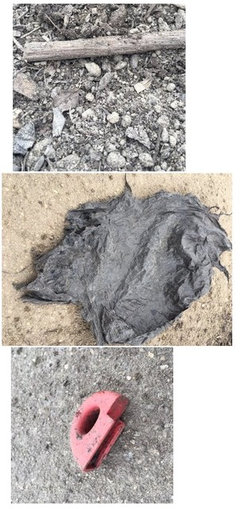
Original Author9 years agolast modified: 9 years agoOK, a picture of the soil and some of the things I found in it. Would YOU grow vegetables in it? (the background in the two bottom pics are concrete, not the soil).
- 9 years ago
Hello Heimdall83, I'm one of those long on money and short on sense , would you mind telling me where you bought your soil ?
- 9 years agolast modified: 9 years ago
"Woods and marshes" are exactly where one dumps vile stuff. No, no one would have dumped a load of poison on the yard of a house. You take it out to the woods and marshes. There, that should help your paranoia.
Would I grow vegetables in that soil? Um, sure. Vegetables are pretty immune to plastics. It is a bit of a pain for the gardener, having to fish that cr*p out, but it's not going to hurt any plants having been there.
What I'm seeing is what I call dirty compost. It's not necessarily bad compost, but is littered with some trash. Trash happens, unfortunately. Did the advertised content say "no trash"? Well, there you go. I would just chill, and enjoy your garden.
Scott (Long Island, NY--7b)
Original Author9 years agoIt was woods and marshes back in the early 1900s, when the only people living around these parts were fisherman and horse-based farmers. The most they'd have dumped here was a big load of fish heads.
My issue is whether the trash is only the visible part. If the description was total BS, for me that undercuts the seller's overall trustworthiness. If the description was simply "organic soil/compost mix, great for gardening" I wouldn't be so peeved, but turns out the seller just made up a whole load of BS to make it sound like something it isn't, which makes me wonder what other corners they cut.
- 9 years ago
What you want to know about the soil you will be growing plants in is the soils pH and major nutrient levels and if the Phosphorus, Potash, Calcium. and Magnesium are in balance. Excess levels of nutrients, major and minor, can interfere with a plants ability to properly utilize other nutrients and that can cause problems as well as nutrient deficiencies will.
Cornell offers soil testing thru Agro-One for about $8.00 to $14.00 per sample. You could learn more at your local office of the Cornell Cooperative Extension Service.
The basis of every garden is a good healthy soil and you cannot know about that without taking a good look at the soil you have.
- 9 years ago
You might want to learn more about your state's requirements for compost and soil (so-called clean fill regulations for example). In a state as highly regulated as NY (not making a judgment on that, just a fact) there are probably rules for what they can use for soil and what is allowed to go into compost. Even my relatively backward state issues permits for composting and mulching operations and prohibits certain materials.
It is not unusual to find plastic trash though, because much of what goes into composting operations is yard waste, which comes in plastic bags, and has everything from pop cans to pieces of toys and swingsets.
Scott (Long Island, NY--7b)
Original Author9 years agoWell, I took a sample to the local cooperative extension, as well as mailing out a sample for testing to the lab they recommended (Agro-One). So far, the results aren't promising: pH 7.6, and the "soil" was very sandy loam.
They recommended some pretty serious remediation, so at the least I think I'm going to remove the top layer from the raised bed and replace it with much better soil, and add compost.
- 9 years ago
pH 7.6 isn't "promising"? Serious remediation? Very slightly alkaline soils are not perfectly optimal for nutrient delivery, but if you have plenty of those nutrients, it simply isn't an issue. It's amazing how folks are seriously distracted from real problems by slightly off-neutral pH values.
Sandy loam? Sure. Apply compost. What else did you get from the lab?
Scott (Long Island, NY--7b)
Original Author9 years agolast modified: 9 years agoIt wasn't just because of the pH. They added water to the sample I brought in and tried to make a bolus, but it just fell apart. It had the texture of coarse sand mixed with compost that hadn't broken down—twigs, leaves, etc. Little actual dirt
So far I only have pH and that soil texture test; the lab test results haven't come back.
- 9 years ago
Regular application of lots of compost will fix sandy loam, and for what it's worth, will acidify slightly. But pH is mostly about nutrient availability. Phosphorous and trace elements may be less accessible to plants in alkaline conditions, but if you've got plenty of those in your soil, mildly alkaline soil is no big deal.
Scott (Long Island, NY--7b)
Original Author9 years agolast modified: 9 years agoMy error: I just checked the test form and 7.6 was for another area, where I'd mixed this new soil in with existing soil. The new soil by itself in the new beds was 7.8
FWIW, based on the descriptions at this site the stuff was "loamy sand" rather than "sandy loam," which is what I'd described above. That's what they might have said at the extension office... I could have reversed it in the retelling. But it definitely fit the "field texture grade" of loamy sand.
- 9 years ago
If what you have from this supplier is basically builder's sand mixed with partially composted materials, you may be in for a long struggle, because coarse sand does not retain moisture or nutrients very well, does not form a good crumb structure, etc. So the ph may not be the most immediate or the most salient issue if there is not enough "loam" in the "loamy sand" to base future soil-building efforts upon.
Scott (Long Island, NY--7b)
Original Author9 years agoI've already started acquiring substitutes. I don't have to replace all of it, I don't think: I built the bed so high because we get at least some periodic coastal flooding around here and I wanted to make sure everything was above any salt. It might be best if I consider this "garden mix" just fill, strip off the top six or so inches, spread that elsewhere where I'm not concerned about growing things and replace that layer.
- 9 years ago
If it's got that much semi-composted organics in it, it's going to continue to decompose - and shrink. That means you'll be adding volume later anyway. Which affords an ideal opportunity to blend in some silty soil.
- 9 years ago
This is a very good example of why someone wanting to buy soil should go and look at what is being proffered and not simply accepting the sellers description of what they have. No one I know would buy a refrigerator or automobile by calling a salesperson and telling them to send one over, so why do we do that with soil?
Scott (Long Island, NY--7b)
Original Author9 years agolast modified: 9 years agoAnd how do you do this with soil? Most of these places get the soil from a supplier; even in the unlikely event you can see the soil, how do you verify that what they put onto the truck is what you just saw? Look at it, test it, and then say OK put it on the truck right now while I watch? If they're going to fraudulently describe what it is they're selling they'll just as easily send you junk after showing you gold.
- 9 years ago
That surely applies in some cases, but many (if not most) places and contractors are going to be honest and you'll get what you asked for. Some folks are going to have their own pickup truck or trailer and will be able to have it loaded on the spot. Let's not give the impression that everyone selling soil or doing landscaping work is a crook.
- 9 years ago
I guess it may be a regional thing but here, bulk soil suppliers create their own mixes and most actually compost on site as well so it is dead easy to see the quality of the soil mix/compost you are getting.
As mentioned above, I would never purchase soil or compost in bulk sight-unseen. And since I am now very familiar with the products my local bulk suppliers have, I can order freely for my clients without needing examine every batch.
Scott (Long Island, NY--7b)
Original Author9 years agolast modified: 9 years agoOK, I have some test results, and I don't know what to do with them.
Soil pH: 7.8
Phosphorus (P): 72 lbs/Acre
Potassium (K): 1665 lbs/Acre
Organic Matter: 13.4 %
Soluble Salts: 1.7 mmhos/cm
And a note that "You will need a total of about 3.5 ounces of nitrogen for every 100 square feet of garden for the entire year." I.e., that amount to be distributed over a year.
On the one hand, from what I've read you should lower pH using compost. But I have 13.4% organic matter; according to here:
https://blogs.cornell.edu/gblblog/files/2016/07/Veggie-Info-Sheet-2016-1jsq90e.pdf
"Sandy soils with an organic matter content of 2-21⁄2% and clayey soils with 3-5% organic matter will perform fine. Organic matter levels twice this amount could lead to nutrient imbalances." My soil was described as loamy sand, so I presume it has way too much organic matter already. Am I reading this wrong? Do I need to turn to sulphur compounds to bring down the pH a bit?
Just HOW high are those P and K numbers, compared to a normal range?
The analysis also said, "Soil P level is very high, so no additional P is needed. However if you are planting into cool soils, transplants may benefit from a starter solution high in P. This will help plants recover from transplant shock."
Does this mean a solution applied to the transplant at the time of transplant, or some time before, to prepare them for the high levels?

theparsley