Software
Houzz Logo Print
g_tvbnj

Massachusetts Lawn Soil Test - Help

9 years ago
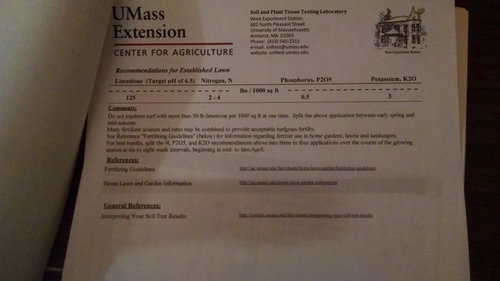
Hi everyone. Did a soil test and the results are shown below. I have to admit, while I understand the lawn is deficient on Potassium and Calcium, I'm not sure what fertilizer to buy to accomplish increasing (K) without further pushing up (P). Then Nitrogen is another story. I have access to the following Lesco products:

19-0-7

24-0-11

18-0-9

So, I would like to ask for some help as to what product to purchase, and I think I will need some help with setting the spreading number on the spreader appropriately.

Also, I have purchased 3 bags of lime to apply as it shows I need to apply 125 pounds in this area.


The calcium low number not sure what product the big box stores carry to help with that one. Should I stay with lime or go to gypsum? But what will the lime then do to my optimum level of magnesium?

Thanks in advance to all for the help.


Comments (18)

  • 9 years ago

    Where are you located?

  • 9 years ago

    Massachusetts

  • 9 years ago
    last modified: 9 years ago

    A little prelude (there always seems to be one with me even though you aren't asking for an interpretation). I will eventually try to answer your questions. :)

    When I make suggestions/recommendations based on soil tests, I use guidelines based on the research done using Mehlich III tests. In some cases, researches have done some conversions and correlations between M3 and other types of soils tests and some of them are pretty simple conversion formulas. There is no simple correlation that has been done for M3 and Morgan tests and the conversion formulas are very complicated. So complicated that I will not spend the time needed to do them.

    Beyond that stated Modified Morgan issue, I'm not enamored with the UMASS report because it does not provide OM. Your soil bulk density is 1.03. Very low. Very low bulk densities occur due to higher clay content or higher OM content. Without an tested OM%, we don't know. Another problem is that the reported Exchangeable Acidity is not a result of testing, but calculated. Their lime recommendations are based on that "calculated" Exchangeable Acidity. Proceed with extreme caution as this can create very inaccurate recommendations. TEC/CEC= 11.8 meq and of that, they calculate 7.5 meq (63%) is held by hydrogen and aluminum for a pH 5.9 soil.

    None of those are particularly ideal to meet your potassium needs, but then no fertilizer you can find is likely to be perfect for your situation. BTW, You don't want/need to avoid P. Your levels are in the low end of the 4-14 ppm range that UMASS recommends for sufficient levels. Personally, I'd want to be at least on the high end, if not a bit beyond. In addition, P is going to get tied up from the lime applications, so some additional P will be advantageous. I understand your position of caution (even UMASS recs .5lbs), but you're not going to find a fertilizer with a low P and a high enough K fraction to meet your K needs (3lbs by UMASS recs). You're either going to need to go the triple NPK route (the extra P shouldn't hurt anything, although excessive) or find Potassium sulfate.

    Lime will supply most of your Ca shortage. Once you get your pH where you want it, any remaining Ca shortage can be made up at that time with Gypsum. Wait for a follow up test before you add any Ca sources besides lime.

    EDIT: Mg can be adjusted after next year's soil test.

  • 9 years ago

    Thank you for the insight. I could get other tests done if there is a company and test you can recommend, also that is reasonably priced.

    On the (K), I will try and hunt around for a bag. I guess it would be a bag of "Potassium Sulfate - Sulfate of Potash". 0-0-50 or 0-0-45.

    So, I think were I am is what would you suggest I purchase to begin?

    Thank you in advance again.


  • 9 years ago
    last modified: 9 years ago

    g tvbnj,

    N.P.

    I would suggest you get a buffer pH test for accurate lime pH adjustment, but no need to get another comprehensive test, you can use UMASS recommendations for P and K this year.

    You will need to apply 2#/k of SOP three times this year, so 6#/ each k of lawn total for the year. You can use any starter fertilizer for the P and some of the N. Use any of the fertilizers you first mentioned for the rest of your N and K needs.

    You can send a soil sample out to any lab that will do a buffer pH solo. I know A&L will do it for <$7.

    These are the labs and the sampling procedure I suggest people might want to use:

    IMO, for a person who knows what they are doing, probably the best
    lab is Brookside Analytics. they have one of the best battery and
    selection of tests available, but you MUST know what you need to ask for
    and able to do your own analysis.

    There are a number of alternatives by region. e.g. A&L Eastern located in Virginia or the
    Carolinas for the S. E. and N.E. Another choice for the N.E. is Agro-One
    which is associated with Cornell (http://dairyone.com/wp-content/uploads/2014/01/Form-T.pdf). Spectrum
    is used by a large number of farmers in the Eastern U.S and Mid West (but their default is a buffer pH calculation for lime, not a buffer pH TEST, so make sure you request an additional buffer pH TEST when sending the sample to them), but any lab that does Mehlich III is good for Midwest soil testing.
    West of the Mississippi, I'd say probably A&L Western located in
    Cal. or Oregon. Last I checked they all offer recommendations, but verify that a buffer pH TEST (Not a calculation) and results are included (or at least is available at a reasonable cost) in the report before you order.

    Proper and consistent soil sampling is a must in order to reduce inconsistencies and get the most accurate results possible.

    Proper: When digging the samples, use only high quality steel
    tools. Use only plastic buckets for holding and mixing the samples.
    Avoid brass, galvanized or other zinc coated utensils. Otherwise, the
    sample can be contaminated. If you do not have a soil sampling tool
    (auger or
    probe), insure that your soil sample is an even thickness vertical slice
    and not a wedge shaped slice. Take 8 samples, evenly
    dispersed, from each 60 x 60' area. Try not to sample any sooner than 30
    -60 days after an amendment application.

    Consistent: Take all samples to the same depth (4" for turf)
    and do so each year of testing. Use the same "range" of soil for each
    sample and from year to year. e.g. soil from the 0" depth down to the 4"
    depth (preferred, but remove the soil surface and any fertilizer
    prills it may contain). or from 1"-4", or the 2" to 4" depth, etc. if so suggested. Stay
    consistent. Take the samples in the same
    month each year.

    Use the same lab each year. Use an established professional or
    university lab that offers a broad menu of testing processes, reports
    results in ppm or lbs/acre and at a minimum, reports CEC/TEC, Ca, Mg, P,
    S, K, Na, OM, Mn, Zn and Cu. Verify that they offer ammonium acetate
    cation and buffer pH testing and that their fees are reasonable. Verify
    if they use Mehlich III (unless otherwise recommended) as their default extractant and extra points if
    they offer Bray and Olsen too.

    Do the vinegar test on a small sample. If it fizzes, request that an
    ammonium acetate test be performed. If it doesn't fizz, either ask for
    or be prepared to request that (if the test comes back with a soil pH
    less than 6) a buffer pH test be done.

  • 9 years ago

    thank you for the addition info Ridgerunner. found A & L. Lots of tests on their site. I must say you can get easily lost. I'll call tomorrow and ask which one is for buffer PH test I assume it's the one under the "individual tests that says PH for $9, but I will call and verify. I figured since I'm going to send soil sample, I'd be interested in seeing what I would get from them regarding full tests lime Umass did. My reasoning is I had heard from a landscaper some time ago he was not all that impressed with them, but myself, I didn't really have any one else's input.

    Also, you know how the cost of shipping goes so I figured since the sample is going anyways, a few more bucks for better tests would be curious.

  • 9 years ago
    last modified: 9 years ago

    It's the buffer pH test (not a calculation) you want and yes, do call A&L Eastern (Virginia or Carolina) and verify that is what you will get. I believe they told me they use SMP but may be the Mehlich test. Any buffer pH test is fine. It looks like the individual test for pH and buffer pH is $6.40.

    http://al-labs-eastern.com/showpdf2.aspx?spdf=0

    Did I emphasize buffer pH TEST? :)

  • 9 years ago

    Hi Ridgerunner, was away on vacation. Well, need to check with lab on my buffer test, but short of that could you guide me with what the mix of fertilizer I should get. I know you said 2# K three times this year, but can you tell me what the whole fertilizer would look like, and what suggestions I should buy.

    I have access to the following lesco products:

    19-0-7 or

    24-0-11 or

    18-0-9

    Also this Lesco and Scotts starter fertilizer:

    18-24-12 - Lesco Starter

    24-25-4 Scotts Starter

    35-0-5 Vigoro Starter

    Potassium Sulfate - Sulfate of Potash:

    0-0-50

    0-0-45

    So not sure which bags to buy to get rolling this weekend.


  • 9 years ago
    last modified: 9 years ago

    This weekend?

    Usually you would want to avoid N until June 1 if you winterized last Fall.

    This weekend you could apply 2#/k (of product, not 2# of K2O) of 0-0-50. Then apply 35-0-5 at 3#/k June 1.

    or just wait and apply 5.5#/k of of 18-0-9 June 1 instead of the 0-0-50 (it wont build up potassium reserves as fast though).

    Either way, if you didn't winterize, you could also apply Lesco or Scotts Starter Fertilizer at half bag recommended rate this weekend to kick start the turf and help promote increased root growth at these low soil temperatures.

    Whichever route you take, you can repeat the N source fertilizer again Sept and Oct. 1 (except no starter and if you went the SOP route, apply 3#/k of Sop again Sept 1 only.) Apply 2#/k of 46-0-0 Urea after the grass stops growing around Thanksgiving.

    Lime is still up in the air.

    Re-test next year.

  • 9 years ago

    Hi when you say apply 2#/k (of product, not 2# of K2O). Both the 0-0-50 & 0-0-45 say K2O on the back of the bag.


  • 9 years ago

    This link is the product I was going to get:

    http://southernag.com/wp-content/uploads/2014/07/sul-of-potash.pdf

  • 9 years ago

    I was doing the math for you. 0-0-50 is 50% K2O. So every pound of product is 0.5lbs of K2O. Therefore, to get 1# of K2O you would apply 2# of product. My rec. is to apply 2# of product (which will actually apply 1# of K2O). Ok?

    Go with the 0-0-50, you don't need the coated nor the extra expense for less K2O.

  • 9 years ago

    Well as bad luck would have it hunting all around after my go to nursery was out, The best I could come up with in a 50 lb. bag was 0-0-7. The link below is what I can get. Is this acceptable, understanding I would have to apply more.

    So I guess I would be at 14.29 lbs needed to be applied? And that would be for 1000 sq ft? But the area is 2100 so basically 29 lbs? Just for that area?

  • 9 years ago
  • 9 years ago

    Also have you ever used University of Georgia calculator?

    http://aesl.ces.uga.edu/soil/fertcalc/


  • 9 years ago

    http://www.turfcaresupply.com/upload/documents/label/900636.pdf

    No. That is a very strong NO.

    Did you read the application advisory?

    If you re-check, I gave you an alternative:

    "or just wait and apply 5.5#/k of of 18-0-9 June 1 instead of the 0-0-50 (it wont build up potassium reserves as fast though).

    Either way, if you didn't winterize, you could also apply Lesco or
    Scotts Starter Fertilizer at half bag recommended rate this weekend to
    kick start the turf and help promote increased root growth at these low
    soil temperatures."

    With as small a yard as you have, it may be more cost effective and safer for you to hire a service like Weed Man.


  • 9 years ago

    Gottcha, I did find the potash today. The yard in total is about 4500, those Umass soil analysis was just a portion of the back yard. Didn't want to overwhelm you with too many soil samples. Wanted to get started and do some learning first. This has been helpful.

    On the 0-0-7 what was the biggest concern you saw? Seems this carried the normal, and I use that word a little loosely advisory as say a GrubX would carry, but I saw the waterway concern, and not getting it on your skin, etc.

    Just kinda curious what you saw.

  • 9 years ago
    last modified: 9 years ago

    The application rates. It is an insecticide. I don't know what health or environmental risks may/are associated with it, but recommended application rates should always be followed unless you know something to the contrary than the manufacturer hasn't stated.

    Do not apply more than 200 lb of TCS GROWSTAR ALLEC

    TUS

    ®

    0.225 G Plus Turf Fertilizer Insecticide (0.25

    lb of imidacloprid, 0.2 lb bifenthrin) per acre per

    application on residential use sites (i.e., around

    private homes,

    apartment buildings, condominiums, non-agricultural

    outbuildings, non-commercial greenhouses, pre-scho

    ols or

    day care facilities). May be applied at up to 400 l

    b of TCS GROWSTAR ALLECTUS

    ®

    0.225 G Plus Turf

    Fertilizer Insecticide (0.5 lb of imidacloprid, 0.4

    lb bifenthrin) per application on non-residential

    use sites (i.e.,

    around institutional, public, commercial or industr

    ial buildings; parks; recreational areas or athleti

    c fields).

    Do not apply when turfgrass areas are waterlogged o

    r the soil is saturated with water. Adequate distr

    ibution of

    the active ingredient cannot be achieved when these

    conditions exist. The treated turf must be in suc

    h a

    condition that the rainfall or irrigation will pene

    trate vertically in the soil profile. Total amount

    applied cannot

    exceed 400 lb (0.5 lb of imidacloprid, 0.4 lb of bi

    fenthrin) per acre per year.


    You are proposing to apply more than one and a half times the maximum annual rate in one dose.