Software
Houzz Logo Print
amunk01

Early Blight?

9 years ago
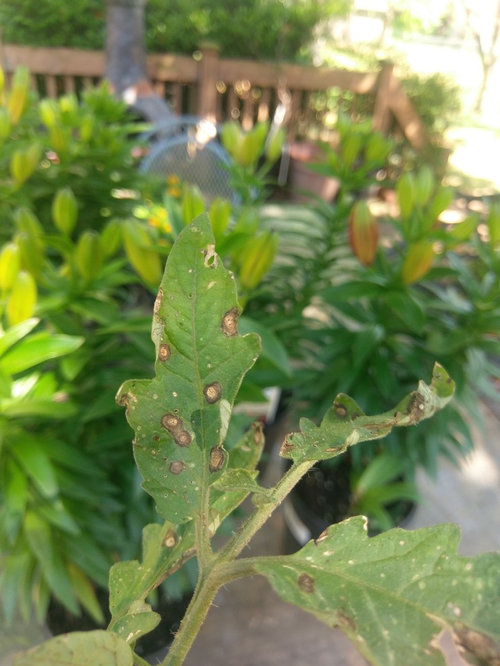
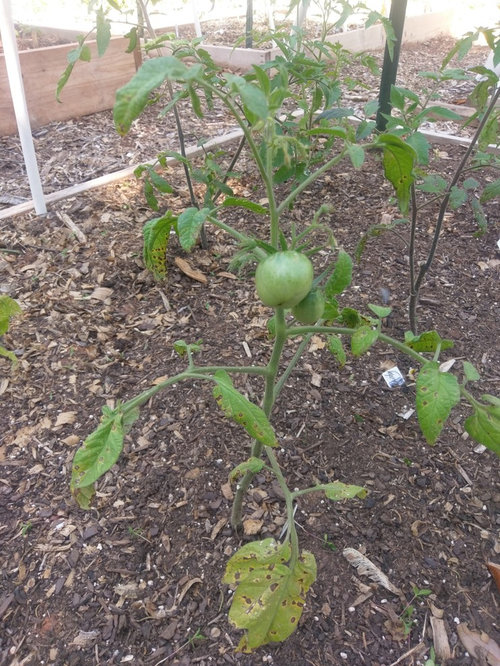
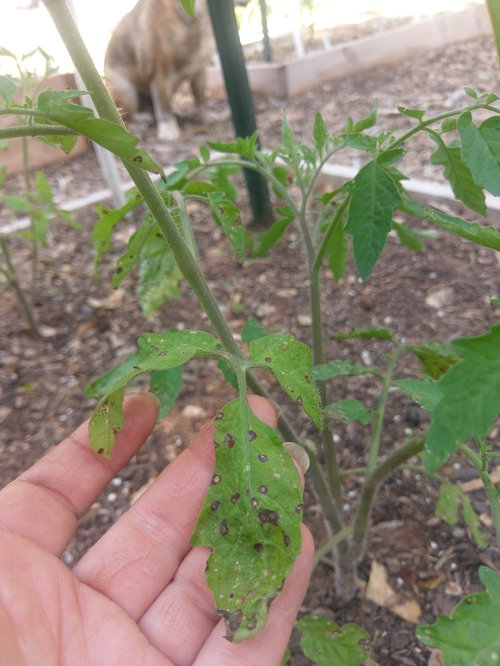
Well, I think I have early blight in a few tomato beds... should I treat them or rip them out? They all have it at least on 1 or more stems, but are flowering and some have fruit already.. I have some backups but won't they just get infected if I plant them in the same spot? Here are some pictures. They were all started indoors, potted up once, possibly have been stressed with chilly weather but were always covered anytime temps went below 45-50°. It's been developing for about a week or so, I'd guess, starting from the bottom and working it's way up. The tops are still green, and healthy on most plants

Comments (5)

  • 9 years ago

    Alexis, I'm not seeing the yellow halos that characteristically surround the Early Blight lesions in very many of the photos, nor can my old eyes tell if the brown lesions themselves contain the concentric rings that make lesions look like a bull's eye type target. Can you look closely at your leaves and tell me if you see the yellow halos on any of them or if you see concentric circles.

    Have you considered the possibility that it might be Septoria Leaf Spot or Bacterial Spot? Let's talk about it and see what we can figure out. Bacterial Spot (and also Bacterial Speck) tend to develop earlier in the season, and then Septoria Leaf Spot and Early Blight a bit later. With it being warm early this year, I think it might be conceivable to have them all pop up at once.

    I wouldn't remove any plants yet. I think that no matter what it is, it is possible to treat the plants and contain the infection although an actual cure doesn't really happen.

    Dawn

  • 9 years ago

    Thanks Dawn. I'm lost when it comes to diagnosing tomato diseases. Do you think I should treat with an anti-fungal like copper or a dormant oil?

  • 9 years ago

    Because it is hard to tell if you are dealing with only EB or with something bacterial, it is your choice what to use. The standard recommendation is to strip off all the affected foliage*, spray with two products alternating.....so spray first with copper. Wait however many days product labels say....it may be 7 to 10 or 14, I don't know, and then spray with the alternate product. Keep alternating the products then on a regular basis. This prevents the disease on these plants from developing a tolerance of only one product. If you are comfortable spraying Daconil on your plants, it works pretty well. If you prefer to go organic, the best anti-fungal probably is Serenade. I felt like Serenade worked pretty well the first year I used it, but it was a fairly dry and not-so-humid year. In a wetter and more humid year, it wasn't that effective.

    Be careful with copper. Overuse can cause copper to build up to toxic levels in your soil, and copper can be hard on earthworms dwelling in the soil. Just spray enough to cover both the tops and bottoms of leaves. You don't want to spray to the point that a lot is dripping off onto the ground (though having some drip is inevitable).

    Is the ground mulched to prevent soil splashback when it rains? That goes a long way towards preventing a recurrence. The layer of mulch should be several inches thick and no soil should be visible.

    If the spots are fungal in nature, you never really cure the plant. All you do is prevent it from progressing. The fungicides work by covering the foliage and stems so that fungal spores cannot easily find a place to attach to a new location. This means when you spray, do your best to get 100% coverage.

    If you have to irrigate, don't use sprinklers. Use soaker hoses or drip irrigation lines. (I know you know this, but I'm saying it for someone newer to gardening you might be reading this.) I know you are a lot farther north than me and may be about to get a lot of heavy rainfall over the next few days. If that happens, after the rainfall has ended, you may need to spray again because I don't know if anything you spray on the foliage now will survive heavy rainfall if it occurs.

    I've never used an oil product to try to coat the foliage to prevent spores from attaching, though some people think neem oil will do this. Since I haven't used it, I cannot say either way if it works or not.

    If your are having trouble getting this under control, you can step up to a stronger product like Mancozeb. Or, at your option, you might try it first. I don't know what amount the label recommends, but I do know it is labeled for use on tomatoes.

    I'm sorry this happened to you, and I wouldn't ditch plants that already are blooming and producing fruit, not if there is a chance that you can save them.

    It is possible too much rain is the main cause for what you're seeing. You cannot control the rain. However, if there's anything impeding good air flow, try to remove that.

    The only time I've seen similar spotting on tomato foliage in such quantity, it was during a prolonged rainy spell. My brain still is arguing with me that this is more likely bacterial than fungal, but that is largely because it is so rare to have Early Blight show up in April. Not impossible, just uncommon. It is more likely on greenhouse plants that have suffered from poor air flow and excessive heat inside a greenhouse.

    *As for the standard recommendation to strip off all the foliage, I had to say to do it and you need to do it UNLESS it would leave your plants pretty much stripped down to bare stems. Use your judgement. If you remove too much foliage, the fruit you have will sun scald, and the plant may lack the vigor to recover if it has too few leaves left. If you have to leave some foliage, strip off the worse leaves, spray and watch the plant recover. As more new growth comes out that is healthy, remove the rest of the diseased leaves. It is hard on very young plants to lose too much foliage.

    I'm not that good at tomato diagnosis. All the bad things (except late blight, TSWV, and Tomato Russet Mites) look the same to me. It is further complicated by the fact that multiple disease issues often show up together. Normally in April, it will be bacterial spot, bacterial speck or gray leaf spot. From May onward, if the weather is warm, it is more likely to be Septoria Leaf Spot or Early Blight. Thankfully, here in Oklahoma, we seldom have the conditions that lead to Late Blight, so at least there's that, because Late Blight is a disease from which there is absolutely, positively no recovery.

    Because your plants are established and are producing, I would only replace them as a very last resort because newer plants put in the ground now would be so far behind in setting fruit that you'd be going crazy waiting for ripe tomatoes.

    Don't blame yourself for your tomato plants illness. The fungal diseases are airborne and hard to prevent during the time when we have the right combination of humidity and temperatures that they like. The bacterial diseases are soil-borne, and you cannot grow tomatoes without soil. Well, unless hydroponically, but to me the hydroponic tomatoes have poor flavor. Just do your best to work with what you've got now, manage the disease symptoms, and remember that even tomato plants that do not look great often recover and produce great crops. While we all would love for our tomato plants to look perfect throughout the entire growing season, we need to remind ourselves that they are grown as production plants not ornamentals, so as long as they are producing, it is okay if they are not looking perfect.

    Keep in mind that fall tomato plants can go into the ground in late June, and if they are an option for you, try to plant them as far away from the sick plants as possible in order to limit the spread of the disease to the new plants. With new plants for fall, you then can feel comfortable removing diseased plants after they've produced a good crop if their health continues to go downhill and you don't think they'll survive the summer. Don't give up on them too early though. I've had some plants with pretty bad EB make a great comeback with regular fungicide treatment, especially once warmer, drier weather sets in. If it is bacterial speck or spot, I cannot comment on how well the plants recover because I've very rarely had either one. When I did have them, they appeared early in wet weather, only on lower leaves, and I stripped off the sick leaves and the diseases did not progress even though I didn't spray.

    By the way, this may be the first time I've ever suggested the use of Mancozeb on tomatoes, and that's not because it isn't a good product. It is just that Daconil and copper work well enough in most cases that you might never need to step up to a stronger product. In this case, with this showing up so early, I might be tempted to use copper first, and then use Mancozeb for the next treatment. I believe it is stronger than Daconil. If you're 100% organic, which is a laudable goal that a lot of us strive for, then it would be copper and Serenade. While I try to be as organic as possible, though, there are times with the use of Daconil and other synthetic anti-fungals are necessary to save crops, so I am happy if I can just be 95-99% organic and let myself use a good anti-fungal when needed. Organic perfection is hard to achieve!

    Good luck,

    Dawn

    PS---since you're pregnant, read the product labels carefully and wear the recommended protective gear, including a respirator if necessary. Gotta protect the baby!


  • 9 years ago

    Thanks Dawn! You're a tomato-saver! (Wink!)

  • 9 years ago

    You're welcome, Alexis.