Software
Houzz Logo Print
chad_belinfanti

Decision on Hardwood addition to existing

9 years ago
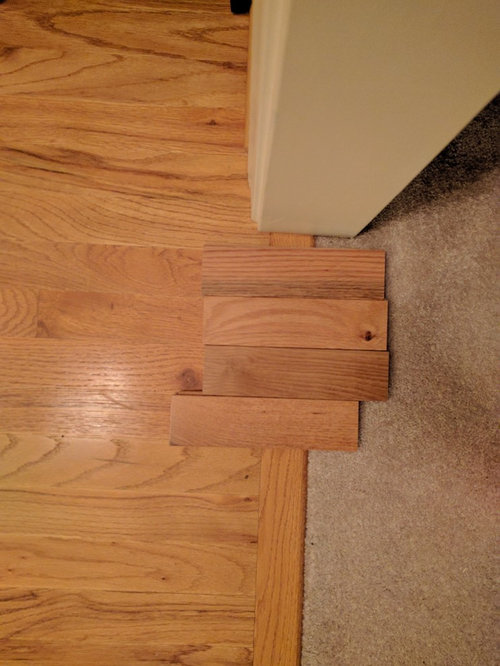
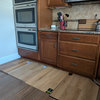
So, I didn't realize how big of a dilemma this actually was until my wife pointed out the tone difference between our existing Oak floor and new flooring we were getting ready to purchase.


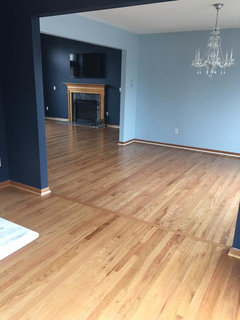
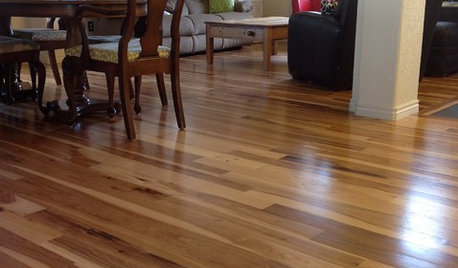
The house is about 12 years old and the existing Oak strip flooring (2.25") is aged and has turned more yellow. I have 2 rooms (total of about 600sqft) both physically adjacent to the existing hardwood that currently have carpet and we want to replace that with hardwood. In the picture, are samples of Red Oak and White Oak - both natural stain, and there is just a slight tone variation that I'm sure will be more noticeable when the flooring is laid. That new flooring will never match the existing so herein lies my dilemma... deal with the difference or embrace the contrast...


I like the idea of having a darker oak color (more brown than say an ebony) but my wife calls that 'patchwork'. I think it adds a bit of character to the fact that they are in fact separate rooms. Of course that argument fails because the dining room and kitchen are already hardwood. I'm even open to trying wider planks (3.25 up to 5") so if anyone has any advice on other options to consider, I'd be happy to evaluate.


At this time, replacing all of the hardwood is just not financially possible and sanding and re-staining is also outside of our budget constraints. This is the only area that is not hardwood on our entire mainfloor of about 1800sqft. Thanks in advance for any feedback and I'm happy to provide any additional photos requested.

Comments (22)

  • 9 years ago

    That's a fantastic suggestion... that gradient will help make the transition not so obvious... I'll propose that to the boss lady. I'll be getting about 12 boxes so there should be quite a few to choose from for the initial rows.

    Any idea on how long the new stuff will take to start the yellowing? I couldn't find any information on that.

  • PRO
    9 years ago

    Step 1) MATCH the SPECIES

    Step 2) MATCH the width of the plank

    Step 3) MATCH the "cut" (rift sawn vs. quarter sawn, etc)


    According to the above, you need to KNOW your species. I would say you have white oak simply from the gold tones rather than cinnamon pink that red oak likes to turn. But this can be confirmed by a laboratory = $100 worth of insurance to know for sure.

    Go ahead and put in the EXACT match (as above) and then STAIN the two rooms something that you like! Excellent! Now you have the "best of both worlds". You have MATCHED EVERYTHING (very important for future buyers) AND you have avoided the heavy price tag of the FULL SAND and refinish that is too costly for your current budget.

    By achieving a full match, you leave yourself the POSSIBILITY to do a full sand/refinish to get a floor that will match seamlessly. This is very important. Even if you never do it that way, you give yourself the OPTION of doing it. And the home retains it's value better than mismatched wood floors (there are many flooring snobs out there that will not purchase a home that has a mix of wood flooring types in it...or they demand a significant price reduction for the floors).

    Good luck.

    Chad Beez thanked Cancork Floor Inc.
  • 9 years ago

    Thanks for the reply, another great suggestion! The width i'm sure of. 1 and 2 I'll need to confirm, but I'm 99% sure it's White Oak, I'll look into getting that testing. Can the new prefinished wood be stained? We are actually ok with going to a darker stain overall so this may just be a viable option. I'm assuming staining entails the color and then a couple layers of poly? The old wood could certainly use some poly.

  • 9 years ago

    Dont waste your money on getting the floor tested, its not white oak, its Red oak.

    Chad Beez thanked gregmills_gw
  • 9 years ago

    Why so sure? I've been told white oak, and it looks closer to the white oak samples I got. I'm happy to wrong, just trying to understand how you can tell with such certainty.

  • 9 years ago

    I was certain I had white oak looking at the samples, but now I believe it is in fact Red Oak because of the 'rays', the vast majority have the very short rays as described by the websites that talk about the differences. I don't have any scrap to check, but I'll still look into ways to validate. I did also confirm the cut. So my question still remains about staining the new prefinished, is that an option?

  • 9 years ago

    gregmills is correct. It took about a millisecond to conclude you have Red Oak. The medullary ray length is the most reliable way to visually determine which one you have but yours is undoubtedly Red Oak. It has the uniformity, coloration and I can see the deeper grain reflected from the light in your picture.

    Personally I'm a fan of continuity, but could the added area be turned perpendicular to the existing without looking odd? If not I'd inquire whether the end joints can be interwoven into the existing floor. If you're going to be in the house a long time, eventually you'll have to refinish. At that time you'll end up with a seamless flow throughout (assuming it currently runs all one way).

    Chad Beez thanked User
  • 9 years ago
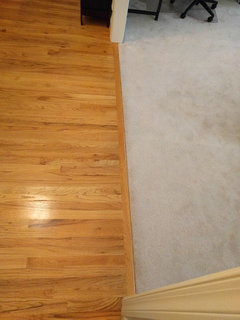
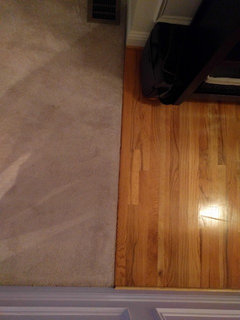
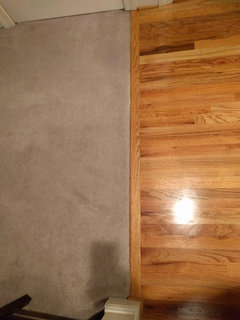
    The existing wood flows in one direction but there is currently a transition type strip for where it meets the carpet. We are doing the installation ourselves. My wife does not like the look of going perpendicular so the plan was to use t-strips to maintain the straight edge and continue in the same direction as the existing flooring. We are not sure about how to do the fingering/merging technique. I can provide pictures of the transition areas if that helps but they are both pretty much the same as in my original picture. The family room has 2 entrances, one of which is perpendicular to the grain. That is the transition into the kitchen.
  • 9 years ago

    That arrangement might make this job more difficult than you could handle but I may be underestimating your skills. To interweave the perpendicular doorway you'd have to lay off the parallel doorway then make sure the wood stays straight and is spaced properly to ensure a seamless match. It's not that hard to interweave. Use a Fein saw or equivalent to cut end joints in the existing with each staggered end back at least 9" from the one next to it and remove the boards between the new end joint and the doorway. Where the floors meet, the new pieces would have the bottoms of the grooves removed so the tongues could slip into the existing grooves. The pieces can be glued and surface nailed with the nails set and holes puttied. All this assumes that the tongue side of the boards point from the parallel doorway to the perpendicular doorway since you nail into the top of the tongue. If they run the opposite way, it would be much more difficult to accomplish.

    This makes a t-mold sound attractive but I'd at least suggest you use a flush board like the one you have now, but with the rounded edge removed. The boards may not line up across the doorway but there'd be no hump at the doorway.

  • 9 years ago
    Thank you all for the suggestions, I'll definitely take that into consideration jfcwood. We may even be able to use some of my extra wood to do the perpendicular transition correct? I'm still not certain if we can do the interweave but I'll talk it over with my parents who are the real mvp's haha. At this point I'm leaning towards hand picking the transition pieces to minimize the visual differences and then I'll look into the option for staining with the knowledge that eventually I'm going to have to sand and restain at some point. I think I can sell the boss lady on that plan.
  • 9 years ago
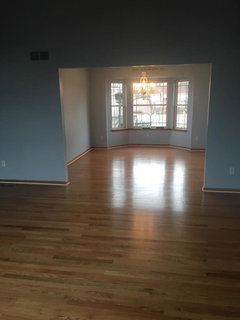
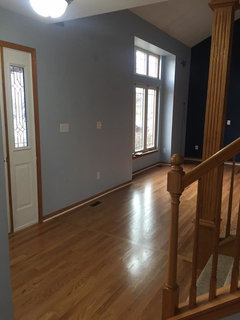
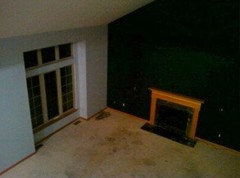
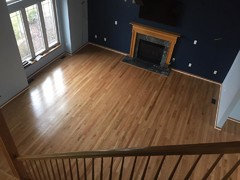
    Attached are pictures of all transitions. 2 will have a perpendicular row or transition, and then the 3rd we'll try to tie in into the same direction. That is the plan at this point. The last picture is my only concern which is how to tie everything back together around the corner. Hope this helps clarify
  • 9 years ago

    Ive been doing this a long time, and have seen 1000's upon 1000's of ft of both red and white oak, as you said the rays and the way the grain looks its just a no brainer.

    certain floors can make it a bit more difficult to tell the difference, but your picture was obvious.

    good luck on your project, hope it turns out to your liking.

    Chad Beez thanked gregmills_gw
  • PRO
    9 years ago

    "Can the new prefinished wood be stained?" Sure....full sand and refinish. Other than that - Nah. Not worth it. Tinted polyurethanes are tough to work and often look HIDEOUS. And factory finishes HATE other finishes being applied to them. Many professionals would walk away if that was something you wanted to pay for.

    If you want to stain then go with a site-finished hardwood (not normally a DIY project...but it can be).

    If your old floor needs "more polyurethane" then you probably need to look at some sort of refreshing of the original. Which would lead me to believe it may need a full sand and refinish sometime in the near future. Keep that in mind.

    Chad Beez thanked Cancork Floor Inc.
  • PRO
    9 years ago

    When my hubby and I were discussing the stain color for the oak we installed in the kitchen of our remodeling project, he was concerned about the stain match as the wood was a different cut than the existing flooring. So, I asked him how much it bothered him that the living room in our current house is a different tone than the hallway where we had removed carpeting. His reply was "I never noticed it" Sorry dear, you've lost your vote on matching stains. When I look at the floor directly, I see the difference between the newer oil finish and the original shellac finish but from a distance I don't notice it. With rugs and furniture in place and activity going on, the flooring becomes less of an issue

    Were you intending to remove the current transition strip? Definitely no to a T strip in the doorway which might just make the transition zone more noticeable than if it was the consistent height.

  • 9 years ago

    We just did exactly what you're planning a year ago. We had it done, we did not DIY. We had 2 rooms of hardwood installed and then then entire first floor sanded and poly'd. We have red oak. No stain, just 3 coats of oil based poly. I wanted no transition strip. I wanted the new floor weaved into the existing floor so that it looked like the house was built that way. When was your house built? Ours was built in 1999, and the existing floor had settled (or whatever) and had some gaps between the boards - slight and small - I didn't even really notice them until the floor guy pointed them out. We also have two openings too (kitchen into dining room, and entry way into living room). He said weaving them in, the new floor would be extremely tight, and the existing floor is not, so even though the first boards would line up exactly, when you got to the end of the one doorway, they could be 1/4" (to maybe 1/2") off and with 2 openings, it would never line up. To my dismay, it was better to leave the transition strip. Now, a year later, I'm fine with that and don't notice. Here are a couple pictures, trying to show before and after, and the transition boards.

    Dining room before (and you can see a small part of existing hard wood that is in the kitchen) - this is when we bought the house in 2009.

    Dining room after we hand hard wood installed (March 2016).

    Here is the transition strip that we left (replaced with a new one) from the kitchen to the dining room

    And here is the transition strip from the entry way to the living room

    And just to show that hardwood is definitely the right choice :)

    Carpet when we bought the house in 2009

    Carpet after I cleaned it (2010)
    Carpet ripped out and hardwood installed 2016

    Chad Beez thanked Debbi Branka
  • 9 years ago

    Your end result is beautiful... what price per sq foot did it cost to sand and apply poly? We have about 1500 - 1800 sqft on the main floor which is why that option is prohibitive for our budget. The house was built in 2004. We are leaning towards just going with the red oak and saving up to do the sand and refinish at a later date when our budget allows. Our carpet is a similar color and we're just ready to get rid of it.

  • 9 years ago

    I had to look back to find the quote. My email says approximately $9/sf for refinishing, but that can't be right because we have about 800sf of floor (about 1000 sf of main level) and our total price, with buying the new wood, installation, sanding and finishing entire area was in the $7k range (I don't remember exact amount, but $7000 something). I guess the price depends on your area too. We are in the metro Detroit area.

  • 9 years ago

    And thank you!


  • 9 years ago

    So to quickly update this, we're going to go for a hybrid approach. We're going to install the red oak in the new area ourselves. Then we're going to have a professional crew come in and resand the whole mainfloor + light stain color and repoly. Total measured sqft was around 1200 for the main floor including the area i'm installing the new. The contractor I spoke to today said we should even consider unfinished red oak as they will have to send everything anyway as opposed to pre-finished so I'm giving that some thought as well. I'll update this post in a few months when the project is completed. Thanks so much to all of you for your input!!!! It is truly appreciated.

  • 9 years ago

    Using unfinished is a good idea. It should cost less and acclimate better since it has no surface finish in addition to be square edged.

  • 9 years ago

    Definitely use unfinished!