Software
Houzz Logo Print
heimdall83

Q: non-smelly fertilizer for seedlings

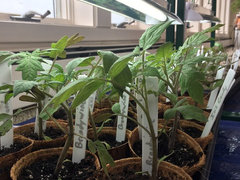
I started a bunch of seedlings (mainly tomato, but also cukes, various herbs, and a few other things) back in early March. They're getting pretty big and have been transplanted into fresh 3" plantable pots. I have liquid fish fertilizer, but I've moved all of the tomatoes up from the basement (under grow lights) up to living space (with a mix of natural and fluorescent light) and that stuff stinks. What organic product can I use to lightly supplement the potting soil to hold them over for the next 4-5 weeks, until I plant outside?

Comments (18)

  • 9 years ago

    Feathermeal is a wonderful, odorless fertilizer. Perfect for indoor gardening!

  • 9 years ago
    last modified: 9 years ago

    @gekkodojo, I am not sure that feathermeal will break down fast enough to benefit his seedlings.

    @heimdall83, will the fish fertilizer smell be sufficiently reduced if you dig a little trench in the potting soil, pour in just enough fish fertilizer, and then cover it up?

    I think the least smelly organic fertilizer would be finished compost because it would have already gone through the decomposition process every organic fertilizer must go through before its nutrients become available.

  • 9 years ago

    Seedlings are currently in 3 inch peat pots so trenching would be tricky. I think I'd have to dispense to liquid with a large syringe into holes.

  • 9 years ago

    Try watering with diluted coffee.

  • 9 years ago

    Skip the coffee.


    obtain any fertilizer to dissolve in water for this use.

  • 9 years ago

    I'm assuming OP is looking for an organic fertilizer given this is an organic board.


    I might be mistaken but I don't think there are any dissolvable organic fertilizers?


    OP - I was kidding about the feather meal. It is stinky. But not about coffee. Coffee beans are a high protein seedmeal, like cottonseed or soybean. Coffee is a leachate of that seedmeal. There are many accounts on the web of people using old, diluted coffee. In many households it is free and abundant. I've used it in the past on tomato seedlings and it seemed to work well.

  • 9 years ago

    Do those seedlings really need a "fertilizer"? I have started seeds in a good starting mix (compost added) and never needed to fertilize them until they went out into the garden.

    Seedlings do not need to be fed until they develop their first true leaves and then only a little of a very dilute fertilizer.

  • 9 years ago

    Thanks for the replies. My tomatoes started out in early March and have about 5 weeks to go before transplanting outside; they've gotten pretty big, very much having developed true leaves. I have other (non-tomato) plants as well, started later and not quite as developed.


    Should I collect old coffee grounds and make a sort of tea with them?


  • 9 years ago

    Thanks. I've seen the Dr. Earth products, but I'm not sure if I've seen the liquid fertilizers. I think I know a place with the worm casting tea.

  • 9 years ago

    Gardengal - please provide backup for your assertions. I would be curious to read them. I've done quite a bit of Internet searching on the topic and didn't see anything authoritative on diluted coffee one way or the other. Just a lot of anecdotes from home growers and "echo chamber" assertions.... I did find that coffee grounds have a nitrogen content of 2%, which is quite a bit higher that compost or worm castings. Therefore, one would think a tea from coffee beans(i.e. Coffee) would have a higher nitrogen content than worm tea or compost tea, especially since boiling water is used. And again, my direct experience is that it seemed helpful to seedlings. In full disclosure, I didn't conduct a rigorous controlled experiment - just a casual "let's water these plants with coffee for a few weeks and these with water...". Perhaps I will next season.

  • 9 years ago

    Well, I do not have the time to go through all the documentation available on this topic and regurgitate it here - I'll let you do that yourself. Suffice it to say that liquid coffee (not the used grounds) has tested out to show that it offers some benefit with P & K but negligible N. But it also contains significant amounts of caffeine and studies involving the use of caffeine on plants have shown that, initially, cell growth rates are stable but soon the caffeine begins to kill or distort these cells, resulting in a dead or stunted plant. It also tends to be moderately acidic so most appropriate for use on acid loving plans. And it must be diluted before application so the nutrient load is diluted as well

    Using the composted grounds CAN be of benefit - that's where the N is focused. Also caffeine levels are substantially reduced with UCG's and pH is virtually neutral. But this is still not going to be an appropriate or efficient method of fertilization for any container plants. The nutrient load is too low, too limited and the methodology of converting it into a plant usable substance is simply not present.

    By all means, feel free to go ahead and continue what you are doing if you are happy with the results. I aim for longevity and optimum performance with my container plantings and that means utilizing a "real" fertilizer with a full compliment of macronutrients in a suitable concentration and any required trace elements. I am a degreed horticulturist and teach classes on soils, fertilizers and container gardening, among other topics, and I prefer to provide my students with the best and scientifically accurate information on these subjects. You may be happy with less.


  • 9 years ago
    last modified: 9 years ago

    FWIW, a local nursery/garden store had this with specific instructions for diluting for seedlings.

  • 9 years ago

    There ya go!! That will work just fine :-)

  • 9 years ago

    I'm all for science. I'm a scientist myself. I don't want to burden you with regurgitating ALL the information that's available. ONE authoritative study would be sufficient. Otherwise sounds like you're just part of the Internet echo chamber. Despite whatever fancy certificates you claim to have.

  • 9 years ago

    BTW- OP is not taking about container gardening. He / she is taking about fertilizing seedling for four weeks until they are put in the ground. So your focus on long term nutritional needs of container grown plants is irrelevant. All growing situations are different and require different tools in the horticultural tool chest.

  • 9 years ago

    " taking about fertilizing seedling for four weeks until they are put in the ground"

    And you think pouring coffee on them is actually going to address this?? A focus on long term nutritional needs seems just slightly more 'relevant' than dosing them with what is just caffeinated water. How about YOU show US a study - just ONE authoritative study would be sufficient - that dilute coffee actually supplies seedling plants with any nutritional benefit??


  • 9 years ago

    I am testing some method that I got from the friend: banana peels (cut in small pieces), crushed egg shells and a little bit coffee grounds (used) in water for several days. Looks so far that it works.